As the owner of a factory that has been audited by brand compliance teams from New York to Los Angeles, I can tell you that asking the right questions is what separates successful partnerships from costly mistakes. Last year, a startup brand from Austin nearly lost their entire investment because they only asked their previous supplier, "Are your fabrics OEKO-TEX certified?" The answer was a confident "yes," but the certificate was for a basic knit fabric (Grade 3 for home textiles), not for the finished baby garments (Grade 1) they were paying for. The difference in chemical limits is vast, and the shipment was rejected at their warehouse.
You must ask your supplier specific, detailed questions about the scope, validity, and proof of their OEKO-TEX Grade 1 certification. Simply asking "are you certified?" is insufficient. You need to verify that the certification is for the correct product class (Class I for infants), covers the entire finished garment, is current, and is genuinely issued to your direct manufacturing partner.
A vague answer here is a red flag. Your goal is to move from trust-based assumptions to evidence-based verification. Let’s break down the exact questions that will protect your order and your brand.
Is the Certificate Specifically for OEKO-TEX STANDARD 100, Product Class I?
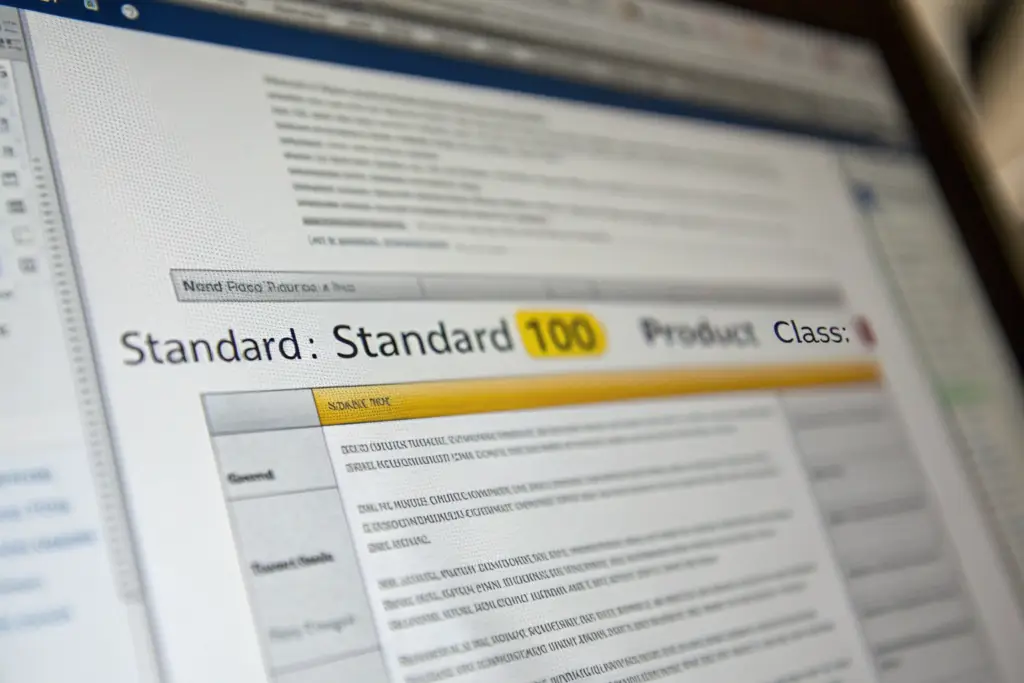
This is the foundational question. Many suppliers use "OEKO-TEX certified" as a broad, misleading term. There are different OEKO-TEX labels, but for product safety, you need STANDARD 100. More critically, you must confirm the Product Class. For children's wear, especially for infants and toddlers, it must be Product Class I. This class has the strictest limits for harmful substances.
Confirm that the supplier's certificate explicitly states "OEKO-TEX STANDARD 100" and lists the certified article(s) under "Product Class I." This is non-negotiable for baby and children's apparel. Class I has limits up to 90% stricter for certain substances compared to Class IV (decorative materials), making this distinction critical for safety and compliance.
What is the difference between Product Class I and other classes?
OEKO-TEX STANDARD 100 has four product classes based on product use and skin contact. Product Class I is for articles for babies and toddlers up to 3 years old and has the most stringent limits. Product Class II is for articles with direct skin contact like adult underwear. Product Class III is for articles with no or little direct skin contact, such as jackets. Product Class IV is for decoration materials like curtains. A supplier might have a valid certificate, but if it's for the lining fabric certified under Class III, it is not suitable for a baby's onesie. At Shanghai Fumao, we certify our finished children's garments under Class I, and we provide this specific documentation upfront.
Can a factory have a general "factory certificate"?
No. There is no such thing as a general "factory OEKO-TEX certificate." Certification is always issued for specific articles or article groups. A responsible supplier will have a certificate that lists the exact types of products they are approved to make under the standard, such as "children's knitted jackets." You must ask to see the certificate that covers the specific product you are ordering.
Does the Certification Cover the Final Finished Garment or Just the Fabric?
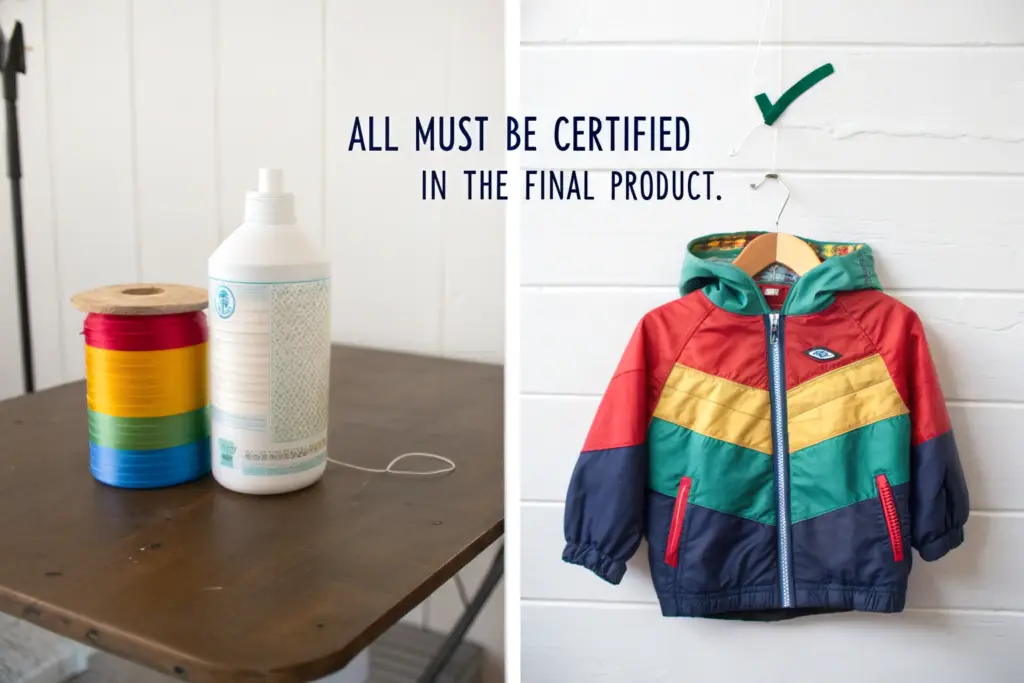
This is the most common point of failure in the supply chain. A fabric mill's OEKO-TEX certificate does not certify the final garment you receive. Dyes, prints, sewing threads, zippers, buttons, elastics, and bonding adhesives used during garment manufacturing can introduce new substances. The only certificate that matters for your liability is the one issued for the final, assembled product from your direct supplier.
You must ask: "Can you provide the OEKO-TEX STANDARD 100 certificate for the finished [insert your product, e.g., baby romper] as it will be shipped to me, including all trims and accessories?" The certificate's "Article Description" should match your final product, not just a component like "100% cotton knit fabric."
What components need to be included in the certification?
The finished product certification must account for every component that is part of the garment. This includes main and lining fabrics, sewing threads, interlinings and adhesives, zippers and snaps, elastic bands, and all prints and labels. A rigorous manufacturer like Shanghai Fumao manages this through full-package production, sourcing all components from pre-approved, certified sub-suppliers and then certifying the final assembled unit.
How can I verify the scope of the certificate?
The certificate document lists the "Article Description" or "Product Description." It should be specific. Descriptions like "knitted garment for children" are acceptable if the certificate holder is your garment factory. Be wary of descriptions like "polyester filament yarn," as these indicate a mill certificate, not a finished goods certificate. Always cross-reference the description with what you are actually buying.
Can I See the Valid Certificate and Verify Its Number Online?
Always demand the actual certificate, not a claim. A trustworthy supplier will readily provide a PDF of the current, valid certificate. Then, you must perform your own verification. Use the free, public OEKO-TEX certificate database on the official OEKO-TEX website. Enter the unique certificate number from the PDF.
Ask your supplier: "Please send me the PDF of the valid OEKO-TEX certificate for this product. I will verify it using the official online database." This simple step protects you from falsified or expired certificates and confirms that the certification is genuinely issued to your supplier for the correct product.

What details should I match during online verification?
When you check the number, the database will show the certificate holder, article description, product class, and validity period. The holder name must match your direct supplier. The description should match your product type. The class must be "I." The certificate must be current. If any detail doesn't match, it is a major red flag. We had a client who discovered their supplier was using a certificate from a different, larger factory to appear compliant. The database check revealed the fraud instantly.
What if the certificate is about to expire?
Certificates have a clear validity period. Ask your supplier about their renewal process. A professional factory will have a scheduled renewal audit before the old certificate expires to ensure no gap in coverage. At our facility, we manage renewals proactively and inform our key clients in advance, ensuring continuous compliance for all DDP shipments.
What Is Your Process for Maintaining Compliance in Production?
A certificate is a snapshot from a test sample. The real challenge is ensuring every single garment in every production batch meets that standard. You need to understand the supplier's internal quality control systems. How do they ensure that uncertified materials don't enter the production line for a certified order?
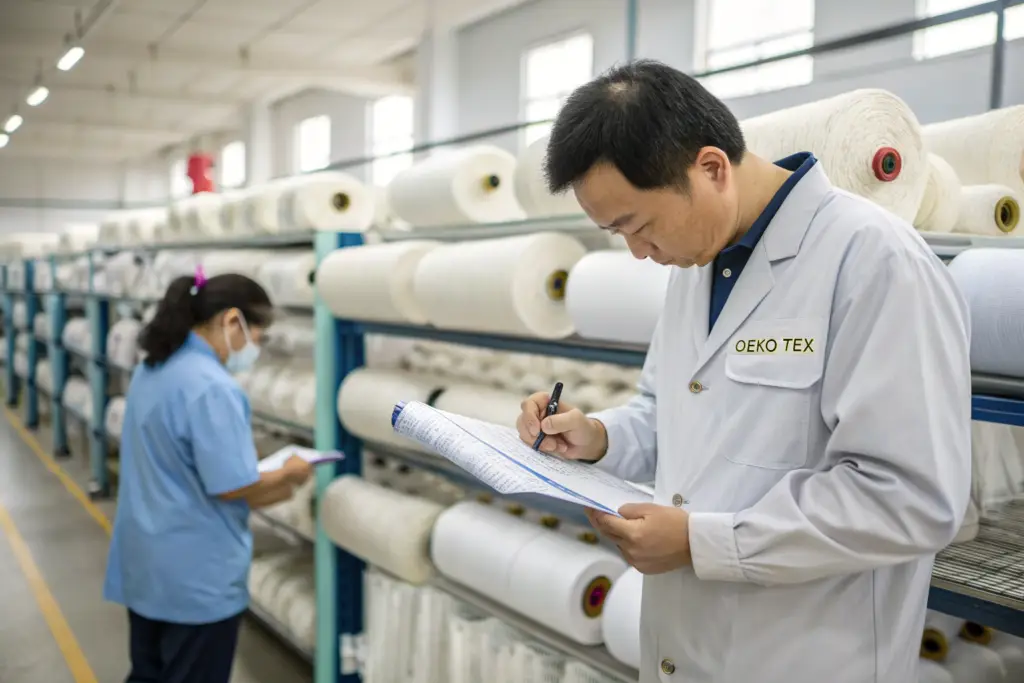
Ask: "What specific quality control measures do you have in place to ensure every batch of my OEKO-TEX Grade 1 order remains compliant? How do you manage and document material sourcing for certified production?" Their answer should include procedures like batch testing of incoming materials, segregated production lines, and traceability systems.
How do you handle material sourcing for certified orders?
The supplier should have a list of approved sub-suppliers whose materials are either pre-certified or have been tested to meet Grade 1 requirements. They should not source randomly from the open market for such orders. For example, at Shanghai Fumao, we maintain an approved vendor list for OEKO-TEX production. All materials for a Class I order are sourced from these vendors, and we keep batch records for full traceability, a practice highly valued by our B2B clients in regulated markets.
What happens if a batch fails an internal check?
A robust system has a clear non-conformance procedure. Ask what they do if an incoming material fails their internal test. The correct answer should involve quarantining the material, not using it for the certified order, and informing the sub-supplier. This demonstrates a mature quality assurance culture, not just a paperwork exercise. It’s this operational discipline that partners like Shanghai Fumao bring to the table, turning a certification from a document into a guaranteed process.
Conclusion
Asking these detailed questions does more than just gather information—it establishes you as a knowledgeable, serious buyer and sets a high standard for the partnership. It shifts the conversation from price alone to value, reliability, and shared responsibility for product safety. OEKO-TEX Grade 1 is a powerful tool for market access, but its value is only unlocked with complete transparency and rigorous process control from your manufacturer.
Don't let your brand's reputation hinge on a supplier's vague assurance. Demand evidence, verify independently, and partner with manufacturers who welcome these questions because they have built their systems to answer them confidently. If you are looking for a partner that offers this level of transparency and controlled, certified production for your children's wear line, let's have a detailed conversation. At Shanghai Fumao, we are prepared to answer all these questions and show you the documents and processes behind them. Contact our Business Director, Elaine, at elaine@fumaoclothing.com to begin a partnership based on clarity and guaranteed compliance.