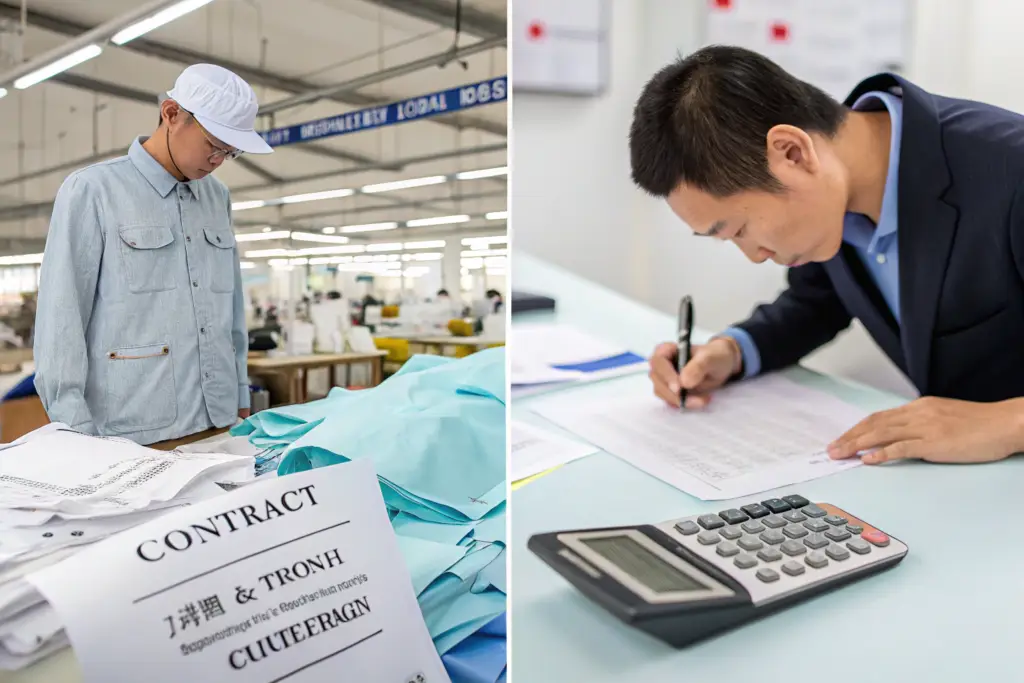
As the owner of Shanghai Fumao, I have sat across the table from American brand owners more times than I can count. The energy is always the same. We spend hours talking about fabric weight, stitch density, and delivery dates. But when it comes time to sign the contract, the room gets quiet. The real negotiation isn't about the price per piece. It's about who takes the risk. I’ve seen promising partnerships fall apart because the payment terms were not structured right. You feel it in your gut. You are sending a large wire transfer overseas, and you have no guarantee that the goods will arrive as promised. Or, on my side, I am buying expensive raw materials for an order and trusting that you will pay the balance when the production is done. This anxiety is common, but it doesn't have to kill the deal. There is a middle ground where both of us can sleep at night.
Protecting a large-scale apparel contract requires moving beyond simple wire transfers and combining structured milestones, trade credit instruments, and third-party inspections. The most balanced approach pairs a Letter of Credit (L/C) with a conditional advance payment guarantee, making sure the exporter gets working capital and the importer gets a guarantee of quality and shipment.
Before we get into the details, I want to walk you through the mechanics that have saved my company millions of dollars in disputes over the last decade. Whether you are buying 50,000 units of knitwear or distributing a full outdoor collection, the goal is to keep the cash flow healthy on both ends. Let’s break down how to structure a deal that doesn't leave anyone holding an empty bag.
How Does a Letter of Credit (L/C) Work for Garment Orders?
I remember a deal we did with a mid-sized brand in Texas last fall. They wanted 12,000 fleece hoodies for a winter drop. The total value was over $280,000. They were worried about wiring that cash upfront to a factory they had never visited. I was worried about buying tons of custom fleece with just a 20% deposit. The solution was an Irrevocable Letter of Credit at sight. It was not the cheapest option, but it was the safest. The bank acts as the middleman, holding the credit on their behalf and releasing it to me only when I present strict compliance documents proving the goods were shipped exactly as specified.
A Letter of Credit shifts the risk from the buyer’s trust in the supplier to the bank’s creditworthiness. You get paid when you prove shipment, and the buyer pays only when the bank confirms the documents match the order. For large-scale production, this prevents the catastrophic cash-flow gap that happens when a balance payment is delayed by 30 days after a shipment leaves the port.
Let’s dig deeper into why this matters for a big order. When you are shipping ten containers, you can’t afford to have them sitting at the Port of Los Angeles waiting for a payment release. You need the cargo moving. An L/C is not a single block of money. It is a process. You need to understand the specific triggers.
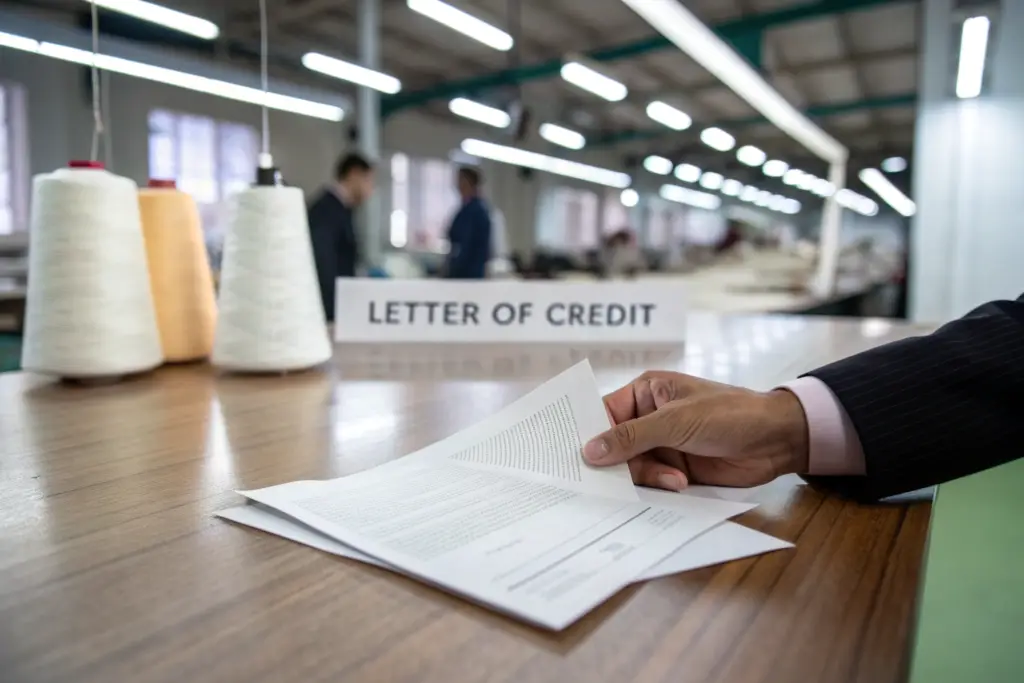
Why Do Buyers Insist on "Irrevocable" When Sourcing from China?
A revocable L/C is a dangerous illusion. It can be changed or canceled without the seller’s agreement. I would never accept one, and neither should you as a buyer if you want the factory to actually start cutting your fabric. When we see “Irrevocable” on a draft from a major commercial bank, we treat it as a confirmed sale. We will order the yarn immediately. Without that word, it is just a suggestion.
If I see a revocable clause, I stop the pre-production process. We cannot allocate 15% of our factory’s monthly capacity to a guess. American buyers often get advised by their local banks to use trade finance tools, but they sometimes don't specify the irrevocable nature. This small detail can cause a 20-day delay in raw material sourcing. You must ensure your issuing bank puts "Irrevocable" in the Swift message. It binds the bank to the payment obligation, insulating the deal from a sudden change of heart or a dip in the market.
What Is the "Discrepancy" Trap in Garment Export Documents?
This is the fine print that breaks deals. An L/C does not check the quality of your zippers. It checks the words on your Bill of Lading against the L/C phrasing. I saw a buyer lose a seasonal shipment because the freight forwarder wrote "10,500 Cotton Hoodies" on the document, but the L/C said "Men's Fleece Tops." The bank deemed it a discrepancy. The shipment arrived on time, but the bank refused to release the payment to us until the buyer waived the discrepancy —which gave the buyer leverage to demand a 5% price cut.
In garment manufacturing, we use a lot of internal style codes. Never put those on a shipping document meant for an L/C. I always tell my documentation team at Shanghai Fumao to copy the exact description from the purchase order onto the commercial invoice. Even a missing period matters. I advise buyers to keep the product description on the L/C simple. Do not overload it with technical specs. Put "10,000 Pcs of Men's Cotton Woven Shirts" instead of an essay on fabric blend. We will put the technical details in the packing list, which is not usually required for the banking payment trigger under a standard L/C.
How to Structure a Deposit to Avoid Losing Capital?
The upfront payment is the bloodline of a factory. We need it to buy the specific fabric and trims for your order. But I have also seen buyers get burned. They send 50% of the money, the factory goes silent, and they are stuck fighting for a refund across international borders. That is the old way of doing things. The modern way leverages milestones and guarantees. Instead of just buying us materials, your deposit should also buy you security.
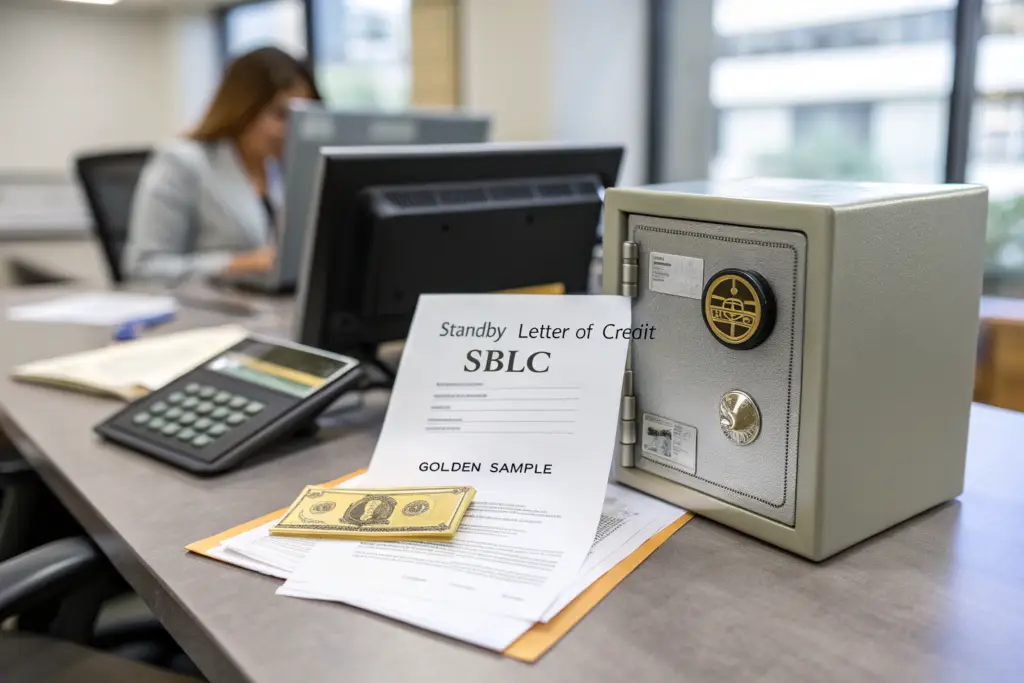
A safe deposit is backed by a Standby Letter of Credit (SBLC) or a bank guarantee, keeping it as security rather than a sunk cost. By linking the advance payment to a visual production milestone like a "Golden Sample" approval, the buyer retains control. If the factory stops communicating, the bank returns the deposit, preventing total loss on a custom production run.
There is a better way to think about this. It is called a conditional advance payment. I often propose a 30% upfront structure where 15% is a pure credit for materials, and 15% is tied to a production checkpoint. This forces both sides to hit their targets early.
Can a Standby Letter of Credit Replace the Usual Cash Deposit?
Yes, and for orders over $500,000, it should. An SBLC acts like a performance bond. The buyer does not give me $150,000 in cash. Instead, their bank issues a $150,000 guarantee in my favor. I can show this guarantee to my fabric suppliers to get raw materials on credit. It secures my supply chain without taking the buyer’s cash out of their working capital.
If I fail to deliver the finished goods, the buyer can draw on that SBLC. But this requires strict triggers. We need to agree on what "failure" looks like. Is it missing the shipment date by one day, or by one week? You would link the SBLC draw to a third-party inspection failure report. If SGS or Bureau Veritas gives a "Fail" on a pre-shipment check, that triggers the return mechanism. This keeps the pressure on us to get it right, while giving you, the buyer, a hard asset to hold. At Shanghai Fumao, we have used this for a large men’s suits order destined for the North American market. The fabric was so expensive that neither party wanted to carry the inventory risk.
Why Should Payments Tie to Fabric Cutting Approval?
Sending money without seeing the cut fabric is a risk. I structure deals so that the second installment fires only after the "Fabric Cut Approval." Here is the flow:
We receive the initial 10% design fee. We develop lab dips and strike-offs. The buyer approves them. Then the 20% material deposit arrives. We buy the fabric in bulk.
But before we cut 5,000 garments, we send a pre-production sample made from the actual bulk fabric. You approve this "PP Sample." Then we cut.
Once the cutting is done, the fabric is uniquely yours. If you cancel after cutting, you must pay for the fabric and the labor up to that point. We write this into a "Cutting Release" email. By aligning a payment milestone with this irreversible step, you only commit deep capital when you see the final physical state of the goods. This has saved our partners from a "batch dye-lot variation" issue we discovered last April. The cotton took the dye 5% darker. We stopped the cutting, adjusted the recipe, and only charged the buyer the initial dye lot fee—not the full cutting cost.
How Do DDP Terms Reshape Payment Schedules?
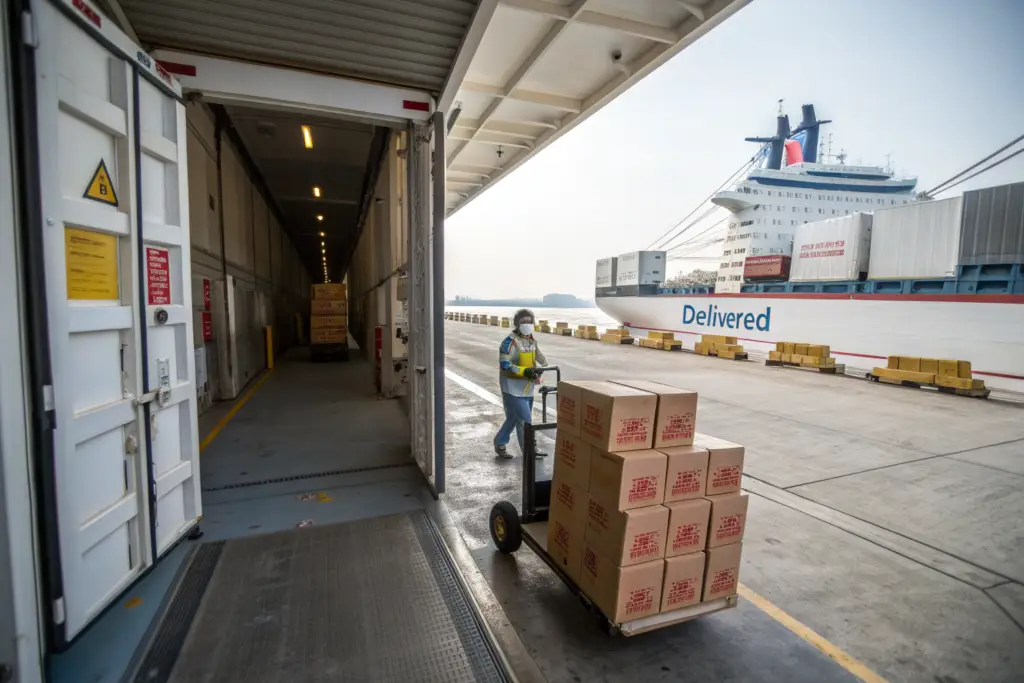
Delivered Duty Paid (DDP) is changing the game for American buyers who hate logistics. Under DDP, we handle not just the manufacturing, but also the ocean freight, US customs clearance, duties, and trucking to your warehouse door. You pay us one price for the goods sitting in your distribution center. But this shifts massive financial responsibility to the factory. It also shifts the payment leverage. I need to pay duties upfront before the container is released. You don't want to pay me for duties that I haven't paid yet. This changes the entire payment schedule.
DDP payment terms should isolate the logistics cost and tie it to a verified customs clearance release, protecting the factory from being out-of-pocket on duty bills and the buyer from paying for undelivered freight. The payment schedule often splits the "product" cost and the "landed" cost. The product cost follows the standard ex-factory terms, while the landed cost balance falls due only upon providing the Proof of Delivery (POD) signed by the buyer's warehouse.
This is where we blend manufacturing finance with logistics finance. It is complex, but it separates the men from the boys in garment export. We started offering DDP for our North American clients through Shanghai Fumao specifically to reduce the anxiety of hidden costs. But the payment schedule must reflect the reality of the cash flow.
| Payment Stage | Trigger Event | Percentage | Coverage |
|---|---|---|---|
| 1 | Order Confirmation | 25% | Product Sourcing + Design |
| 2 | Pre-Production Sample Approval | 25% | Bulk Cutting & Sewing |
| 3 | Ex-Factory Inspection Pass | 20% | Product Balance |
| 4 | Customs Clearance & POD | 30% | Logistics, Duties, Trucking |
What Happens to Payment if U.S. Customs Detains a DDP Cargo?
This is the nightmare scenario. A shipment of winter coats gets flagged by Customs and Border Protection (CBP) for a random exam. The container sits at the terminal for two weeks, racking up demurrage charges. Who pays the factory? Under standard DDP Incoterms, the factory is responsible for clearing the goods. But did the buyer cause the delay? Not usually.
I address this directly in our contracts. We agree that product payment (the first 70% in the table above) is independent of the logistics. You pay for the goods you bought because we manufactured them correctly. The 30% logistics payment pauses.
We insert a "Force Majeure Customs" clause. If CBP detains the goods without evidence of misdeclaration by us, the buyer must cover demurrage costs but can deduct them from the final logistics bill. If we made a mistake on the paperwork, we eat the cost. By negotiating this before signing the international trade contract, we avoid a chaotic fight while $2,000 a day in storage fees piles up. Transparency in these tough conversations is what makes our partnership sustainable.
Can You Withhold the Logistics Fee Until Final Mile Delivery?
Absolutely. The buyer should not pay for a trucking cost until the truck unloads at their warehouse in Kansas City or Dallas. We use a "Delivered Proof" trigger. The final 15-20% of the logistics fee is due upon receipt of a Proof of Delivery (POD) number from the carrier.
Sometimes, the goods are perfect, but a pallet gets lost in a cross-dock facility. If you paid 100% logistics upfront, you are chasing me to find a lost pallet. If you hold the logistics fee, I am motivated to chase the trucking company. This alignment of incentives is critical for apparel brands. I have a distributor in the Midwest who regularly calls me to say the shipping was perfect, but they often note that they feel more comfortable knowing the last payment only left their account after the stock was scanned into their system. This builds a trust that a simple Ex-Works price never can.
What Certifications Prove Payment-Worthy Quality?
A certificate is just a piece of paper until it saves you money. I learned this the hard way a decade ago. A buyer rejected a shipment of children's pajamas, a $90,000 loss, because we hadn't properly documented the flame-retardant treatment. The quality was fine, but the proof was absent. Since then, Shanghai Fumao has treated inspection and certification not as a cost, but as a negotiation tool for better payment terms. When you ask for 30% upfront instead of 50%, I can accept that only if you provide verifiable, certifiable proof that our production is being monitored by an authority you trust.
Certifications turn a subjective promise into an objective trigger for the release of funds. Linking payment installments to the issuance of an Intertek or SGS inspection certificate shifts the payment obligation from "buyer trust" to "third-party verification." This cuts through the inefficiency of arguing about stitch quality after the goods are boxed, allowing the L/C or escrow payment to release without emotional friction.
You don't need to fly to China to check the goods. You need a local, accredited pair of eyes. That is your third-party lab. By linking payment to their stamp, you protect your cash.
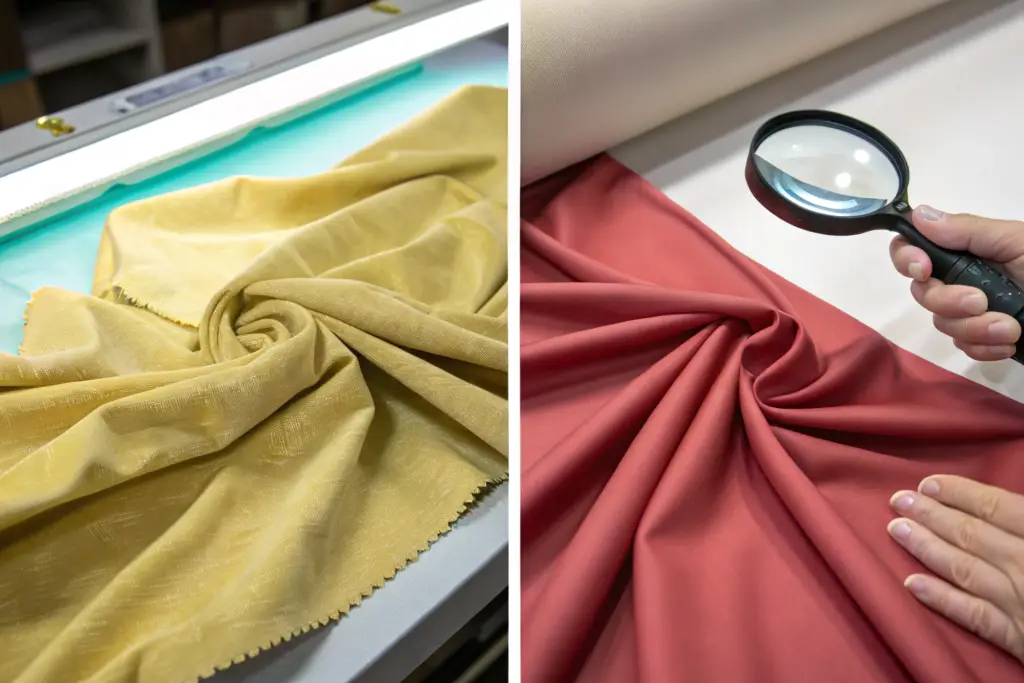
Why Are AQL Reports the Only Bridge Between a Factory and a Buyer?
The Acceptable Quality Level (AQL) report is the universal translator. An AQL 2.5 standard means "I am generally satisfied," while an AQL 4.0 might mean "I am discounting this." A brand owner came to us from a bad experience in Vietnam. She received dresses with uneven hem lines. She had no leverage because the contract only said "good quality."
We embedded an AQL chart in our Sales Contract.
If the inspection results in a failure under AQL 2.5, the goods cannot ship until we rework them. If we rework and fail again, the buyer has the option to cancel and claim the advance payment guarantee. This specific definition—"Major defects shall not exceed 2.5% of the sample size per ISO 2859-1"—is what protects your wallet. You are not buying a feeling. You are buying a statistical standard. Always ask for an AQL audit before releasing the final product payment.
How to Verify Raw Material Certifications Before Sewing?
The yarn is the soul of the garment. I recall an order for a California activewear brand in 2023. They ordered "100% Supima Cotton." The market price for Supima was high. A dubious supplier might blend cheaper Upland cotton.
We send out cuts of the bulk fabric to a lab like Bureau Veritas for fiber content analysis. The buyer pays for the test. We wait. Before we cut the fabric, we get a certificate that proves the molecular structure of the fiber is what we claimed.
This is a payment trigger in my contracts. The "Bulk Fabric Approval" stage requires a lab test report. If the fabric fails, we do not proceed. If we proceeded anyway, we pay for it. This has protected a luxury menswear client of ours who demands precise wool micron counts. It adds three days to the pre-production timeline but prevents a $200,000 recall.
Conclusion
The best payment terms do not come from a template. They come from a conversation about what scares you the most. If you fear losing your deposit, we need an SBLC or a clean, irrevocable documentary credit. If you fear the goods falling apart after one wash, we need an AQL 2.5 linkage with a third-party lab that stops payment until the stitches are counted and the fabric is verified. And if you fear the chaos of international logistics, a DDP structure with a split payment schedule keeps you in control until the boxes land in your facility.
At Shanghai Fumao, I have always believed that a contract is just a reflection of a relationship. I want our payment terms to prove that we are so confident in our cut, make, and trim that we are willing to tie our money to your satisfaction. If we fail inspection, the money stays with you. If we deliver perfection, the payment flows automatically without you having to manually approve a wire. That is how scale works.
If you are planning your next big collection and you are tired of suppliers offering only a risky 50% upfront wire transfer with no guarantees, let’s build a payment structure that actually fits your financial rhythm. Reach out to me directly. You can contact our Business Director, Elaine, at elaine@fumaoclothing.com. Let’s set up a call and prove that a factory can be your most reliable financial partner, not just your vendor.