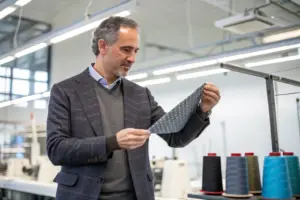
You're developing a new line featuring that highly sought-after licensed camouflage or character print. The pressure is on - these patterns aren't just designs; they're valuable intellectual property. One mistake in color matching or unauthorized reproduction could lead to legal troubles and damaged brand reputation. You might wonder: with so many manufacturing options globally, what actually distinguishes a top-tier Chinese factory in this specialized field? The answer lies in a unique combination of infrastructure, compliance culture, and technical precision that's been honed over decades.
A Chinese garment factory leads in licensed pattern manufacturing through its integrated ecosystem of certified printing facilities, rigorous compliance protocols with brand guardians, and advanced color management technology. This ecosystem ensures exact pattern matching, consistent quality at scale, and legally secure production—transforming complex licensed apparel from a high-risk venture into a reliable, scalable operation.
The leadership position isn't accidental. It results from systematic investment in the specific capabilities that licensed manufacturing demands: absolute accuracy, unwavering consistency, and bulletproof legal compliance. While other regions may excel in certain aspects, China's comprehensive supply chain and technological adoption create an unmatched end-to-end solution. Let's examine the concrete pillars of this leadership.
How does integrated printing infrastructure ensure pattern accuracy?
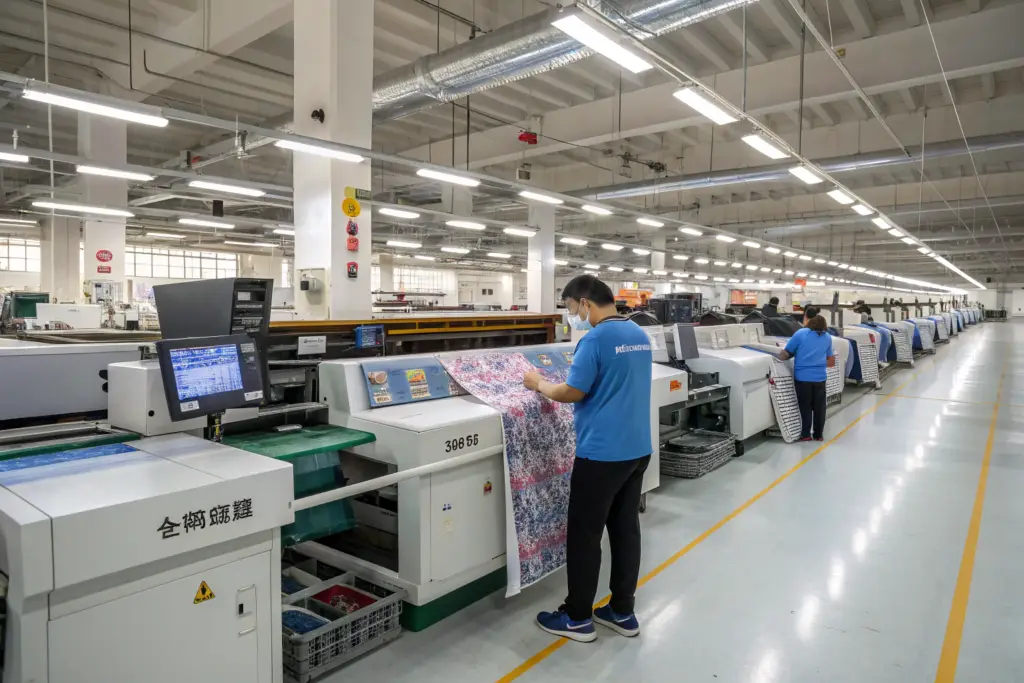
Licensed patterns require perfect execution from digital file to finished fabric. The greatest risk points occur in the printing process itself - where colors can shift, patterns can misalign, and details can be lost. Leading Chinese factories control these risks by bringing critical printing capabilities in-house or through tightly managed partnerships.
Unlike factories that must outsource printing to distant, third-party mills with varying standards, leaders operate certified printing facilities or have exclusive partnerships with specialized printers. This vertical integration allows for real-time quality control and rapid iteration during sampling, which is crucial when working with exacting brand style guides.
The infrastructure advantage manifests in both technology and process control.
What printing technologies do leaders master?
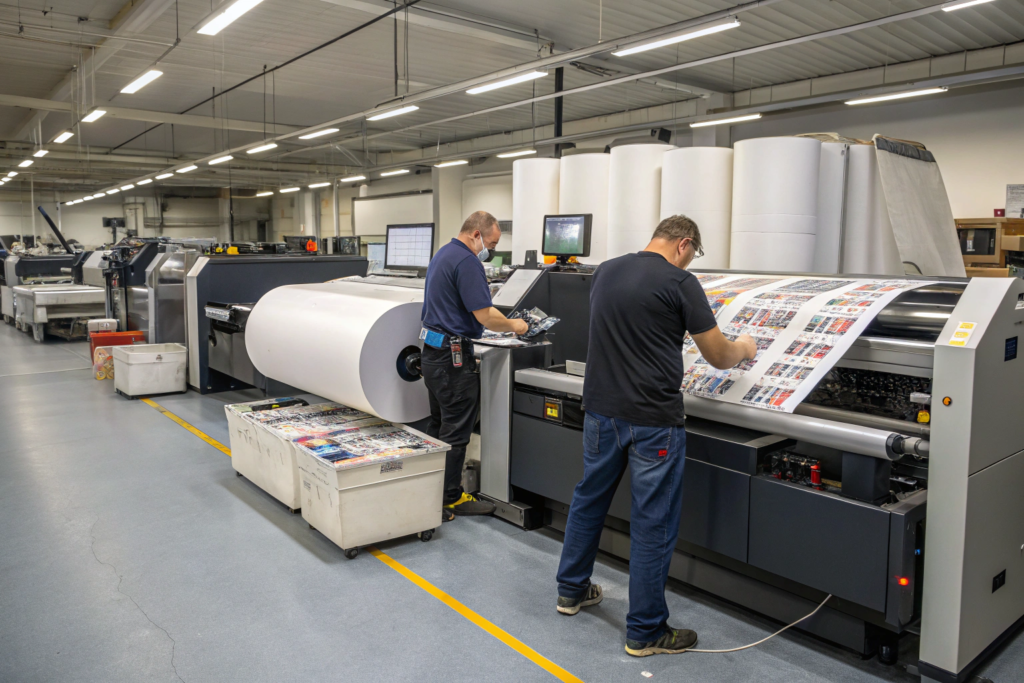
Top factories don't rely on a single method; they match technology to the pattern requirements:
- Sublimation Printing: Perfect for all-over patterns on polyester performance wear. Leaders use high-resolution, multi-pass industrial printers capable of achieving the subtle gradients found in patterns like Mossy Oak Break-Up Country or Realtree Edge. We've invested in machines that print at 1200 dpi, capturing fine details that cheaper printers miss.
- Rotary Screen Printing: The go-to for large-volume, repeat patterns on natural fabrics like cotton. Precision here is measured in microns. Our factory's screen engraving workshop can achieve registration tolerances under 0.1mm, ensuring that the iconic elements of a licensed cartoon character or sports logo align perfectly at every seam.
- Digital Direct-to-Fabric: For short runs or complex designs with many colors. This eliminates the cost and time of creating physical screens, allowing for economical production of test batches or limited editions.
For a major client's hunting line last year, we used a combination of sublimation for jackets and digital printing for uniquely patterned accessory items, all under one roof. This reduced the total production timeline by 25% compared to their previous supplier who coordinated three separate facilities.
Why is in-house color lab certification critical?
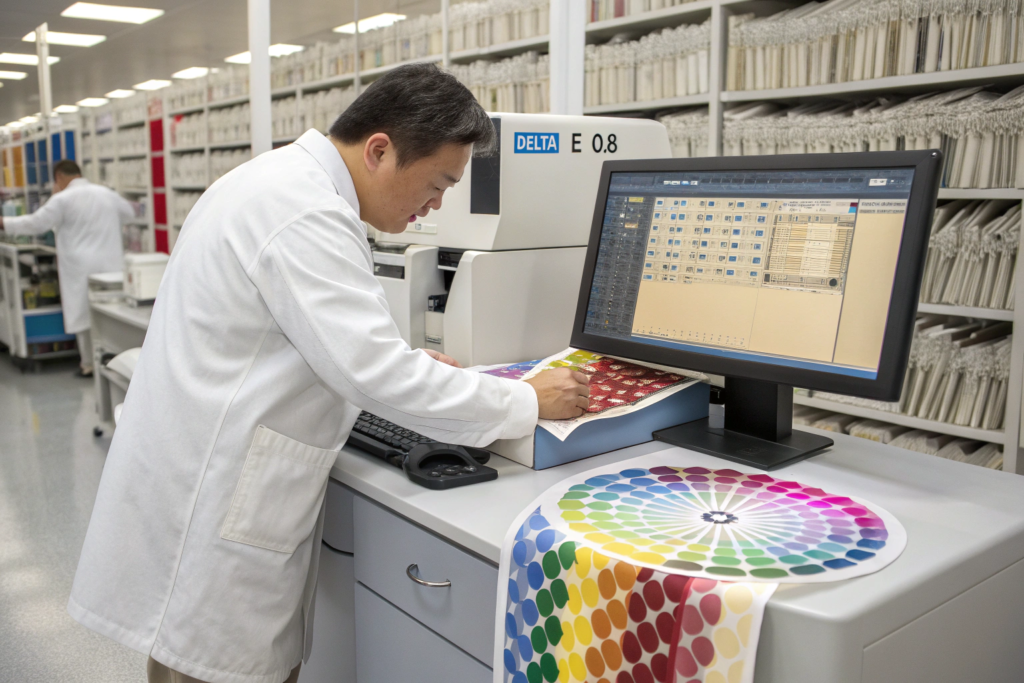
Color is the soul of a licensed pattern. A "green" that's 5% off can violate brand standards. Leading factories operate ISO-certified color labs equipped with spectrophotometers and controlled lighting booths (D65 daylight standard).
The process is scientific:
- The brand provides a physical color standard swatch or Pantone reference.
- Our lab technicians perform color matching, creating a digital dye recipe.
- Multiple strike-offs are produced and measured until the Delta E (ΔE) value—the numerical difference between our print and the standard—falls below 1.5 (often below 1.0 for critical colors), which is virtually indistinguishable to the human eye.
- This approved recipe becomes the locked standard for the entire production run, with lab checks conducted on fabric from every print batch.
This system eliminated color rejection issues for a client producing apparel with a popular animated film license, where character colors had to be identical across 50,000 units of various garment types.
What compliance systems protect licensed intellectual property?
Manufacturing licensed goods is as much a legal undertaking as a production one. Brand owners and licensing agencies (like Disney Consumer Products or Authentic Brands Group) require ironclad safeguards against overruns, unauthorized sales, and pattern theft. Leadership in this field is defined by transparent, auditable systems that build trust.
Leading factories don't view compliance as a burden but as a core competency and a competitive advantage. They establish direct lines of communication with brand guardians and implement physical and digital controls that often exceed contractual requirements.
The compliance framework operates on multiple levels, from the factory gate to the software managing production counts.
How do material tracking and access controls work?
Every centimeter of licensed fabric is accounted for from the moment it enters the factory.
- Secure Storage: Licensed fabrics and components (like branded labels or hangtags) are stored in dedicated, access-controlled warehouses. Access logs are maintained.
- Weight-Based Reconciliation: For printed fabrics, we track not just yardage but weight. The theoretical fabric consumption (based on marker plans) is compared to the actual weight of cut pieces and leftover remnants. Any discrepancy beyond 2-3% triggers an immediate investigation. This system caught a minor internal error in a recent order for collegiate licensed sportswear, preventing a potential overage.
- Destruction Protocols: Off-cuts, misprints, and defective garments with the licensed pattern are destroyed under video surveillance. We provide certificates of destruction to the client, often using industrial shredders that render the material unusable.
What is the role of production monitoring software?
Modern ERP (Enterprise Resource Planning) systems are configured for license management. When an order for a licensed pattern is entered, the system:
- Locks the Pattern File: The digital print file can only be accessed by authorized operators for the specified quantity.
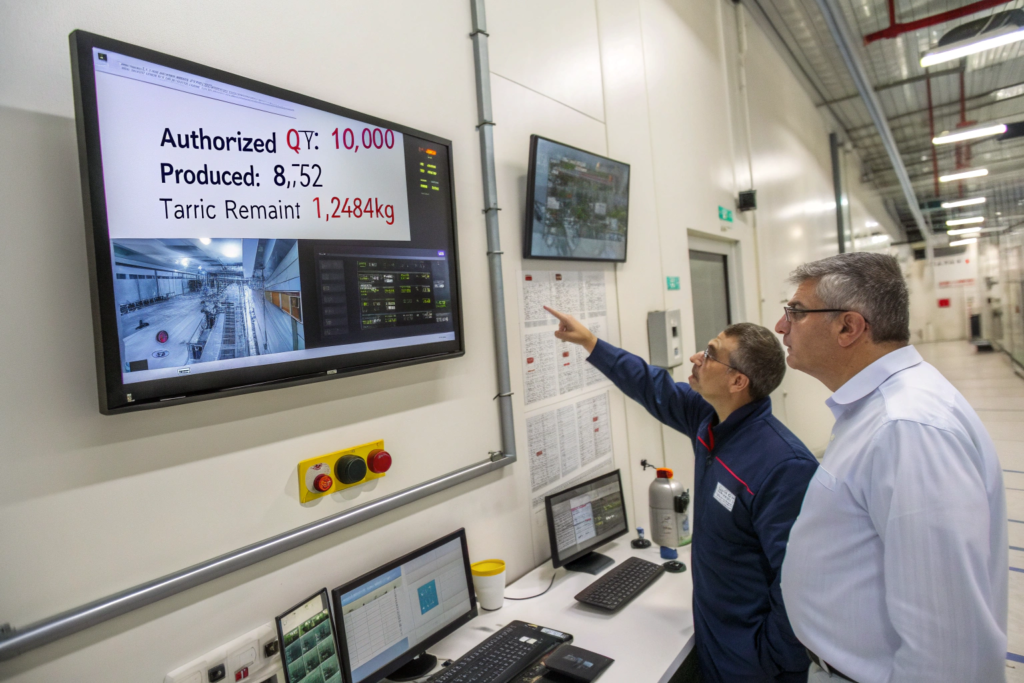
- Tracks Yield in Real-Time: The system compares units produced against units authorized, automatically flagging any overage before it happens.
- Manages Label and Tag Allocation: Each garment's unique RFID or barcode tag is linked to the license, ensuring that only the correct quantity of licensed branding is used.
We underwent a surprise audit by a major sports league's licensing team last quarter. Our ability to instantly generate reports showing fabric intake, production output, and tag usage for their specific pattern across six months of orders was pivotal in securing their long-term partnership.
How does technical expertise solve complex manufacturing challenges?
Licensed patterns introduce unique production hurdles that generic garment manufacturing doesn't face. The pattern isn't just a decoration; it's an integral part of the garment's structure that must align at seams, stretch correctly with the fabric, and maintain integrity through washing. Technical expertise is what transforms a perfect print roll into a perfect finished garment.
Leadership comes from a deep understanding of how printing interacts with cutting, sewing, and garment construction. This requires specialized pattern engineers and sample makers who think in terms of pattern placement, not just garment pieces.
The challenge is three-dimensional: a flat, repeating pattern must wrap around a dynamic human form seamlessly.
How is pattern matching engineered at critical seams?
For patterns like camouflage or stripes, mismatched seams can ruin the visual effect and violate brand standards. Our technical team employs strategic planning:
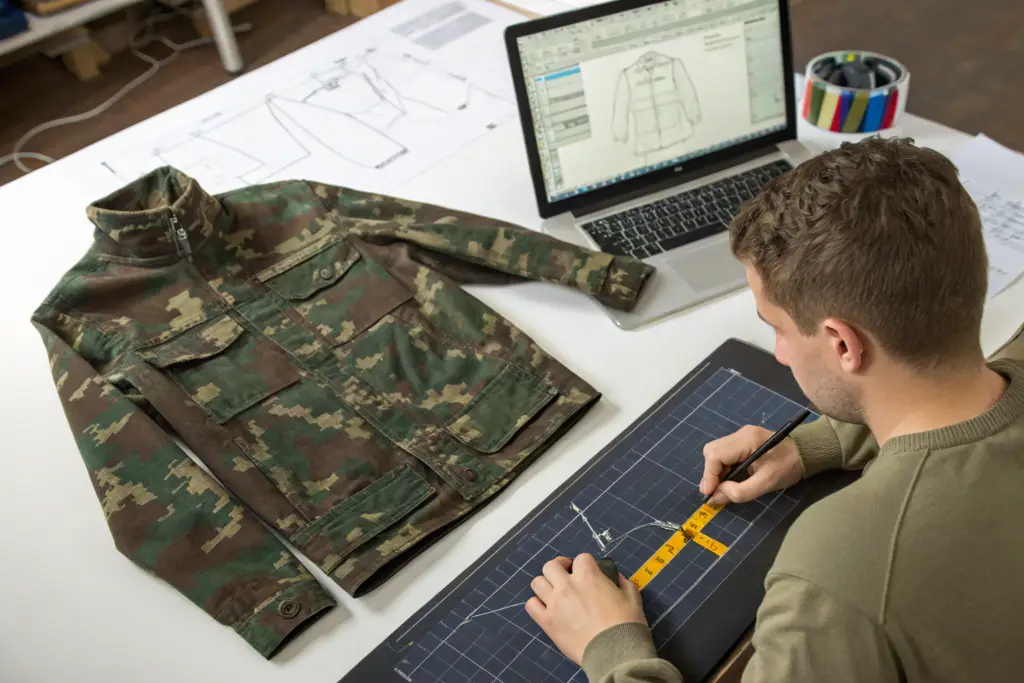
- Marker Making for Pattern Continuity: Using advanced CAD software, our pattern makers create cutting markers that position garment pieces on the fabric print in a way that ensures the pattern flows continuously across side seams, shoulders, and sleeves. For a client's hunting jacket with a tree bark camouflage, we developed a proprietary marker that guaranteed the pattern branches aligned horizontally across the back and chest, a detail their previous supplier couldn't achieve.
- Tolerancing and In-process Checks: We establish clear visual standards and tolerance limits (e.g., "pattern may shift up to 1/4 inch at side seam"). Sewing operators are trained to match patterns at key points using guide notches, and inline QC inspectors verify this before pieces are joined.
How are stretch and wash stability managed?
A pattern that looks perfect on flat fabric can distort when the garment is worn or washed.
- Pre-testing: We conduct pre-shrinkage tests on all printed fabrics and adjust our patterns accordingly. If a licensed polyester fabric shrinks 3% longitudinally in a wash, we enlarge the cutting pattern by 3% to compensate.
- Print-on-Knit Expertise: Printing on stretchy knit fabrics for licensed activewear requires specialized inks and techniques. We use disperse dyes and fixation processes that allow the print to stretch over 30% without cracking. A performance wear brand trusted us with their first licensed graphic print leggings line because we demonstrated this capability through multiple wash and stretch test cycles.
Why is the end-to-end supply chain a decisive advantage?
Licensed manufacturing isn't just about printing and sewing. It involves a synchronized chain of specialized suppliers: for approved base fabrics, licensed hangtags and labels, specific threads, and even packaging. A factory's ability to reliably orchestrate this entire chain under tight deadlines is a key marker of leadership.
Chinese manufacturing hubs offer an unparalleled concentration of these specialized suppliers within a close geographic radius. This reduces logistics time, enables faster problem-solving, and simplifies quality oversight. A factory like Shanghai Fumao doesn't just make garments; it manages a curated network of vetted partners.
The supply chain advantage provides both speed and risk mitigation.
How does local sourcing accelerate timelines?
When all critical components are sourced within a 200-mile radius:
- Rapid Sampling: New label or trim samples can be obtained in 24-48 hours for client approval, not weeks.
- Just-in-Time Delivery: Components can be delivered in small batches as needed, reducing inventory cost and risk.
- Quick Issue Resolution: If a batch of licensed woven labels has a flaw, a supplier representative can be at our factory in two hours to resolve it. We avoided a two-day production stoppage for a children's wear license this way, where the embroidered character logo on the label needed a minor thread color adjustment.
How does vertical integration of key processes help?
For certain licenses, we take integration further. For instance, our investment in our own embroidery and label-making department means that for licenses requiring embroidered logos (common in professional sports leagues), we can convert the digital artwork into a stitch file, produce a sample, and run production without ever sending the sensitive logo artwork to an external supplier. This significantly reduces security risks and speeds up the process by 5-7 days per order.
Conclusion
Leadership in licensed pattern manufacturing is not a single attribute but a symphony of capabilities. It's the integrated technical infrastructure that guarantees accuracy, the robust compliance culture that protects intellectual property, the deep technical expertise that solves unique construction challenges, and the orchestrated supply chain that delivers reliability and speed. Chinese factories that lead in this field have built these pillars not in isolation, but as interconnected systems.
This holistic approach transforms the complex, risk-laden process of producing licensed apparel into a smooth, predictable, and scalable operation. It allows brands to focus on marketing and sales, confident that their valuable licensed products are being manufactured with precision, security, and consistency. This is the standard we have built at Shanghai Fumao, making us a trusted partner for global brands that cannot afford compromises with their most valuable patterns.
If your brand is looking to scale licensed apparel production without sacrificing quality or compliance, partnering with a factory that masters this complete ecosystem is essential. Let us show you how our systems and expertise can safeguard your brand's integrity while delivering exceptional product. To discuss your next licensed project, contact our Business Director, Elaine, at: elaine@fumaoclothing.com.