A brand owner from the UK called me in a state of controlled panic last March. He had sold 2,000 pairs of classic chino shorts to a boutique chain in Germany under DDP terms. He thought DDP meant "easy." The factory would handle everything. The goods arrived at Hamburg port. Then the bills started arriving. A customs clearance fee he did not budget for. A VAT bill calculated on an incorrect customs value. A storage charge because his customs broker had filed the paperwork one day late. A trucking surcharge for delivery to a pedestrian zone. His landed cost was 22% higher than his spreadsheet. His margin on the order was gone. He had signed up for DDP without understanding what DDP actually demanded of him as the seller.
The primary logistics challenges of DDP shipping for classic shorts to Europe include navigating the fragmented EU customs and VAT systems, managing the Importer of Record liability, absorbing unpredictable destination port fees and last-mile delivery surcharges, and ensuring the commercial invoice is technically perfect to prevent customs holds and demurrage costs.
DDP, or Delivered Duty Paid, is the most seller-responsible Incoterm. It means you, the exporter, pay for everything: the freight, the insurance, the import duties, the import VAT, the customs clearance, and the final delivery to the buyer's door. The buyer simply receives the goods. This sounds like a great sales pitch—"We handle everything!"—but it concentrates all logistics risk onto your balance sheet. At Shanghai Fumao, we ship DDP to Europe for several brand partners, and I have learned exactly where the traps are hidden. Let me map them out so you can navigate DDP without the panic.
Why Is EU Customs Clearance a Maze of Different National Systems?
The European Union is a single market for goods once they are inside the border. But the border itself is not singular. It is twenty-seven different national customs authorities, each with its own interpretation of the same EU customs code, each with its own electronic filing system, and each with its own language. A shipment of classic shorts clearing customs in Rotterdam enters a Dutch system. A shipment clearing in Hamburg enters a German system. The duty rate is the same, but the clearance process, the documentation preferences, and the inspection triggers differ. A DDP seller must navigate this fragmented reality for every shipment.
EU customs clearance complexity arises from national variations in customs IT systems, language requirements for supporting documents, and differing risk-profiling algorithms that can trigger physical inspections on a seemingly random basis, delaying clearance and adding storage costs.
I experienced this fragmentation directly with a two-pallet shipment of sample shorts to a client in Italy. The same shipment, with the same HTS code and the same commercial invoice, had cleared German customs in two days on a previous order. Italian customs held it for nine days. No reason given beyond "document verification." The storage charges at the bonded warehouse accumulated daily. The client was calling me every morning. There was nothing I could do except wait and pay the bill when it arrived. The lesson was clear: each member state is a unique clearance environment. A DDP shipper must build country-specific buffer time and budget into their planning. The official EU customs union framework is documented by the European Commission's Taxation and Customs Union directorate, but the implementation varies nationally.
Why Do HS Code Classifications Get Challenged at the EU Border?
The Harmonized System code determines your duty rate. For classic cotton shorts, the code is typically 6203.42. The duty rate is 12%. But what if the shorts have a polyester pocket lining? What if they are a cotton-linen blend? The exact fiber composition determines the correct sub-classification. EU customs officers are trained to check fabric content labels against the declared HS code. If they suspect the declaration is wrong—even by a single digit—they can hold the shipment, request a lab test, and issue a reclassification. The reclassification might change the duty rate from 12% to 16%. The difference is billed to the importer of record, which under DDP terms is you, the seller. You cannot recover this cost from the buyer because the DDP price was fixed. I always advise DDP shippers to have their fabric composition certified by a testing lab like SGS and to attach the test report to the customs documentation. Preemptive evidence reduces the risk of a challenge.
What Is an EORI Number and Why Must Every DDP Shipment Have One?
EORI stands for Economic Operators Registration and Identification. It is a unique identification number required by any business that wants to import goods into the EU. Without an EORI number, customs will not clear your shipment. Under DDP terms, the seller must have an EORI number, or must use a customs broker who has one and who is willing to act as the indirect representative. Obtaining an EORI number from outside the EU can be a bureaucratic process requiring proof of business registration and tax status. Some non-EU factories try to bypass this by using the buyer's EORI number. This is illegal under strict DDP terms because the buyer is not the importer of record. The correct process is either to register for an EORI in the destination country or to engage a VAT and customs agent who provides a fiscal representation service. The costs for this service must be built into the DDP price. More information on EORI registration is available from the European Commission.
How Does the VAT Payment Mechanism Create Cash Flow and Compliance Risks?
Import VAT is the silent cash flow killer in DDP shipping. When goods enter the EU, import VAT is due at the rate applicable in the destination country. For Germany, that is 19%. For France, it is 20%. For the Netherlands, 21%. This VAT is calculated on the CIF value (cost of goods plus insurance plus freight) plus the import duty. On a €30,000 shipment of classic shorts to Paris, with €3,600 in duty, the import VAT bill is approximately €6,720. That is money you must pay upfront to clear the goods. You can theoretically reclaim it later if you are VAT-registered in that country. But the reclaim process takes months. In the meantime, your cash is gone.
The DDP VAT obligation forces the seller to pre-finance a significant tax payment—typically 19-21% of the CIF value—with reimbursement taking weeks or months through the EU's fragmented VAT refund systems, creating a heavy working capital burden.
A brand I advised was nearly broken by this. He shipped DDP to four EU countries in one season. His total VAT outlay was over €40,000. He had not budgeted for it. He thought the buyer paid the VAT. Under DDP, the buyer does not. The seller does. He had to take out a short-term loan at 8% interest to cover the VAT float. The interest cost ate another margin point. He now understands that DDP is not just a logistics term. It is a financing term. Sellers who do DDP well often use a Deferred VAT Accounting scheme if they are established in the EU, or they work with a fiscal representative who manages the VAT payments and reclaims on their behalf. The rules on import VAT are complex, and the European Commission's VAT page provides the legal framework.
What Is the Difference Between a Fiscal Representative and a Direct VAT Registration?
A non-EU company selling DDP into the EU needs a mechanism to pay and reclaim VAT. One option is direct VAT registration in the destination country. This requires filing periodic VAT returns and maintaining compliance with local tax authorities. It is administratively heavy. The other option is appointing a fiscal representative—an EU-based company that acts on your behalf for VAT purposes. The fiscal representative files the returns and handles the payments. This service costs money, typically an annual fee plus a percentage of the VAT reclaimed. But it shifts the compliance risk and administrative burden off your shoulders. For a brand shipping DDP to multiple EU countries, a fiscal representative is often the only practical solution. The choice depends on shipment volume and frequency. Specialized VAT compliance firms provide these services, and their offerings can be researched through trade finance resources like the International Chamber of Commerce.
How Do Postponed VAT Accounting Schemes Work and Are They Available to Non-EU Sellers?
Postponed VAT accounting, also called deferred VAT, allows the importer to account for import VAT on their VAT return rather than paying it at the border. This eliminates the upfront cash flow hit. However, this scheme is generally only available to companies that are established in the EU and have a valid VAT registration in the country of import. A non-EU factory selling DDP cannot directly use postponed accounting in most member states. The factory must either establish an EU entity, which is expensive, or work through a fiscal representative who can use the scheme. The availability of postponed accounting varies by country. The Netherlands and Belgium are known for having relatively flexible schemes. France and Italy are more restrictive. The specific rules are detailed by each country's tax authority and are summarized in trade guides from organizations like the International Trade Centre.
What Are the Hidden Destination Port and Last-Mile Delivery Costs?
The ocean freight quote tells you the cost to move a container from Shanghai to Rotterdam. It does not tell you the cost to move that container from the Rotterdam terminal to a warehouse in a German village, or to a boutique on a pedestrian street in Milan, or to a fifth-floor walk-up stockroom in Paris. Last-mile delivery in Europe is expensive, complex, and full of surcharges that do not appear on the initial forwarder quote. Diesel taxes, congestion zone fees, tail-lift requirements, appointment-based unloading, limited delivery windows in historic city centers—each of these adds a line item to the final invoice.
Destination port handling, customs examination fees, demurrage at congested EU terminals, and last-mile delivery surcharges for restricted urban zones, residential addresses, and non-ground-floor deliveries can add 15-25% to the door-to-door logistics cost compared to the base ocean freight quote.
A DDP shipment I managed to a client in central Barcelona taught me the lesson of the "pedestrian zone surcharge." The boutique was located on a narrow street in the Gothic Quarter. Trucks were only allowed between 6 AM and 8 AM. The delivery required a small box truck, not a standard semi-trailer, which incurred a vehicle change fee. The driver needed a hydraulic tail-lift because the boutique had no loading dock. The driver waited thirty minutes for the shop assistant to arrive with a key. Every minute of waiting time was billed. The final delivery leg, which I had estimated at €200, cost €540. The DDP price had not accounted for any of this. My margin on that shipment turned negative. I now build a 20% buffer into every DDP destination charge estimate.
Why Are Demurrage and Detention Fees Higher at Major EU Ports?
European ports are congested. Rotterdam, Hamburg, Antwerp—these are among the busiest ports in the world. Shipping lines allocate a limited number of free days for the container to sit at the terminal. At Rotterdam, the free time is often only three to five days. After that, demurrage charges begin at approximately €100-€150 per day. If customs clearance takes a week, which is common, the demurrage bill can exceed €500 per container. The shipping line is not flexible. The charges are non-negotiable. The DDP seller is responsible. The only defense is to have a customs broker who files clearance documents the moment the vessel arrives, not the day after. Speed in documentation is the only demurrage prevention strategy. The operational realities of European port logistics are reported by industry news sources like Supply Chain Dive.
What Documentation Is Required for a Smooth Last-Mile Delivery in Europe?
The driver needs more than an address. They need a delivery appointment confirmed by the consignee. They need a commercial invoice and packing list in the local language. They need a CMR consignment note for road transport. They need proof of customs clearance. If any document is missing, the driver turns around and the delivery is rescheduled. A failed delivery attempt is billed as a surcharge. For DDP to a residential address—which is increasingly common with direct-to-consumer brands—the driver may need a pre-call to the recipient. If no one answers, the delivery fails. The DDP seller pays for the re-delivery. The logistical precision required for European last-mile delivery is underappreciated by sellers accustomed to US domestic shipping. Partnering with a freight forwarder that has a strong European ground network is essential. Forwarder directories and reviews can be found on platforms like Freightos.
How Do You Structure a DDP Price to Avoid Losing Margin on European Orders?
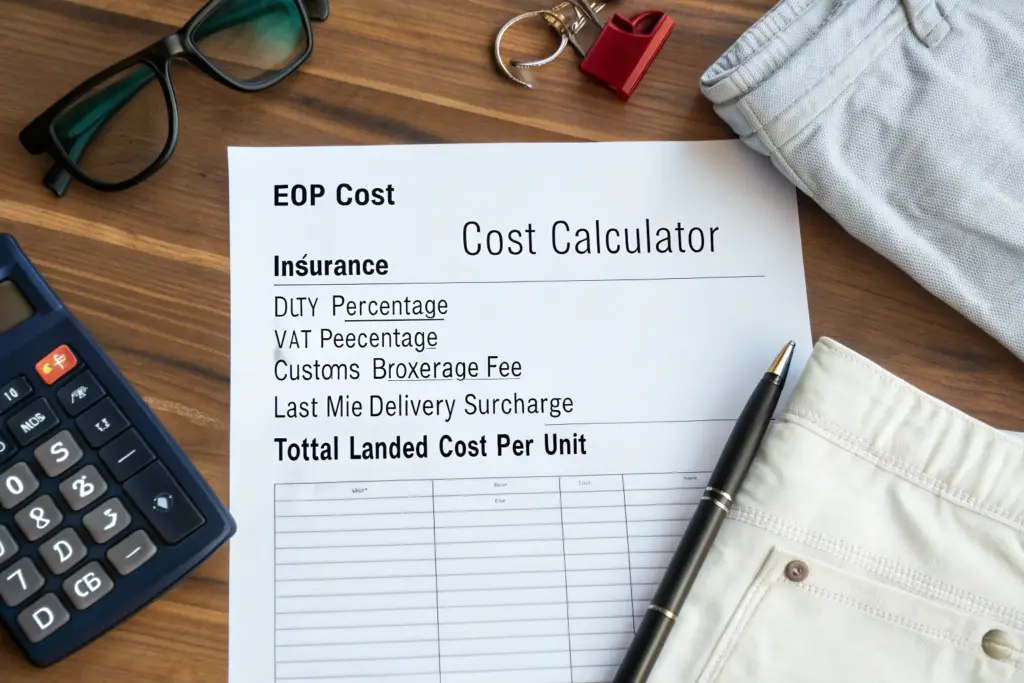
A DDP price that is not fully calculated is a DDP price that will lose money. The factory FOB price plus a rough guess for freight is not a DDP calculation. It is a wish. A proper DDP landed cost model has at least ten line items. It is built destination by destination because the costs for Germany are not the same as the costs for Portugal. It is updated quarterly because freight rates, currency exchange rates, and fuel surcharges change. It includes a contingency buffer for the random customs examination, the unexpected demurrage day, and the failed delivery reattempt. The buffer is not optional. It is the cost of selling DDP profitably.
A profitable DDP pricing structure requires a country-specific landed cost model that includes factory FOB, ocean or air freight, insurance, import duty at the destination rate, import VAT upfront payment cost, customs brokerage, port handling, demurrage risk buffer, and last-mile delivery with urban surcharges, plus a minimum 5% contingency for unexpected charges.
A client I partnered with was losing 8% on his German DDP orders and did not know why. We built a line-by-line cost model for his Berlin-bound shipments. The culprit was a combination of three small charges he had never seen itemized: a "congestion surcharge" added by the shipping line during peak season, a "remote area delivery surcharge" for the warehouse location outside the city, and a "VAT handling fee" from the customs broker. These three items totaled €1.85 per pair of shorts. His margin per pair was €1.50. He was underwater. We restructured his DDP pricing by country, added the surcharges to the model, and raised his DDP price to the German buyer by 6%. The buyer accepted because the price was still competitive. The margin was restored. The lesson: if you cannot name every cost, you cannot price for profit.
| DDP Cost Element | Estimated Range (Per Shipment) | Notes |
|---|---|---|
| Ocean Freight (Shanghai to Rotterdam) | $2,500 - $4,500 per 40' container | Fluctuates seasonally; highest in Q3 |
| Insurance | 0.3% - 0.5% of CIF value | Covers total loss and damage |
| Import Duty (6203.42) | 12% of CIF value | Varies by fiber composition |
| Import VAT | 19% - 21% of CIF + Duty | Upfront cash outflow; reclaimable later |
| Customs Brokerage Fee | €150 - €350 | Depends on complexity and country |
| Terminal Handling & Port Charges | €200 - €500 | Includes THC, documentation, port security |
| Last-Mile Delivery (Pallet) | €150 - €600 | Varies hugely by distance and urban access |
| Contingency Buffer | 5% of total estimated cost | Covers demurrage, exams, re-delivery |
Why Must DDP Pricing Be Country-Specific and Not a Flat EU Rate?
The EU is not a single pricing zone. Germany has a 19% VAT rate. Hungary has a 27% VAT rate. A DDP price that averages these into a flat "EU rate" will overcharge the German buyer and lose money on the Hungarian buyer. Similarly, last-mile delivery to a warehouse in Rotterdam costs far less than last-mile delivery to a shop in rural Sicily. Customs brokerage fees vary by country. Some countries require additional documentation like a Certificate of Conformity for textile imports. Each destination has a unique cost profile. A professional DDP seller maintains a country-specific rate card. The administrative effort is higher, but the alternative is cross-subsidizing one market with the margin from another, which distorts pricing and profitability. The specifics of each EU member state's import requirements can be researched through the European Commission trade portal.
How Should You Communicate DDP Value to a European Buyer Who Sees a Higher Unit Price?
A European buyer comparing an FOB price from one supplier to a DDP price from you will see your price as significantly higher. They may not understand that the DDP price includes costs they will pay separately under FOB terms. Your quotation must educate. Break down the DDP price on the quotation. Show the FOB equivalent. Show the estimated freight, duty, and VAT components. Show that the DDP total is comparable to, or lower than, the buyer's total landed cost if they arranged logistics themselves. Position DDP as a convenience service that eliminates the buyer's customs risk and administrative burden. When the buyer sees that the DDP price is not a markup but a consolidation of unavoidable costs, the higher unit price becomes a value proposition, not a negotiation obstacle. Sales training on communicating Incoterms to buyers is available from trade education resources like the International Trade Centre.
Conclusion
DDP shipping to Europe is a powerful sales tool. "We handle everything" is a compelling promise to a buyer who has been burned by customs delays and surprise duty bills. But the promise is expensive to keep if the costs are not fully understood and meticulously priced. The fragmented customs systems, the upfront VAT financing, the unpredictable last-mile surcharges, and the country-specific regulatory quirks combine to create a logistics landscape that punishes the unprepared seller.
The solution is not to avoid DDP. It is to master it. Build a country-specific landed cost model with a contingency buffer. Partner with a strong freight forwarder and a knowledgeable customs broker who operate in your destination countries. Consider a fiscal representative for VAT compliance. Educate your buyers on the value of the DDP service. DDP done well is a competitive advantage that builds buyer loyalty and removes friction from the purchasing process. DDP done poorly is a margin-destroying liability.
If you are considering offering DDP terms on your classic shorts to European buyers, I encourage you to consult with a factory that has experience navigating these logistics. At Shanghai Fumao, we have shipped DDP to over a dozen EU countries. We can help you build a realistic landed cost model and manage the logistics on your behalf. Contact our Business Director, Elaine, at elaine@fumaoclothing.com to discuss your target European markets and request a sample DDP cost breakdown for your classic shorts program. Let us handle the complexity so your buyer simply receives the goods.