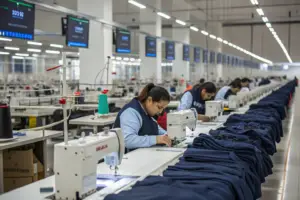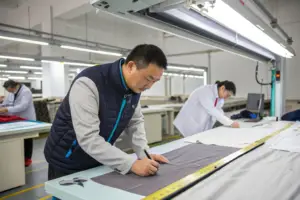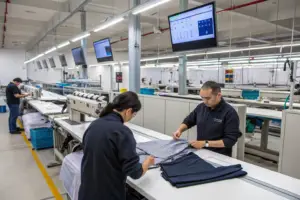
For brands and manufacturers in the technical skiwear sector, staying ahead of chemical compliance is not just about meeting today's standards—it's about anticipating tomorrow's. The OEKO-TEX® Association's annual update of its STANDARD 100 criteria is a critical event, signaling shifts in regulatory focus, scientific understanding, and market expectations. The updates for 2025, which will come into effect after a three-month transition period following their official publication, introduce significant new restrictions that directly impact the materials and chemistry foundational to high-performance ski apparel. Proactive adaptation is no longer a best practice; it's a competitive necessity.
The latest OEKO-TEX® updates for 2025 affecting skiwear include a major expansion of PFAS restrictions, new limits for UV stabilizers and other process chemicals, updated requirements for bio-based materials, and enhanced labeling rules. These changes will require skiwear brands and their suppliers to audit material formulations, qualify alternative chemistries, and update supply chain documentation to maintain certification. The overarching trend is a continued tightening of the noose around "forever chemicals" and a push for greater transparency in material composition.
At Shanghai Fumao, our compliance team has already begun a pre-emptive review of our certified material library and mill formulations against the anticipated 2025 criteria. A specific concern arose with a high-performance, windproof softshell fabric used by several clients. The mill's current DWR (Durable Water Repellent) finish, while OEKO-TEX® compliant in 2024, uses a C6 fluorocarbon chemistry that is now squarely in the crosshairs of the expanded PFAS restrictions. We are already working with the mill to transition this fabric to a certified, high-performing PFAS-free alternative to ensure our clients' 2025 productions are not disrupted. This forward-looking action is what separates a reactive supplier from a strategic partner.
What Are the New PFAS (Per- and Polyfluoroalkyl Substances) Restrictions?
This is the most consequential update for the outdoor and skiwear industry. PFAS have been under scrutiny for years due to their persistence in the environment and potential health risks. The 2025 update dramatically widens the net.
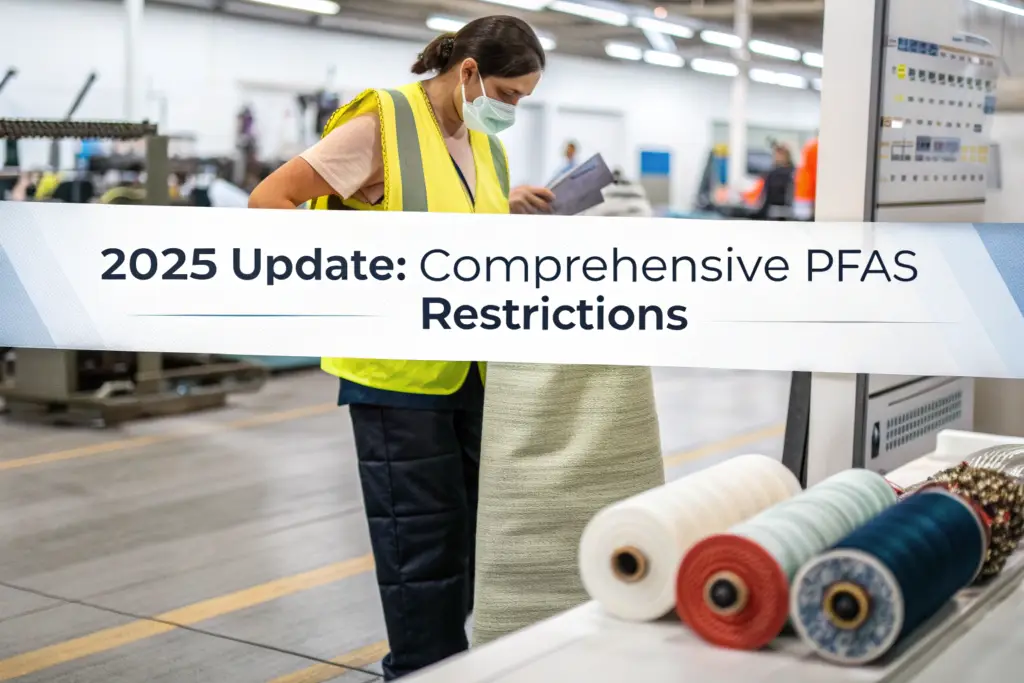
The 2025 update introduces a comprehensive, group-based restriction for PFAS. Instead of regulating a limited list of specific PFAS compounds (like PFOA, PFOS), the new criteria will restrict any intentionally added PFAS across nearly all product classes, with extremely low detection limits. This is a paradigm shift from targeting specific "bad actors" to eliminating the entire chemical class from certified textiles, with very narrow exceptions for certain protective workwear.
What Does This Mean for Skiwear Components?
Practically every component that uses fluorocarbon chemistry for water, oil, or stain repellency is affected:
- DWR Finishes on Outer Shells: This is the primary impact. Most high-performing, long-lasting DWR treatments have historically been fluorocarbon-based. Brands must now switch to PFAS-free DWR technologies for any new fabric seeking certification after the enforcement date.
- Waterproof Membranes: Some proprietary membranes may incorporate fluorinated chemistries for oleophobicity (oil resistance) or enhanced durability. These will need reformulation or documented exemption.
- Stain-Repellent Treatments on Insulations or Linings: Less common, but any such treatment must be PFAS-free.
- Threads and Tapes: Even sewing thread or seam tape with fluorinated coatings to aid waterproofing must be reviewed.
Action Item for Brands: Immediately contact your fabric and trim suppliers to request confirmation on the PFAS status of their products and their plan for 2025 compliance. For ongoing development, specify "PFAS-free DWR" as a mandatory requirement in all new tech packs.
What Are the New Limits for UV Stabilizers and Other Process Chemicals?
Beyond PFAS, the updates reflect a growing understanding of the environmental and health impacts of other substance groups used in textile manufacturing.
New or lowered limits are being introduced for several substance groups, including certain UV stabilizers (like Benzotriazole derivatives), residues from spinning oils and knitting lubricants, and specific plasticizers. These chemicals are often used in the production of synthetic fibers (polyester, nylon) common in skiwear to enhance durability, processing efficiency, or hand-feel.

Why This Matters for Performance Skiwear:
- UV Stabilizers: Added to fabrics to prevent degradation from sunlight, which is intense at high altitudes. The new restrictions target specific stabilizers that are potentially environmentally persistent or bio-accumulative. Mills will need to reformulate.
- Process Chemicals: Oils and lubricants used in yarn manufacturing and fabric knitting can remain as residues. The new, stricter limits mean mills must improve their scouring and washing processes to ensure cleaner, safer fabrics from the outset. This can positively impact the fabric's odor retention and skin-feel.
Action Item for Brands: While this is primarily a mill-level reformulation, brands should ask their manufacturers for assurance that their fabric suppliers are aware of and preparing for these changes. A proactive manufacturer like Shanghai Fumao will be gathering updated compliance statements from its mill partners throughout 2024.
How Do the Updates Affect Bio-Based and Recycled Materials?
As brands increasingly incorporate recycled polyester, bio-based polymers, or other alternative materials, OEKO-TEX® is updating its framework to address their unique chemical profiles.
The 2025 updates include clarified testing and assessment criteria for materials containing genetically modified organisms (GMOs), bio-based materials, and recycled materials. The focus is on ensuring that the recycling process or bio-based production does not introduce new, unregulated harmful substances into the textile. This provides more robust guidance for certifying sustainable material innovations.
Implications for Skiwear:
- Recycled PET Insulation/Fabrics: The certification will now more explicitly verify that the recycling process effectively removes contaminants from the post-consumer waste stream. This adds credibility to using recycled materials.
- Bio-Based Durables: Emerging materials like bio-based polyamides or PTFE alternatives will have a clearer path to certification, supporting innovation in sustainable performance fabrics.
Action Item for Brands: If you are marketing recycled or bio-based content, ensure your supplier can provide OEKO-TEX® certification that is valid under the 2025 criteria. This will be a stronger marketing claim than a generic certification.
What Are the Changes to Labeling and Documentation Requirements?
Transparency and traceability are becoming as important as the chemical restrictions themselves.
Enhanced rules for labeling and documentation will likely require more precise information on certificates, potentially including clearer identification of material composition and the specific production sites involved. This makes supply chain mapping easier for brands and responds to regulatory trends like the EU's upcoming Digital Product Passport (DPP).
What Brands Need to Do:
Ensure your manufacturing partner has a robust digital documentation system. When you receive your OEKO-TEX® certificate for a finished garment, it should be easy to trace back to the certificates of its components. This traceability will be crucial for responding to retailer queries and future regulatory compliance.
How to Prepare Your Supply Chain for the 2025 Transition?
A wait-and-see approach is risky. The transition period will be busy, and mills with high demand may face backlogs reformulating and re-certifying fabrics.
To prepare, brands should initiate a four-step action plan: 1) Communication with suppliers, 2) Material library audit, 3) Prototyping with compliant alternatives, 4) Updating internal specifications.

Step-by-Step Preparation Guide:
| Step | Action | Responsible Party | Timeline (2024) |
|---|---|---|---|
| 1. Official Update Review | Obtain the full official OEKO-TEX® update document once published (typically Q3 2024). | Brand / Manufacturer Compliance Team | Q3 2024 |
| 2. Supply Chain Communication | Issue a formal letter to all material suppliers (fabric, trim, insulation mills) requesting their 2025 compliance plan. | Brand with support from Manufacturer (e.g., Shanghai Fumao) | Q3-Q4 2024 |
| 3. Critical Material Audit | Identify all currently used materials that are high-risk for PFAS (e.g., shells with DWR) and other updated substances. | Manufacturer & Brand | Q4 2024 |
| 4. Alternative Sourcing & Testing | Source and lab-test PFAS-free alternatives for high-risk materials. Conduct performance comparisons. | Manufacturer | Q4 2024 - Q1 2025 |
| 5. Pilot Production | Run a small production batch with the new compliant materials to ensure no issues in lamination, sewing, or final performance. | Manufacturer | Q1 2025 |
| 6. Update Tech Packs & Specs | Officially update all technical packages and specifications to mandate 2025-compliant materials. | Brand | Before new production POs |
The Role of Your Manufacturing Partner
A certified manufacturer is your greatest asset in this transition. They should:
- Have a compliance team dedicated to tracking these updates.
- Maintain strong relationships with mills to access reformulated fabrics early.
- Offer a pre-compliant material library of options that already meet or are likely to meet the 2025 criteria.
- Manage the re-certification process for finished garments seamlessly.
At Shanghai Fumao, this proactive management is part of our integrated service. We view regulatory adaptation as a core component of supply chain resilience, not an administrative headache to be passed to the client.
Conclusion
The OEKO-TEX® 2025 updates represent a significant step-change, particularly with the sweeping PFAS restrictions. For the skiwear industry, this is not merely a compliance exercise but an opportunity to lead in the development and adoption of cleaner, next-generation material chemistry. Brands that start their transition now will secure their supply chains, avoid costly last-minute substitutions, and be able to market their 2025 collections with confidence as leaders in product safety and environmental responsibility.
Staying certified is not static; it's a continuous journey of improvement. The 2025 update is the next major checkpoint on that journey.
Ensure your next ski collection is built for the future, not just the present. Partner with Shanghai Fumao, where we monitor, interpret, and implement regulatory changes so you can focus on design and marketing. Contact our Business Director Elaine to future-proof your 2025 line: elaine@fumaoclothing.com.