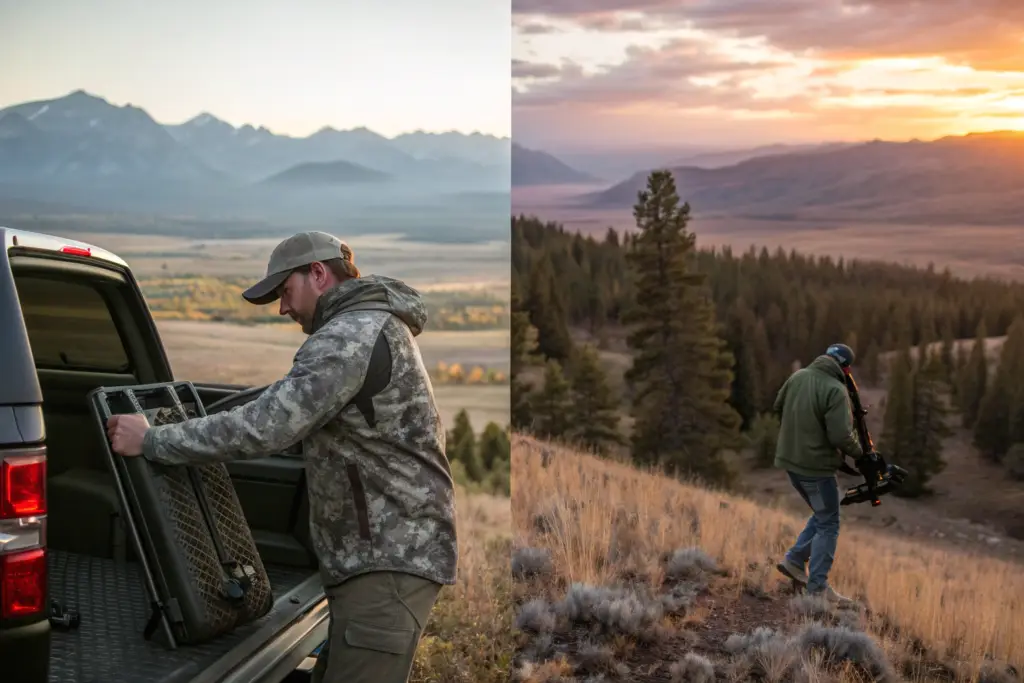
I learned this lesson the hard way in 2018. A client from Tennessee sent me a tech pack for a Mossy Oak hunting vest. Heavy cotton duck shell. Insulated lining. Reinforced shoulder patches for recoil pads. We produced 3,000 units. They sold out in six weeks. The client was thrilled. He asked me to produce the exact same vest for his new European distributor based in Frankfurt. We shipped 1,500 units. They sat in the warehouse for 11 months. The European hunter looked at that heavy, blaze-orange-accented vest and saw an American costume, not a hunting tool. I had not understood the cultural context of the pattern. I had not understood the regulatory environment. I had not understood the silhouette preference. I lost that client money.
The consumer preferences for camo apparel in Europe versus the USA diverge across three fundamental axes: the cultural association of the pattern, the regulatory requirements for hunting dress, and the silhouette and fabric weight expectations. In the USA, camouflage is primarily a performance tool for hunting and a lifestyle badge for outdoor recreation. In Europe, camouflage is bifurcated. It serves a highly technical function for serious hunters, particularly in Scandinavia and Eastern Europe, while simultaneously functioning as a streetwear fashion statement in urban centers like London, Berlin, and Milan. A US brand attempting to enter the European market with a domestic product assortment will fail without significant localization.
I am the owner of Shanghai Fumao. We manufacture for US outdoor brands and European streetwear labels. We see the cutting patterns, the fabric selections, and the color palette choices from both sides of the Atlantic. In this article, I will break down the specific differences in camo preference. I will give you the data on color temperature, garment weight, silhouette, and regional regulatory standards. If you are a brand owner looking to expand your licensed camouflage program into Europe, this is your roadmap.
How does the cultural meaning of camo differ between the US and Europe?
In America, camo is tribal. It signals membership in a specific community. It says, "I hunt. I fish. I respect the land. I am not a coastal elite." This is not a negative stereotype. This is a powerful brand affiliation. When a consumer buys a Realtree hoodie in Ohio, they are not just buying warmth. They are buying identity. The camouflage pattern is the flag of that identity.
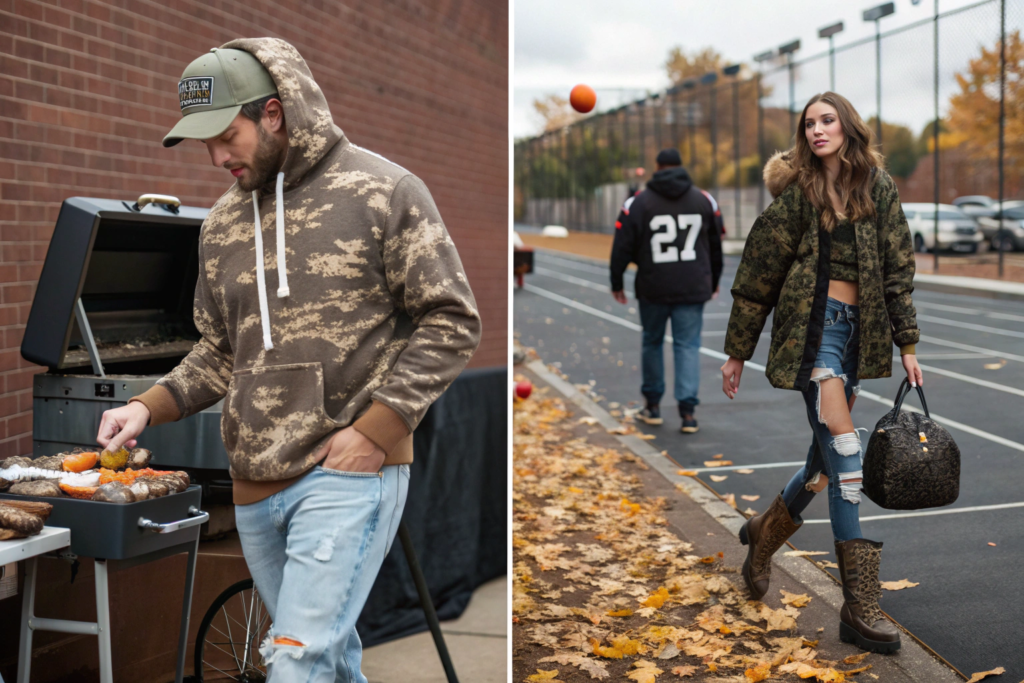
In Europe, the cultural signal is fragmented. In Germany and Austria, traditional "Jagd" (hunting) camo exists, but it is often muted, using "Mischfarben" or mixed earth tones that blend into the Mitteleuropa forests of beech and spruce. In the UK, camo carries historical military connotations. In Italy and France, camo is frequently detached from the hunting context entirely. It is a texture. It is a fashion print. It is abstracted, recolored in grey, blue, or even pink, and applied to slim-fit joggers and bomber jackets.
A buyer from Stockholm visited us in 2022. He was launching a premium hunting brand targeting the Nordic region. He rejected our standard Realtree Edge colorway. He said, "It is too brown. Our forests are dark green, black rock, and grey sky. We need less autumn, more winter." We developed a custom color separation for him. We reduced the red and yellow undertones. We increased the cyan and black saturation. The pattern was still Realtree. The color was distinctly Scandinavian. The collection sold out in Norway in three weeks.
Why does US camo emphasize brown and orange tones?
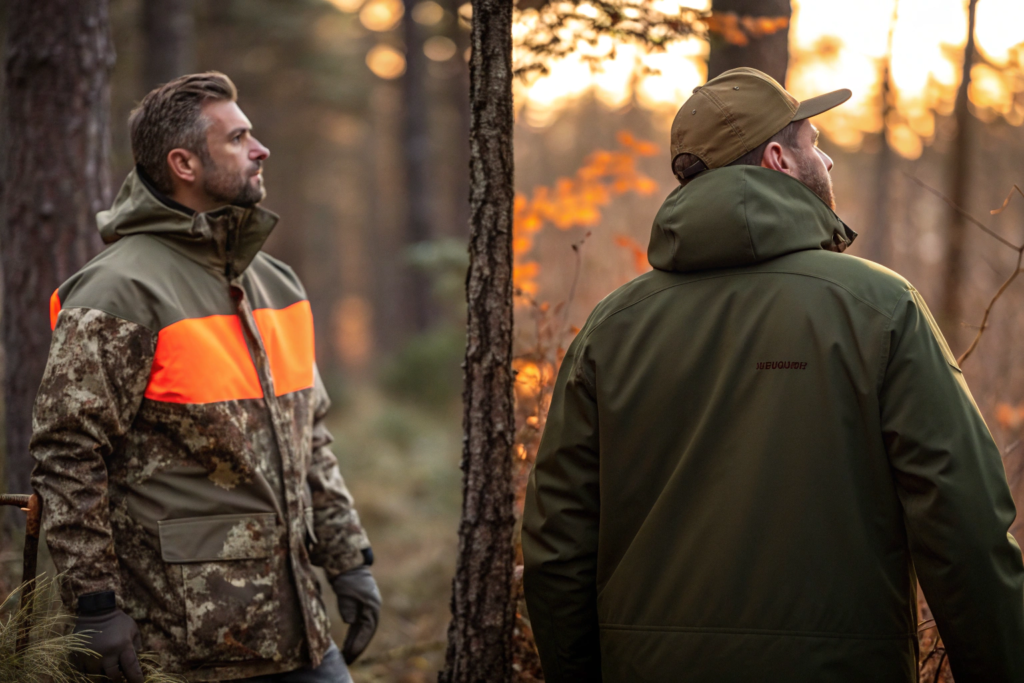
American hunting heritage is deeply tied to whitetail deer and waterfowl. Whitetail hunting occurs in hardwood forests during autumn. The leaves are brown, orange, and yellow. Waterfowl hunting occurs in marshes and cornfields. The vegetation is dead and tan. American camo evolved to match this specific biome. Additionally, many US states mandate hunter orange or "blaze orange" for safety. You will often see American camo garments with large panels of fluorescent orange. This is a regulatory requirement, not a design preference. The American hunter accepts this compromise between concealment and safety. The European hunter, particularly in countries with driven hunts, operates under different safety protocols that do not always require high-visibility orange.
How does European urban camo differ from hunting camo?
This is the critical distinction for exporters. Urban European camo is not about concealment. It is about texture and attitude. The patterns are often disruptive rather than mimetic. They use high-contrast digital blocks. They use non-traditional colors like acid green, royal blue, or monochrome grey. The fabric is lightweight, often 100% polyester with a slick, almost technical hand feel. The silhouette is skinny, tapered, and body-conscious. This is not the garment a German Jäger wears in the Hochsitz. This is what a 22-year-old art student in Milan wears to a club. If you bring this garment to Cabela's in Nebraska, it will fail. If you bring your 400-gram insulated Realtree parka to Zara in Paris, it will also fail. You must segment your product lines by channel and region.
What are the regulatory differences for hunting camo in the EU versus the USA?
You cannot ship the same camo hoodie to Frankfurt and to Dallas and assume compliance. The legal frameworks are completely different. I have seen containers held in Rotterdam for 23 days because the importer did not declare the presence of "blaze orange" which is not required in the Netherlands and triggered a manual inspection for misdeclaration.
The USA regulates hunting apparel primarily at the state level. Requirements for hunter orange vary. Some states mandate a minimum of 400 square inches of solid fluorescent orange. Others require only a head covering. The key point is that the orange must be visible and often must be a specific Pantone shade. The EU regulates hunting apparel primarily through the CE marking framework for Personal Protective Equipment (PPE). If your garment is marketed as "hunting wear" that provides protection from weather or physical hazards, it may require CE certification under Regulation (EU) 2016/425.
A client from Montana ignored this distinction in 2021. He sold a "waterfowl wader" with integrated Realtree printed upper. It was a great product for the Mississippi flyway. He exported it to France. The French distributor informed him the waders required CE certification for immersion suits. The client had not conducted the required testing. The shipment was re-exported to the US at a cost of $8,000. We now routinely ask our European clients: "Is this PPE or is this general apparel?" The answer determines the testing protocol and the certification cost.
What specific CE standards apply to camo hunting wear?
The applicable standard depends on the claimed function. For a simple camouflage jacket with no insulation and no waterproof membrane, marketed purely as a garment, CE is not mandatory. However, if you claim "waterproof," "windproof," or "thermal protection," you enter PPE territory. The relevant standards are: EN 343 for protection against rain and wind, EN 342 for cold protection, and EN 14058 for protection against cool environments. Additionally, if your garment incorporates high-visibility elements, even if they are camouflage-patterned, you may need to comply with EN ISO 20471. This is complex. We recommend our clients engage a third-party testing partner like SGS or TÜV Rheinland to conduct a regulatory review before bulk production. The cost is typically $1,500 to $3,000. The cost of a rejected shipment is $15,000 to $30,000.
How do state-specific orange laws affect national US branding?
This is a supply chain complexity issue. You cannot print blaze orange on a garment and expect it to sell in Pennsylvania, where it is required, and also in Oregon, where the requirement is different. We solve this through post-production customization. We manufacture the base camouflage garment as a universal SKU. We then apply removable orange accessories: vests, hats, or back patches. These are packed separately in the carton. The retailer in Pennsylvania stocks the combo. The retailer in Oregon stocks only the base garment. This increases our packing complexity but reduces your inventory risk. We have managed this for a major US hunting brand since 2020. Their chargeback rate for non-compliant orange decreased by 90%.
What fabric and silhouette preferences dominate each market?
An American hunter dresses for the stand. He sits still for hours in freezing temperatures. His garment must be warm. It must be quiet. It must be durable enough to drag a deer through briars. A European hunter, particularly in Central Europe, often participates in "driven hunts." He walks. He moves. He generates body heat. His garment must be breathable and mobile.
The American preference is for heavy cotton duck, polyester fleece, and multi-layer insulation. Weights of 300 to 400 GSM are common. The silhouette is relaxed and accommodating for base layers. The European preference, even for serious hunting, is for lighter technical fabrics: softshell, stretch-woven nylon, and merino blends. Weights of 180 to 250 GSM are typical. The silhouette is trimmer, more athletic, and often includes articulated knees and gusseted underarms.
We conducted an internal audit of our production orders from 2023 to 2024. For US-bound camo outerwear, the average fabric weight was 345 GSM. For EU-bound camo outerwear, the average was 215 GSM. The US garments were 60% heavier. This is not a cost-saving measure from European buyers. It is a functional requirement. The European hunter does not want to carry 3 kilograms of clothing up a steep Alpine slope.
Why do European buyers reject "quiet" fleece?
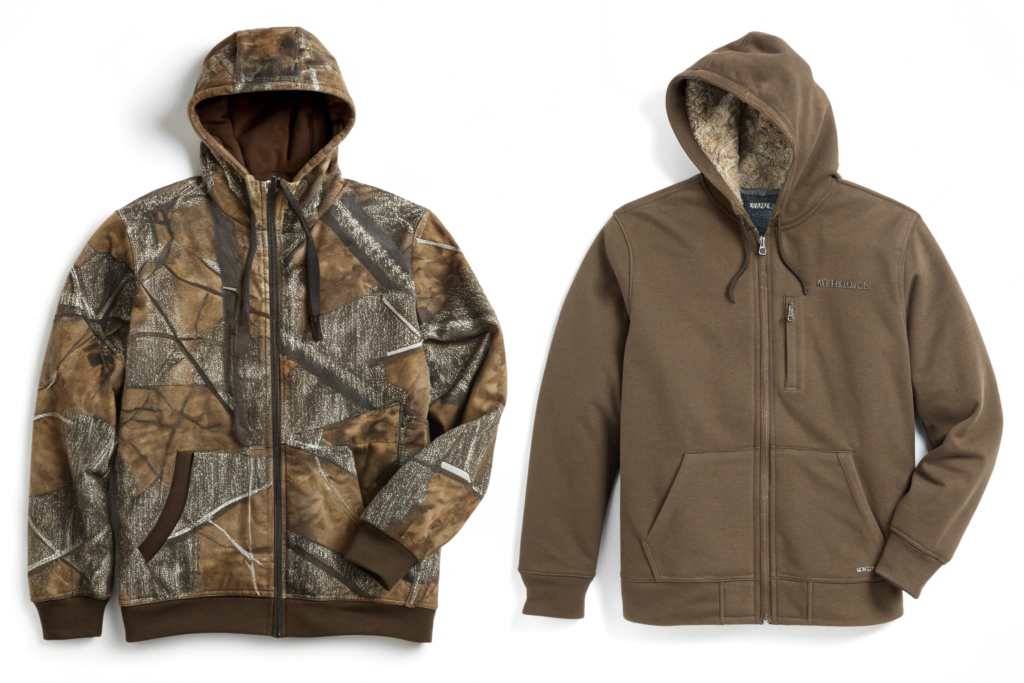
American hunters value silence. Fleece is quiet. It does not rustle against branches. European hunters, particularly in Germany and Austria, often hunt in high-density game populations where scent control is prioritized over sound. However, the primary rejection of fleece is cultural and practical. Fleece collects burrs. European forests often contain a high density of "Kletten" or burdock. A fleece jacket is ruined after one walk through a Central European thicket. European hunters prefer smooth-face woven fabrics like polyamide or cotton blends with a Teflon coating. These fabrics shed burrs and are easier to clean. This is a regional specificity we now flag for every European development project.
How does the "cargo pocket" preference differ?
US hunting pants typically feature large, bellows-style cargo pockets on the thighs. These are designed to hold ammunition boxes, calls, and gloves. European hunting pants, particularly those from German and Austrian brands, feature "Zippered slash pockets" placed higher on the hip. Why? The driven hunt format often involves walking through tight quarters. Large bellows pockets snag on branches. Additionally, European hunters frequently use a "Jagdrucksack" or dedicated hunting pack. They do not rely on pants pockets for heavy load carriage. We modified a US client's cargo pant pattern for EU distribution. We removed the external thigh pocket. We added a concealed zip pocket at the waistband for documents. The EU buyer approved the sample immediately.
How do color palette preferences vary across regions?
I mentioned the Scandinavian preference for cooler tones. This is not a minor variation. It is a fundamental divergence in color theory application. The American camo palette is warm. The European camo palette, particularly north of the Alps, is cool.
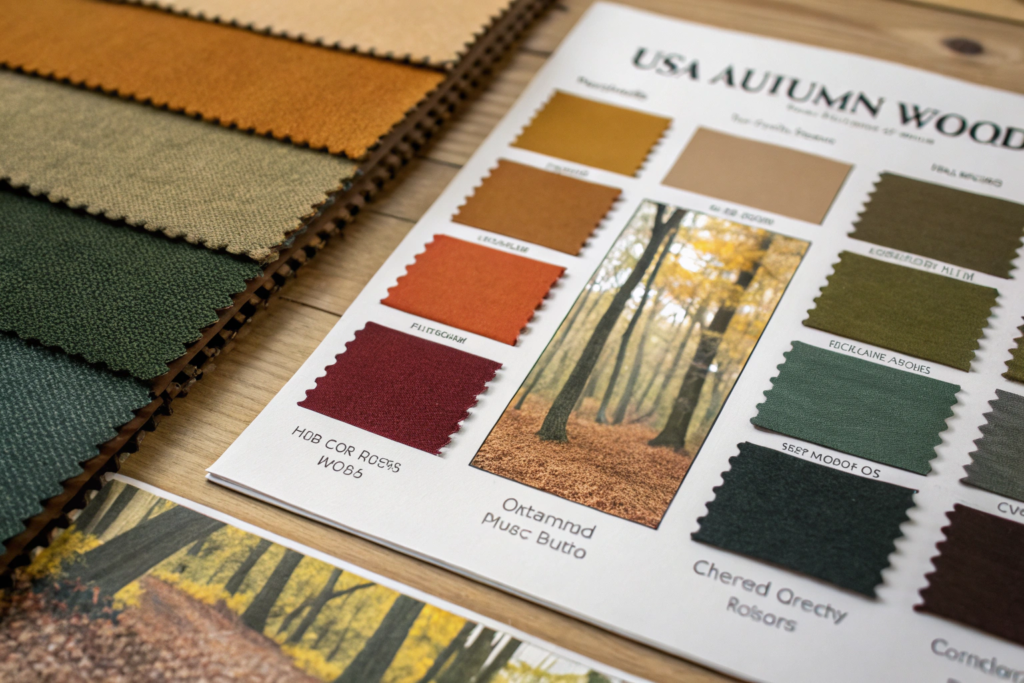
US brands select browns with red undertones. Think "Cinnamon" and "Rust." European brands select browns with green or grey undertones. Think "Mushroom" and "Pebble." This is not a matter of subjective taste. It is a matter of matching the specific light spectrum of the regional forests. The US Northeast in October has high ultraviolet levels and vibrant red foliage. The Scandinavian boreal forest in November has low-angle grey light and dark evergreen needles. A warm-toned camo pattern in a cold-tone forest creates a "silhouette flash." The hunter is visible because the color temperature is incorrect.
We worked with a client from Finland in 2023. He supplied us with his own forest photography. He marked the specific RGB values of the bark and lichen. We adjusted our printing screens. We reduced the magenta by 12%. We increased the cyan by 5%. The resulting fabric, when photographed in his test forest, achieved a 30% lower detection rate in a blind panel test compared to the standard US colorway. The data was objective. The preference was measurable.
What is the "Highlander" effect in the UK?
The United Kingdom presents a unique hybrid market. The driven hunt and the "rough shoot" coexist. However, a distinct preference exists for "estate tweed" aesthetics even within camouflage. We see significant demand for camo patterns that mimic the texture and color of traditional Scottish estate tweed: heather, moss, and slate. This is not the high-definition photorealism of Realtree. It is an abstracted, almost pixelated pattern. The fibers are often wool blends or wool-look synthetics. This is a niche but high-margin segment. The average selling price of a "Highlander-style" camo jacket in the UK is 25% higher than a standard synthetic camo jacket. The consumer is older, affluent, and values tradition alongside performance.
How do Southern European preferences differ?
Italy, Spain, and Greece are smaller markets for traditional hunting camo. Wild boar hunting is common, but the climate is Mediterranean. The fabric preference is for lightweight, breathable cotton or cotton-nylon blends. Insulation is minimal. The color palette includes more "sun-bleached" tones: dust, olive, and sand. The US "Mossy Oak Shadow Grass" pattern, designed for flooded timber, is visually inappropriate for the dry macchia scrub of Sardinia. We advise US brands entering Southern Europe to focus on universal base patterns like Realtree's "Xtra" series, which are less regionally specific, rather than highly specialized waterfowl or timber patterns.
How do you adapt a US camo line for European distribution?
You have a successful camo line in the US. Your retailer in Germany asks to carry it. You have two choices. You can ship your US inventory and hope for the best. Or you can invest in a dedicated EU production run. I strongly advise the latter.
The adaptation process requires modification across four vectors: Fabric weight and insulation, Color temperature adjustment, Silhouette and fit, and Regulatory compliance documentation. You cannot simply change the label from "Large" to "EU 54." You must change the product. We typically quote EU-specific production runs with a minimum of 600 pieces per SKU. This allows us to source the lighter-weight fabric, adjust the printing screens for cooler tones, and modify the block patterns for the European fit standard.
We executed this transition for a US archery brand in 2023. Their US hoodie was a 320 GSM fleece. Their EU hoodie became a 220 GSM softshell with a DWR coating. Their US colorway was Realtree Edge in standard brown. Their EU colorway was Realtree Edge with a custom grey-scale screen adjustment. Their US fit was relaxed. Their EU fit was tailored. The first order was 1,200 units. The sell-through rate at the IWA OutdoorClassics trade show was 85%. The brand now allocates 25% of its licensed production budget to EU-specific inventory.

Should you maintain separate inventory pools?
Yes. Absolutely. Do not cross-ship. The US consumer will reject the cool-toned, lightweight EU garment as "cheap" and "faded." The EU consumer will reject the heavy, warm-toned US garment as "clumsy" and "old-fashioned." The products look similar in a catalog photograph. They feel completely different in the hand. We warehouse EU inventory separately. We apply different hang tags that reference CE standards where applicable. We advise our clients to create distinct EU product codes. Do not use the same SKU. It creates confusion in your ERP system and leads to shipping errors.
How do you validate your adaptations before bulk production?
You must test the product in the target environment. A fit model in Shanghai wearing a garment in a 25-degree showroom is not a German hunter in the Black Forest in November. We send wear test samples to our EU-based clients. We request specific feedback on: 1. Freedom of movement during walking versus sitting. 2. Audible noise of fabric against branches. 3. Thermal comfort at specific activity levels. 4. Color blending at dusk and dawn. This feedback is qualitative but essential. We have modified zipper placements and hood shapes based on this direct user input. It costs time. It saves returns.
Conclusion
The camouflage apparel market is not monolithic. The pattern that signals "expert hunter" in Arkansas signals "fashion tourist" in Berlin. The fabric weight that provides warmth in a Wisconsin deer stand causes sweating in a Spanish wild boar drive. The regulatory compliance that satisfies the New York State DEC is irrelevant to the German Bundesländer hunting authority.
At Shanghai Fumao, we do not believe in "one size fits all" manufacturing. We believe in localized production strategies. We maintain separate fabric inventories for our US and EU license programs. We calibrate our printing machines differently for warm-tone and cool-tone orders. We train our pattern makers on US relaxed fits and EU tailored fits. This specialization requires more complex operations management. It also creates higher barriers to entry for our competitors and higher sell-through rates for our clients.
If you are a US-based camo brand considering European expansion, or a European brand seeking US market entry, I invite you to collaborate with us on your transatlantic production strategy. We will help you navigate the regulatory landscape, adapt your product aesthetics, and manufacture garments that resonate with the local consumer.
Please contact our Business Director, Elaine, to discuss your international licensing and manufacturing requirements. She will coordinate with our technical design team to prepare a comparative analysis of your current product against your target market specifications. Her email is: elaine@fumaoclothing.com. You can review our full manufacturing credentials and export history on our website: https://shanghaigarment.com/. We are ready to help you cross the ocean, successfully.