Navigating the complex web of European regulations for apparel exports can feel like preparing for a difficult descent—both require the right equipment and knowledge to avoid costly missteps. A common question we hear from American brands at Shanghai Fumao is whether specific certifications like OEKO-TEX® Standard 100 are a legal requirement to access the lucrative EU market. The answer is nuanced, sitting at the intersection of hard law, market expectation, and practical business necessity.
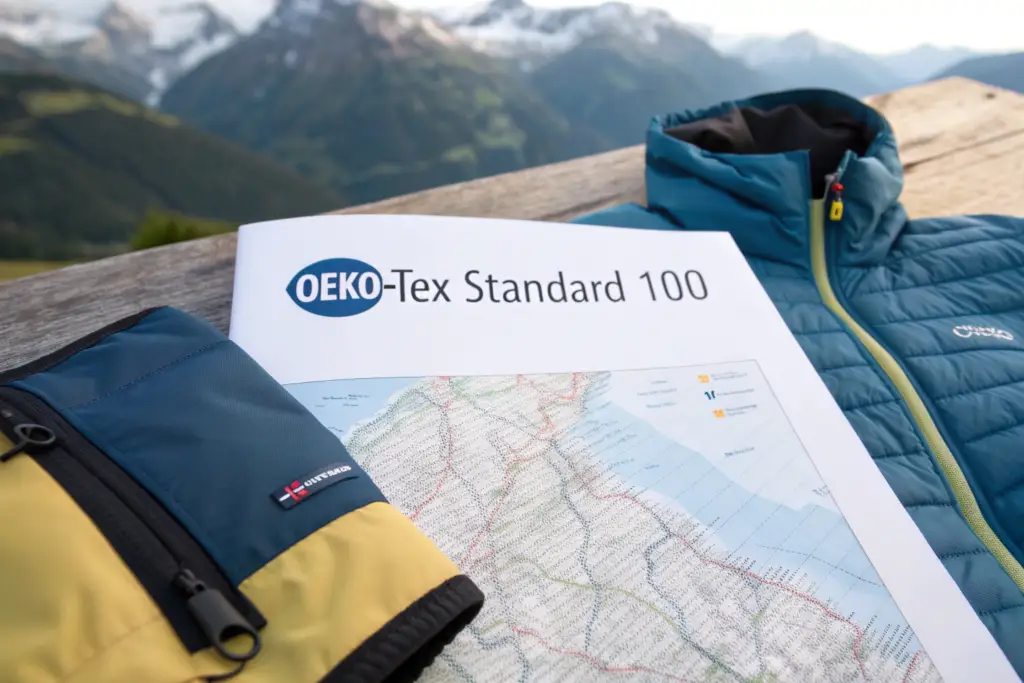
OEKO-TEX® Standard 100 is not a mandatory legal requirement for exporting skiwear to Europe in the same way that CE marking is for certain product categories. However, it serves as the most comprehensive and efficient compliance tool for meeting the EU's stringent, legally mandatory chemical regulations, such as REACH. Therefore, while not legally compulsory, it is de facto essential for any brand seeking reliable, risk-free market entry. Think of it this way: no law requires you to use a GPS on a mountain trek, but doing so is the most reliable way to ensure you don't violate any protected area boundaries and reach your destination safely. Skipping certification means assuming the immense burden and risk of proving compliance yourself.
We worked with a Californian outdoor brand in 2023 that initially believed they could self-declare compliance with EU laws. They provided fabric specifications from their mill but had no third-party verification. Just before shipment, upon our strong recommendation, they agreed to a pre-shipment audit. The lab found levels of NPE (nonylphenol ethoxylates)—a restricted substance under REACH—in the water-repellent finish. The discovery forced a last-minute, expensive fabric wash treatment, delaying the shipment by a critical three weeks. Had they used OEKO-TEX® certified fabrics from the start, this costly delay and risk would have been eliminated entirely. This is the practical reality of "mandatory."
What Are the Actual Legal Requirements for Skiwear in the EU?
To understand where OEKO-TEX® fits, you must first grasp the legal landscape it helps you navigate. The European Union enforces some of the world's strictest consumer protection laws, and ignorance is never a valid defense for non-compliance.
The actual legal requirements for selling skiwear in the EU are primarily governed by the REACH regulation (Registration, Evaluation, Authorisation and Restriction of Chemicals), the General Product Safety Directive (GPSD), and specific restrictions on hazardous substances in textiles. These are not voluntary guidelines but enforceable law. REACH Annex XVII, for instance, contains over 70 entries restricting specific chemicals in consumer articles. For skiwear, common restricted substances include:
- Certain azo dyes that cleave into carcinogenic amines.
- Dimethylformamide (DMF) in synthetic materials like polyurethane coatings.
- Nickel in metal trims like zippers and snaps if its release rate is too high.
- Phthalates in plastic components (e.g., prints, PVC).
The legal obligation lies with the "importer"—the EU-based company bringing your goods into the bloc—to ensure your products comply. As the manufacturer, you will be required to provide a Technical File and a Declaration of Conformity. Failure to comply can result in the product being withdrawn from the market, recalled, or destroyed, with significant financial penalties for the importer, who will in turn hold you liable.

How Does REACH Regulation Directly Impact Skiwear Manufacturing?
REACH is the cornerstone of EU chemical policy, and its impact on manufacturing is direct and profound. It shifts the responsibility for chemical safety from public authorities to industry.
Under REACH, substances of very high concern (SVHCs) must be communicated through the supply chain if they are present above 0.1% weight by weight in an article. For many restricted substances, the limit is total ban for certain uses. This means your fabric mill, dye house, and trim suppliers must provide you with accurate information. In practice, without a system like OEKO-TEX®, obtaining this data is a monumental task. Each supplier must provide a detailed SDS (Safety Data Sheet) and disclosure statement for every component. For a single ski jacket with 15 different materials and trims, the paperwork becomes a full-time job to manage and verify. OEKO-TEX® Standard 100 simplifies this: its certification inherently confirms that the product does not contain REACH-restricted substances above the allowed limits, serving as a bundled compliance passport.
What is the Role of the EU Declaration of Conformity?
This document is your product's legal ticket into the EU market. It is a legally binding statement that you, as the manufacturer, take full responsibility for your product's compliance with all applicable EU laws.
Crafting a valid Declaration of Conformity requires you to:
- Identify all relevant EU legislation (e.g., REACH, GPSD).
- Have objective evidence of compliance (i.e., test reports from an accredited lab).
- Sign the declaration with your company details.
The critical element is point #2: the evidence. Sending a shipment with a self-signed declaration based on supplier promises is extremely high-risk. Accredited test reports are the only robust evidence. OEKO-TEX® Standard 100 certification, conducted by independent institutes, provides this evidence in a widely recognized and accepted format. It turns a complex, multi-lawyer task into a streamlined process.
How Does OEKO-TEX® Certification De-Risk EU Market Entry?
Given the legal complexity, OEKO-TEX® certification operates as the ultimate risk mitigation strategy. It transforms abstract legal requirements into a concrete, manageable, and trusted quality assurance process.
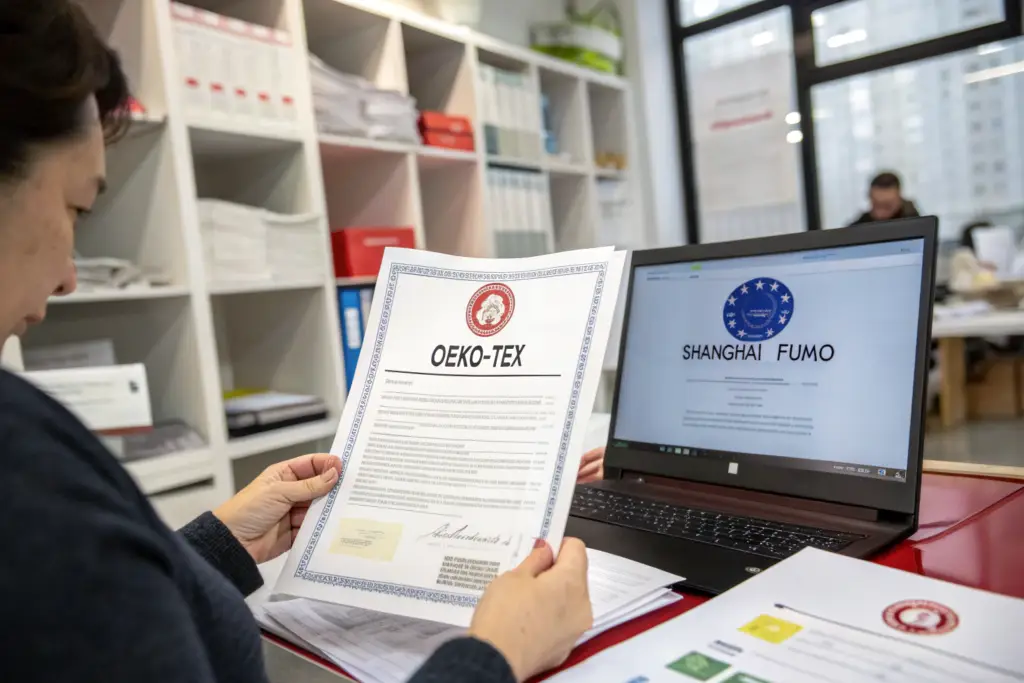
OEKO-TEX® certification de-risks EU market entry by providing pre-verified compliance evidence, streamlining due diligence for EU importers (making your product more attractive to them), and significantly reducing the probability of costly border rejections or post-market surveillance failures. For an EU importer, sourcing from an OEKO-TEX® certified manufacturer like Shanghai Fumao dramatically lowers their compliance burden and liability. They can trust the label, which is more recognizable and trusted across Europe than individual lab reports. This gives your brand a competitive edge in partnership negotiations. Furthermore, EU customs authorities are familiar with the standard. While certification doesn't guarantee no checks, it greatly reduces the likelihood of your shipment being flagged for exhaustive and expensive laboratory testing.
Can Certification Prevent Customs Delays and Associated Costs?
Absolutely. Customs delays are a major hidden cost and a primary pain point for brands.
When a shipment arrives in the EU, customs officials perform risk assessments. Products without clear, recognizable proof of compliance (like generic, non-accredited test reports) are deemed higher risk. They may be held for documentary checks or even physical laboratory testing, which can take weeks and cost thousands in demurrage fees. An OEKO-TEX® certificate and label provide a universally understood signal of due diligence. It tells customs, "This product's chemical safety has been rigorously verified by an accredited third party." This dramatically speeds up clearance. One of our clients, after switching to fully OEKO-TEX® certified production with us, reported their average clearance time at the Port of Rotterdam dropped from 8-10 days of uncertainty to consistent 2-3 day release.
How Does It Protect Against Post-Market Surveillance and RAPEX?
The EU's RAPEX (Rapid Alert System) is a public database for dangerous non-food products. Having your product listed here is a reputational catastrophe.
National authorities in EU countries conduct random market surveillance, testing products already on shelves. If they find a violation—for example, excessive levels of a restricted phthalate in a ski glove's printed logo—they order a recall and list the product on RAPEX. The financial and brand damage is immense. OEKO-TEX® certification is your best defense against this. The standard's testing criteria are aligned with, and often stricter than, EU regulations. By certifying your products, you are proactively passing the test before it can be failed on the public stage. It's a strategic quality control investment that protects your brand's European reputation.
What Are the Consequences of Exporting Without OEKO-TEX® or Equivalent Proof?
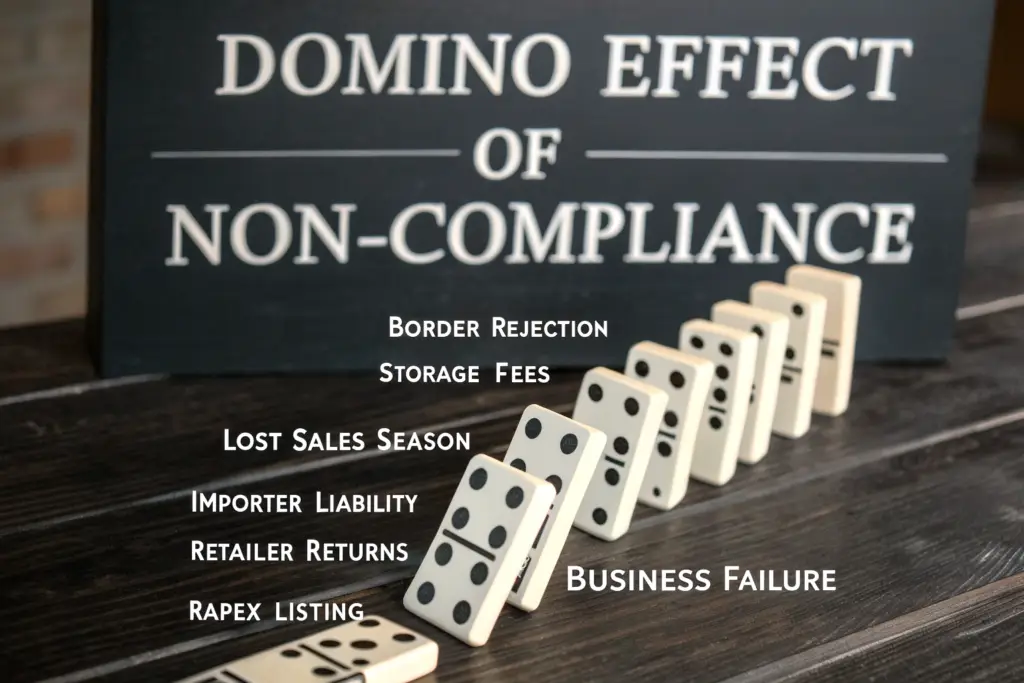
Choosing to export to the EU without third-party certification like OEKO-TEX® is a high-risk strategy that places the entire burden of proof on you and your EU importer. The consequences are severe, layered, and often fatal for business relationships.
The consequences range from immediate logistical and financial penalties (seizure, destruction, fines) to long-term commercial damage (loss of importer partnership, exclusion from retailers, irreparable brand harm). Without recognized certification, you are essentially asking your EU partner to stake their business on your unverified word—a proposition fewer and fewer responsible European companies will accept. The assumption of risk is enormous, and the cost of failure is passed directly back to you as the manufacturer.
What Happens During a Customs Rejection Scenario?
The process is bureaucratic, costly, and time-sensitive. Here is a typical sequence:
- Notification: The importer is notified the shipment is on hold.
- Request for Evidence: Authorities request proof of compliance (test reports).
- Testing (if evidence is insufficient): Authorities send samples to a lab. This takes 4-6 weeks.
- Outcome – Fail: If the test fails, the goods are typically ordered to be destroyed or re-exported at your expense. The importer faces fines.
- Outcome – Pass: Even if they pass, you have lost weeks of selling season and paid substantial storage fees.
The table below summarizes the cost centers:
| Cost Category | Typical Financial Impact | Who Bears the Cost? |
|---|---|---|
| Demurrage & Storage Fees | €50 - €200+ per container, per day | Importer / Manufacturer |
| Laboratory Testing Fees | €1,000 - €5,000+ per sample | Manufacturer |
| Destruction/Re-export Costs | €2,000 - €10,000+ | Manufacturer |
| Lost Sales & Seasonality | 100% of order value + future orders | Brand / Importer |
| Administrative & Legal | Significant staff time & potential fines | Importer / Manufacturer |
How Does It Damage Your Relationship with EU Importers and Retailers?
The business relationship damage is perhaps the most lasting consequence.
An EU importer's business is built on reliable supply. A delayed or rejected shipment causes them to miss their delivery windows to retailers, incur penalties, and lose credibility. Even one such incident can destroy a partnership built over years. Major EU retailers increasingly mandate certifications like OEKO-TEX® from their suppliers as a condition of doing business. Without it, you are automatically excluded from these channels. In essence, lacking certification doesn't just add risk; it actively closes doors to key partnerships and distribution networks in Europe.
Is OEKO-TEX® the Only Way to Prove Compliance? What Are the Alternatives?
While OEKO-TEX® Standard 100 is the most globally recognized and efficient path, it is not the only theoretical way to prove compliance. However, the alternatives are often more complex, costly, and less trusted.
Legally, you can achieve compliance without OEKO-TEX® by conducting your own comprehensive testing against the full REACH Annex XVII list (and other regulations) at an accredited laboratory for every material batch and component, then compiling the technical file. This is a valid approach, but it is administratively burdensome, often more expensive in the long run, and lacks the universal brand recognition of the OEKO-TEX® label, which itself is a marketing asset.
What Does a DIY Compliance Testing Regime Entail?
A self-managed regime is a massive undertaking:
- Batch-Level Testing: Every new lot of fabric, thread, zipper, insulation, etc., must be tested. You cannot test once and assume future batches are the same.
- Full Substance Screening: You must test for the entire relevant list of restricted substances, not just a few.
- Documentation Management: You must securely store and manage all test reports, supplier declarations, and correspondence for at least 10 years (as required by the GPSD).
- Supplier Management: You must continuously audit your suppliers to ensure their processes haven't changed, introducing new risks.
For most brands, especially those without a dedicated regulatory team, this DIY approach is impractical and prone to error. It distracts from core business activities. The strength of OEKO-TEX® is that it outsources this entire complex process to a specialized, trusted system.
Are There Other Certifications That EU Authorities Accept?
Yes, but they serve different or narrower purposes. Key comparisons:
- bluesign®: A very respected system focused on sustainable textile production from input stream management. It includes chemical safety but is broader and often implemented at the fabric mill level. It is excellent but can be more resource-intensive to implement across a full supply chain.
- GOTS (Global Organic Textile Standard): Primarily for organic fibers. It includes environmental and social criteria and has chemical restrictions, but its scope is limited to organic content products.
- Specific Brand or Retailer Standards: Large retailers may have their own RSLs (Restricted Substances Lists) which you must test against.
For the specific goal of proving chemical safety compliance for all textile products to EU authorities, OEKO-TEX® Standard 100 remains the most targeted, widely available, and directly applicable tool. At Shanghai Fumao, we find it provides the optimal balance of comprehensiveness, recognition, and cost-effectiveness for our clients targeting the European market.
Conclusion
So, is OEKO-TEX® Standard 100 mandatory for exporting skiwear to Europe? In a strict legal sense, no—the mandatory elements are the underlying EU regulations like REACH. However, in any practical, commercial, and risk-aware sense, the answer is a resounding yes. It is the mandatory tool for proving compliance efficiently, reliably, and credibly. Treating it as anything less than essential is to gamble with your shipment's clearance, your importer's trust, and your brand's European future.
The European market rewards responsibility and punishes negligence. By partnering with an OEKO-TEX® certified manufacturer, you are not just buying a product; you are purchasing peace of mind, market access, and a powerful brand story. You are choosing the clearly marked, safe trail over the treacherous, unverified shortcut.
If your goal is seamless, reliable access to the European ski market, let’s build your certified collection. At Shanghai Fumao, we integrate OEKO-TEX® compliance into every stage of our full-package manufacturing process, from fabric sourcing to finished garment. Contact our Business Director Elaine to discuss how we can ensure your skiwear meets and exceeds European expectations: elaine@fumaoclothing.com.