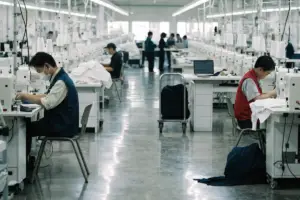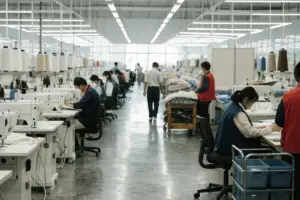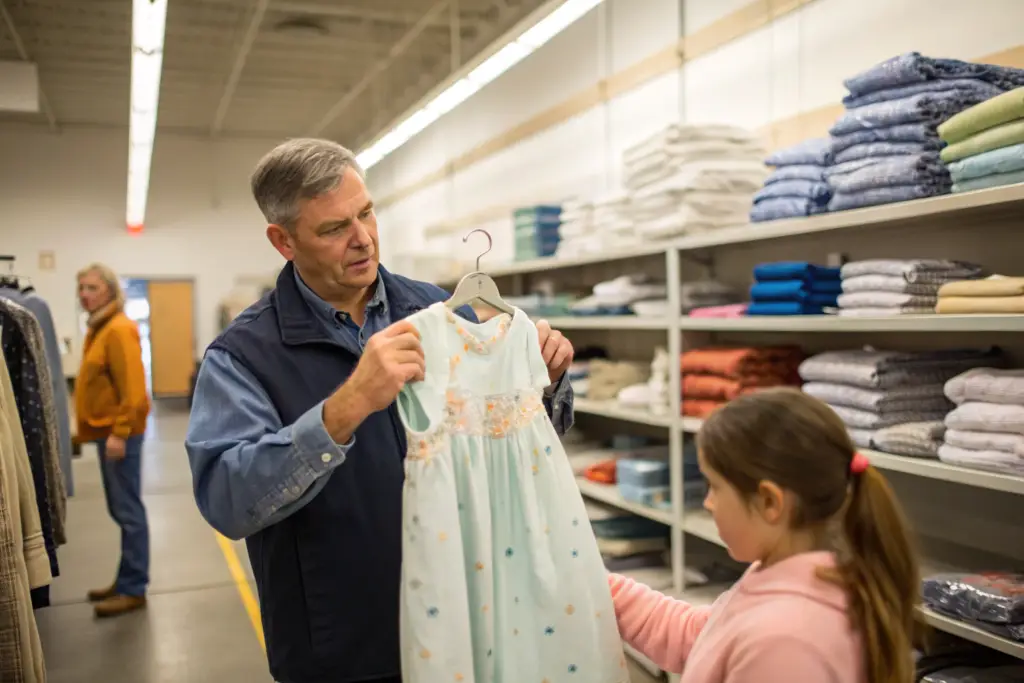
A children’s wear wholesale distributor from Seattle once told me about the single metric that defined his business. He said, "I do not judge a kids’ garment by how it looks on the hanger. I judge it by how many times a parent can wash it before it looks tired. My boutique accounts call me the moment they get a return because a dress pilled after three washes, or a pair of leggings lost its shape. One bad quality batch, one fabric that fails the laundry test, and I lose a boutique relationship I spent years building. My entire business is built on fabric that survives children." He was not exaggerating. In the wholesale channel, durability is not a feature. It is the distributor’s reputation, delivered in fabric form.
Yes, Shanghai Fumao’s fabrics are specifically engineered for the extreme durability demands of kids’ wear wholesale. We use long-staple, compact ring-spun cotton yarns for inherent pilling resistance and tensile strength, reinforced stress-point construction with hidden bartacks and flatlock seams, and all fabrics are subjected to a rigorous battery of in-house durability tests, including aggressive multi-wash shrinkage, Martindale abrasion for pilling, and tensile strength testing, before being released for cutting. We do not use standard adult-weight commodity fabrics repurposed for children’s clothing. Every fabric we select for a kids’ wear order is chosen and tested for its ability to survive the playground, the washing machine, and the hand-me-down cycle.
Kids’ wear durability is a specific engineering challenge, distinct from adult apparel durability. A child’s garment experiences higher mechanical stress from active play, more frequent and more aggressive washing with stronger detergents and higher temperatures, and a longer expected functional lifecycle, as it is often passed down to siblings. A fabric that is acceptably durable for an adult t-shirt worn occasionally and washed gently will fail catastrophically in a children’s wear context. Our fabric selection, construction techniques, and testing protocols are all oriented around these specific demands. I want to walk you through what makes a fabric genuinely durable for wholesale kids’ wear, and how we ensure that standard is met on every order.
What Fabric Qualities Are Essential for Kids’ Wear Durability?
A children’s wear designer from London once showed me two seemingly identical white cotton t-shirts. One was from a high-street chain, priced at £8. The other was from a premium Scandinavian kids’ brand, priced at £28. She had washed both shirts exactly 20 times in a home washing machine, using the same detergent and the same cycle. The high-street shirt was a disaster. The surface was covered in tiny fuzzy pills. The seams were twisted. The neckline was wavy and stretched out. The color had faded to a dull, uneven grey. The Scandinavian shirt looked almost new. The surface was smooth. The seams were straight. The color was still a crisp, clean white. She said, “My customer might not understand yarn counts or stitch densities, but she can see this. The £28 shirt will be worn by two children and still look good. The £8 shirt will be a cleaning rag in three months. That is durability.”
Durability in kids’ wear is determined by a combination of three fundamental factors: the quality and length of the raw cotton fiber, the spinning method used to create the yarn, and the knit or weave construction. These are not visible on a spec sheet, but they determine the garment’s entire lifecycle performance.
Why Is Compact Ring-Spun Cotton Superior for Kids’ Wear?
Cotton yarn is created through a spinning process that twists individual cotton fibers together. The quality of this process directly determines the fabric’s resistance to pilling, its tensile strength, and its surface smoothness.
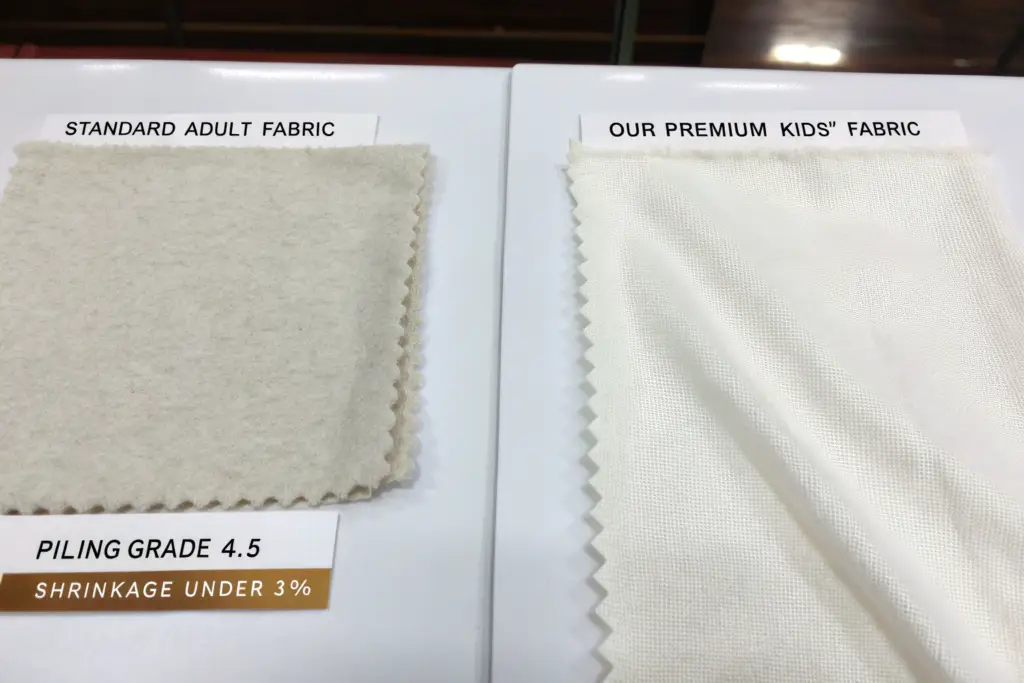
There are three main spinning methods, representing a hierarchy of quality. Carded open-end spinning is the cheapest and lowest quality. The fibers are roughly aligned, and short fibers and impurities are not fully removed. The resulting yarn is uneven, hairy, and weak. Fabrics made from this yarn pill quickly, lose shape, and have a rough hand-feel. Combed ring-spun is a significant step up. The cotton is combed to remove short fibers, and the yarn is twisted more tightly and evenly. The fabric is smoother, stronger, and more resistant to pilling. Compact ring-spun is the premium tier for knit fabrics. This process uses a pneumatic condensing system to completely eliminate the spinning triangle, binding all fibers tightly into the yarn. The resulting yarn has virtually zero surface hairiness, exceptional strength, and a very clean, smooth surface. This is the yarn we specify for our premium kids’ wear fabrics. A compact ring-spun cotton jersey will resist pilling far longer, maintain its surface integrity after dozens of washes, and have significantly higher tensile and burst strength than a carded open-end fabric. The cotton spinning methods and fabric quality explain the technical differences. The difference in a child’s garment is that it survives the playground and the washing machine without looking worn out.
How Does Fabric Weight (GSM) Impact Longevity and Hand-Feel?
Fabric weight, measured in grams per square meter (GSM), is a primary indicator of durability. For children’s playwear, leggings, dresses, and tops, we recommend fabrics in the 200gsm to 260gsm range for a balance of durability and comfort.
A lightweight 120gsm to 140gsm single jersey, commonly used for cheap adult fashion t-shirts, is completely inadequate for children’s wear. It will be semi-transparent, it will tear easily at the seams under the stress of active play, and it will lose its shape after a few washes. A 220gsm to 260gsm interlock or heavy single jersey provides a substantial, protective feel without being heavy or restrictive. The increased weight means more fiber per square meter, which translates directly into higher tensile strength, better opacity, and a longer functional life. The fabric also drapes better and feels more premium, which is important for the parent’s initial purchase decision. For bottoms and outerwear, we use fabrics in the 280gsm to 320gsm range, such as our brushed-back French terry. This weight provides excellent abrasion resistance for knee and seat areas, warmth without bulk, and a robust, long-lasting garment. The fabric weight guide for apparel helps define the correct specification for the intended end-use.
How Do We Reinforce Construction for Active Children?
The Seattle distributor told me another story about a specific garment failure that cost him a boutique account. A batch of kids’ leggings from a previous supplier had a beautiful fabric, but the seams kept blowing out at the knee and the seat. The fabric was strong enough, but the construction was weak. The seam allowance was too narrow. The stitch type was a basic lockstitch that had no stretch. When an active child squatted, climbed, or crawled, the seam simply snapped. The boutique had a dozen returns in a single month. They dropped his entire line.
Fabric durability is only half the equation. The construction methods, the seam types, the seam allowances, and the reinforcement at high-stress points, are what translate fabric strength into garment longevity. A durable fabric sewn with weak construction will still fail.
What Seam Types and Reinforcements Do We Use on Kids’ Garments?
We use seam types and reinforcements specifically selected for the high-stress, high-movement reality of children’s wear. The standard seam for a basic adult t-shirt is not adequate.
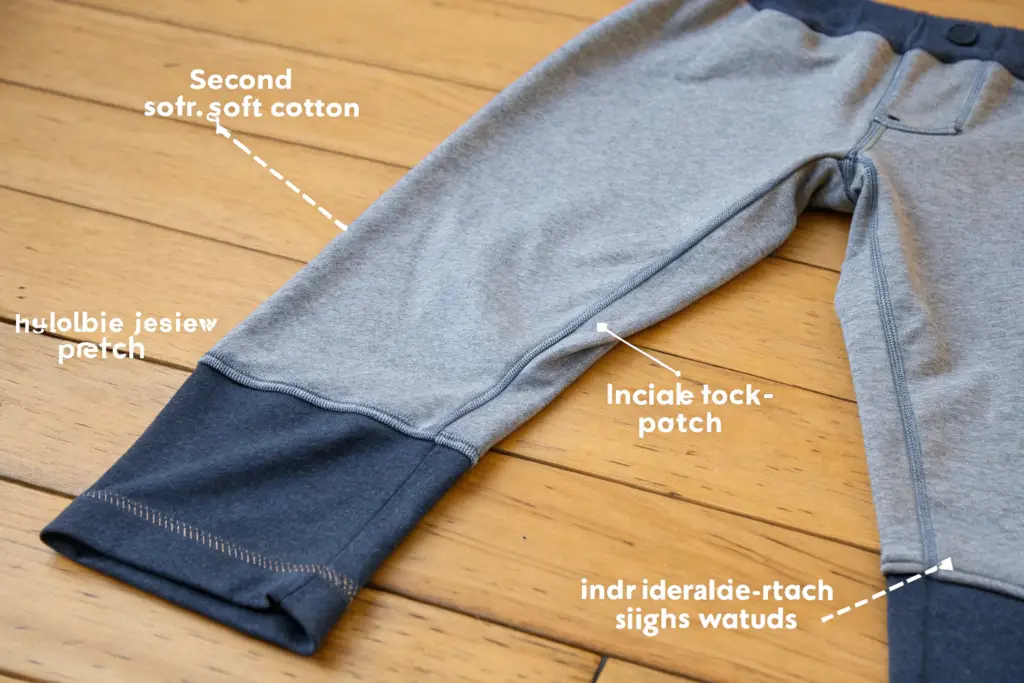
For knit garments, we use a 4-thread overlock safety stitch for main construction seams. This stitch type simultaneously sews the seam, trims the raw edge, and overlocks the edge to prevent fraying. It has inherent stretch and is significantly stronger than a basic lockstitch. For side seams on leggings, activewear, and any garment that will experience repeated stretching, we use flatlock seams. A flatlock seam lays completely flat against the skin, has excellent stretch and recovery, and is visually clean and professional. For high-stress points, knees, elbows, and the seat of trousers and leggings, we add hidden reinforcement panels. A second layer of the same soft body fabric is flatlock-stitched to the inside of the garment at the stress point. This doubles the fabric strength and abrasion resistance at the point of maximum wear, without any visible patch on the outside and without adding stiffness. For woven garments, we use a larger seam allowance of 1cm to 1.2cm, and a denser stitch count of 10 to 12 stitches per inch for increased seam strength. These seam construction types for durable garments are standard in performance wear, and we apply them to kids’ wear because the demands are identical.
How Do We Test Seam Strength and Overall Garment Durability?
Seam strength is not assumed. It is measured. We use a tensile strength tester in our in-house lab to objectively measure the force required to break a seam.
Samples of the specific seam construction, using the actual bulk fabric and the actual stitch type, are prepared. The sample is clamped into the tensile tester, and a steadily increasing force is applied until the seam breaks. The result is recorded. For kids’ wear, we apply a minimum seam strength standard that exceeds the general industry requirement, reflecting the higher expected stress. We also perform a complete garment wash test. A finished, pre-production sample of the garment is subjected to 10 aggressive home laundry cycles, with hot water washing and high-heat tumble drying. After the 10 cycles, the garment is inspected for seam integrity, any broken stitches, any seam slippage, any fabric distortion, and any significant color loss or pilling. This test simulates the first few months of a child’s life with the garment. Only a garment that passes this aggressive wash test is approved for bulk production. The seam strength testing standards and garment durability wash testing are part of our standard pre-production quality assurance.
What Testing Proves Our Fabrics Are Safe and Tough Enough?
The Seattle distributor’s final frustration with his previous supplier was the lack of testing documentation. When the seams started blowing out, he asked the supplier for the seam strength test reports. The supplier could not provide them. They had never tested the seams. They had simply assumed the construction was adequate based on past experience with adult garments. The distributor had no recourse. He could not prove the supplier was at fault. He had to absorb the cost of the returns and the lost account himself.
Testing is not a bureaucratic exercise. It is the objective evidence that protects both the brand owner and the manufacturer. It proves that the fabric and construction met the specified standards before the goods were shipped. It is the foundation of a defensible quality position.
What Specific Durability Tests Do We Perform on Kids’ Wear Fabrics?
Every fabric batch intended for a kids’ wear order undergoes a specific battery of durability tests in our in-house laboratory. The tests are performed to AATCC or ISO standards, depending on the destination market.
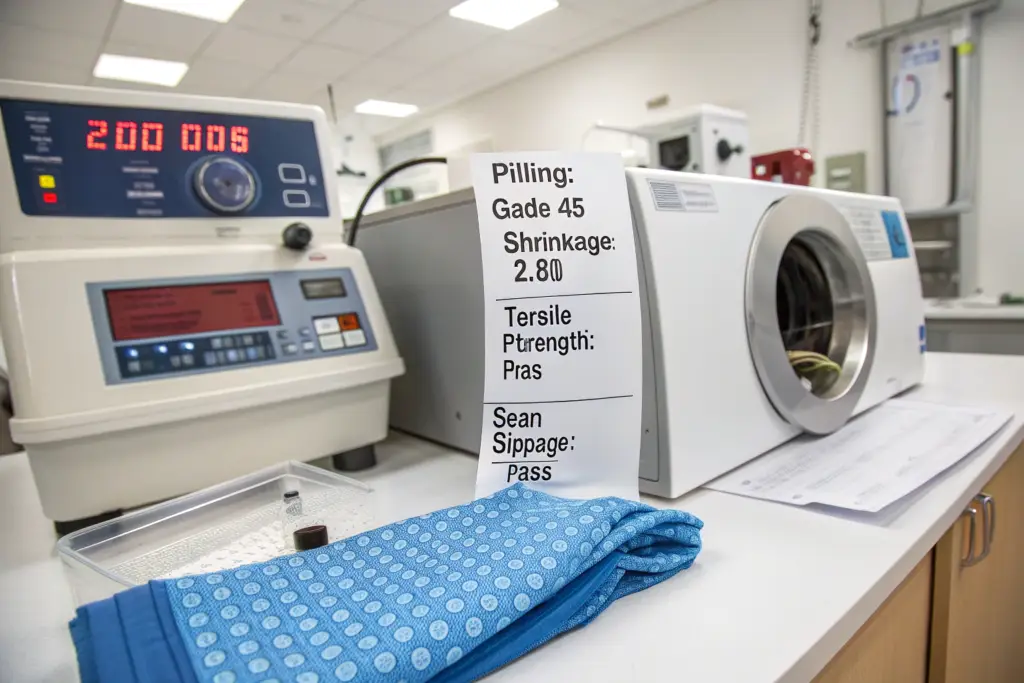
The specific tests include the following: Dimensional stability to washing and drying, using a Wascator machine, with shrinkage measured after 5 aggressive cycles. Our standard for kids’ wear is less than 5% shrinkage for knits. Pilling resistance, using a Martindale abrasion tester, with the fabric surface evaluated after 2,000 rubs against standard grading scales. Our minimum is Grade 4. Tensile and tear strength, using a tensile strength tester, to measure the force required to break or tear the fabric. Color fastness to washing, using a Launder-Ometer, to evaluate color change and staining after repeated aggressive washes. Color fastness to crocking or rubbing, both wet and dry, to ensure the dye does not transfer onto other garments or the child’s skin. Seam slippage, for woven fabrics, to ensure the seam does not open under stress. These tests are performed on the actual fabric roll allocated to your production. A fabric that fails any test is rejected and returned to the mill before a single meter is cut. The AATCC fabric durability testing standards are the objective language of quality.
Do We Provide the Test Reports for Your Wholesale Customers?
Yes. We can provide a comprehensive fabric test report for each production order. This report can be supplied to you as a quality assurance document for your internal records, or it can be formatted for presentation to your wholesale boutique accounts.
This report provides objective, third-party-verifiable, within our factory, but independent of the production line, evidence that the fabric in your garments meets the specified durability and safety standards. For a wholesale distributor, this is a powerful sales tool. It transforms a subjective quality claim, “our fabric is durable,” into an objective, documented fact. You can show your boutique accounts the test report, with the pilling grade, the shrinkage percentage, and the tensile strength results. This builds their confidence in your brand and reduces their perceived risk in stocking your line. We believe that transparency in testing is a competitive advantage for our clients. The fabric test report as a wholesale sales tool adds tangible value to your product presentation.
Conclusion
Durable kids’ wear fabric for the wholesale market is not found. It is engineered, constructed, and tested. At Shanghai Fumao, we engineer durability from the yarn up, using long-staple, compact ring-spun cotton for inherent pilling resistance and tensile strength, and selecting appropriate fabric weights for the demands of active children. We construct for durability, using 4-thread overlock and flatlock seams with appropriate stretch and strength, and reinforcing high-stress points with hidden internal panels. And we test for durability, subjecting every fabric batch to a rigorous battery of AATCC-standard wash, abrasion, and strength tests, and providing the documented test reports as proof of quality. The result is a garment that a parent can wash 50 times, pass down to a younger sibling, and still have it look and feel like a quality product. For a wholesale distributor, this durability is not just a product feature. It is the foundation of their reputation with their retail accounts.
If you are building a kids’ wear wholesale line where durability and quality are non-negotiable, I invite you to test our fabrics against your current supplier’s. Contact our Business Director, Elaine, at elaine@fumaoclothing.com. Request a kids’ wear fabric swatch pack, including our compact ring-spun interlock and our brushed-back French terry, along with a sample durability test report. Wash the swatches yourself. Stretch them. Compare them. Let the physical evidence of our fabric engineering inform your sourcing decision.