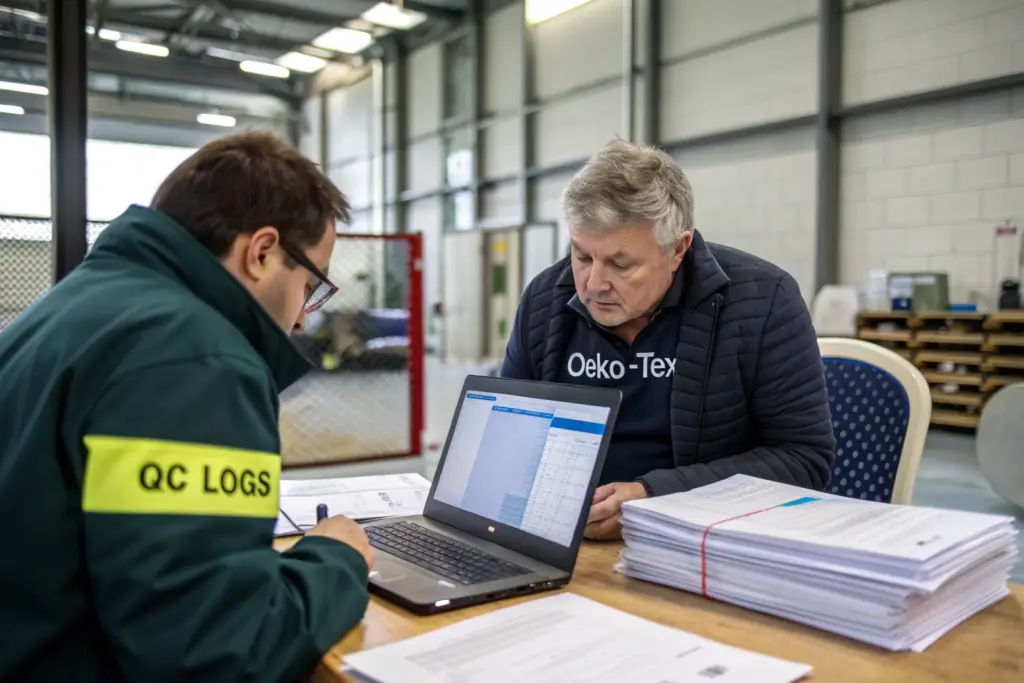
A client once showed me a beautiful OEKO-TEX certificate from their prospective factory. It was valid, the product description matched their golf shorts, and the factory was listed as the holder. Confident, they placed a 5,000-piece order. The first shipment arrived, and their quality team performed a random test. The results showed elevated levels of a restricted phthalate in the elastic waistband. When confronted, the factory manager was shocked. He provided the certificate for the main fabric but had sourced the elastic from a cheaper, uncertified vendor without updating the certification scope. The certificate was real, but the product delivered was not the product certified. This experience taught us that a certificate is the starting line for verification, not the finish line.
To verify a supplier's OEKO-TEX claims beyond the certificate, you must conduct a multi-layered audit that examines the supplier's operational systems, material traceability, and production discipline. The certificate proves a sample passed a test; your audit must prove the system ensures every garment passes. This involves physical checks, document reviews, and process observations that look for evidence of a living compliance culture, not just a framed document.
Trust, but verify with forensic diligence. Here is your actionable verification checklist to separate authentic partners from opportunistic claimants.
What On-Site Physical Evidence Should You Demand to See?
The factory floor tells the truth that paperwork can obscure. A scheduled "showroom tour" is not due diligence. You need an unscripted walk-through focused on the flow of certified materials.
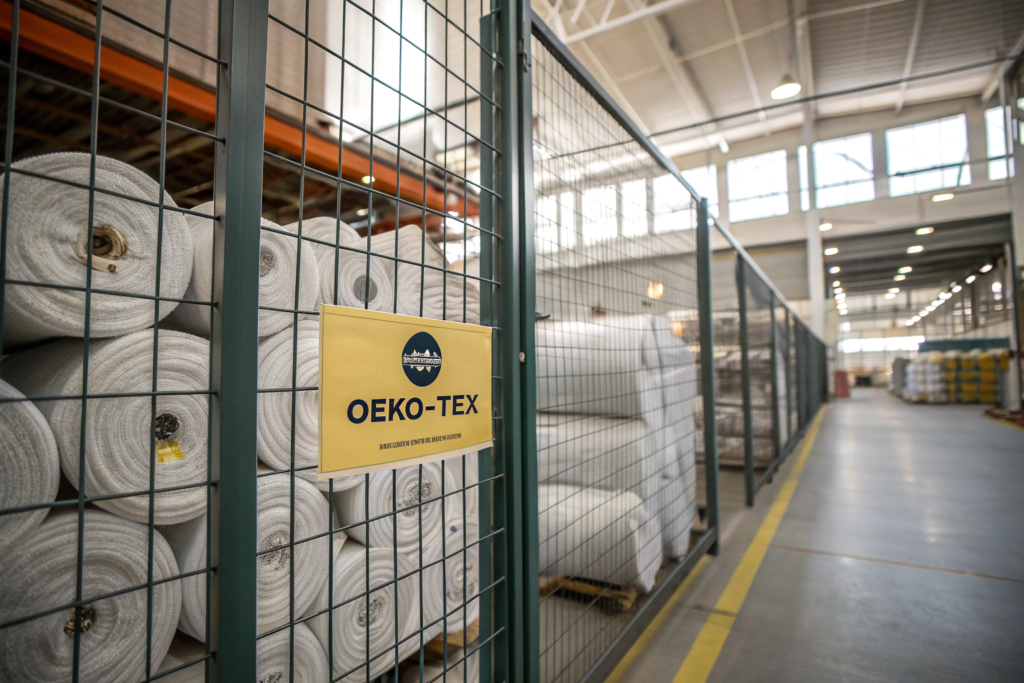
Demand to see physical evidence of segregated material handling. Look for: 1) A locked and labeled storage area for OEKO-TEX certified raw materials (fabric rolls, thread cones, trim boxes) separate from general inventory. 2) Lot-specific identification on all stored materials, matching tags or labels to test reports. 3) Color-coded tools or containers (e.g., green bins) used exclusively for certified production lines. 4) Digital or physical job tickets at work stations that clearly specify the use of certified materials for your order.
What questions should you ask on the production floor?
Ask the line supervisor: "How do you know this batch is using OEKO-TEX certified thread?" The correct answer involves a scanned barcode on the thread cone, a matching entry on a digital screen, or a specific issued lot from the locked storage. A vague answer like "We always use certified thread" is a red flag. Ask to see the material issuance log for the day.
Can you perform a simple spot-check?
Yes. Randomly select a fabric roll from the "certified" area. Ask to see the mill's test report or Certificate of Conformity (CoC) that accompanies that specific lot number. Then, cross-reference that lot number with the factory's internal material receiving record. This verifies a chain of custody from the mill to the factory floor.
How to Audit the Supplier's Documentation and Traceability System?
Paperwork is the skeleton of a compliance system. You need to see if it has muscle—if documents are living, connected, and used to drive decisions.
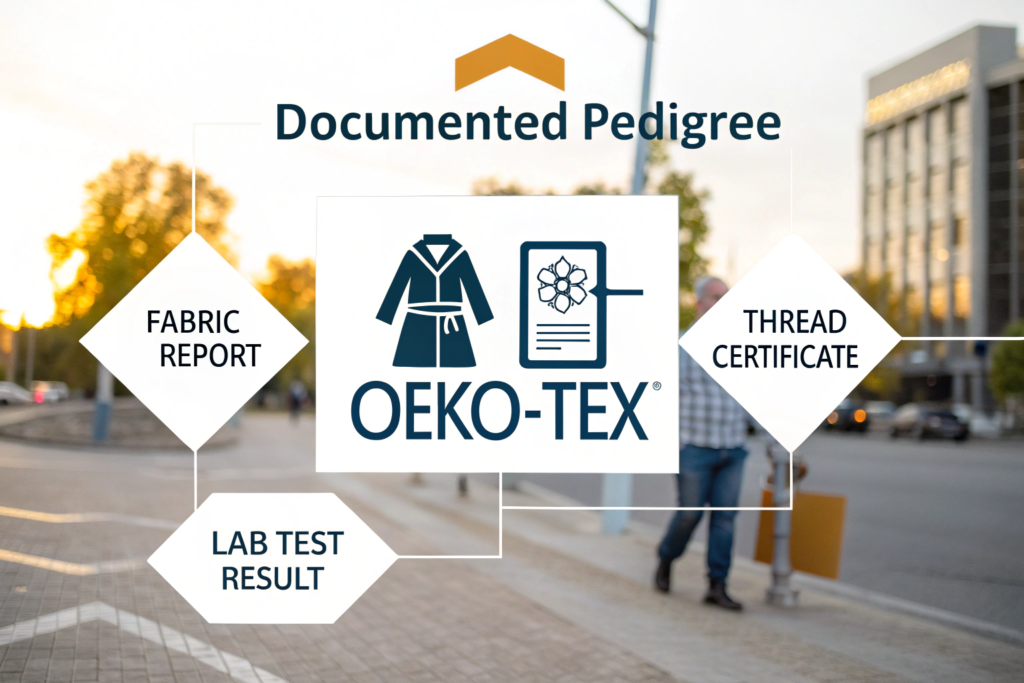
Audit the documentation system by requesting a complete dossier for a recently completed certified order. This should include: 1) The OEKO-TEX certificate. 2) Test reports for every component (fabric, dye, thread, zipper, elastic, etc.). 3) Material Safety Data Sheets (MSDS) for any chemicals used in processing. 4) Incoming quality control (IQC) records showing the materials were checked upon arrival. 5) Production batch records linking specific material lots to finished garment lots.
How do you verify the test reports are valid and current?
Check the dates on all component test reports. They should be recent (within 1-2 years) and should predate the production of the order you are auditing. A test report from 2018 for a fabric produced in 2024 is worthless. Also, verify that the testing laboratory is accredited (e.g., ISO/IEC 17025) and that the report clearly states compliance with OEKO-TEX STANDARD 100 for the correct product class.
What is a "closed-loop" traceability request?
Ask the supplier: "For this specific finished garment serial number (or production lot #), can you show me all the documentation for every component that went into it?" A sophisticated supplier with a digital ERP/MES system should be able to pull this up in minutes. A supplier relying on manual records will struggle, indicating a high risk of commingling or substitution.
How to Assess the Supplier's Internal Compliance Culture and Training?
Certification is meaningless if the people on the floor don't understand or care about it. Culture eats strategy for breakfast, and it eats compliance manuals for lunch.
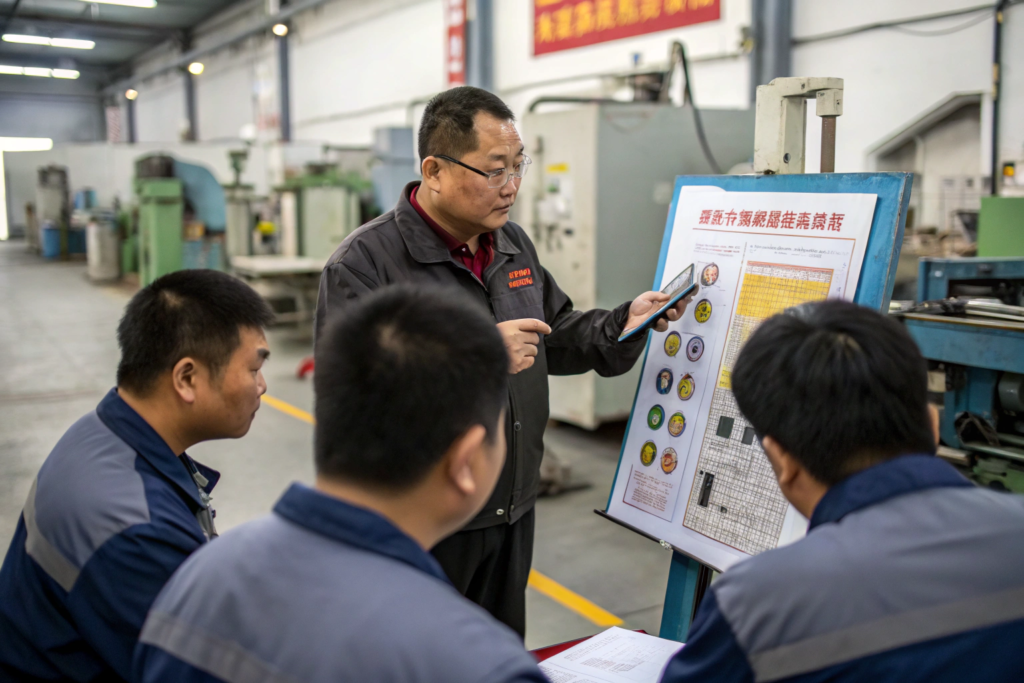
Assess the compliance culture by interviewing staff at different levels. Ask the quality control manager about their procedure if a non-certified material is found on a certified production line. Ask a line worker what the OEKO-TEX label means and what they do if they run out of certified thread. Observe if compliance checkpoints (like pre-line clearance checklists) are visibly posted and being used, or if they are just plastic-covered posters gathering dust.
What are the signs of a robust compliance culture?
Look for empowerment where workers feel comfortable stopping the line for a suspected issue, visibility of safety messages in the local language, accountability with compliance KPIs in job descriptions, and evidence of continuous improvement in their OEKO-TEX processes over the last year.
What questions reveal a weak culture?
Ask: "What was the last OEKO-TEX-related non-conformance you had, and what corrective action did you take?" A supplier with a strong culture will have a documented case, a root cause analysis, and evidence of a fix. A weak supplier will say, "We never have problems," which is statistically improbable and indicates a lack of transparency.
What Role Does Third-Party Verification and Your Own Testing Play?
Even the most thorough audit has limits. The final layer of verification involves independent, objective evidence.
Third-party verification and your own testing provide an unbiased reality check. This includes: 1) Random Pre-Shipment Testing: Send randomly selected finished samples from the production batch to an accredited lab like SGS, Bureau Veritas, or Intertek for a specific substance test. 2) Unannounced Audit Rights: Include the right for you or a third-party auditor to conduct unannounced inspections in your contract. 3) Retailer-Approved Lab Reports: If you are selling to a major retailer, use their required lab for testing; this serves a dual purpose.

How to design an effective random testing protocol?
Don't just test one sample. For a batch of 5,000 pieces, pull 3-5 units at random from packed cartons. Send them to the lab with clear instructions to test for compliance with OEKO-TEX STANDARD 100, with a focus on key restricted substances. The cost is a few hundred dollars—a tiny insurance premium against a six-figure recall.
Can you rely on the supplier's in-house lab?
A supplier's in-house lab is useful for process control but should never be the final arbiter of compliance. It lacks independence. Their test results can be used for trend analysis, but your final release should be based on a third-party report or the validated OEKO-TEX certificate from an accredited institute.
Conclusion
Verifying OEKO-TEX claims beyond the certificate is a discipline, not an event. It requires moving from passive acceptance of documents to active investigation of systems, from trusting a label to trusting a process. The most reliable suppliers won't see this as an intrusion; they will welcome it as a demonstration of their own rigor and a chance to build deeper partnership trust.
For brands, this level of verification is not extra work—it is the core work of responsible sourcing. It transforms you from a customer into a quality assurance partner in your own supply chain.
At Shanghai Fumao, we have built our operations to not only pass but to excel at this level of scrutiny. Our systems are designed for transparency, and we encourage our partners to audit, test, and verify. Because we know that real trust is built on proof, not promises. If you are ready to partner with a manufacturer that welcomes forensic verification, contact our Business Director, Elaine, at elaine@fumaoclothing.com. Let's build a relationship where every claim is backed by visible, verifiable evidence.