You're sourcing garments and need a factory you can trust—not just with quality and price, but with verifiable, credible safety standards. You've heard of OEKO-TEX®, but typing it into Google brings a flood of results: certification bodies, informational blogs, and suppliers with vague claims. How do you cut through the noise and actually find a reliable, audit-ready manufacturing partner? The key is moving beyond a simple keyword search to a strategic, layered investigation using OEKO-TEX® as your primary filter for competence and transparency. As a manufacturer with a deeply integrated OEKO-TEX® system, Shanghai Fumao understands what separates authentic partners from those merely using the term for SEO.
Using OEKO-TEX® effectively in your search isn't about finding any factory that mentions it; it's about identifying factories where the certification is a core operational truth, not just a marketing bullet point. This guide will show you how to structure your Google searches, interpret the results, and ask the right questions to separate truly reliable suppliers from the pretenders. This method saves you time, reduces sourcing risk, and leads you to partners capable of delivering the compliant, high-quality production you need.
What are the advanced Google search operators for OEKO-TEX?
Typing "OEKO-TEX clothing manufacturer" is your starting point, but it's too broad. You must use advanced search operators to narrow and deepen your investigation. These operators force Google to show you more specific, often more credible, information.
Use these combinations in the Google search bar:
"OEKO-TEX STANDARD 100" "full package" China– The quotation marks force an exact phrase match, filtering out vague mentions. "Full package" indicates a higher level of service integration.site:alibaba.com "OEKO-TEX" "factory audit"– This searches within a specific site (like Alibaba) for suppliers who likely have more robust profiles by mentioning both certification and factory audits."OEKO-TEX" "childrenswear manufacturer" -blog -article– The minus sign (-) excludes common but less actionable result types like blogs and generic articles, pushing factories and B2B sites higher."OEKO-TEX certificate" filetype:pdf– This can uncover technical documents, supplier whitepapers, or actual certificate samples that factories have posted, indicating a willingness to be transparent.
These searches move you past marketing fluff and towards suppliers who incorporate the language of compliance into their core business description. When you see a factory like Shanghai Fumao consistently using precise terminology across its website—"OEKO-TEX® Class 1 production," "certified material tracking," "internal compliance audit"—you know you're looking at a specialized operator.
How to analyze supplier websites for genuine OEKO-TEX integration?
Once search results lead you to a supplier's website, your detective work begins. A reliable supplier's website will demonstrate an integrated understanding of the certification, not just display a logo. Look for these signs of depth:
- Specificity Over Generality: Avoid sites that only say "we are OEKO-TEX certified." Look for details: "Our production lines for infant wear are OEKO-TEX® STANDARD 100 Class 1 certified," or "We maintain a library of OEKO-TEX® certified fabrics." This shows application.
- Evidence of Process: Reliable suppliers explain how they ensure compliance. Do they mention "incoming material checks," "dedicated production lines for certified goods," or "batch traceability"? For example, on the Shanghai Fumao site, we detail our quality control protocols that are built around maintaining certification integrity.
- Transparency in Communication: Look for contact information for a compliance or technical manager, not just a generic sales email. The presence of case studies or blog posts explaining their approach to sustainable or safe manufacturing is a strong positive signal.
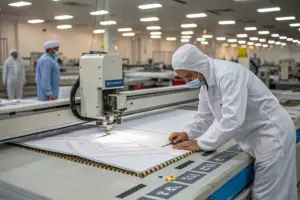
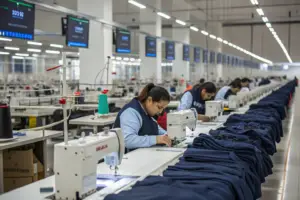
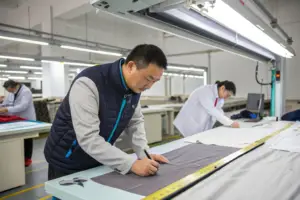
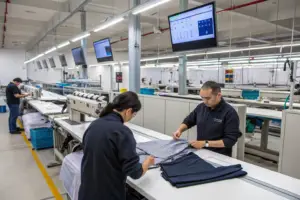
- Visual Proof: Do they show photos or videos of their facility that align with a compliant operation? Look for organized warehouses, clean production floors, and lab equipment—not just rows of sewing machines.
What are the red flags on a supplier's website?
- Blurry or Unverifiable Certificate Images: A tiny, pixelated image of a certificate you can't read.
- Vague Claims: "All our fabrics are safe and OEKO-TEX certified." This is impossible to prove and shows a lack of understanding.
- No Mention of Class Differentiation: If they produce kids' wear but never specify "Class 1," they may be using a generic factory certificate (Class 2 or 3) incorrectly.
- Over-Promising on Everything: A site claiming to be experts in every certification (OEKO-TEX, GOTS, BCI, Fair Trade) for every product type may lack depth in any single one.
What verification questions should you ask via email/contact?
Your initial email is a critical test. Go beyond "Are you OEKO-TEX certified?" Ask specific, operational questions that a reliable supplier will be able to answer clearly and promptly. This filters out sales reps who lack technical knowledge.
First-Tier Questions:
- "Can you provide the OEKO-TEX® license number and the name of the certified entity (is it the factory or a trading company)?"
- "For a children's apparel order, which product class would apply (Class 1, 2, or 3), and can you produce to that specific class?"
- "Do you source pre-certified fabrics, or do you certify the final garment? Can you provide a sample compliance dossier for a previous order?"
Second-Tier (Depth) Questions:
- "How do you prevent cross-contamination between certified and non-certified production runs?"
- "What is your process for verifying the certificates of your trim and accessory suppliers?"
- "Can you facilitate a virtual audit of your facility and compliance documentation?"
A supplier like Shanghai Fumao welcomes these questions. We have standard responses and documentation packs ready because our system is built to be audited. Hesitation, vague answers, or a long delay in providing a certificate copy are major red flags.
How to use the OEKO-TEX® buyer's guide?
Once a supplier gives you a license number, use the official OEKO-TEX® Buyer's Guide. Enter the number. Verify:
- The certified company name matches the factory you're speaking to.
- The certification is valid (not expired).
- The product scope includes the items you want to produce (e.g., "garments for babies").
This 2-minute check can expose if a trading company is using a factory's certificate misleadingly or if the certification has lapsed.
How to cross-reference findings with other platforms?
Don't rely solely on a supplier's own website. Use Google to cross-reference their name and reputation across multiple platforms, using OEKO-TEX as a connective thread.
- Search:
"Factory Name" OEKO-TEX lawsuitor"Factory Name" compliance issue. Look for any negative news. - Check B2B Platform Profiles: Search for the factory on Alibaba, Global Sources, or Made-in-China. Do their profiles consistently mention OEKO-TEX? Are there customer reviews that specifically praise their quality control or compliance adherence?
- Look for Third-Party Validation: Search for the factory name alongside "case study" or "client list." Have any recognized brands published content about working with them on certified collections? While client names may be confidential, generic references ("a leading US kids' brand") add credibility.
- Use LinkedIn: Search for the company and its key staff (e.g., Quality Manager, Compliance Officer). Their profiles and activity can reveal expertise and industry engagement.
This 360-degree view helps you see if the supplier's OEKO-TEX commitment is a consistent part of their identity across the web, or if it's only highlighted in one place for SEO purposes.
What is the role of virtual factory tours?
In today's environment, a virtual tour is a powerful verification tool. A reliable supplier will offer this. During the tour, you can ask them to:
- Show the labeled storage area for OEKO-TEX certified fabrics.
- Walk you through their quality control station and ask to see a testing device (like a pH meter).
- Show how they manage and file compliance documentation.
This real-time interaction is the closest you can get to an in-person audit and is a strong indicator of a transparent, reliable partner.
How does this method save time and prevent costly mistakes?
This layered search and vetting method may seem intensive upfront, but it is exponentially more efficient than the alternative: placing a trial order with a poorly vetted supplier and discovering compliance failures, quality issues, or fraudulent claims after money and time have been spent.
The cost of a failed shipment—due to customs rejection, retailer refusal, or product recall—dwarfs the time invested in rigorous sourcing. By using OEKO-TEX® as a proxy for a factory's overall management capability, you are filtering for partners who are likely to be organized, systematic, and transparent in all aspects of production, from communication to on-time delivery.
A brand we now work with spent nearly 8 months and lost significant capital on a supplier who provided a fake OEKO-TEX® certificate. By adopting the search and verification strategy outlined here, they found and onboarded with Shanghai Fumao in under 6 weeks, with full confidence in our documented systems. Their comment was: "We finally found a partner where the paperwork matched the walk-through."

What is the long-term benefit?
Finding a truly reliable, OEKO-TEX-competent supplier like Shanghai Fumao is not a one-time transaction. It establishes a long-term partnership for growth. As your brand expands into new product categories or markets, you have a partner whose compliance framework and quality systems can scale with you, providing peace of mind and operational stability for years to come.
Conclusion
Using OEKO-TEX® in Google searches to find a reliable garment supplier is a skill that combines technical querying with investigative due diligence. It's about leveraging the certification as a beacon to find manufacturers who prioritize systematic integrity over shortcuts. By mastering advanced search operators, critically analyzing website content, asking precise verification questions, cross-referencing across platforms, and insisting on transparency, you move far beyond luck in sourcing.
You transform the search from finding "a factory that can make it" to identifying "a partner that guarantees its integrity." In a global market where claims are cheap and proof is priceless, this method is your most effective filter for building a secure, compliant, and high-quality supply chain.
Ready to shortcut the search and connect directly with a manufacturer whose OEKO-TEX® commitment is verifiable, operational, and transparent? Your search can end here. Contact Shanghai Fumao. Our systems are built to pass the most stringent vetting, and we are ready to provide the evidence and partnership you need. Reach our Business Director, Elaine, at elaine@fumaoclothing.com to start a fact-based conversation.