You've decided to launch your private label weekday pants. You know the market demands comfort, style, and trust. You've heard about OEKO-TEX certification for safety, but navigating how to actually source certified pants feels overwhelming. Where do you start? How do you verify claims? What are the hidden steps that separate a successful order from a compliance disaster? The process is systematic, and getting it right from the beginning protects your investment and builds your brand's credibility.
Sourcing OEKO-TEX certified weekday pants requires a methodical, four-phase approach: defining your certification level, identifying and vetting qualified manufacturers, integrating compliance into the product development cycle, and establishing rigorous documentation and quality control protocols. It's not just about finding a supplier who claims to have certification; it's about partnering with a factory that has the expertise to weave the standard into every stitch, from fabric sourcing to final shipment.
For private label brands, this process is your blueprint for turning a quality and safety promise into a tangible, market-ready product. Let's break down each phase into actionable steps, drawing on real-world challenges and solutions to ensure your sourcing journey is smooth and successful.
Phase 1: Define Your OEKO-TEX Requirement & Product Scope
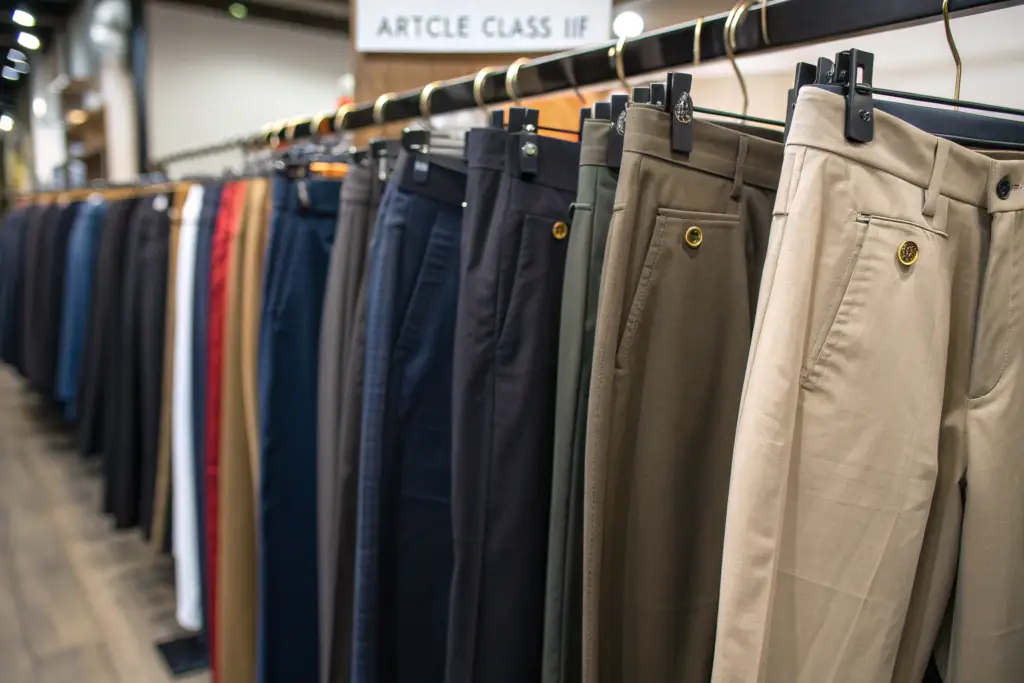
Before you contact a single supplier, you must clarify exactly what you need. "OEKO-TEX certified" is a starting point, but it's not specific enough. Your first decision is determining the correct Article Class. For weekday pants, this is typically:
- Article Class II: For items worn directly on the skin (underwear, base layers). If your pants are lightweight leggings or tight-fitting trousers meant to be worn without a layer underneath, Class II applies.
- Article Class I: The strictest standard, for items for babies and toddlers up to 3 years. Only relevant if you are producing children's pants.
- Article Class IV: For decorative materials (e.g., non-skin-contact lining in a jacket). Not typically for pants.
Most general weekday pants—chinos, tailored trousers, wide-leg pants—that are worn over underwear fall under a broader scope where the main fabric's safety is paramount, but the official Article Class may be interpreted differently. You must decide with your manufacturer. A best practice is to require the fabric and all trims (zippers, buttons, thread) to be certified to at least Article Class II standards, regardless of the final product class. This ensures the highest safety level for all skin-contact components.
Next, define the scope of certification. Will you certify only the final garment, or the fabric itself? For efficiency and cost-control, we at Shanghai Fumao recommend the "Fabric Certification" approach. This means your fabric mill provides OEKO-TEX certified fabric rolls. Your garment factory then uses these pre-certified materials to make your pants. This is faster and cheaper than certifying the finished garment from scratch. Ensure your tech pack explicitly states: "Main fabric and all trims must be OEKO-TEX STANDARD 100 certified. Provide valid certificate numbers for all components."
What Specific Questions Should You Answer Before Sourcing?
- What is my target market? (E.g., EU markets have stricter perceptions; requiring Class II is wise.)
- What is my pants' end-use? (Office wear, casual lounge, travel? This influences fabric choice and certification rigor.)
- What is my budget for certification? (Understand it adds 3-8% to fabric cost; factor this into your cost model.)
- Who is my end consumer? (E.g., health-conscious professionals, parents? This justifies the certification in your marketing.)
A client of ours, launching a line of "studio-to-street" pants, initially thought Class I was needed for marketing. We guided them that Class II for their high-twist cotton fabric was commercially sufficient and more cost-effective, while still allowing a strong "skin-safe" marketing story.
How to Create a Tech Pack That Enforces Compliance?
Your tech pack is your legal and technical blueprint. Beyond dimensions and stitch details, include a dedicated Compliance Section:
- Material Specification: "Fabric: 98% Cotton, 2% Spandex, OEKO-TEX STANDARD 100 Certified (Certificate # required)."
- Trim Specification: "Zipper: YKK #5, OEKO-TEX certified. Button: Polyester, OEKO-TEX certified. Thread: Certified."
- Labeling Instruction: "Attach OEKO-TEX label to care label."
- Documentation Requirement: "Shipment must include copy of valid fabric & trim certificates and the factory's OEKO-TEX license (if applicable)."
This clarity prevents misunderstandings and filters out suppliers who cannot meet these precise demands.
Phase 2: Identify & Vet Qualified Manufacturing Partners
This is the most critical phase. The right partner doesn't just have a certificate; they have a system. Start your search on platforms like Alibaba, but use advanced filters for keywords like "OEKO-TEX factory," "certified manufacturer," or "sustainable apparel." Attend trade shows (like Intertextile Shanghai) where you can meet suppliers in person and immediately ask for their certification documents.
When evaluating a potential partner like Shanghai Fumao, move beyond the sales rep. Request to speak with their technical or quality control team. Their ability to discuss the nuances of OEKO-TEX compliance is a key indicator of real expertise. Ask them how they manage certified versus non-certified production runs to prevent cross-contamination. A professional factory will have segregated storage for certified fabrics and dedicated lines or clear cleaning protocols.
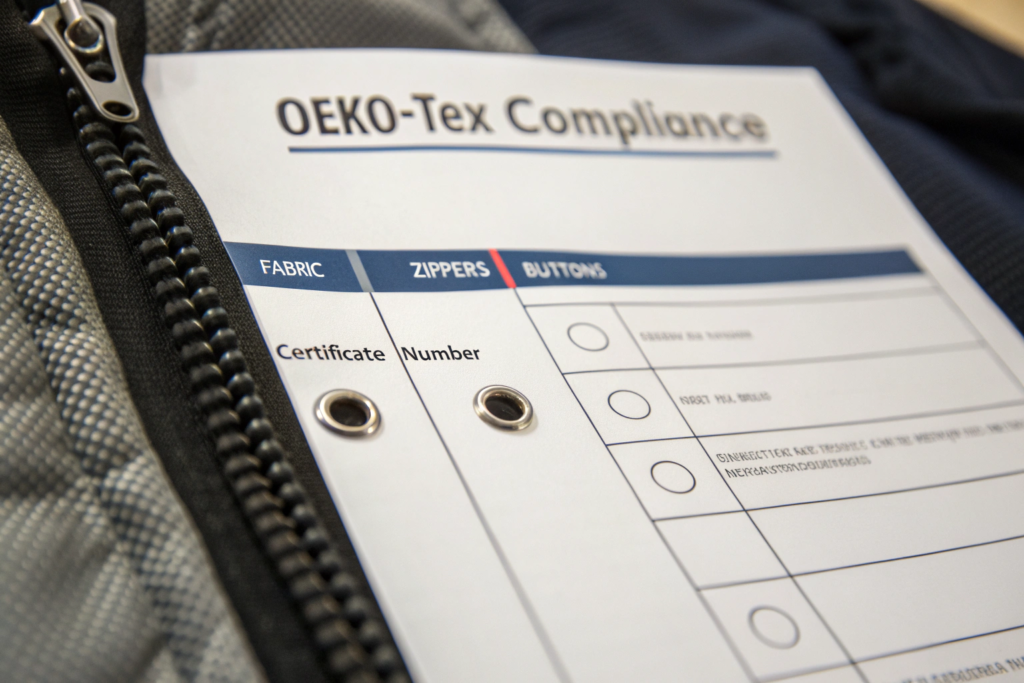
Verification is non-negotiable. Any legitimate supplier will freely provide their OEKO-TEX certificate numbers. Use the official OEKO-TEX Certificate Check online database. Enter the number to verify:
- Validity: Is the certificate current and not expired?
- Scope: Does it cover the product categories you need (e.g., knitted/woven fabrics, garments)?
- Company: Does the name and address on the certificate exactly match the company you are dealing with? Beware of agents using a factory's certificate falsely.
What Are the Red Flags During Supplier Vetting?
- Vague Language: "Yes, we can do certified." vs. "Yes, here is our certificate number for fabric certification, and here is our process for handling certified orders."
- Price Too Low: OEKO-TEX certified materials cost more. A quote matching uncertified prices suggests corner-cutting or fraud.
- Reluctance to Provide Details: Hesitation to share certificate numbers or introduce you to their QC team.
- No Internal Testing: Ask if they conduct in-house phthalate or heavy metal spot checks on incoming fabric. A "no" indicates passive compliance.
We once audited a new fabric mill for a client's trousers order. They provided a certificate, but our check showed it was for a different subsidiary and had expired. This red flag saved our client from a major compliance risk.
Why is a Factory's "Full-Package" Capability Crucial?
For private labels, a full-package manufacturer that manages fabric sourcing, trim procurement, production, and export is ideal for OEKO-TEX items. They control the entire chain, simplifying traceability. You have one point of contact responsible for ensuring all components are certified and documented correctly.
A factory that only does CMT (Cut, Make, Trim) requires you to source certified fabric and trims yourself—a complex task for a new brand. A full-package partner like us has established relationships with certified mills and trim suppliers. We leverage bulk purchasing and guaranteed quality, reducing your administrative burden and risk. For a recent client's order of 5,000 certified work pants, we sourced the certified cotton twill, coordinated with the certified zipper and button suppliers, and consolidated all compliance documentation, providing a single, hassle-free package.
Phase 3: Integrate Compliance into Development & Production
Once you've chosen a partner, certification must be woven into every stage, from sampling to bulk production. Treat it as a core component of your product, not an afterthought.
Start with development samples. When you request the first proto sample, insist it is made with the actual OEKO-TEX certified fabric you plan to use for bulk. This allows you to assess the true hand-feel, drape, and quality. Do not accept a sample made with "similar" uncertified fabric. Also, request that the OEKO-TEX label is attached to this sample to verify the correct labeling process. This step prevents surprises later.
During the pre-production stage, your factory should provide you with the test reports and certificates for the specific batch of fabric and trims that will be used for your order. This is called batch-specific certification. A certificate from two years ago is invalid for current production. Cross-check these batch numbers against the physical materials when you conduct a pre-production inspection (PPI). At Shanghai Fumao, we include this certificate pack in our pre-production meeting with clients, ensuring full transparency before cutting begins.

What Critical Checkpoints Are Needed During Production?
- Fabric Receiving Check: The factory's QC should verify the OEKO-TEX certificate matches the incoming fabric roll labels.
- In-Process Audit: Ensure certified fabrics are stored separately and work-in-progress is clearly identified to avoid mixing with non-certified orders.
- Final Random Inspection (FRI): Your inspection protocol must include a check for the correct OEKO-TEX label sewn into the garment. Also, randomly select packaged cartons and verify the included certificate copies match the order.
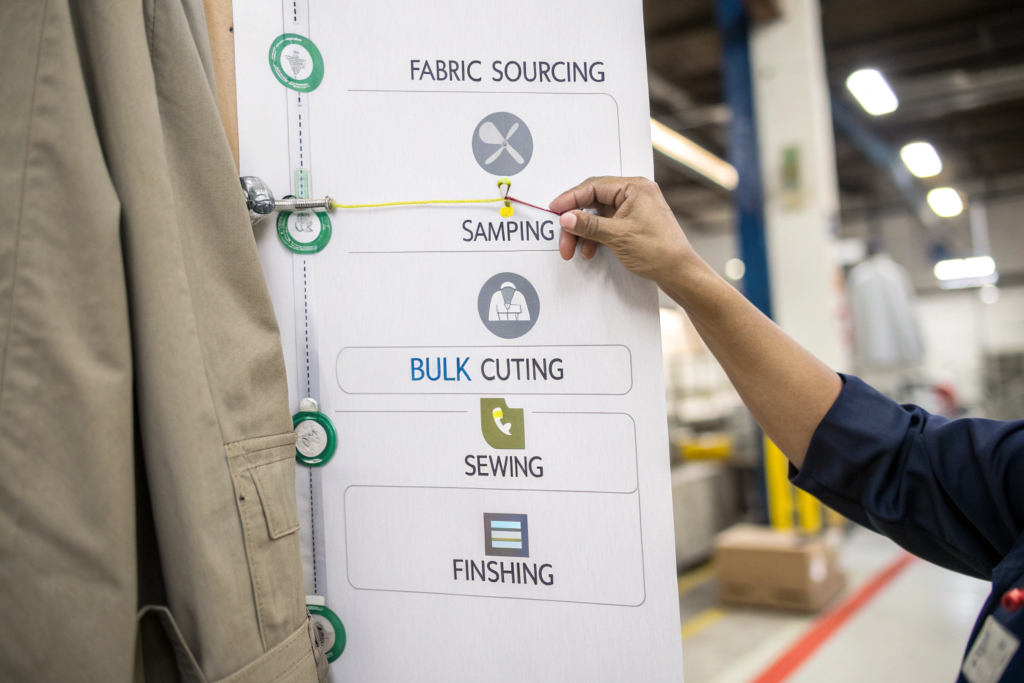
| A practical tool is a Production Compliance Checklist. We provide this to our clients for milestone sign-off: | Milestone | Compliance Action | Sign-Off |
|---|---|---|---|
| Fabric Sourcing | Receive & verify batch-specific fabric certificate. | ✅ | |
| PP Meeting | Review & approve all component certificates. | ✅ | |
| Pre-Production | Confirm label artwork and placement. | ✅ | |
| During Production | Audit factory floor for material segregation. | ✅ | |
| Final Inspection | Verify labeling and documentation in shipping cartons. | ✅ |
How to Handle Changes or Unexpected Issues?
What if you need to change a button style mid-production? Any new component must be certified. Your factory should have a process to quickly source a certified alternative and provide its test report before it is used. This may cause a short delay, which is why finalizing all trims during development is crucial. We experienced a case where a client's chosen drawcord supplier failed a retest. Because we had pre-qualified backup suppliers with valid certificates, we switched sources within 48 hours with zero impact on the production schedule.
Phase 4: Master Documentation, Logistics, and Marketing
Your certified pants are produced. Now, securing the proof and leveraging it correctly is key. The documentation is your legal and marketing lifeline.
Request a complete Certification Dossier from your manufacturer before shipment. This should include:
- The OEKO-TEX certificate for the fabric (with the specific batch/lot number used).
- Certificates for all major trims (zippers, buttons, etc.).
- A copy of the garment factory's OEKO-TEX license (if they are certified for manufacturing).
- A Declaration of Conformity from the factory, stating that your specific order was manufactured in accordance with the OEKO-TEX STANDARD 100 requirements.
Keep these documents digitally and physically. You will need them for retailer onboarding, customs inquiries, or consumer transparency requests. For DDP (Delivered Duty Paid) shipments, ensure these documents are included in the master shipping packet to facilitate smooth customs clearance, as some regions may request evidence of safety standards.
Finally, market your certification authentically. Use the official OEKO-TEX label on your hangtag. On your website, don't just say "OEKO-TEX certified." Explain what it means for your weekday pants: "Certified free from harmful substances, for all-day comfort and peace of mind." Share the story of your diligent sourcing process—it adds depth to your brand narrative. A client of ours created a "From Mill to You" page on their site, featuring photos of the certified fabric and explaining the OEKO-TEX standard, which significantly boosted consumer trust and conversion rates.
What Are Common Pitfalls in Logistics and Labeling?
- Incorrect Labeling: The OEKO-TEX label must be sewn in permanently, not as a sticker. It should include the standard (e.g., STANDARD 100), the certification institute number (e.g., 123), and the license number.
- Missing Documentation in Shipment: Always insist that a copy of the key certificates is placed inside one of the shipping cartons, not just emailed. This provides physical proof that travels with the goods.
- Last-Minute Packaging Changes: If you change polybags or cartons, ensure the printing ink used on them is also non-toxic and doesn't compromise the certification. Use suppliers who understand REACH compliance for packaging.
How Does This Process Future-Proof Your Brand?
By mastering this sourcing process, you build a scalable, compliant supply chain. As you expand into new product categories or markets, you have a proven framework and a trusted partner. The diligence you apply to weekday pants sets a precedent for quality and safety that becomes your brand's cornerstone, building lasting customer loyalty and protecting you from reputational and legal risks.
Conclusion
Sourcing OEKO-TEX certified weekday pants for your private label is a deliberate journey from clarity to compliance. It begins with defining your specific requirements, continues through the rigorous vetting of partners who possess real expertise, integrates checks at every production stage, and culminates in securing the documentation that proves your claim. This process transforms a quality aspiration into a defensible, marketable asset.
While it demands more upfront diligence than conventional sourcing, the return is immense: reduced risk, enhanced brand equity, and a product that truly stands for safety and responsibility. In a market where consumers seek authenticity, a properly sourced OEKO-TEX certified product is a powerful statement.
Ready to launch your certified weekday pants with a partner who navigates this process daily? Shanghai Fumao specializes in guiding private label brands through every step of OEKO-TEX compliant apparel manufacturing. Contact our Business Director, Elaine, at elaine@fumaoclothing.com to begin your sourcing journey with confidence. Visit Shanghai Fumao to discover how our full-package expertise can turn your vision into a verified, successful product line.