In garment sourcing, the best price and the most favorable payment terms often feel like opposing forces. Suppliers may offer a lower unit cost in exchange for rigid, upfront payments, or extend generous credit only at a higher price. The art of strategic negotiation lies in breaking this zero-sum game, creating agreements where both you and the factory achieve optimal value. This requires understanding the factory's true cost drivers and leveraging what you can offer beyond just order volume.
You secure the best price with flexible payment terms by demonstrating you are a low-risk, high-value, long-term partner. This is achieved through providing exceptional planning (clear forecasts, complete tech packs), offering financial security (bank references, L/Cs), and structuring win-win proposals that share cost savings and improve the factory's cash flow.
This guide provides a framework to move beyond simple haggling, enabling you to negotiate price and terms as an integrated package that benefits both parties.
How Does Being a "Perfect Client" Lower Your Costs?
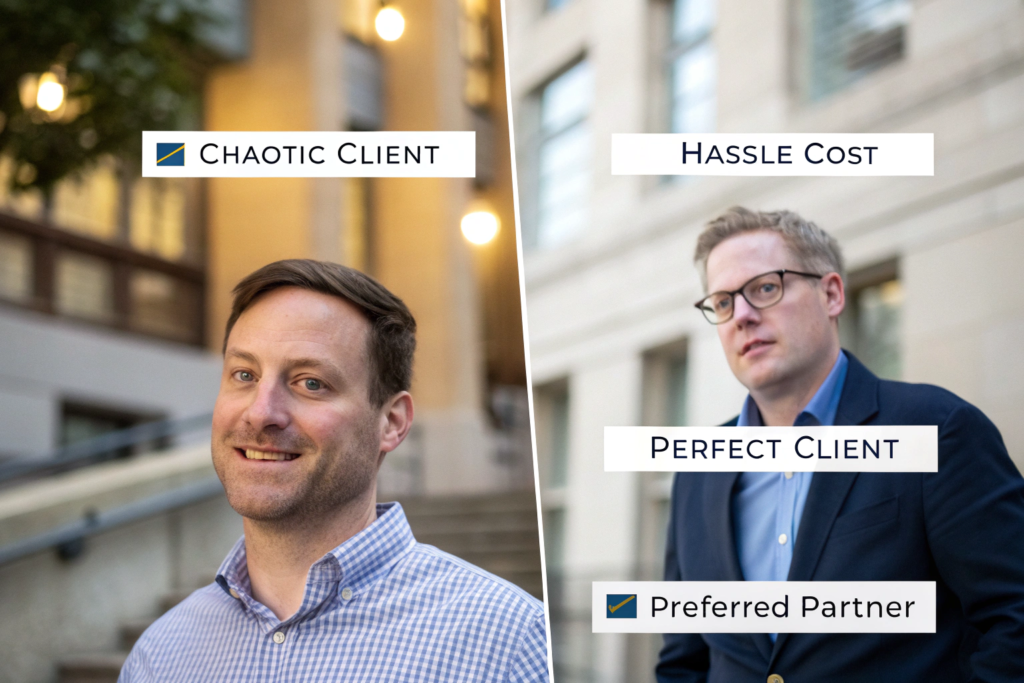
Factories incur significant hidden costs dealing with disorganized clients: time spent clarifying vague instructions, money wasted on incorrect samples, and production line disruptions from last-minute changes. By systematically reducing these "hassle costs," you make yourself more profitable to serve, which gives you legitimate leverage to request better pricing and terms.
Being a "perfect client" lowers your costs by reducing the factory's operational friction and risk. This makes your business more valuable per dollar of revenue, allowing them to afford offering you more competitive pricing and flexible terms without sacrificing their margin.
Your professionalism is a tangible financial asset in negotiations.
What Specific Behaviors Reduce Factory Friction?
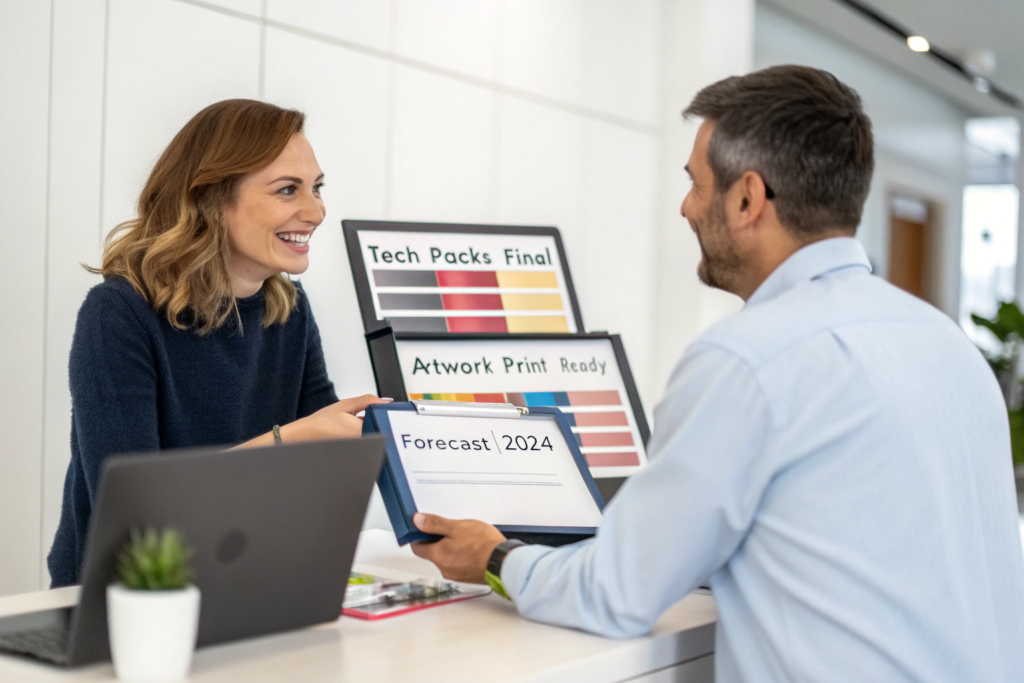
- Provide Impeccable Tech Packs: A complete, detailed tech pack eliminates guesswork and prevents sampling rework. It shows you respect their time.
- Give Fast, Consolidated Feedback: Approve or reject samples, colors, and fabrics within 48 hours with clear, actionable notes. This keeps their schedule on track.
- Communicate Proactively: If you foresee a delay, tell them immediately. If you have a growth plan, share it. Uncertainty is costly.
A client of ours at Shanghai Fumao provides 18-month rolling forecasts and tech packs that rival professional designers. Because we can plan fabric purchases and capacity around their orders with confidence, we offer them pricing 5-7% below our standard rate and flexible Net 30 terms.
How to Quantify and Present This Value?
During negotiations, don't just say you'll be easy to work with. Frame it: "We provide complete tech packs with certified print-ready artwork, guarantee 48-hour sample feedback, and adhere strictly to our agreed payment schedule. This efficiency saves your team an estimated [X] hours per development cycle. We believe this reduced operational cost should be reflected in a more collaborative pricing and term structure."
Can Offering Financial Security Unlock Better Pricing?
A factory's biggest fear is not low margins, but bad debt and cash flow gaps. If you can mitigate these financial risks for them, you directly address their core vulnerability. In return, they can often afford to reduce their price, as the "risk premium" they build into quotes can be lowered.
Offering financial security can unlock better pricing by reducing the supplier's financial risk premium. Instruments like Letters of Credit (L/C), early payment discounts, or providing bank guarantees make you a safer bet, justifying a lower unit cost.
Security is a currency in manufacturing.
How Does a Letter of Credit (L/C) Create Leverage?
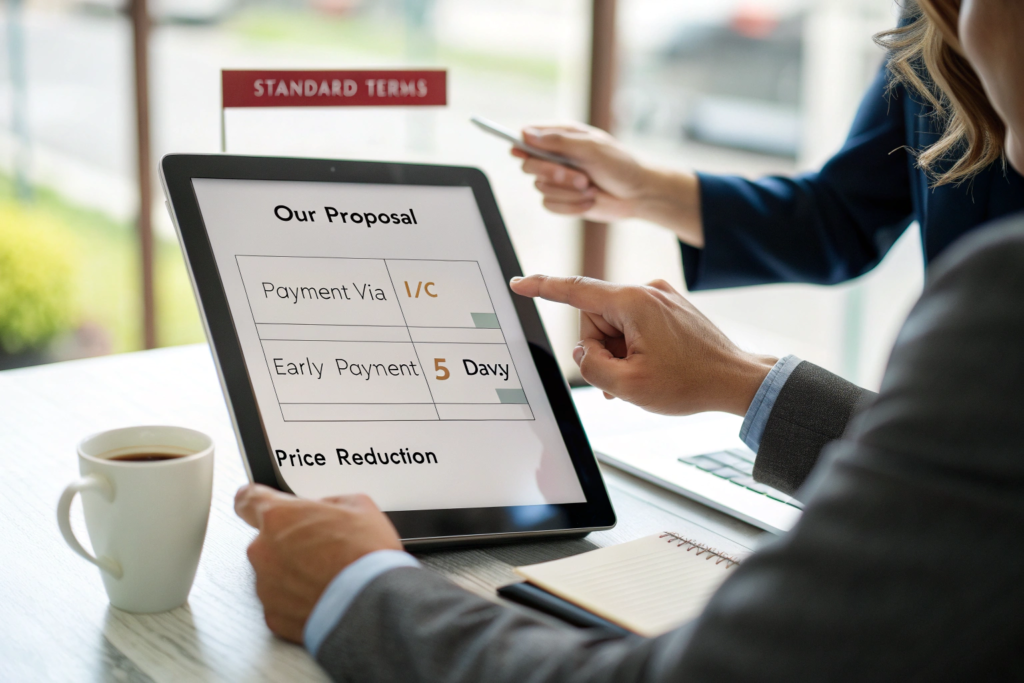
An L/C guarantees the factory will get paid by a bank once they ship compliant goods. It eliminates their credit risk entirely. You can use this as a bargaining chip: "We are willing to pay via L/C (bearing the bank fees), which provides you with 100% payment security. In exchange, we request a 3-5% reduction in the FOB price, as you no longer need to factor in payment default risk." This is a fair trade. We have agreed to such terms with new clients ordering high-value items, as it makes financial sense for both sides.
What About Early Payment Incentives?
If you have strong cash flow, propose an early payment discount. For example: "If the standard terms are 30% deposit, 70% net 30 after shipment, we propose: 30% deposit, and we will pay the 70% balance within 5 days of you providing the Bill of Lading, in exchange for a 2% discount on the total order value." This gives the factory cash almost immediately, improving their working capital, and you get a direct price reduction. It's a classic win-win.
How to Structure Win-Win, Tiered Term Proposals?
Instead of demanding both a lower price and extended terms, propose a tiered structure that rewards the factory for the flexibility you seek. This aligns incentives and shows you understand their business needs. The goal is to share the value created by the partnership.
Structure win-win proposals by linking improved payment terms to volume commitments, longer partnership horizons, or shared cost-saving initiatives. Create clear "if-then" scenarios that give the factory a tangible benefit for meeting your request.
Tiered proposals build better relationships over time.
What Does a Volume-Based Tier Look Like?
"Based on our initial order of 2,000 units, we propose the following structure for our ongoing partnership:
- Tier 1 (Order 1): 30% deposit, 70% balance before shipment.
- Tier 2 (Combined Orders 2 & 3, forecast 5,000 units total): 25% deposit, 75% balance Net 15 days from BL date.
- Tier 3 (Annual volume exceeding 10,000 units): 20% deposit, 80% balance Net 30 days from BL date, with a 2% annual volume rebate."
This gives the factory a clear, valuable future in exchange for gradually extending credit.
Can You Tie Terms to Cost-Saving Actions?
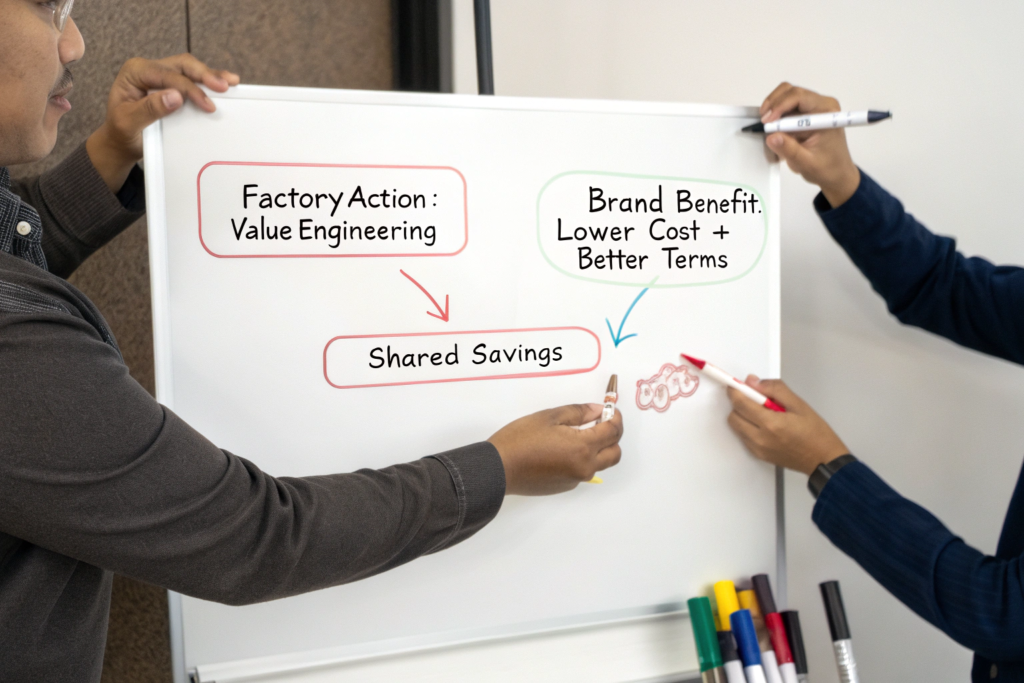
Yes. Propose collaborative value engineering. Say: "If your technical team can suggest a fabric or construction modification that reduces the unit cost by $0.50 without compromising quality, we will split the savings 50/50. Our share of the saving will be applied as a discount, and in return, we will move from a 30% to a 25% deposit structure." This incentivizes the factory to use their expertise to lower the base cost, making extended terms more affordable for them to offer.
What Non-Monetary Value Can You Offer?
Your negotiation power isn't limited to money and orders. Factories seek stability, market access, and reputational benefits. If you can provide strategic value that helps them grow or de-risk their business, you create another axis for negotiation.
Non-monetary value you can offer includes providing high-quality marketing assets they can use to attract other clients, committing to a non-exclusive but primary partnership status, or offering to be a reference case study for their new capabilities. This enhances their brand, making your business partnership more valuable.
This is about being a strategic partner, not just a revenue source.
How Do Testimonials and Case Studies Help?
A factory's sales cycle relies on social proof. Offer: "If we are satisfied with the first three orders, we will provide a detailed video testimonial and a written case study you can use in your marketing, and we will list you as our official manufacturing partner on our website." For a factory investing in sustainability or new technology, having a reputable Western brand as a public reference is extremely valuable and can be worth a percentage point in negotiation.
What Does "Primary Partner" Status Mean?
This doesn't mean exclusivity, which can be restrictive. It means you commit to giving them the first right of refusal on all new projects and a significant majority of your production volume. In return, you ask for priority access to their best production lines, a dedicated account manager, and most-favored-nation (MFN) pricing—guaranteeing you always receive their best available price for your order volume. This gives them predictable business, which is worth a lot.
Conclusion
Securing the best price with flexible payment terms is not about grinding a supplier down on every line item. It is about reconstructing the commercial relationship so you become a client they cannot afford to lose—one who minimizes their operational costs, reduces their financial risk, offers predictable growth, and enhances their market reputation. By packaging your professionalism, financial security, volume forecasts, and strategic value into a coherent proposal, you transform the negotiation from a transactional debate into a partnership design session.
This approach builds durable, profitable relationships where both sides win. At Shanghai Fumao, we actively seek and reward clients who bring this level of partnership to the table, because we know it leads to mutual, long-term success. To discuss structuring a win-win agreement for your next collection, contact our Business Director, Elaine, at elaine@fumaoclothing.com.