
You've found a great supplier overseas. They offer competitive prices, and their terms are straightforward: a 30% deposit via telegraphic transfer (T/T) to start production, with the 70% balance paid before shipment. But a nagging question keeps you up at night: "If I pay most of the money before I even see the goods, how can I guarantee the quality won't be a disaster?" This is a very real fear for U.S. importers, and it's one of the biggest pain points in sourcing from China and other developing markets.
Managing quality control (QC) effectively under T/T payment terms is entirely possible. The key is to build a proactive, multi-stage inspection process directly into your contract and production timeline. You shift the focus from reactive problem-solving—after payment is made—to active prevention and verification at critical checkpoints before you release the final payment. This strategy protects your investment and leverages the payment schedule to ensure supplier accountability.
Relying solely on a supplier's promise is risky. Delayed shipments and poor quality that miss your selling season can cripple a business. As a factory owner, I've seen partnerships fail because of a lack of structured QC aligned with payments. Conversely, I've seen brands thrive by implementing a clear system. Let's break down the actionable steps you can take to secure both quality and your finances.
How to Structure Payments for Maximum QC Leverage?
A smart payment schedule is your first line of defense. It should be a roadmap that links your money to verified milestones, not just calendar dates.
The Milestone-Based Payment Breakdown
Instead of a simple 30/70 split, consider a more detailed structure tied to production stages. For example, you could propose: 30% deposit with order confirmation, 40% upon approval of pre-production samples and successful initial production check, and the final 30% balance after passing the final random inspection (FRI) and before shipment. This gives you two quality checkpoints (sample and bulk production) where you have significant financial leverage. The supplier knows that the larger 40% payment depends on your approval of the early production quality, motivating them to get it right from the start.
Why a Smaller Final Balance Matters
The size of the final payment is a powerful tool. When 70% is due before shipment, your leverage after the FRI is minimal. If serious defects are found, the factory may be reluctant to re-work the order quickly since they already have most of the money. However, if the final balance is 30% or less, they are highly motivated to correct any issues promptly to receive the remainder. Last year, we worked with a Denver-based brand that switched to this model. They held a 35% final balance. When an FRI revealed inconsistent dye lots, our team prioritized the re-dyeing process immediately to secure that payment, and the shipment was only delayed by 5 days.

What Are the Critical Production Milestones to Tie Payments To?
Identifying the right moments to inspect and pay is crucial. These milestones should be objective and based on tangible outputs.
- Pre-Production Sample Approval: This is the "gold standard" sample made with actual production fabrics and trims. Your contract must state that bulk production cannot begin until you approve this sample in writing. Release your first payment (e.g., 30%) only after this approval. This ensures everyone agrees on the quality target.
- Initial Production Check (IPC): Conducted when 15-20% of units are finished. An IPC verifies that the early production matches the approved sample in workmanship, measurements, and materials. It’s your chance to catch systemic errors early. Linking a significant progress payment (e.g., 40%) to IPC approval aligns the factory's cash flow with your quality requirements. According to the American Apparel & Footwear Association (AAFA), early detection of defects can reduce correction costs by up to 50%.
How to Negotiate QC Clauses Into Your Purchase Contract?
Your contract is the rulebook. Vague terms like "good quality" are unenforceable. You need specific, measurable clauses.
First, define the quality standard explicitly. Reference detailed tech packs, approved physical samples (with sign-off sheets), and specific international testing standards (like AATCC for fabrics or ISO for processes) that the goods must meet. Second, outline the inspection protocol. State the inspection stages (IPC, FRI), the sampling method (based on AQL levels), and who conducts them. Specify that the cost for failed inspections and re-inspections is borne by the supplier. Finally, link payment releases to successful inspection reports. The contract should clearly state, "The [40%] progress payment is due within 7 days of the buyer receiving and approving the IPC report."
Who Should Conduct the Inspections: You, Third-Party, or the Factory?
The credibility of your inspection data is everything. Who gathers this data directly impacts its reliability and your ability to make informed payment decisions.
The Trust but Verify Matrix
Each inspection party has pros and cons. Relying solely on the factory's QC report is a conflict of interest, especially before a payment release. Sending your own staff is highly effective but can be costly and logistically challenging for smaller brands. The most balanced and common solution for importers using T/T terms is to hire a professional third-party inspection company for critical checks like the IPC and FRI.
The Value of an Unbiased Report
A third-party report provides an objective snapshot of quality. For the final payment decision, this report is your evidence. If it shows a "Pass" based on the agreed AQL, you can release payment confidently. If it's a "Fail," you have a legally defensible reason to withhold payment and demand re-work. We at Shanghai Fumao proactively recommend and facilitate third-party inspections for our clients before their balance payment. It builds immense trust. In one instance, a client's inspector found issues with stitch tension during an IPC. Because the report was clear and objective, we fixed the machines immediately, and the subsequent FRI was perfect. The client released the final payment the same day.

When Is a Third-Party Inspection Service Worth the Cost?
The cost of an inspection is tiny compared to the risk of a rejected, paid-for shipment. It's almost always worth it for the FRI before the final payment. Consider it essential when:
- Order value is high.
- The product is complex or has strict safety requirements (like children's wear).
- You are working with a new supplier.
- The sales season is critical, and you cannot afford delays from poor quality.
Use a reputable global firm like SGS, Bureau Veritas, or Intertek, or a reliable local agency vetted by your network.
Can You Rely on the Factory's Internal QC Reports?
You should review them, but never rely on them as the sole basis for payment. A factory's report is a useful tool for tracking their internal progress. We provide all our partners at Shanghai Fumao with access to real-time production data and internal QC checklists. However, we always encourage an external verification step before payment. A good factory will have nothing to hide. Treat the factory's report as a collaborative document, and use the third-party report as the final arbiter for financial transactions.
What Are the Non-Negotiable QC Checkpoints Before Final Payment?
Before you authorize that last wire transfer, certain boxes must be checked. This is your final gateway to prevent financial loss.
The Pre-Payment Verification List
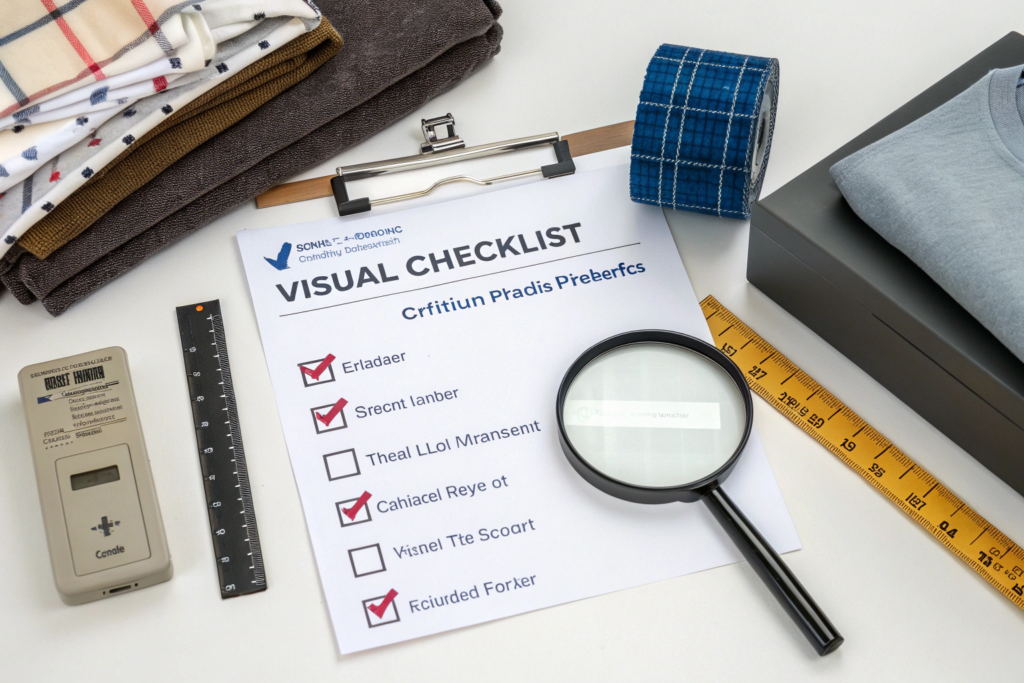
This is your actionable checklist. Do not release the final balance until you have:
- A "Pass" Final Random Inspection (FRI) Report: Based on the correct AQL level (usually AQL 2.5 for general apparel). The report should cover workmanship, measurements, function, packaging, and labeling.
- Verified Lab Test Reports: For physical properties (shrinkage, colorfastness) and safety (if applicable). Ensure the reports are from an accredited lab and match the order details. This guards against certificate falsification—a known pain point.
- Pre-Shipment Photos & Videos: Request clear images of the packed cartons, shipping marks, and a random selection of finished goods. A quick video walkthrough of the warehouse with your cartons is a great final verification.
- Completed Packing List Verification: Cross-check the carton quantities and assortment against your packing list to avoid shipping errors.
The Power of Holding Shipping Documents
A practical tactic is to state in your contract that the original shipping documents (Bill of Lading, etc.) will only be released to the supplier after the final payment is received and cleared. This gives you a small but important safety window, as the factory cannot clear goods at the destination port without these documents.
How to Implement an Effective AQL-Based Final Inspection?
The Acceptable Quality Limit (AQL) is your quantitative benchmark. For most apparel, AQL 2.5 for major defects and AQL 4.0 for minor defects is standard.
- Process: An inspector randomly selects a sample size from the total order (based on statistical tables). They inspect each unit against your checklist.
- Decision Rule: If the number of defects found is at or below the AQL limit, the lot "Passes." If defects exceed the limit, it "Fails."
Insist that the inspection report clearly states the AQL standard used, the sample size, defects found, and a clear PASS/FAIL recommendation. This objective data is your justification for releasing or withholding the final payment.
Why Are Lab Tests Crucial Before Releasing Final Payment?
Lab tests are your scientific proof of quality and compliance. They are non-negotiable for several reasons:
- Safety & Liability: They ensure products (especially kids' wear) are free from harmful substances and meet regulations like CPSIA in the U.S.
- Performance Verification: They confirm the fabric will perform as promised (e.g., less than 3% shrinkage).
- Payment Leverage: A failed test report before final payment forces the supplier to address material issues. Releasing payment without these reports means accepting all risk for performance failures that appear later with your customers.
How to Build a Partnership That Reduces QC Risk?
The most effective quality control system is built on a foundation of strong partnership, not just policing. A reliable supplier sees your success as their own.
From Adversarial to Aligned
View your supplier as a manufacturing partner. The goal is to move from a cycle of "inspect-fail-argue" to one of "plan-check-confirm." This starts with clear, documented communication from day one. We dedicate a single-point project manager for each of our clients at Shanghai Fumao to eliminate the pain point of inefficient communication. This person understands the entire order and is your direct line, preventing misunderstandings that lead to quality issues.
Transparency as a Tool
Share your business goals and seasonality. When we know a shipment is for a key holiday launch, we build in extra time buffers and schedule QC checks earlier. Last fall, for an East Coast brand's crucial holiday line, we completed our internal QC a week early, which allowed time for a third-party FRI and minor corrections without any rush, ensuring the shipment left on the exact day planned.

How Can Regular Factory Audits Secure Long-Term Quality?
An audit assesses the factory's systems and capability, not just a single batch of goods. Conducting a social compliance and quality management audit before you even place your first order can prevent countless problems. It verifies their certifications, checks their machinery, and evaluates their process control. An audit answers: Do they have the systems to be consistently good? This due diligence significantly de-risks the entire T/T payment relationship.
What Role Does Technology Play in Real-Time QC Monitoring?
Use technology to bridge the distance. Simple tools can create transparency:
- Shared Cloud Folders: For instant access to all tech packs, comments, and photos.
- Live Video Calls: For virtual line checks or to review potential issues in real-time.
- Production Management Software: Some factories offer portal access to see production stages.
This constant visibility reduces surprises and builds trust, making the formal inspection before payment a confirmation rather than a discovery of problems.
Conclusion
Managing quality control under T/T payment terms is not about finding ways to avoid payment; it's about structuring a transparent, evidence-based process that protects both you and your supplier. By strategically linking payments to verified quality milestones, employing credible third-party inspections for critical checks, and building a partnership based on clear communication, you transform the inherent risk of T/T terms into a manageable, even advantageous, sourcing strategy. This approach ensures you only pay for what you ordered, in the quality you expected, and on the timeline you need.
Ultimately, your goal is to have a supplier who views these rigorous checks not as a burden, but as a mark of a professional and reliable partnership. If you are looking for a manufacturing partner in China that proactively integrates these QC and payment safeguard practices into every order, we invite you to discuss your needs with us. Let Shanghai Fumao be your trusted partner in bringing your apparel visions to market with confidence and quality. To explore how we can streamline your sourcing and secure your quality, please reach out to our Business Director, Elaine, at elaine@fumaoclothing.com.