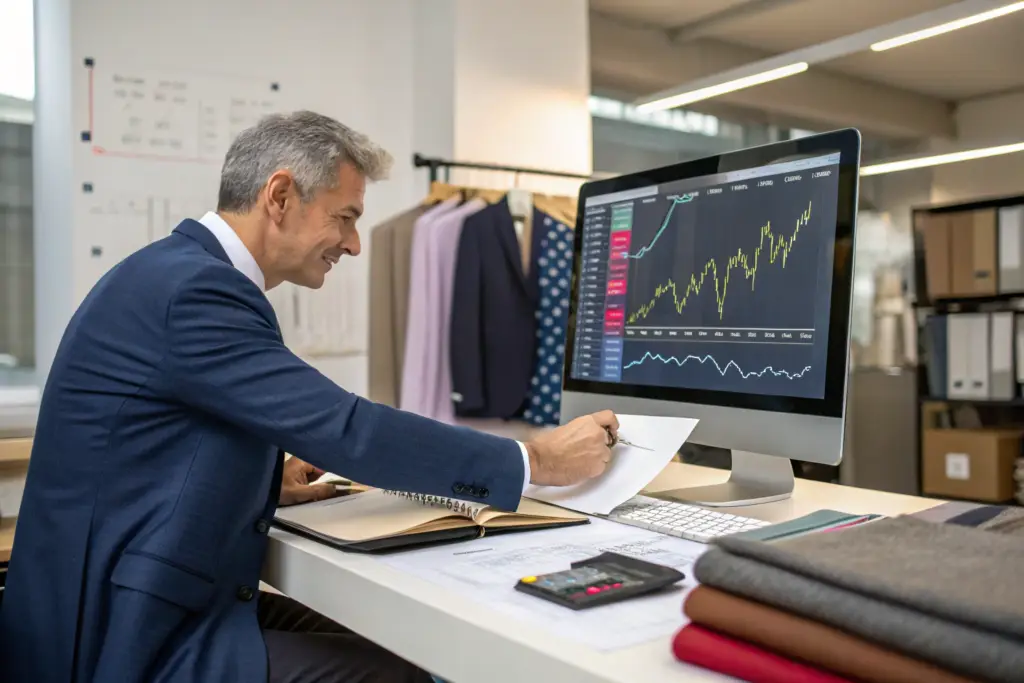
If you're an American apparel brand owner sourcing from China or Vietnam, you've likely felt the sting of an unexpected currency swing just before a payment deadline. You budgeted $50,000 for your production run, but a sudden shift in the exchange rate means you now need to send $52,000 for the same invoice. This eats directly into your profit margins and creates frustrating financial uncertainty.
The most effective way to handle currency fluctuations in T/T payments is through a multi-layered strategy that includes negotiating payment currency terms, using forward contracts to lock in rates, strategically timing payments, and building buffer clauses into your costings. Proactive financial management, not just reactive worry, is key to protecting your margins in international garment trade.
While T/T (Telegraphic Transfer) remains the most common and straightforward payment method in our industry, its simplicity belies the hidden foreign exchange risk. Let's break down practical steps you can take, from the negotiation table to the moment you click "send" on your bank transfer.
What Payment Currency Should You Negotiate: USD, CNY, or Supplier's Local Currency?
The first and most critical decision point is which currency to transact in. This isn't just a technicality; it's a primary risk allocation tool. The default for many U.S. buyers is to pay in U.S. Dollars (USD), pushing the exchange risk onto the supplier. However, this isn't always the best long-term strategy for cost control.
You should aim to negotiate payment in U.S. Dollars (USD) to transfer the currency risk to your supplier and simplify your accounting. However, be aware that savvy suppliers will often build a hidden 'risk buffer' into their USD price, potentially making it higher. Paying in the supplier's local currency (like CNY or VND) can sometimes secure a lower base price, but you then assume the full exchange rate risk.
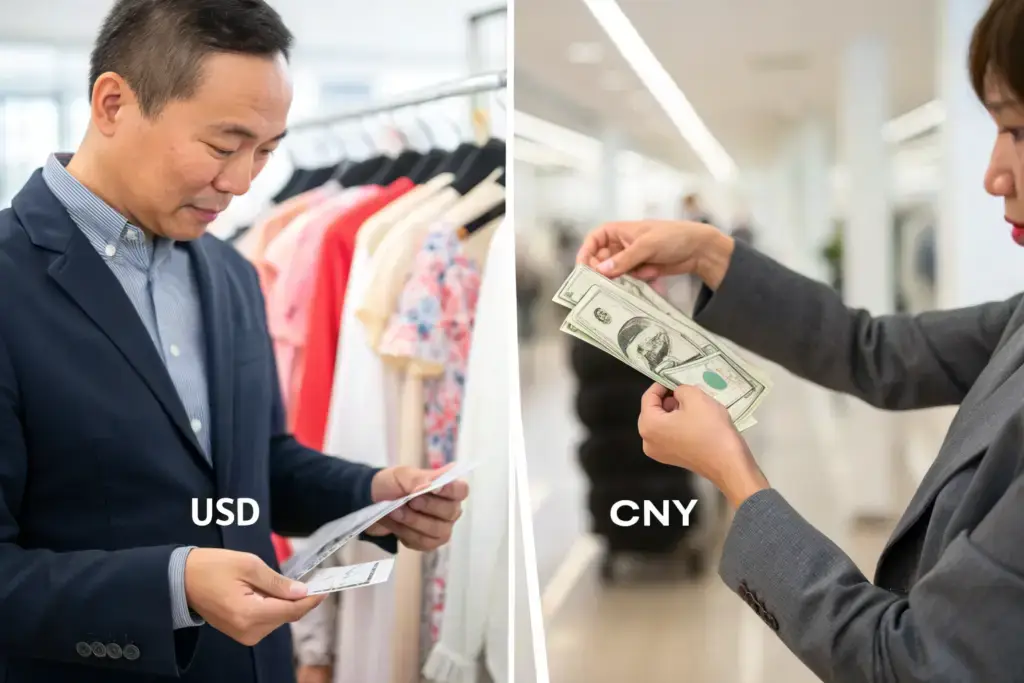
How Does Paying in USD Versus CNY Affect Your Final Cost?
When you pay in USD, your cost is fixed from the moment you sign the proforma invoice (PI). If the Chinese Yuan (CNY) strengthens against the USD, your supplier receives fewer CNY for your fixed USD payment, hurting their margin. To protect themselves, ethical factories like Shanghai Fumao typically use a conservative exchange rate when quoting and may include a small buffer. Less scrupulous ones might cut corners on quality if their margin is squeezed.
Paying in CNY can get you closer to the factory's true cost. Last year, a client from Miami insisted on paying in CNY for a large order of woven trousers, believing it was cheaper. They did not hedge the rate. Between deposit and balance payment, the CNY strengthened 3%. The client paid thousands more than planned, wiping out their perceived savings. The lesson: if you pay in local currency, you must manage the risk.
Can You Use a Currency Clause in Your Contract?
Yes, this is a smart preventative tool. A currency adjustment clause can stipulate that if the exchange rate moves beyond an agreed range (e.g., +/- 3%), the parties will share the impact or renegotiate. For example, a clause could state: "Prices are based on USD/CNY = 7.00. If the rate moves beyond 6.80 or 7.20 at time of payment, the price will be adjusted by 50% of the difference." This fosters partnership. We once had such a clause with a Denver-based outerwear brand during a period of high volatility. When the USD unexpectedly spiked, we voluntarily passed on part of the benefit to them, strengthening our relationship.
What Financial Tools Can Lock in Exchange Rates?
Once you know the payment currency and amount, you can use banking instruments to eliminate uncertainty. The most common and relevant tool for apparel imports is the forward contract. Think of it as reserving an exchange rate for a future date.
The primary financial tool for locking in rates is a forward contract with your bank or currency specialist. You agree to exchange a specific amount of USD for CNY (or other currency) at a fixed rate on a future date, completely eliminating the risk of adverse movement. This provides budget certainty for your garment production costs.

How Do Forward Contracts Work for Garment Payments?
Here’s a typical scenario: You sign a purchase order (PO) with your supplier in March for a $100,000 order, with a 30% deposit due now and 70% balance due upon shipment in July. You immediately contact your bank and execute a forward contract to buy $70,000 worth of CNY for the July payment date at today's locked rate. No matter how the markets move, your July payment cost in USD is set. You pay a small margin to the bank, but it's insurance.
Many of our successful clients use this tool. One activewear brand from Oregon uses forward contracts for every balance payment over $20,000. Their finance director told me it's the single biggest factor in achieving predictable quarterly margins, even when sourcing costs from multiple countries.
Are There Alternatives to Forward Contracts?
For smaller brands, a limit order can be a good alternative. You instruct your bank or currency platform (like Wise or OFX) to automatically execute the trade only when the USD/CNY rate reaches a favorable level you specify. This doesn't guarantee execution but can help you capture better rates. Another simple tool is multi-currency accounts, which allow you to hold CNY and convert when you choose, giving you more time flexibility than a standard business checking account.
| Tool | How It Works | Best For | Key Consideration |
|---|---|---|---|
| Forward Contract | Locks in an exchange rate for a future date. | Large, known future payments (e.g., balance payments). | Provides certainty; may require a credit line. |
| Limit Order | Auto-converts currency when a target rate is hit. | Smaller, flexible payments where timing isn't critical. | No execution guarantee; requires monitoring. |
| Spot Transaction | Convert and transfer at the current market rate. | Urgent payments (e.g., deposits for fast-track samples). | Immediate exposure to current market volatility. |
| Multi-Currency Account | Hold foreign currency and convert at your discretion. | Brands with frequent, variable payments. | Allows for strategic timing without immediate transfer. |
What Tactical Timing Strategies Can Mitigate Risk?
Beyond formal contracts, the when of your payment can be a powerful lever. Currency markets are constantly moving, and while you can't time the market perfectly, you can adopt rules to avoid the worst outcomes.
Effective tactical timing involves avoiding major market announcements, spreading out large payments over time (dollar-cost averaging), and establishing a regular monitoring routine. The goal is not to gamble on speculation but to systematically reduce exposure to bad luck and volatile periods.

When Are the Best and Worst Times to Execute a T/T Payment?
The worst times are often around major economic data releases (like U.S. Non-Farm Payrolls or Chinese GDP data) and central bank announcements. Rates can gap significantly. It's wise to schedule your payment conversion a day or two before or after such events. The "best" time is relative, but many traders observe that volatility can be lower during the overlapping hours of the London and New York trading sessions.
A practical tip from our experience at Shanghai Fumao: communicate with your supplier. If you see a sharp favorable move and want to pay a few days early to capture the rate, ask if they can accommodate early payment. Most factories welcome early cash flow. Conversely, if rates spike against you, a transparent discussion about a slight delay (if cash flow allows) can be part of a partnership.
How Can Payment Scheduling and Buffer Budgets Help?
For very large orders, consider splitting the balance payment into two or more transfers over a few weeks. This "dollar-cost averaging" approach means you get the average rate over that period, not the potentially worst single-day rate. Most importantly, always build a currency fluctuation buffer of 2-4% into your total landed cost calculations. This isn't for profit; it's a risk management reserve. If you don't use it, it becomes extra margin. We advise all our new clients to do this. Last fall, a client ignored this advice on a $250,000 jacket order. A sudden 5% move in the EUR/USD rate (they were selling in Europe) turned a profitable order into a loss. They now use a 3% buffer and forward contracts religiously.
How to Build a Long-Term, Risk-Aware Partnership with Your Supplier?
Ultimately, the best defense against financial volatility is a strong, transparent relationship with your manufacturer. When you work as partners, you can find mutually beneficial solutions that go beyond adversarial negotiations.
Building a long-term partnership involves transparent communication about cost structures, exploring value-engineering together to absorb minor fluctuations, and aligning on forecasting. A reliable supplier like Shanghai Fumao becomes a stable partner in your supply chain, reducing the need for extreme financial hedging on every transaction.

How Can Transparency Reduce Hidden Currency Costs?
Ask your supplier for a basic cost breakdown. Understanding the proportion of raw material (often priced in USD), labor (in local currency), and overhead helps you see where exchange rates truly impact them. This knowledge allows for fairer negotiations. For instance, if fabric is 60% of the cost and is USD-denominated, a weak USD mainly affects the local labor portion. We share high-level breakdowns with our key partners, which builds tremendous trust and leads to more stable long-term pricing.
What If a Major Currency Shock Happens?
Have a pre-agreed protocol. In 2022, during a period of rapid CNY appreciation, we proactively contacted several long-term clients. For orders in production, we absorbed a portion of the increase. For future orders, we presented options: a small price adjustment, a slight fabric specification change to offset cost, or shifting to a longer-term pricing model. This consultative approach retained every single client. The alternative—suddenly springing a large cost increase—damages relationships irreparably.
Conclusion
Currency fluctuations are an inherent part of international garment manufacturing, but they don't have to be a threat to your profitability. By combining strategic negotiation on payment terms, utilizing practical financial tools like forward contracts, applying smart timing tactics, and most importantly, fostering a transparent partnership with your supplier, you can transform exchange rate risk from a scary unknown into a managed cost of doing business.
The goal is not to eliminate every cent of risk—that is impossible and costly—but to build a resilient supply chain that can withstand market movements without crisis. At Shanghai Fumao, we view financial stability as a joint responsibility. We work with our partners to find pragmatic solutions, whether that means adjusting timelines, reviewing specifications, or simply providing clear forecasts to aid in planning.
If you're tired of unpredictable costs eating into your apparel line's margins and want to work with a manufacturer that understands the business realities from both sides of the Pacific, let's talk. We can help you develop a sourcing strategy that includes financial risk management. Contact our Business Director, Elaine, to start building a more predictable and profitable partnership at strong>elaine@fumaoclothing.com</strong.