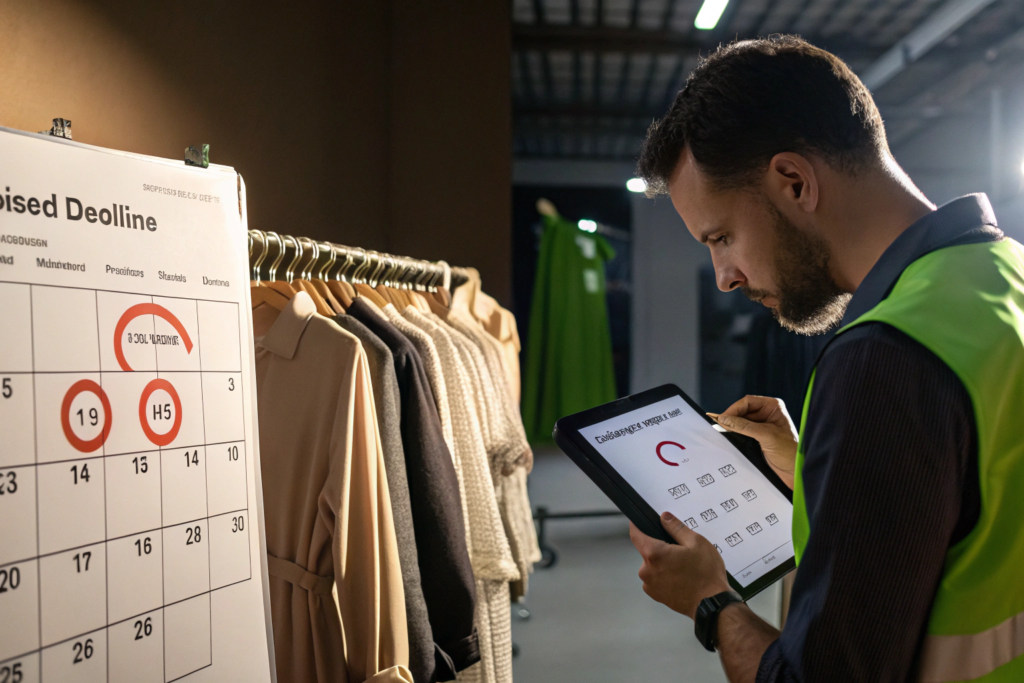
A brand owner from Chicago once called me in a voice I recognized immediately. It was the tight, controlled panic of someone watching their selling season evaporate. She had ordered 800 units of a women's spring dress collection. Her previous supplier had confirmed a ship date of February 10th. On February 1st, she received a short email: "Sorry, slight delay. New ship date March 5th." No explanation. No apology. No options. That three-week delay meant her dresses would hit her boutique accounts in April, not March. She would miss the peak spring selling window. She estimated the delay would cost her $22,000 in lost sales and markdowns. She was calling me not just to make a new order, but to understand why this kept happening to her, and how to prevent it from ever happening again.
You avoid lead time issues with Shanghai Fumao by engaging in a three-part proactive scheduling protocol: pre-order capacity reservation that locks your production slot before you finalize your design, a weekly visual progress update system that surfaces micro-delays within 48 hours rather than hiding them for weeks, and a pre-agreed escalation menu of logistics acceleration options, including strategic air freight uplift, that are costed and approved before the order reaches the cutting table. Lead time reliability is not a promise we make. It is a system we operate.
Most lead time failures are not caused by unexpected events. They are caused by a communication structure that hides emerging delays until they are too large to fix. The factory knows on day three that a fabric delivery is five days late. But the sales rep does not tell the client because they hope the delay will be recovered later. It is not. The five-day delay becomes a fifteen-day delay. The client finds out when the ship date has already passed. This is the standard industry pattern. We have systematically dismantled it. I want to show you the exact mechanisms we use, and the specific actions you can take as a buyer, to make lead time reliability a structural reality, not a hopeful wish.
What Is Capacity Reservation and How Does It Secure My Delivery Slot?
I had a revealing conversation with a distributor from Texas at a trade show. He told me he always placed his orders "early" to avoid delays. I asked him what "early" meant. He said he sent his purchase order and deposit about eight weeks before he needed the goods. I told him that in peak season, our production lines are fully allocated twelve to fourteen weeks in advance. His "early" order was actually a last-minute request in the context of factory scheduling. He was not booking a slot. He was hoping for a cancellation. This explained why his previous suppliers always seemed to delay his orders. They were squeezing him into a schedule that was already full.
Capacity reservation separates the production schedule from the design finalization. It is the single most powerful tool a buyer has to guarantee an on-time delivery, and it is tragically underused. It works like reserving a venue for a wedding. You lock the date first, then you finalize the flowers and the seating chart.
How Do I Reserve Production Capacity Before Finalizing My Design?
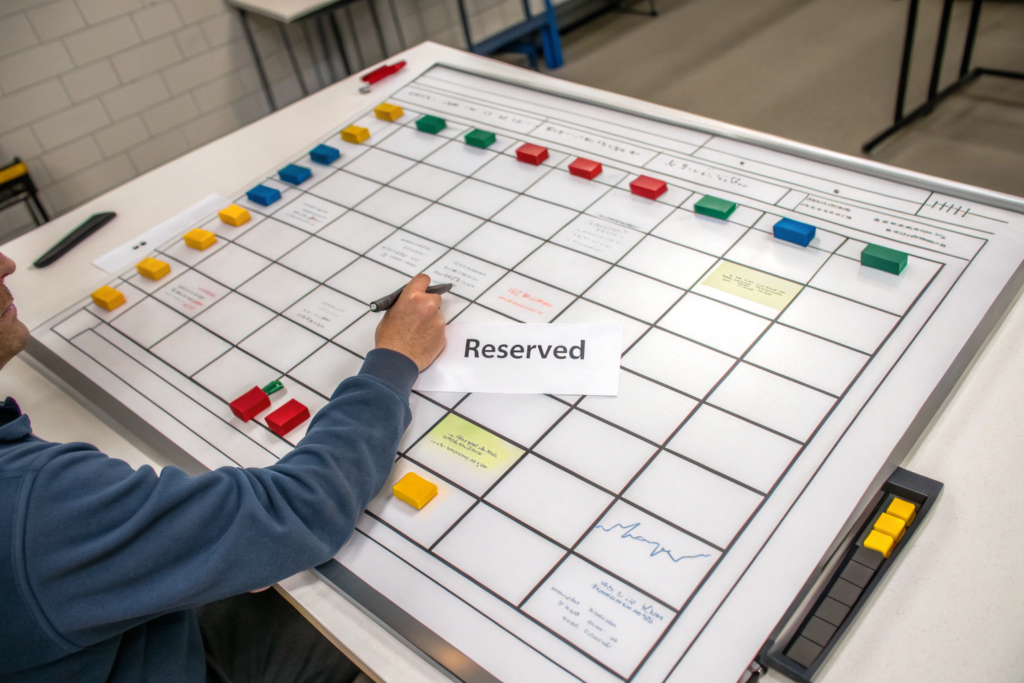
You reserve capacity by signing a simple capacity reservation agreement and paying a nominal holding deposit, typically a small percentage of the estimated order value. This agreement specifies the quantity of units you intend to produce, a rough product category, such as "woven shirts" or "knit polos," and the required ex-factory date window.
This reservation takes your order out of the speculative pipeline and places it into the confirmed production calendar. Our production planner allocates a specific line, a specific labor allocation, and a specific raw material procurement window to your order. This allocation is a hard commitment. We do not overbook our lines. If we reserve a slot for your 2,000 woven shirts, that slot is yours. We turn away other clients who request that capacity. The design details, the fabric, the trims, the logo, can be finalized later, typically up to four weeks before the cutting date. For a client launching a fall collection, we reserved their production slot in March for an August ex-factory date. They finalized their fabric choices and tech packs in June. The capacity was already secured. The production flowed into the pre-allocated slot without competing for resources. This model requires trust and forward planning, but for any brand with a seasonal collection calendar or a predictable reorder cycle, it is the most effective lead time insurance available. The capacity reservation model transforms the manufacturing relationship from transactional to partnership-based.
What Happens If My Design Changes After I Reserve a Slot?
Design flexibility within a reserved slot is a core feature of the model, not a bug. The capacity reservation reserves the production resources, labor, machine time, management attention. It does not lock you into a specific, unchangeable design.
You can adjust the fabric selection, the trim specifications, the logo placement, and even the style within the reserved product category, provided the adjustments do not fundamentally alter the production complexity or require a completely different raw material lead time. A woven shirt slot can accommodate a change from an Oxford button-down to a poplin camp collar shirt without disrupting the schedule. It cannot accommodate a change from a woven shirt to a heavily embroidered down jacket, because the required machinery, worker skills, and material supply chains are entirely different. We define the scope of flexibility in the reservation agreement. We ask for a preliminary design brief at the time of reservation. This brief gives our production team enough information to begin raw material sourcing and line tooling preparation, while leaving the creative details open for finalization. For a client who reserved capacity for a knitwear program, they initially planned a basic crewneck sweater. Three weeks before production, they shifted to a more complex cable-knit cardigan. The change was within the knitwear capability of the reserved line, so we accommodated it. The lead time did not shift because the production slot was already protected. This flexible manufacturing scheduling capability is what allows brands to respond to late-breaking trend information without sacrificing delivery reliability.
How Do Weekly Visual Updates Prevent Hidden Delays?
I once asked a client what the most stressful part of his previous manufacturing relationship had been. He did not say the price. He did not say a quality defect. He said, "The silence. The weeks of silence after I sent the deposit. I would lie in bed at night wondering if anything was actually happening with my money. Then, three days before the ship date, I would get an email saying the order was delayed by two weeks. The silence was the lie. The delay was just the consequence of the lie."
The "silence period" between deposit and delivery is where lead time failures incubate. A fabric delivery is three days late in week two. Nobody tells the buyer. The production team hopes to catch up. They do not. A zipper order is delayed. Nobody tells the buyer. The problems accumulate in the dark. The weekly visual update system is designed to shine a light on the production process every seven days, making it structurally impossible for a delay to grow in the shadows.
What Specific Information Does a Weekly Update Contain?
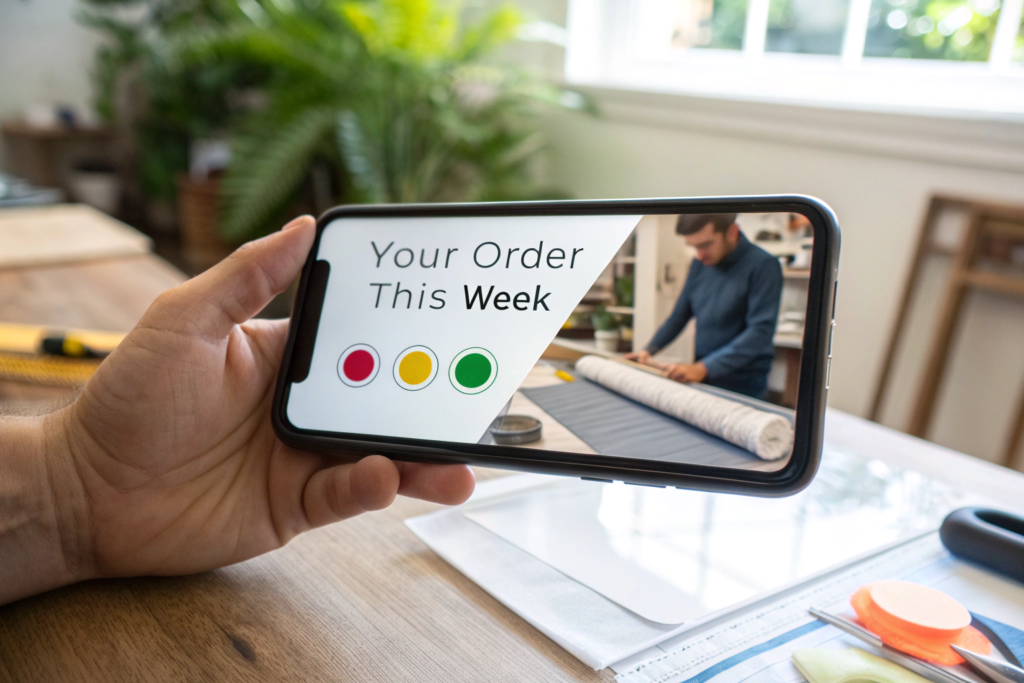
Our standard weekly update is a single email with three mandatory components: a real-time photograph of your specific goods at their current production stage, a simple traffic light status indicator for each major production phase, and an alert section that flags any deviation from the plan, even a minor one, with the corrective action already initiated.
Here is the exact structure of the update you receive every Friday, Shanghai time:
| Update Component | What It Shows | Why It Matters |
|---|---|---|
| Visual Progress Tracker | A horizontal bar showing % complete: Sourcing, Cutting, Sewing, Finishing, Packed. | Instant visual status. No interpretation needed. |
| Live Factory Floor Photo | A photo of your actual fabric, cut panels, or garments on our line, with your order tag visible. | Verifiable proof of progress. Eliminates "trust me" vagueness. |
| Traffic Light Alert | Green (on track), Yellow (minor issue, plan in place), Red (delay, options presented). | Proactive risk surfacing. You know about a problem before it affects the date. |
For a recent order of 1,200 fleece hoodies, the week-three update showed the cutting phase at 100% complete, with a photo of the cut panels bundled and labeled. The traffic light for sewing was green. The alert section noted: "Zipper pull custom dye lot approved one day late. Sewing start shifted by one day. No impact on final ship date." That single sentence prevented a week of anxious email exchanges. The client saw the micro-delay, saw that we had already absorbed it, and continued with their day. This proactive communication protocol is not a customer service extra. It is our internal accountability mechanism. We must surface the truth every Friday, because the client will see it in the photo and the traffic light. The discipline of the weekly photograph prevents the "silence and hope" culture that causes lead time failures in traditional factories.
How Do We Escalate a Delay into a Solution Before It Impacts Your Date?
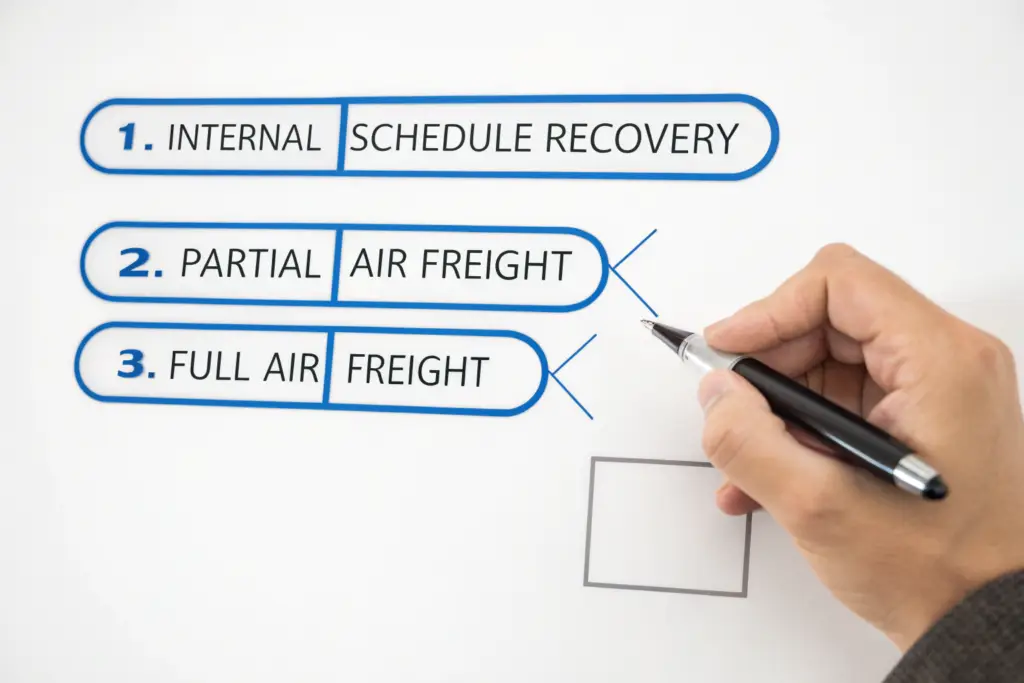
A delay detected early is a problem to be solved. A delay detected late is a crisis to be survived. Our escalation protocol is triggered the moment any production milestone deviates by more than 24 hours from the plan. The protocol has three pre-defined tiers of response.
Tier 1 is an internal recovery. The production team re-sequences work, adds overtime, or shifts resources from a less time-sensitive order to absorb a one-to-three-day delay within the existing schedule. The client is informed in the weekly update but does not need to take any action. Tier 2 is a logistics acceleration. If a delay of four-to-seven days emerges and cannot be internally absorbed, we present the client with a pre-costed menu of acceleration options. This typically means upgrading all or part of the shipment from sea freight to air freight. We present the exact cost, the revised delivery date, and a recommendation. The decision is the client's. Tier 3 is a collaborative re-plan. For delays exceeding a week, we schedule an immediate video call with the client. We present the root cause, the revised timeline, and multiple recovery scenarios. We discuss partial shipments, split deliveries, and direct-to-retail logistics options. For a corporate uniform order that faced a fabric dye lot failure, we executed a Tier 2 escalation. We air-freighted 500 units of the 2,000-unit order to meet the client's mandatory onboarding date, while sea-freighting the remaining 1,500 units. The client paid a portion of the air freight cost, we absorbed a portion, and the critical deadline was met. The escalation management protocol ensures that a problem is never just dropped on the client with a "sorry for the delay" email. A problem is always presented alongside a costed, actionable solution.
What Pre-Agreed Acceleration Options Should We Discuss Upfront?
A streetwear brand owner once told me about a disastrous experience with a previous supplier. His production was delayed by ten days. The supplier's only communication was an email that said, "Order delayed. New ship date is [ten days later]." No options. No recovery plan. No offer to accelerate. He lost a highly anticipated drop date with his fanbase. The social media backlash was intense. He told me, "I would have paid $2,000 for air freight in a heartbeat. They never even offered it. I think they did not know how."
Acceleration options should never be an emergency improvisation. They should be discussed, costed, and pre-agreed during the order negotiation phase, when both parties are calm and collaborative. This transforms a potential delay from a relationship-damaging crisis into a pre-planned operational decision.
When Should We Plan for Air Freight Before the Order Starts?
Air freight should be discussed at the quoting stage for any order that is time-sensitive, trend-driven, or has a hard retail delivery deadline. It should not be treated as a penalty for failure, but as a strategic tool with a known price tag.
I recommend that every client discuss a "Hybrid Logistics Plan" with Elaine at the time of the initial quote. This plan defines a base sea freight timeline and cost, and a parallel air freight timeline and cost for a partial or full shipment. The decision point is pre-agreed. For example: "If production completes on or before [Date X], goods ship via sea freight. If production completes after [Date X], goods ship via air freight to guarantee delivery by [Hard Deadline Y]." This pre-agreement removes the emotional negotiation from a delay situation. The decision is algorithmic, based on the pre-agreed dates and costs. For a client launching a capsule collection at a trade show, we pre-agreed that if the goods were not on the water by a specific date, we would automatically switch to air freight for 50% of the order to cover the show samples and initial wholesale orders. The production actually completed on time, so the air freight was not needed. But the client had complete peace of mind for the entire eight-week production period. They knew their trade show launch was protected, regardless of minor production variances. The air freight contingency plan is a standard part of our order negotiation, not an afterthought.
What Is a Partial Shipment and How Can It Save My Season?
A partial shipment splits an order into two deliveries. The first, smaller delivery is air-freighted to meet an urgent deadline. The second, larger delivery follows via standard sea freight. This balances the need for speed with the desire for cost efficiency.
We used this strategy for a corporate uniform order that faced a three-day production delay. The client needed 200 units for a national sales conference. The remaining 800 units were for a rolling warehouse distribution. We air-freighted 200 units directly to the conference hotel. The cost was $680. The remaining 800 units shipped via sea freight at the standard cost. The conference happened on time. The sales team wore the new uniforms. The brand image was protected. The total logistics cost increase was $680 on a $28,000 order, roughly 2.4%. The cost of missing the conference, in terms of internal brand credibility and the wasted conference sponsorship fee, would have been orders of magnitude higher. Partial shipments can also be directed to different locations. We can air-freight a small quantity to a key retail account for a floor-set date, while sea-freighting the bulk inventory to a central warehouse. This split shipment logistics capability requires a factory with flexible warehouse and packing operations. We build this flexibility into our logistics planning. Ask Elaine about partial shipment scenarios during your quoting process. Knowing the cost and the mechanics in advance makes it an easy lever to pull if the production calendar tightens.
Conclusion
Lead time reliability is not achieved by hoping nothing goes wrong. It is achieved by building a system that makes delays impossible to hide, and by pre-engineering recovery options that make delays easy to solve. The three-part protocol I have described, capacity reservation to lock your production slot weeks before design finalization, weekly visual updates to surface micro-delays within 48 hours, and pre-agreed acceleration options to make recovery a calm, costed decision, is how we have built a track record of on-time delivery that our clients depend on. The key shift is from a reactive, information-hoarding supplier relationship to a proactive, transparent partnership where problems are shared early and solved collaboratively.
If you are ready to experience a manufacturing timeline that you can actually plan your business around, I invite you to start the conversation before you have a finalized design. Contact our Business Director, Elaine, at elaine@fumaoclothing.com. Tell her your estimated order volume, your product category, and your ideal delivery window. She will walk you through our capacity reservation process, our weekly update format, and our hybrid logistics planning. Secure your production slot now, finalize your design later, and let us show you what on-time delivery actually feels like.