Sourcing golf apparel from Asia offers undeniable advantages in cost and scalability, but it also presents a pervasive and costly hidden risk: counterfeit or invalid OEKO-TEX and other safety certificates. You receive a PDF that looks official, the supplier assures you it's genuine, and the order proceeds—only for your shipment to be held at customs, rejected by retailers, or worse, cause a consumer safety incident due to non-compliant materials. In an industry where trust is paramount but verification is complex, how can you protect your brand from the severe financial and reputational damage of fake certificates?
To avoid fake certificates when sourcing golf apparel from Asia, you must adopt a proactive, verification-based approach rather than a passive, trust-based one. This involves three critical actions: demanding specific, original documentation; conducting live, independent database checks; and verifying the chain of custody from the certified material to your production batch. Treating certificate verification as a non-negotiable step in your supplier qualification process is your primary defense.
A brand we now work with learned this lesson painfully. They sourced 8,000 units of performance polos from a factory that provided an OEKO-TEX certificate. The shipment cleared initial export but was impounded at EU customs. The provided certificate number was valid but for a different company—a classic case of certificate forgery. The resulting delays, fines, and lost sales wiped out their profit margin for the entire season. At Shanghai Fumao, we turn this vulnerability into a transparency showcase: we invite clients to joint video calls where we log into the official OEKO-TEX database and verify our certificates in real-time. This level of openness is what separates legitimate partners from risky suppliers.
1. The Red Flags: How to Spot a Dubious Certificate Immediately
Before you even reach for the database, a close inspection of the document itself can reveal obvious warning signs. Treat every certificate with healthy skepticism and examine it forensically.
Fake certificates often have tell-tale signs of poor manipulation, vagueness, or procedural irregularities. Your first line of defense is a meticulous visual and contextual audit of the document provided.

Visual and Contextual Red Flags
- Poor Image Quality: The document is a low-resolution scan, blurry photocopy, or screenshot where text appears pixelated. This can obscure altered details.
- Formatting Inconsistencies: Look for mismatched fonts, misaligned text, or logos that appear stretched or low-quality compared to official samples from OEKO-TEX websites.
- Vague or Generic Details: The "Article Description" is overly broad (e.g., "Polyester Fabric" instead of "100% Polyester Pique Knit, Dyed"). The "Certificate Holder" name may be slightly different from the supplier's legal name without explanation.
- "Pending" or "Applied For" Status: OEKO-TEX certification is a pass/fail outcome for a submitted sample. There is no "pending certification" for production. A supplier claiming this is stalling or misleading you.
- It's Not a Certificate, But a "Letter of Conformity": Some suppliers issue their own internal "Compliance Letter." This is a self-declaration, not an independent certification. It is worthless for compliance purposes.
The First Request: Ask for the Right Documents
Your initial request must be precise. Email your supplier:
"Please provide the original, clearly scanned OEKO-TEX Standard 100 certificate for the specific fabric to be used in our [Product Name] order. The certificate must show the unique certificate number, issue/expiry dates, Product Class I designation, and a detailed article description. We also require the name of the issuing institute."
A legitimate factory will provide this within hours. Hesitation or obfuscation is a major red flag.
2. The Definitive Verification: Using Official Databases Live
The single most powerful step you can take is to independently verify the certificate number in the official, public database maintained by the certification body. This removes all reliance on the supplier's word.
For OEKO-TEX, this means using the OEKO-TEX Certificate Check. For other common standards (like GOTS, Bluesign), locate their respective online registers. This live check confirms existence, validity, and accurate details.
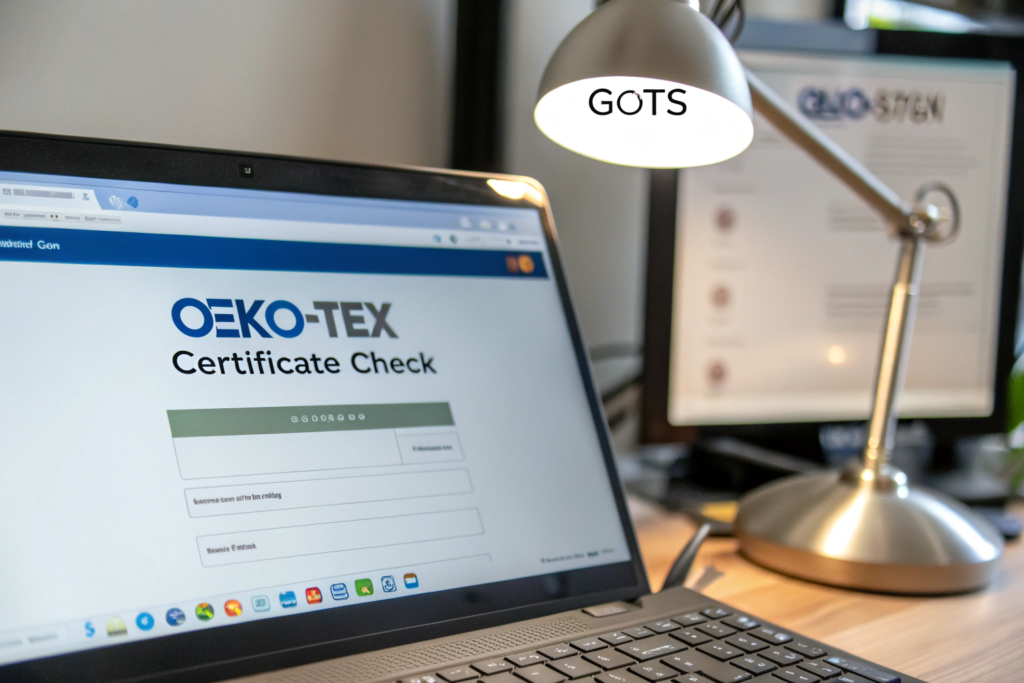
Step-by-Step Guide to the OEKO-TEX Database Check
- Navigate: Go to the official OEKO-TEX website and find the "Certificate Check" or "Verify a Certificate" section.
- Enter Data: Input the unique certificate number from the document provided by your supplier.
- Analyze the Results: A valid certificate will display and must match on these key points:
- Certificate Holder: The company name must match your supplier or their nominated mill.
- Product Class: Must clearly state "Product Class I" for golf apparel.
- Article Description: Must accurately match the material you are sourcing.
- Validity Date: The certificate must be current. Production must occur within its validity period.
Crucial Action: Perform this check on a live video call with your supplier. Say, "Let's verify the certificate together right now. Please share your screen and navigate to the database." A genuine, confident supplier will comply immediately. This practice, which we standardize at Shanghai Fumao, eliminates fraud absolutely.
What Database Results Reveal
- Green Flag: All details match perfectly. Status is valid.
- Red Flag - No Record: The number is invalid. The certificate is fake.
- Red Flag - Details Mismatch: The company or product listed is different. This indicates certificate copying or reuse.
- Red Flag - Expired: The certificate is no longer valid for new production.
3. Beyond the Database: Auditing the Chain of Custody
A certificate can be valid but still not apply to your order. The final layer of verification ensures the certified material is what's being used in your production. This is about traceability.
You must connect the abstract certificate to the physical goods. This requires your supplier to have a system that links material batch/lot numbers to specific certificates.
Key Questions to Uncover Chain-of-Custody Gaps
Ask your supplier these pointed questions:
- "Can you show me the batch or lot number on the fabric roll for our order, and how it links to this certificate number?"
- "What is your process to ensure fabric from a non-certified batch is not mixed into our production?"
- "Will the certificate number and corresponding material lot number be stated on our commercial invoice or packing list?"
A professional factory will have answers. At our factory, this is embedded in our quality assurance system. When certified fabric arrives, our QC records the lot number and cross-references it with the valid certificate before approving it for the cutting room. We provide this traceability information to clients as part of our full-package manufacturing documentation.
The Risk of "Certificate Fishing" or "Mill Sharing"
A common trick is "certificate fishing": a supplier obtains one genuine certificate from a reputable mill and then uses it to validate shipments of similar-looking but cheaper, uncertified fabric from other sources.
Your defense: Insist that the certificate holder is either your direct supplier or that they provide a formal authorization letter from the mill, specifically naming your supplier and your order, permitting the use of that certified material. Better yet, work with a vertically integrated manufacturer like us, where we control the fabric source and its certification directly.
4. Building a Fraud-Resistant Sourcing Protocol
To systematize your defense, integrate these steps into your company's sourcing checklist.
Create a mandatory "Certificate Verification Protocol" for all new suppliers and orders. This makes due diligence a non-negotiable business process, not an ad-hoc task.
A Sample Sourcing Checklist
- Pre-Order:
- Request original, scanned certificates for all key materials.
- Conduct live video verification of all certificates in official databases.
- Confirm Product Class is I (or appropriate level).
- Verify certificate validity covers production timeline.
- Pre-Production:
- Obtain and record material lot numbers from the supplier.
- Confirm link between lot numbers and certificate numbers.
- Approve a Pre-Production (PP) sample made from the certified lot.
- Shipment:
- Require certificate numbers and lot numbers on shipping documents.
- Retain all documentation for your compliance files.
By following this protocol, you shift the power dynamic. You are no longer a hopeful buyer but an informed partner conducting an audit. This alone will deter most dishonest suppliers.
Conclusion
The threat of fake certificates is not a reason to avoid sourcing from Asia; it's a reason to elevate your due diligence and partner selection criteria. By mastering verification, you transform a major sourcing risk into a strategic filter that identifies truly professional, transparent, and reliable manufacturing partners.
The process separates factories that merely sell from those that are qualified to partner. It protects your brand's finances, reputation, and most importantly, the trust of your customers.
When you choose to partner with Shanghai Fumao, you choose a manufacturer that not only meets but welcomes this level of scrutiny. Our systems are built for transparency, and our certifications are your guarantees, open for verification at any moment. Let us show you how a true partnership works. Contact our Business Director, Elaine, to begin with a transparent review of our certifications and capabilities: elaine@fumaoclothing.com.