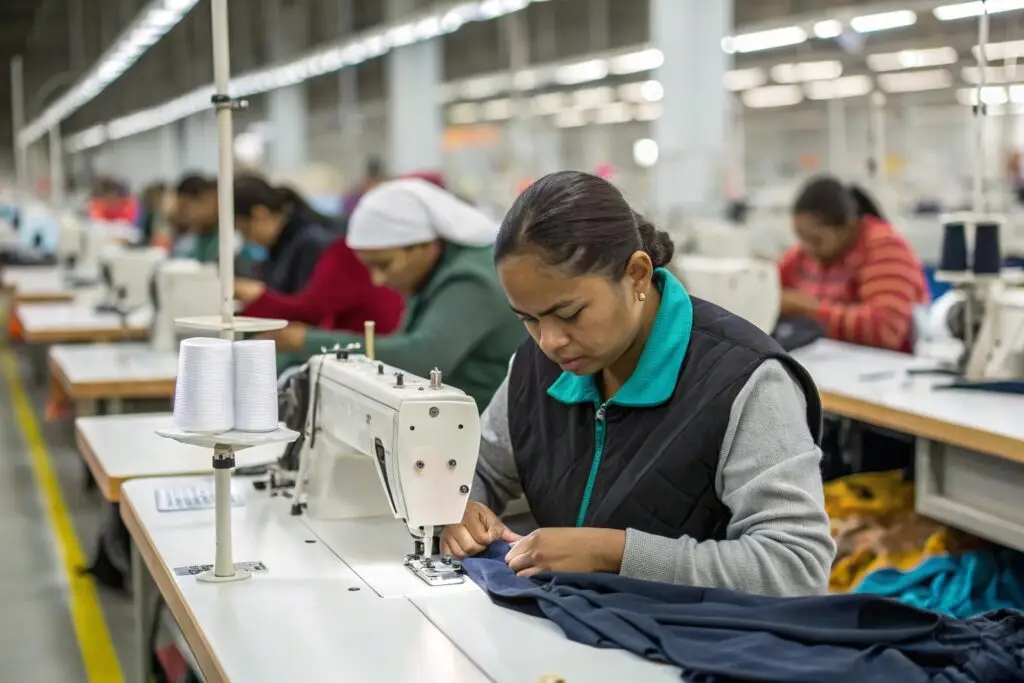
From fast fashion cycles to custom batches, clothing production moves fast. But how much can a real factory worker actually sew in one day?
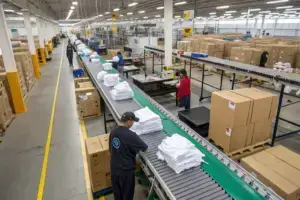
Depending on the garment complexity and factory setup, a single garment worker can sew between 50 to 150 clothing pieces per day—typically as part of an assembly line.
The answer varies by fabric, design, equipment, and labor conditions. Let’s break it down.
How many shirts can be made in a day?
T-shirts are one of the simplest garments to produce, often used to measure a factory’s sewing efficiency.
A skilled worker on an assembly line can produce 80 to 150 T-shirts per day, while a full line of workers can make thousands daily.

How does this number change?
It depends on:
- Factory setup1 – Manual vs. semi-automated
- Operation breakdown – One worker per task vs. full-garment sewing
- Material type2 – Stretchy knits are faster than slippery silks
- Design complexity3 – Graphics, collars, pockets all add time
| Shirt Type | Estimated Daily Output per Worker |
|---|---|
| Basic crewneck T-shirt | 100–150 units |
| Polo shirt with collar | 60–80 units |
| Button-down shirt | 40–60 units |
I’ve worked with factories in Bangladesh that run two shifts producing 8,000–10,000 T-shirts per day using 100+ workers in a tightly managed line. In contrast, a small LA workshop might make 300 custom tees a day—with more care, less speed.
What impacts daily output?
- Skill level of the operators
- Machine type (lockstitch, overlock, flatlock)
- Number of helpers for cutting, pressing, packing
- Defect handling and quality control steps
The more automated and specialized the task, the higher the output.
What is the average number of clothing items?
A factory worker rarely makes an entire piece alone. Most are responsible for just one step in the garment construction process.
On average, a garment worker in a cut and sew facility produces between 50 and 120 clothing units per day, depending on the garment and workflow model.

What does a typical daily breakdown look like?
| Garment Type | Units per Day (per worker) |
|---|---|
| T-shirts | 100–150 |
| Dresses | 30–60 |
| Jeans | 40–70 |
| Jackets | 20–40 |
| Leggings | 80–100 |
In a line system, a worker may do just sleeve attachment all day. In smaller workshops, one tailor might do the whole garment—slowing the total output but increasing craftsmanship.
What are the key variables?
- Fabric handling time4
- Trims and finishings (zippers, buttons, lace)
- Seasonal pressure or overtime hours5
- In-line quality inspection6 frequency
I once observed a factory in Vietnam where each worker could produce over 100 leggings per day—but that number dropped when a new waistband style was introduced. Even small design changes affect speed.
How many hours a day do garment workers work?
The garment industry is infamous for long hours—especially in developing countries. But hours vary widely by region and brand oversight.
Garment workers typically work 8 to 12 hours per day, often 6 days a week. In some factories, especially in fast fashion supply chains, shifts may extend to 14 hours during peak seasons.

What’s common in different regions?
| Region | Typical Daily Hours7 | Notes |
|---|---|---|
| Bangladesh | 10–12 hours | Some overtime8 beyond legal limit |
| China | 8–10 hours | Improved in major cities |
| Vietnam | 9–11 hours | Common to see 6-day workweeks |
| USA | 8 hours | Regulated, often no weekends |
| India | 9–12 hours | Dependent on factory size |
Workers in some fast fashion supply chains report 60+ hour weeks. Ethical factories, however, often cap shifts and provide rotating breaks.
Why do hours run so high?
- Tight deadlines from brands
- Penalties for delays
- Low base wages, pushing workers to accept OT
- Poor enforcement of labor laws in some countries
This is why brands with transparent labor practices are gaining traction—because hours directly affect the quality of both life and garment.
What is a reasonable amount of clothes to have?
Let’s flip the perspective—from how many clothes are made, to how many we need.
A reasonable wardrobe size is around 50–100 items, including basics, workwear, outerwear, and seasonal pieces—depending on your lifestyle.

How does this break down?
| Category | Average Count |
|---|---|
| Tops | 15–25 |
| Bottoms | 10–15 |
| Dresses/Jumpsuits | 5–10 |
| Jackets/Coats | 3–6 |
| Shoes | 5–10 |
| Occasionwear | 2–5 |
| Accessories | As needed |
Most people wear only 20% of their wardrobe regularly. Capsule wardrobes9 (around 30–40 key pieces) are rising in popularity for their simplicity and sustainability.
Why does this matter for manufacturing?
- Overconsumption drives overproduction
- Fast fashion leads to fast waste
- Sustainable brands design for longer wear, fewer pieces
- Custom-fit or made-to-order slows consumption and raises value
I once worked with a DTC brand that encouraged “slow closet” thinking. Their best customers weren’t the ones buying weekly—they were the ones wearing their favorites 100+ times.
Conclusion
Garment workers sew thousands of pieces each week, often under intense pressure. But better systems—like ethical labor policies, customization, and smarter production—are changing that. The more we value fit, quality, and purpose, the fewer pieces we need—and the better the future looks for everyone.
-
Understanding factory setup can help optimize production processes and improve efficiency in manufacturing. ↩
-
Learning about material types can enhance decision-making for faster and more efficient production in the fashion industry. ↩
-
Exploring design complexity can reveal insights into production timelines and resource allocation in garment manufacturing. ↩
-
Understanding fabric handling time is crucial for optimizing production efficiency and reducing costs in garment manufacturing. ↩
-
Exploring this topic can reveal strategies to manage production schedules effectively during peak seasons. ↩
-
In-line quality inspection ensures that defects are caught early, improving overall product quality and reducing waste. ↩
-
Understanding typical daily hours can help you compare work-life balance across regions and industries. ↩
-
Exploring overtime regulations can reveal how labor laws impact worker rights and compensation globally. ↩
-
Explore the advantages of capsule wardrobes for a sustainable and simplified lifestyle, reducing clutter and promoting mindful consumption. ↩