You're planning your next collection and wondering whether to start with a small test run or go all-in with a larger production. The numbers on your estimate seem to change dramatically based on quantity, but why does this happen, and how can you use this knowledge to your advantage?
Order volume directly impacts your per-unit production cost through economies of scale - the economic principle that describes per-unit cost decreasing as production volume increases. This happens because fixed costs like pattern making, sampling, and machine setup are distributed across more units, while material purchasing power improves with larger quantities. Understanding this relationship helps you make smarter decisions about production quantities, inventory management, and pricing strategy.
Let's explore exactly how different order sizes affect your bottom line and how you can optimize your production strategy.
How Do Fixed Costs Distribute Across Different Order Sizes?
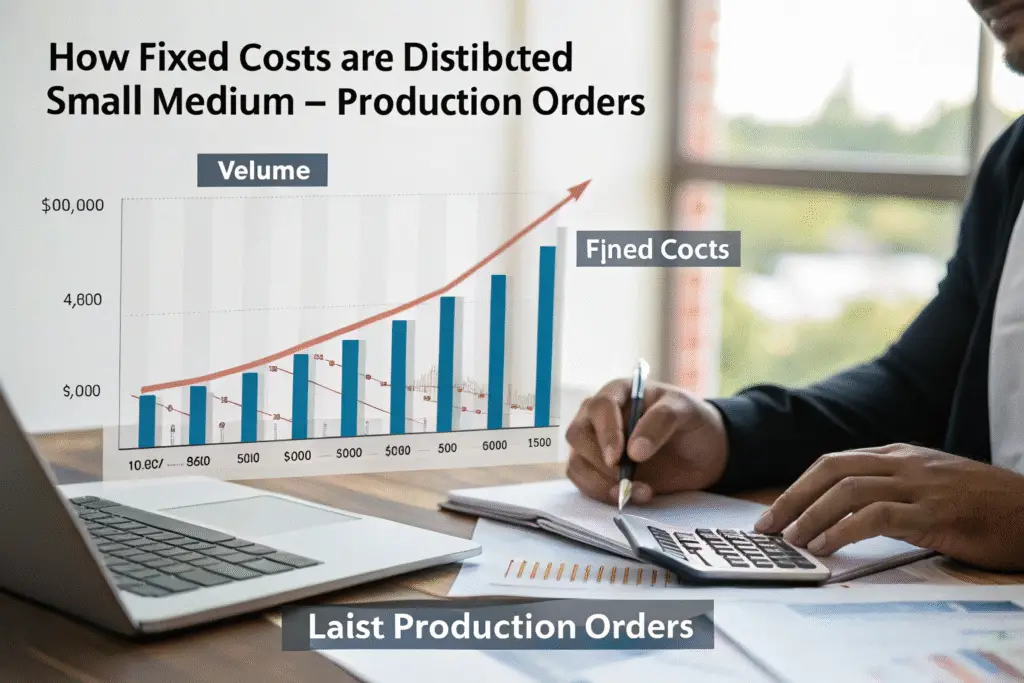
Fixed costs remain constant regardless of how many units you produce. These costs don't change with volume, but their impact on your per-unit price decreases significantly as you order more pieces.
Pattern making, tech pack development, and production line setup represent significant upfront investments that are amortized across your entire order quantity.
What fixed costs are typically included in clothing production?
The main fixed costs include pattern making ($150-400 per style), sample development ($200-600 per sample), machine setup ($100-300 per style), and quality control system setup. These costs remain the same whether you produce 100 or 10,000 units. We recently worked with a streetwear brand that invested $850 in pattern making and sampling for a hoodie design. At 500 units, this added $1.70 to each garment. When they reordered 3,000 units, the same fixed costs added only $0.28 per hoodie, representing an 84% reduction in fixed cost allocation per piece.
How significant is the per-unit cost reduction?
The per-unit cost reduction can be dramatic, particularly between small and medium-sized orders. Our data shows that moving from 500 to 2,000 units typically reduces per-unit costs by 25-35%, while scaling from 2,000 to 5,000 units yields an additional 15-20% reduction. The savings become less pronounced beyond 10,000 units as you've already captured most efficiency gains. A contemporary women's brand we work with saved 32% per unit on their silk blouse by increasing from 800 to 3,000 units, allowing them to maintain their retail price while improving their profit margin by 18%.
How Does Material Purchasing Power Increase With Volume?
Larger quantities give manufacturers significant leverage when purchasing raw materials, and these savings are typically passed along to you through better fabric and trim pricing.
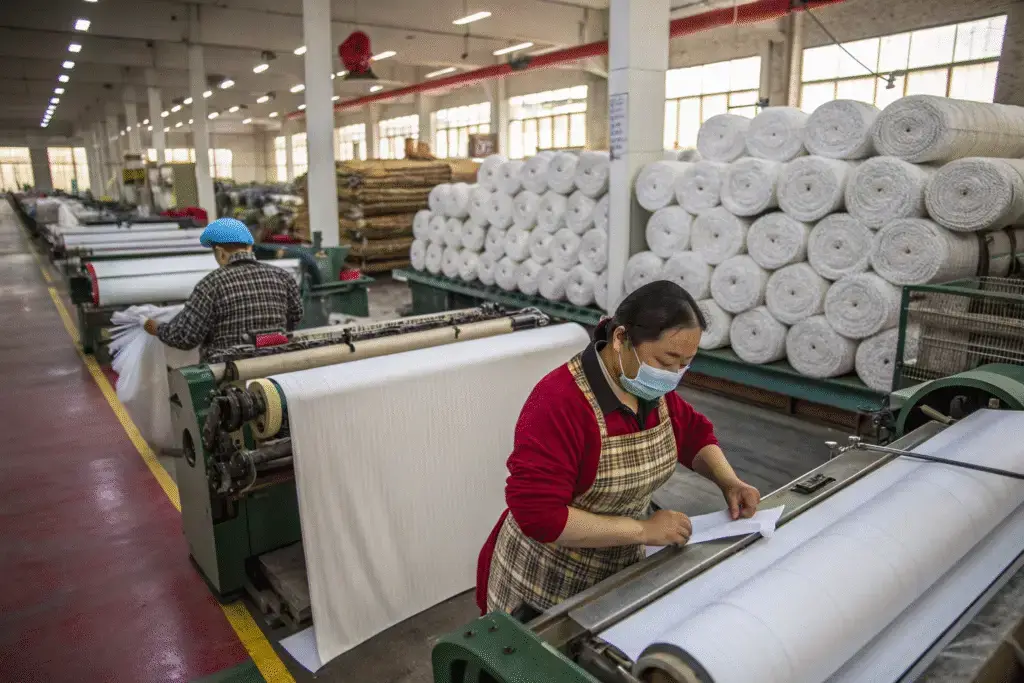
Textile mills and trim suppliers offer substantial discounts for bulk purchases, making your material costs more efficient at higher volumes.
What material cost savings can you expect?
Material savings typically range from 10-25% when moving from small to medium quantities and can reach 30-40% for very large orders. These savings come from multiple factors: mill pricing tiers, reduced waste through optimized fabric cutting, and more efficient material utilization. Last season, a sustainable activewear brand saved 28% on their recycled polyester fabric by consolidating three separate 1,000-yard orders into one 5,000-yard purchase. The larger order qualified for the mill's bulk pricing tier and reduced shipping costs per yard by 40%.
How does volume affect trim and accessory pricing?
The same principles apply to trims, labels, and packaging. Custom woven labels that cost $0.35 each at 1,000 units might drop to $0.18 at 10,000 units. Zippers, buttons, and specialized fasteners follow similar pricing structures. We helped a denim brand reduce their custom hardware costs by 42% when they increased their order from 2,000 to 8,000 pieces. The supplier was able to run a continuous production batch rather than multiple smaller runs, significantly reducing their manufacturing costs.
How Does Production Efficiency Improve With Larger Runs?
Manufacturing processes become significantly more efficient at higher volumes. Workers develop muscle memory, quality becomes more consistent, and machines require fewer changeovers.
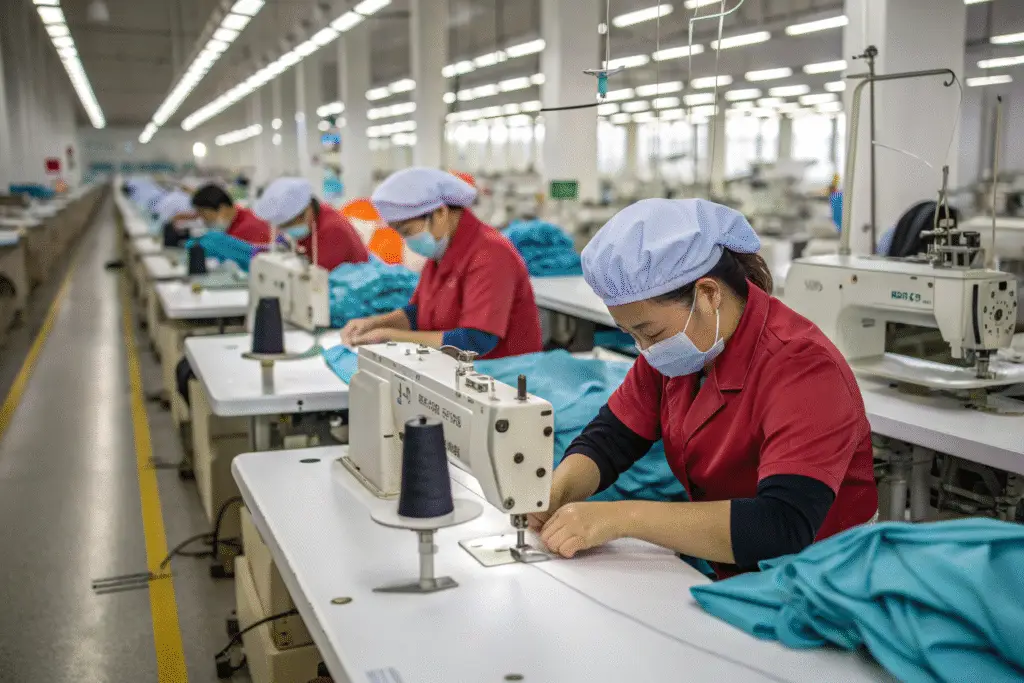
The learning curve effect means that as workers repeat the same operations, they become faster and more precise, reducing labor time and improving output quality.
What is the learning curve effect in garment production?
The learning curve effect describes how production time decreases as workers gain experience with a specific style. Industry data shows that assembly time typically decreases by 10-15% each time production volume doubles, up to a certain point. This is why the first 500 units of a complex jacket might take 45 minutes each to assemble, while units 3,000-3,500 might take only 28 minutes. We documented this with a client's tailored blazer: their initial run of 800 pieces required 38 minutes of labor each, while their reorder of 2,500 units required only 29 minutes - a 24% reduction in sewing labor time.
How does volume affect quality consistency?
Higher volumes often lead to better quality consistency because workers and quality controllers become intimately familiar with the specific requirements of each style. With smaller runs, by the time operators master the construction techniques, the production is complete. We track first-pass yield rates across different order sizes and consistently find that orders above 3,000 units have 8-12% higher first-pass quality rates than orders below 1,000 units. This means fewer repairs, less waste, and more consistent products for your customers.
What Are The Strategic Implications For Your Business?
Understanding the volume-cost relationship helps you develop smarter production and inventory strategies that balance cost efficiency with business risk.
The optimal order quantity depends on your sales velocity, storage costs, and risk tolerance - it's not always about maximizing volume.
How can you leverage volume pricing without over-ordering?
Consider these strategies: consolidated ordering (grouping multiple styles in one production run), phased production (larger initial order followed by smaller replenishments), and collaborative ordering (partnering with complementary brands). A children's wear brand we work with successfully implemented consolidated ordering for their basic styles across different collections. By producing 8,000 units of their core organic cotton jersey across multiple colorways in one order, they achieved bulk pricing while maintaining collection flexibility. Their per-unit cost decreased by 34% compared to separate 2,000-unit runs.
What's the optimal order quantity for your business?
The optimal quantity balances per-unit cost savings against inventory carrying costs and demand uncertainty. Use this framework to decide:
| Order Size | Cost Advantage | Risk Level | Best For |
|---|---|---|---|
| 500-1,000 units | Higher per-unit cost | Lower risk | New brands, test styles |
| 2,000-5,000 units | Significant savings (25-40%) | Moderate risk | Established styles, seasonal collections |
| 5,000-10,000+ units | Maximum savings (35-50%+) | Higher risk | Basic styles, proven bestsellers |
We recommend new clients start with production runs of 800-1,500 units per style, then scale to 3,000-5,000 units for successful styles. One of our most successful clients now uses a 5,000-unit initial order for proven styles with a 2,000-unit replenishment order capability for unexpected demand, optimizing both cost efficiency and flexibility.
How Can You Access Volume Pricing With Smaller Orders?
You don't always need massive order quantities to benefit from volume pricing. Several strategies can help smaller brands access better pricing.
Creative approaches to production planning and ordering can deliver significant cost benefits even with modest quantities.
What strategies work for smaller brands?
Consider fabric pooling (combining with other brands to reach mill minimums), style simplification (reducing the number of SKUs), and year-round production of core items. We helped three emerging activewear brands collectively purchase performance fabric to reach the 5,000-yard minimum for premium pricing. Each brand maintained their unique designs but shared common base fabrics, reducing their material costs by 22% while only ordering 1,500-2,000 units each.
How does repeat ordering affect your pricing?
Building a relationship with consistent repeat orders can sometimes deliver similar benefits to large one-time orders. Manufacturers value reliable, predictable business and may offer improved pricing to loyal clients. We have several brands that place modest initial orders (1,000-2,000 units) but maintain consistent production scheduling across seasons. Because of their reliability and growth potential, we extend volume-level pricing on their third or fourth production cycle, even though their individual orders remain in the 2,000-3,000 unit range.
Conclusion
Order volume significantly impacts your clothing production costs through fixed cost distribution, material purchasing power, and production efficiency. While larger orders generally deliver better per-unit pricing, the optimal quantity for your business must balance cost savings against inventory risk and cash flow requirements. Smart brands use a strategic approach to production planning, leveraging volume advantages where possible while maintaining flexibility for changing market demands.
If you're looking for a manufacturing partner who provides transparent volume-based pricing and helps you optimize your production strategy, let's discuss your needs. At Fumao Clothing, we work with brands of all sizes to develop production plans that maximize cost efficiency while managing business risk. Contact our Business Director, Elaine, at elaine@fumaoclothing.com to analyze how order volume could affect your specific production costs.