You're a designer pushing boundaries. You envision a weekday pant in a crushed velvet that feels like a cloud, or a neon technical jacket that's both vibrant and safe for sensitive skin. The vision is rare, but the roadblocks are common: "That dye can't be certified." "That finish might not pass testing." "The lead time for testing new materials is too long." Your creativity hits a wall of chemical compliance. But what if compliance wasn't a barrier, but the very framework that enables and protects your most innovative work? At Shanghai Fumao, this is our reality.
Fumao’s OEKO-TEX compliance framework actively supports rare style development by providing a curated, pre-vetted material library, a proactive co-development process for new treatments, and a risk-managed pathway to bring technically complex designs to market. It transforms safety from a restrictive checklist into a creative foundation, allowing designers to explore unconventional fabrics, dyes, and finishes with the confidence that the end product will meet the highest global safety standards without compromising aesthetic ambition.
For us, compliance is not the end of the conversation; it's the starting point for innovation. It means we have already done the groundwork to understand the boundaries, so we can help you navigate—and even push—them safely. This turns a potential bottleneck into a unique competitive advantage for developing styles that stand out.
The Foundation: A Curated Library of Certified "Rare" Materials
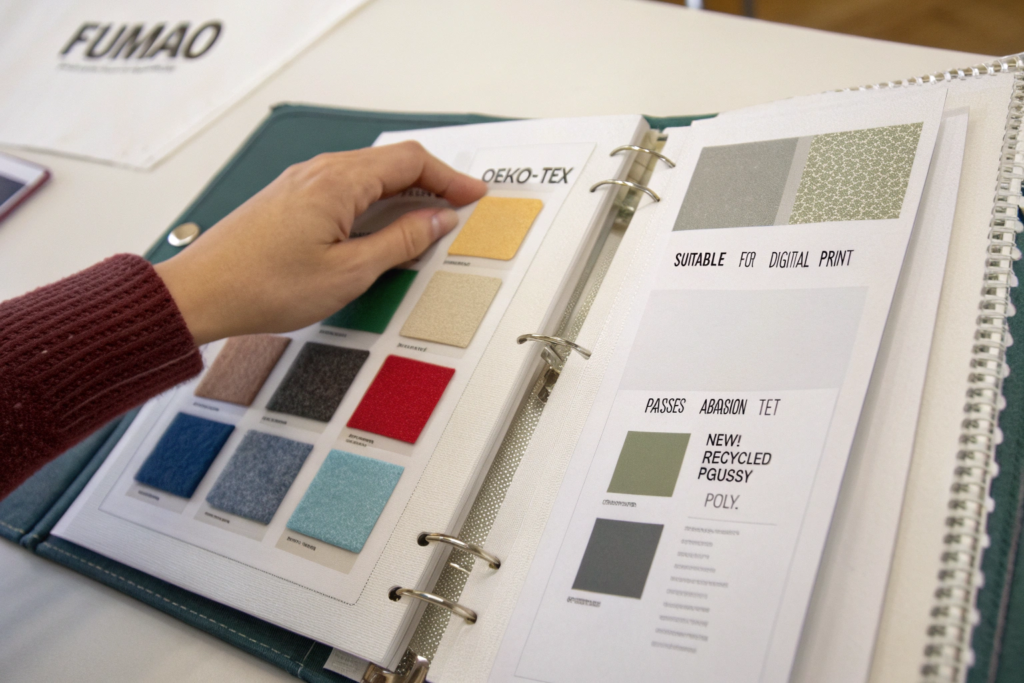
The biggest hurdle in rare style development is sourcing materials that are both unique and certifiable. Most factories treat these as separate, sequential challenges: first find the fabric, then see if it can pass. At Fumao, we invert this process. We have built a proprietary, continuously updated library of OEKO-TEX certified materials that already include unconventional options. This library is our first tool in supporting your vision.
This library isn't just basic cottons and polyesters. It includes categories critical for distinctive styles:
- Specialty Knits: Brushed French Terry with unusual composition blends, bouclé yarns, heat-transfer jacquards.
- Technical Fabrics: Recycled nylon with unique matte or gloss coatings, performance blends with inherent stretch and moisture-wicking properties that are pre-certified.
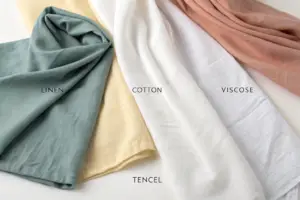
- Eco-Innovations: Tencel™ blends with crushed textures, organic cotton in rare heavyweights, deadstock fabrics with accompanying valid certificates.
When a client approached us with a concept for a line of "office-to-evening" separates using a silk-like cupro fabric, they feared the dyeing process would be a compliance nightmare. Because we had already sourced and certified a cupro blend from a partner mill for a previous project, we could immediately provide swatches and the corresponding OEKO-TEX certificate. This saved 6-8 weeks of fabric sourcing and testing time, allowing the client to fast-track development.

How Does This Library De-Risk the Sampling Phase?
Sampling is expensive and time-consuming, especially for rare styles. The fear of a failed compliance test after investing in sample making paralyzes creativity. Our library mitigates this by guaranteeing that any material selected from it is already compliant. This allows designers and brand owners to sample with confidence, focusing purely on aesthetic, drape, and function. They can create their first prototype knowing it has a clear pathway to bulk production.
Furthermore, we categorize materials not just by composition, but by their certification level (Class I, II, etc.) and the specific chemical treatments they have already passed (e.g., "approved for water-based coating X," "compatible with metal-complex dye Y"). This granularity turns the library into a powerful design tool. A designer can ask, "What certified fabrics can achieve a vintage, garment-dyed look?" and we can provide specific options with proven dye formulas.
What About Materials Not in the Library?
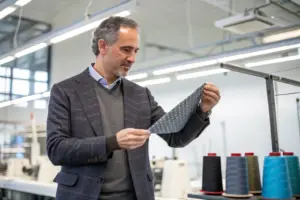
For truly groundbreaking materials outside our library, our compliance framework provides a structured, transparent process for onboarding them. We have established relationships with third-party testing labs like Hohenstein and TESTEX. We guide clients through a feasibility assessment: we submit the new fabric or trim for a preliminary screening test against key OEKO-TEX parameters. This pre-test gives a go/no-go signal before full sampling, managing both cost and creative expectations early. We treated a new bio-based water-repellent finish this way for a sustainable outdoor brand, validating its compliance potential before they committed to the entire collection.
The Process: Proactive Co-Development from Sketch to Spec
Rare styles often involve complex construction or novel finishing techniques. Here, Fumao’s compliance expertise becomes an active ingredient in the development process itself. Our technical designers and QC managers work alongside your team from the initial sketch, not just at the pre-production stage.
This co-development model means we ask compliance-informed questions during the creative phase:
- "This planned distressed wash: will we use pumice stones or enzymatic agents? The enzymes need to be on the approved list."
- "This laser-cut pattern on the leather patch: the laser process itself is fine, but the backing adhesive must be certified."
- "For this neon binding tape, we have three certified pigment dye options. Here are the color accuracy samples for each."
By integrating these discussions early, we prevent costly and demoralizing last-minute changes. Last year, we collaborated with a brand on a deconstructed blazer with a signature welded seam. The initial welding tape they sourced failed phthalate tests. Because we were involved from the tech pack stage, we identified this risk early and sourced an alternative, certified thermoplastic tape that performed identically in the welding process, keeping the design intent and timeline intact.
How Does Compliance Influence Technical Design Decisions?
Our team uses compliance knowledge to suggest design adaptations that enhance both safety and style. For instance, if a design calls for a metal grommet, we might recommend a specific nickel-free alloy from a certified supplier that also has a superior antique finish. If a style requires a functional dye, we might propose a low-impact reactive dye from a certified palette that achieves a unique, heathered effect impossible with conventional dyes.
This turns restrictions into inspiration. We had a client obsessed with a specific shade of cobalt blue for a performance legging. The standard dye route used heavy metals. Our fabric R&D team worked with the mill to achieve an identical color depth using a combination of certified organic dyes and a modified dyeing protocol, resulting in a color that was not only compliant but also had exceptional colorfastness—a functional improvement born from a compliance challenge.
What is the Role of In-House Testing in Accelerating Development?
While we rely on accredited labs for final certification, we maintain in-house rapid test kits for parameters like formaldehyde, pH, and colorfastness. This allows us to perform "sanity checks" on new sample developments within 24 hours. If a new fabric treatment from a mill looks promising, we can screen it in-house before sending it for full, costly OEKO-TEX testing. This rapid feedback loop accelerates iteration, crucial for refining rare styles where small adjustments to hand-feel or shade are everything.
The Assurance: Risk-Managed Scaling of Complex Productions
Taking a rare style from a single, beautiful sample to a consistent, compliant production run of thousands is where many projects fail. Fumao’s compliance systems are designed specifically to manage this scale-up risk.
Our full-package control is critical here. Because we manage the entire chain—from ordering certified raw materials to in-house cutting, sewing, and finishing—we maintain a closed loop. This prevents the introduction of non-compliant elements during secondary processes. For a style involving a custom digital print, we don't just outsource to any printer. We work with a partner whose inks and processes are pre-audited and certified, and we batch-test prints from every production run.
We also implement something we call "Style-Specific Compliance Protocols." For each unique style, especially those with rare elements, we create a one-page summary that hangs on the production floor. It lists:
- The OEKO-TEX certificate numbers for every component.
- Approved chemical agents for any washing or finishing (e.g., "Softener Code #SF-203 only").
- Critical control points for assembly (e.g., "Use adhesive #AD-45 for bonded seam at yoke").
This ensures that every worker, from the spreading table to the final packer, understands the specific requirements that make this particular style both rare and compliant.

How Does This System Prevent "Style Drift" in Bulk?
"Style drift" is when the bulk production garments subtly deviate from the approved sample in look or feel, often due to substitutions or process variations. Our compliance protocols lock in the approved materials and processes contractually and physically. Our warehouse will not release a different batch of fabric, even if it looks similar, unless it has the correct certificate. This discipline, enforced by our Quality Management System, guarantees that the 1000th garment is as true to the rare vision—and as safe—as the first prototype.
A client producing a limited-edition run of embroidered jackets with us experienced this benefit. The embroidery thread was a custom, certified color. Mid-production, the thread supplier had a shortage. A conventional factory might have substituted a near-match. Our system flagged that the substitute thread lacked the certification documentation. We worked with the supplier to expedite a new batch of the correct thread, delaying production slightly but protecting the integrity and legality of the entire limited run.
What is the Marketing Advantage of This Approach?
For a brand, being able to claim "OEKO-TEX Certified" on a highly distinctive, fashion-forward piece is a powerful market differentiator. It tells a sophisticated consumer that the brand does not force a choice between bold style and responsible production. This narrative can be central to the brand's launch and marketing. We help our clients articulate this story, providing them with the documentation and even behind-the-scenes content that shows the rigor behind their rare designs.
Conclusion
At Shanghai Fumao, OEKO-TEX compliance is fundamentally reimagined. It is not a gatekeeper stationed at the end of the production line, but a guide integrated from the first spark of an idea. Our curated material library, proactive co-development process, and rigorous scale-up systems collectively transform compliance from a perceived constraint into a structured platform for innovation. It provides the guardrails within which rare styles can be developed with confidence, speed, and market-ready credibility.
This approach ensures that the rarest styles—those that define a brand and captivate a market—are also the most trustworthy. It allows designers to push boundaries without pushing ethical or legal limits, creating value that is both aesthetic and substantive.
Are you developing a collection where groundbreaking design must meet uncompromising safety and quality? Partner with Fumao to leverage a compliance framework that enables creativity. Contact our Business Director, Elaine, at elaine@fumaoclothing.com to begin a collaboration where your most ambitious visions are realized with precision and trust. Visit Shanghai Fumao to see how we turn creative challenges into certified successes.