For a garment factory, securing payment is as critical as perfecting a stitch. Every shipped order represents significant investment in materials, labor, and time. In an industry where tight margins are the norm, a single unpaid invoice can erase the profit from multiple successful orders. Payment security isn't just a financial concern; it's the foundation of operational stability and growth.
A professional garment factory ensures payment security through a layered, strategic approach that combines financial tools like letters of credit and export credit insurance, structured commercial terms like milestone payments and deposits, and rigorous business processes including client vetting and clear contractual documentation. Relying on a single method is risky; true security comes from a tailored system that matches the level of risk with the nature of the client and the order.
At Shanghai Fumao, we view payment security as a shared responsibility with our partners. Our goal is to structure agreements that are fair, transparent, and protect both parties, allowing us to focus on what we do best: delivering exceptional full-package apparel manufacturing. Over the years, we've refined a multi-step framework that has secured our cash flow and built stronger, more trustworthy relationships with brands worldwide.
What Financial Instruments Provide the Strongest Security?
Formal financial instruments are the cornerstone of high-value transaction security. They introduce trusted third parties—banks and insurance companies—into the transaction, creating legally enforceable guarantees. For large orders or new clients, these tools are non-negotiable. They move the risk from the commercial relationship to the financial system, which is designed to manage it.
While requiring more paperwork and potentially some cost, these instruments provide peace of mind that allows for scalable, long-term business. For example, insisting on a Letter of Credit for a first-time $200,000 order is a standard industry practice that protects both the factory and the buyer by ensuring payment is released only upon fulfillment of precisely documented conditions.
When should you use a Letter of Credit (L/C)?
A Letter of Credit is a bank's promise to pay the seller upon presentation of specific documents proving shipment as per the contract. It is one of the most secure methods. Use an L/C when:
- Dealing with a new client with no established payment history.
- The order value is very high.
- The buyer's country has economic or political instability.
- The buyer requests a very long credit period.
The key is in the details. A "sight" L/C means payment is immediate upon document compliance. A "usance" L/C delays payment for a set period (e.g., 60 days), but the bank's guarantee remains. We always recommend a Confirmed L/C for added safety, where a bank in the factory's country adds its guarantee to the issuing bank's. Last year, a confirmed L/C protected us when a buyer's bank in a volatile market region delayed payment; our confirming bank paid us immediately, assuming the collection risk themselves.
How does Export Credit Insurance work as a safety net?
Export Credit Insurance protects a factory against commercial risks (like buyer insolvency or protracted default) and sometimes political risks. You insure your entire receivables portfolio or specific high-risk accounts. If a covered buyer fails to pay, the insurer typically covers 80-95% of the loss. This tool is powerful because it secures open account terms, making them more viable. After securing a policy, we were able to offer more flexible terms to a fast-growing startup brand we believed in, knowing our risk was capped. This helped them manage their cash flow as they scaled, and we secured a loyal, long-term partner.
How Can Smart Commercial Terms Structure Payment?
The payment schedule itself is a powerful security tool. By aligning payment triggers with your actual costs and production milestones, you ensure you are never financially overexposed. This approach shares the investment in the order between the factory and the client, fostering a partnership mindset.
Smart terms are about fairness and risk-sharing. They demonstrate professionalism and give the buyer confidence that you are financially stable and managing the project effectively. A factory that demands 100% payment before production might seem risky to a buyer, just as 100% payment after shipment is risky for the factory. A balanced schedule is key.
What is an effective milestone payment schedule?
An effective schedule ties payments to tangible, verifiable production stages. A common and fair structure we use at Shanghai Fumao is:
- Deposit (30%): Paid upon order confirmation and before we procure bulk fabrics. This covers our raw material costs.
- Progress Payment (40%): Paid upon completion of production, before shipment. This covers our labor and overhead costs.
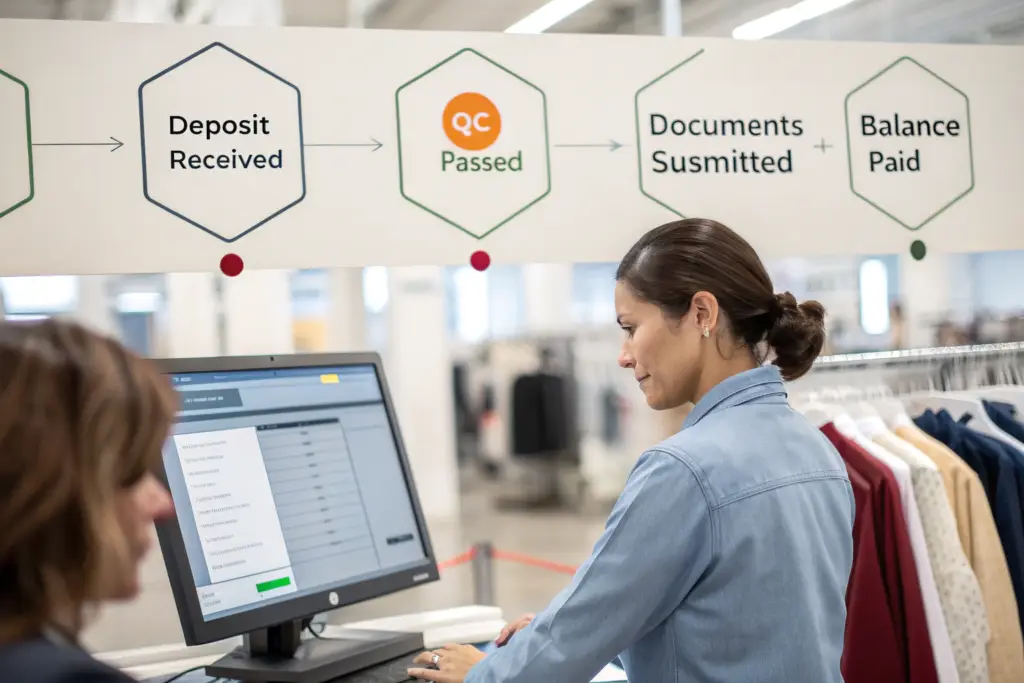
- Balance (30%): Paid upon shipment or within a short period after (e.g., 7 days), against copy of shipping documents.
This model ensures our capital is not stranded. For a complex outerwear order, we once structured it as 30% deposit, 30% after fabric cutting approval, 30% after final pre-shipment inspection, and 10% balance after shipment. The client appreciated the transparency, and we maintained positive cash flow throughout the 4-month production cycle.
Why are deposits and advance payments crucial?
A substantial deposit is the simplest and most effective risk mitigator. It accomplishes two things:
- Commits the Buyer: A buyer who has invested upfront capital is less likely to cancel the order arbitrarily.
- Funds Initial Costs: It allows the factory to purchase fabrics and trims without using its own working capital or taking loans.
For standard orders, we consider a 30% deposit a minimum. For orders requiring specialty or expensive fabrics (e.g., organic certified cotton or technical performance fabrics), we may request a 50% deposit. This practice directly protects us from sudden market shifts that might tempt a buyer to abandon a standard-order. It’s a fundamental rule in our apparel manufacturing agreement.
What Due Diligence is Essential Before Agreeing to Terms?
Payment security begins long before a contract is signed. Thorough due diligence on a potential client is your first and most cost-effective line of defense. It involves moving beyond emails and promises to verify the commercial entity you are dealing with. This process filters out potentially problematic partners and allows you to tailor your payment terms to the actual risk level.
We treat every new client, regardless of their stated size, to a standard verification process. This isn't about distrust; it's about professional responsibility to our own business and our existing clients. A disciplined approach here prevents the vast majority of payment issues down the line.

How do you verify a new buyer's credibility?
Verification is multi-source. We never rely on a single piece of information.
- Company Legal Check: We verify official business registration through international databases or local agents.
- Bank Reference: We request a bank reference letter, which provides insights into their banking history and standing.
- Trade References: We ask for and actually contact 2-3 of their current or past suppliers. This is the most revealing step. We ask specific questions about order sizes, payment timeliness, and communication style.
- Online Presence & Market Reputation: We analyze their website, social media, and look for reviews or news articles.
For instance, before agreeing to open account terms with a U.S. distributor, our reference checks revealed they consistently paid their main supplier within 45 days. This gave us the confidence to propose a 30% deposit with 70% net 45 days terms, which they accepted.
What key elements must a secure contract include?
A strong contract is your legal blueprint. It must be unambiguous and cover all scenarios. Essential clauses for payment security include:
- Clear Payment Schedule: Dates, amounts, and payment methods (TT, L/C details).
- Detailed Scope of Work: Precise product descriptions, approved samples, and quality standards (AQL levels).
- Incoterms: Clearly defined (e.g., FOB Shanghai, DDP Los Angeles) to specify who bears cost and risk during shipping.
- Dispute Resolution: Agreed process and jurisdiction for handling disagreements.
- Late Payment Penalties: A defined interest rate on overdue invoices to incentivize timely payment.
We ensure every contract references the specific Incoterms rules in effect. This clarity prevented a major dispute last year when a buyer tried to claim extra port fees; our FOB contract clearly placed that responsibility on them.
How Do Operational Controls Secure the Payment Process?
Security must be woven into daily operations. This means having internal controls that ensure you only proceed to the next costly stage of an order when the contractual and financial conditions are met. It’s a system of checks and balances that protects the factory from internal error and external manipulation.
At Shanghai Fumao, our production software integrates financial triggers. An order cannot be moved from "fabric sourcing" to "cutting" without the system confirming the deposit is logged. This removes ambiguity and ensures every team member operates from the same, secure protocol.
What is the role of document control in securing payment?
Documents are the proof that triggers payment, especially under L/C. Mismatched or missing documents are the #1 reason for L/C payment delays. We have a dedicated logistics team that masters documentary compliance. Their checklist includes:
- Commercial Invoice
- Packing List
- Bill of Lading/Air Waybill
- Certificate of Origin
- Inspection Certificate (if required)
- Insurance Document (if required)
For every shipment, we perform an internal "document pre-check" 48 hours before presenting them to the bank. This meticulousness ensured we got paid on time for 47 consecutive L/C shipments last year.
How do logistics terms (Incoterms) affect payment leverage?
Your chosen Incoterm determines when ownership and risk transfer. Terms like EXW (Ex-Works) or FOB (Free On Board) give control of the main international freight to the buyer very early. If a payment dispute arises after shipment but before payment, you have little recourse as the goods are already on their chosen vessel.
We often recommend and use DDP (Delivered Duty Paid). As the seller, we control the freight to the buyer's door. This provides significant leverage: if a balance payment is outstanding, we have more options regarding the goods' movement. More importantly, our Shanghai Fumao DDP service provides total supply chain visibility and reliability, which in itself builds the trust that minimizes payment disputes. It shows we are a partner in ensuring the goods arrive, not just a distant supplier.
Conclusion
Ensuring payment security is not a single action but a comprehensive, proactive strategy. It blends the firm guarantees of financial instruments with the smart structuring of commercial terms, all underpinned by rigorous due diligence and disciplined operational controls. A factory that excels in this area is not being difficult; it is demonstrating the financial and operational maturity required to be a reliable, long-term partner in the volatile global apparel trade.
For brands, partnering with a factory that has robust payment security systems is a sign of stability. It means your supply chain is less likely to be disrupted by the financial failure of a key supplier. At Shanghai Fumao, we have built these layers of security into our core operations. This allows us to offer competitive and flexible terms while safeguarding the business that lets us deliver on our promises.
If you are seeking a manufacturing partner that combines creative excellence with rock-solid commercial reliability, let's discuss how we can structure a secure and successful collaboration for your next line. Contact our Business Director, Elaine, at elaine@fumaoclothing.com to begin a conversation built on transparency and trust.