When your brand's identity depends on the precise greens, browns, and grays of Mossy Oak, getting the color wrong isn't an option. A single batch that's too dark, too yellow, or too dull can lead to rejected shipments, unhappy customers, and a damaged reputation. The challenge of perfectly replicating licensed digital camouflage on fabric is immense, and not every factory invests in the technology and processes required.
A factory ensures color accuracy in Mossy Oak camouflage printing through a rigorous, technology-driven workflow: starting with licensor-provided, certified digital files and physical strike-offs, implementing calibrated digital color management systems (like spectrophotometers), and maintaining strict environmental and process controls throughout bulk production. It's a science, not just an art.
Achieving this level of precision requires more than just skilled printers; it requires an institutional commitment to color fidelity as a core component of quality control. For brand owners, understanding this process is key to selecting a supplier who can consistently deliver the authentic Mossy Oak look your customers demand.
Why are official licensor files and strike-offs non-negotiable?
The journey to accurate color begins long before production. Using an unofficial, scanned, or downloaded image of Mossy Oak pattern is the first and most catastrophic mistake a factory can make. The colors and details will be irreparably distorted. Authenticity and accuracy are legally and technically bound to the source material provided by the licensor.
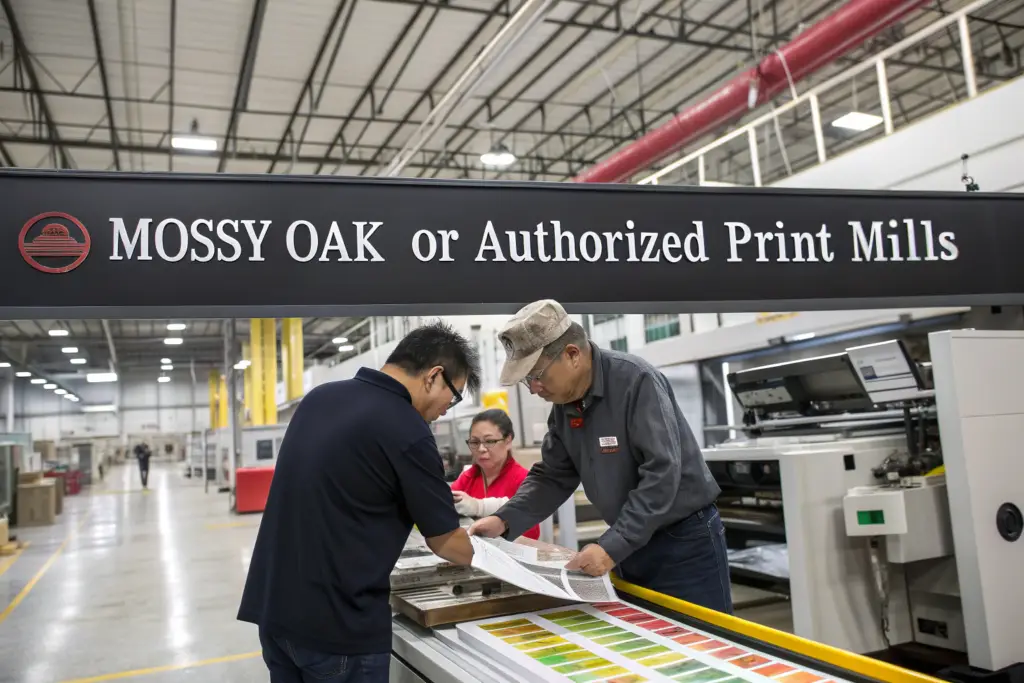
Licensed factories like ours receive official, high-resolution digital print files and precise color standards directly from Mossy Oak or their authorized print mills. The first physical output from these files, called a "strike-off," is then sent to the licensor for visual and instrumental approval against their master standard. This approved strike-off becomes the bible for all subsequent production.
What is included in the official Mossy Oak production kit?
The kit is more than just a picture. It typically includes:
- Certified Digital File: A high-bit-depth file with embedded color profiles, often in formats like TIFF or PDF/X, that specifies the exact pattern geometry and color separations.
- Physical Color Standards: Sometimes provided as printed swatches or Pantone references for key colors within the pattern (e.g., "Forest Floor Brown," "Twilight Grey").
- Technical Specification Sheet: Outlining approved substrate types, print methods (e.g., rotary screen, digital print), and other critical parameters.
A factory without access to this official kit cannot legally or accurately produce Mossy Oak garments. We maintain a secure digital library of these approved assets for every Mossy Oak pattern we are licensed to produce, ensuring every order starts from the perfect original.
How is the initial strike-off approved?
The strike-off is a small sample of the pattern printed on the exact fabric that will be used in production. We submit this, along with instrumental color measurement data from our lab, to the licensor's quality team. They evaluate it under controlled lighting (D65 daylight simulator) and compare it to their master. Only after they issue a formal approval—often a signed document or a digital stamp—do we have permission to proceed to bulk fabric printing. This step is a critical gate that prevents massive, costly errors.
What technology is used for digital color management?
Human eyes are unreliable for judging color due to lighting conditions and subjective perception. Modern factories rely on objective, digital tools to measure, communicate, and control color with mathematical precision throughout the production chain.
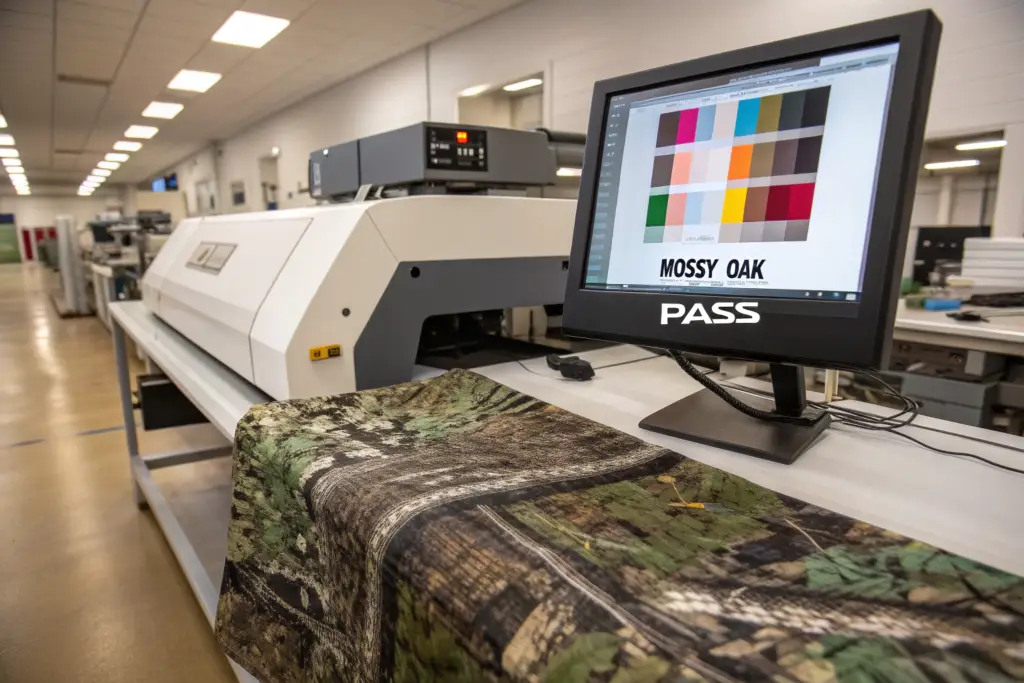
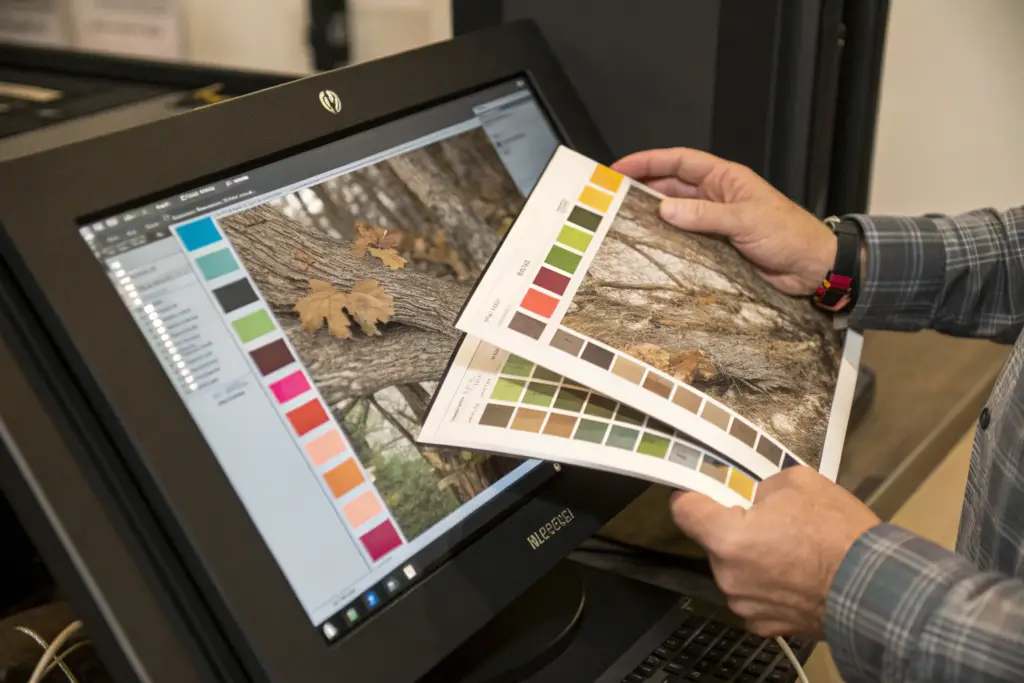
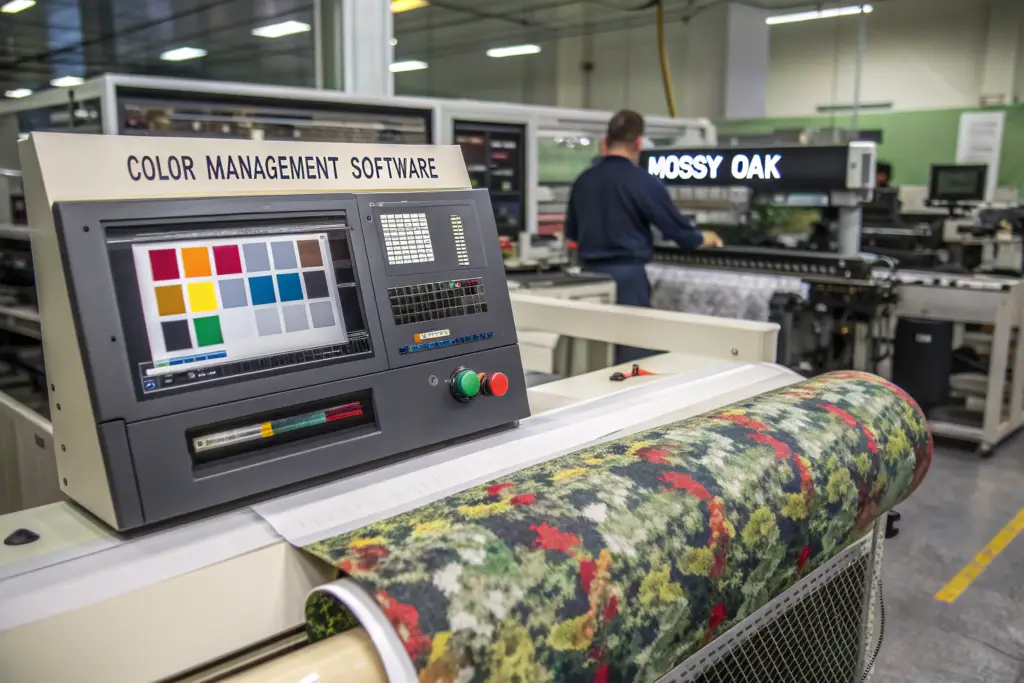
The cornerstone of this system is the spectrophotometer, a device that measures the spectral reflectance of a color and translates it into numerical values (like CIELAB or CMYK). This data is managed through specialized Color Management Software (CMS) that creates a digital fingerprint for every approved color, allowing for precise matching and tolerance setting.
How does the spectrophotometer ensure batch-to-batch consistency?
Before bulk printing begins, we use the spectrophotometer to read the approved strike-off. The software records the CIELAB values for key color areas in the pattern. These values become the production standard. During bulk printing, we take regular readings from the running fabric. The software instantly compares these readings to the standard and calculates the Delta E (dE) value—a single number representing the total color difference. We maintain a strict dE tolerance (e.g., dE < 2.0), which is visually imperceptible to most observers. If a reading exceeds tolerance, the printer adjusts the ink formulation or process immediately. This system eradicated a recurring problem for one of our long-term clients, where earlier, non-instrumented suppliers delivered noticeable color shifts between seasonal drops.
What role does Color Management Software play?
The CMS is the brain of the operation. It does more than store numbers. It:
- Creates Digital Color Libraries: Stores standards for every Mossy Oak pattern and colorway.
- Generates Ink Formulation Recipes: For screen printing, it can calculate the exact pigment mix needed to hit the target values on a specific fabric type.
- Produces Quality Control Reports: Automated reports track color consistency across a production lot, providing auditable proof of compliance.
This integration of hardware and software is what separates a professional print facility from an amateur shop. For more on the science of color measurement, resources from X-Rite Pantone are industry-standard.
How do production environment and process controls affect color?
Even with perfect files and technology, the printing environment and process variables can introduce color drift. Temperature, humidity, fabric pretreatment, ink viscosity, and curing conditions all have a direct impact on the final color outcome. Controlling these variables is what makes accuracy repeatable at scale.
We maintain controlled environmental conditions in our print facility and implement standardized Standard Operating Procedures (SOPs) for every step—from fabric pretreatment and ink mixing to screen engraving, printing pressure, and heat curing. Consistency in process is the only way to guarantee consistency in color.
Why is fabric pretreatment so important?
Most fabrics, especially natural fibers like cotton, require pretreatment with chemicals before printing to ensure ink adhesion and color vibrancy. An inconsistent pretreatment application (e.g., uneven coating or moisture content) will cause the same ink to look different from one section of fabric to another. Our pretreatment line is calibrated and monitored regularly to ensure a uniform base for every meter of fabric, which is a fundamental prerequisite for accurate color reproduction.
How are printing and curing processes calibrated?
For screen printing, key controls include:
- Ink Viscosity: Measured with a viscometer and adjusted to a specific range before and during printing.
- Squeegee Pressure & Angle: Mechanically set and locked for consistency.
- Curing Temperature & Time: The fabric must pass through a dryer at an exact temperature for an exact duration to fully set the ink. Under-curing leads to wash-out; over-curing can cause yellowing or dulling.
We track these parameters on run sheets for every production batch. This discipline was crucial when we produced a large order of Mossy Oak jackets for a national distributor. By strictly following our curing SOP, we ensured the camouflage print passed AATCC wash and crocking (rub) fastness tests, a key requirement for their quality audit.
| Critical Control Point | Tool/Method Used | Target/Standard | Purpose |
|---|---|---|---|
| Fabric Pretreatment | Coating weight measurement, moisture meter | GSM & moisture % within spec | Ensure uniform ink absorption base |
| Ink Viscosity | Rotational viscometer | Pre-defined centipoise (cP) range | Control ink flow and deposit volume |
| Color Measurement | Spectrophotometer & CMS | Delta E (dE) < 2.0 | Objective verification against standard |
| Curing | Infrared temperature sensors, conveyor speed control | °C ±5, Time ±10 seconds | Ensure ink fixation and color fastness |
What quality checks happen post-printing?
The final assurance of color accuracy happens after the fabric is printed and cured. This involves both instrumental checks and trained visual inspections under standardized conditions to catch any inconsistencies that might have slipped through.
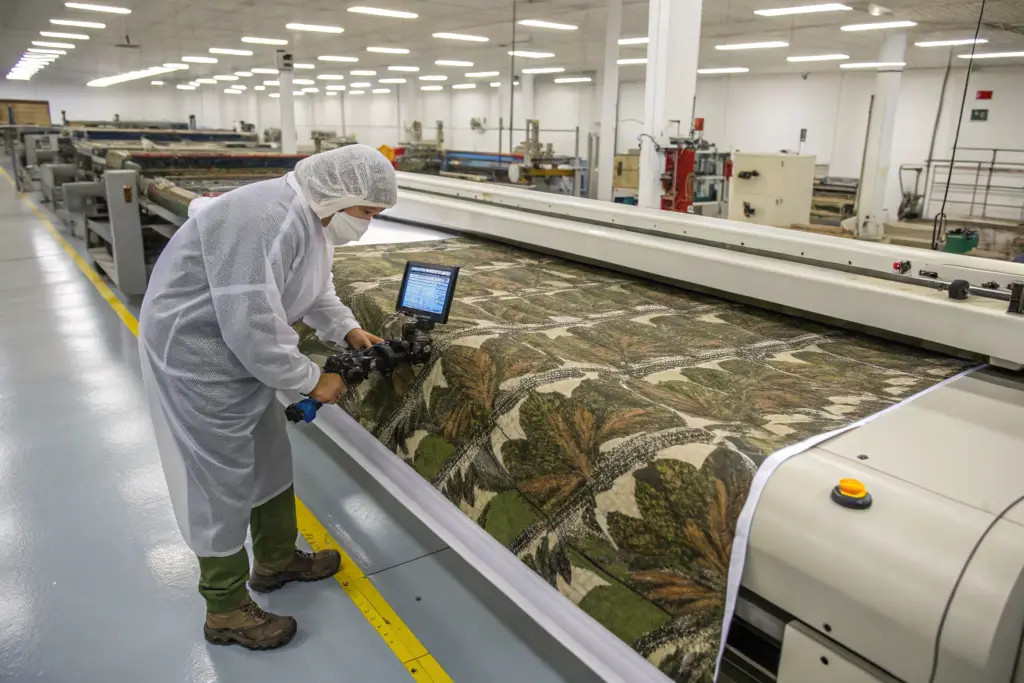
Our post-printing QC involves 100% instrumental scanning of the fabric roll at multiple points and a final visual inspection of cut panels or finished garments under D65 lighting by certified colorists. This dual-layer check guarantees that only fabric meeting the Mossy Oak standard proceeds to cutting and sewing.
What is involved in 100% instrumental scanning?
Advanced factories use on-line or off-line scanning spectrophotometers that can measure the entire width of the fabric roll as it passes by. The system creates a color map and flags any areas where the dE exceeds tolerance. This is especially important for long runs, where gradual ink depletion or screen clogging can cause drift. This technology allows us to catch and correct micro-defects that would be invisible to the human eye until a whole garment was assembled.
How do trained colorists add value?
Technology has limits, especially with complex patterns like Mossy Oak where the overall "color feel" is a blend of many hues. Our QC staff are trained as professional colorists, using standard light booths to evaluate the printed fabric against the approved strike-off. They assess for overall color harmony, pattern clarity, and any visual defects. Their trained judgment is the final, human validation of the instrumental data. This comprehensive approach is why brands trust Fumao Clothing with their most sensitive licensed apparel projects—they know our process leaves nothing to chance.
Conclusion
Ensuring color accuracy in Mossy Oak printing is a multifaceted discipline that blends official licensor collaboration, advanced color science, stringent process engineering, and meticulous final inspection. It is a capital- and expertise-intensive endeavor that goes far beyond basic printing. For brands, partnering with a factory that has mastered this discipline is the only way to guarantee products that look, feel, and perform authentically, protecting your investment and your brand's reputation.
If consistent, licensor-accurate Mossy Oak camouflage is critical to your product line, you need a manufacturer with the proven systems to deliver it. At Fumao Clothing, our entire print operation is built around this precision. Let us show you how our color-accurate process can bring reliability and quality to your next order. Contact our Business Director, Elaine, at elaine@fumaoclothing.com to discuss your specific needs. We are ready to match your standards, exactly.