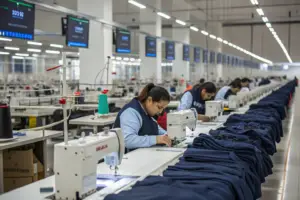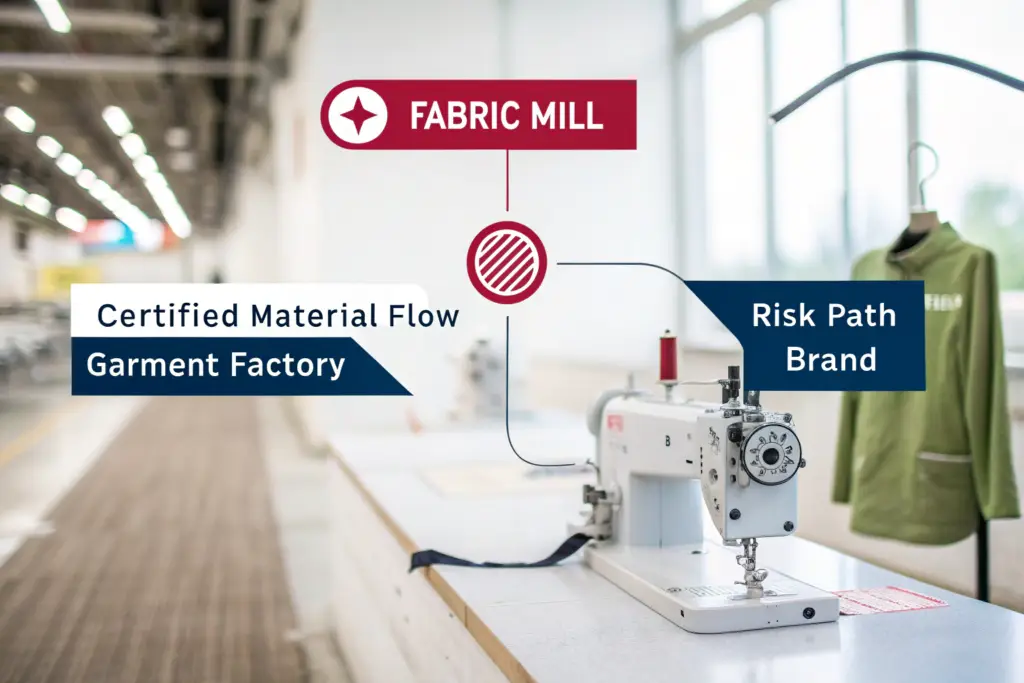
When sourcing OEKO-TEX® certified ski apparel, a critical question often gets overlooked in the rush to check the final garment's certificate: Does the certification chain extend all the way back to the fabric mill? For brands, especially those in the performance-driven ski market, the answer isn't just a technicality—it's the difference between surface-level compliance and deeply rooted supply chain integrity. Relying solely on your garment factory's final product certification is a risky shortcut that can leave your brand exposed to inconsistent quality and hidden liabilities.
Yes, for true integrity and risk mitigation, your garment supplier's fabric mill must also hold valid OEKO-TEX® certification for the materials they produce. This ensures chemical safety and quality control are enforced at the earliest and most impactful stage of production, guaranteeing consistency across fabric batches and providing a verifiable chain of custody that protects your brand from "certificate washing." The mill's certification is the foundational layer without which the final garment's certification is built on shaky ground.
At Shanghai Fumao, we learned this lesson definitively several years ago. A client requested a rush order of ski shells using a specific, technically advanced membrane fabric. Our usual mill was at capacity, so a trading partner offered a "certified-equivalent" fabric from a new mill at a 10% discount. We received the mill's OEKO-TEX® certificate, which appeared valid. However, during our pre-production lab spot-check—a non-negotiable part of our process—the fabric failed for pH imbalance and showed borderline levels of a restricted softener. The root cause? The mill's certification was for their base cloth, but the final lamination and finishing were outsourced to an uncertified sub-contractor. We rejected the entire fabric lot, absorbed the delay, and sourced from our primary certified mill. This incident cemented our policy: we only partner with mills that are vertically certified for their entire production process.
Why Is Mill-Level Certification Non-Negotiable for Ski Wear?
Ski apparel operates in extreme conditions where material failure is not an option. The mill is where the core performance and safety properties of the fabric are engineered. Its certification status directly dictates the reliability of your end product.
Mill-level certification is non-negotiable because it controls the chemical inputs and processes that define a fabric's safety, performance, and environmental footprint. It is the only way to ensure that harmful substances are excluded from the dyeing, finishing, and coating processes critical to waterproof, breathable, and durable ski fabrics. A garment factory can sew a certified label onto a jacket, but it cannot undo chemical contamination baked into the fabric at the mill.
Consider the lifecycle of a ski shell fabric:
- Fiber Production: The polymer or yarn may be treated with spin finishes or additives.
- Weaving/Knitting: Lubricants and sizing agents are used.
- Dyeing & Finishing: This stage uses the most complex chemistry—dyes, auxiliaries, water repellents (DWR), and coatings.
- Lamination: Bonding a waterproof membrane involves adhesives and solvents.
An OEKO-TEX® certified mill is audited on its chemical inventory management and wastewater treatment for all these stages. An uncertified mill, or one that only certifies the final roll, may use non-compliant chemicals that compromise performance (e.g., a DWR that washes out quickly) or safety (e.g., allergenic dyes). For a brand, this means unpredictable product quality and potential liability.

What Specific Risks Arise from an Uncertified Mill?
The risks cascade down the supply chain:
- Batch Inconsistency: Without a mill-level quality management system, fabric performance (color, shrinkage, durability) can vary wildly between lots, leading to mismatched garments in the same order.
- Hidden Substance Hazards: The garment factory's final product test is a pass/fail on a sample. It may not detect every substance if the mill uses non-compliant chemicals that were not on the test panel. The mill's ongoing certification ensures continuous compliance with the full OEKO-TEX® substance list.
- Environmental & Ethical Liability: Uncertified mills often have poorer environmental controls. Your brand may be indirectly linked to water pollution, even if your final garment is sewn in a clean factory. Mill certification includes assessments of environmental performance and worker safety.
- Supply Chain Disruption: If your garment factory's source of fabric is shut down for environmental violations or fails a major customer's audit, your production is jeopardized.
How to Verify Your Fabric Mill’s OEKO-TEX® Credentials?
Verification requires proactive due diligence and should be a collaborative effort with your garment manufacturer. Don't accept assurances; demand evidence.
To verify your mill's credentials, you must obtain the actual OEKO-TEX® certificate issued in the mill's name, check its validity and scope via the official online database, and confirm that the certified product description matches the fabric you are using. Your garment supplier should facilitate this transparently.
Follow this verification checklist:
- Request the Certificate: Ask your supplier: "Please provide the OEKO-TEX® STANDARD 100 certificate from the mill that produced this specific fabric lot." It should be in the mill's company name, not a trader's.
- Scrutinize the Details:
- Certificate Holder: Is it the actual mill, or a holding company/trading firm?
- Product Description & Class: Does it accurately describe your fabric (e.g., "Polyamide woven fabric with PU coating") and is the Product Class appropriate (Class I, II, or III for apparel)?
- Validity Period: Is the certificate current? Certificates are typically valid for one year.
- Check the Official Database: Use the free OEKO-TEX® certificate check. Enter the certificate number and company name. This confirms it's authentic and not revoked.
- Ask for Supporting Evidence: Request a Test Report or Statement of Conformity from the mill that links your specific fabric delivery (with lot number) to their master certificate. This proves your batch is covered.
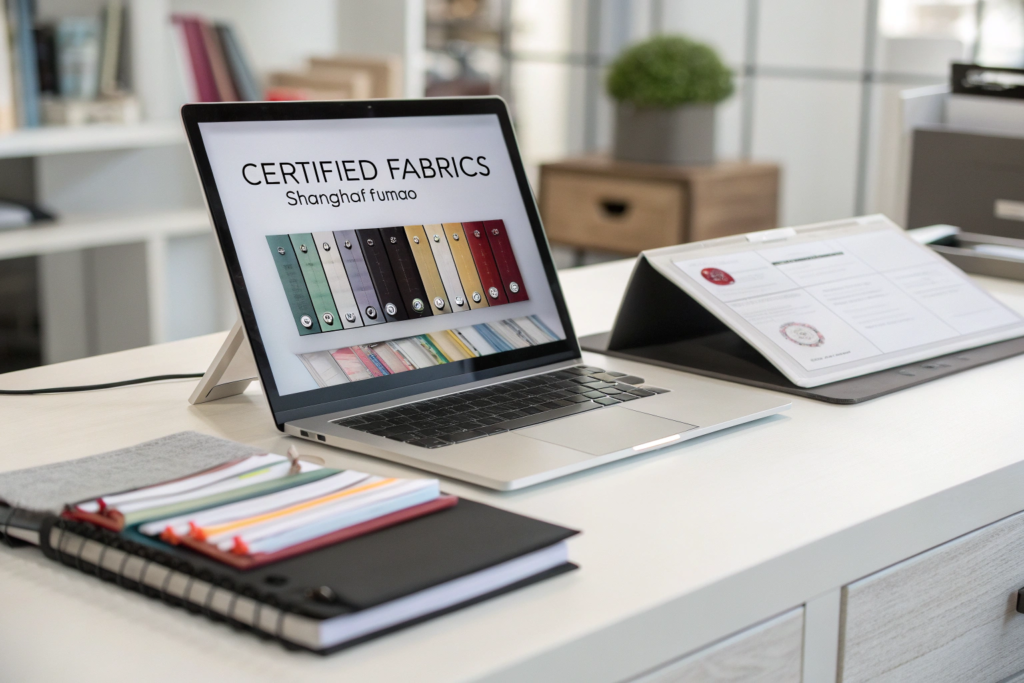
A reputable garment manufacturer will have this documentation organized and ready. At Shanghai Fumao, we maintain a digital dossier for every certified fabric we source, allowing us to provide this to clients within minutes. This level of transparency is a key part of our supply chain management service.
What Questions Should You Ask Your Garment Supplier About Their Mills?
Turn your supplier into an accountability partner with direct questions:
- "Can you map your OEKO-TEX® certified fabric supply chain for me, from mill to finished garment?"
- "How often do you audit or visit your key certified mills?"
- "What is your process if a fabric batch arrives from a certified mill but fails your incoming inspection?"
- "Do you have a preferred list of vertically certified mills, and can I choose from their swatch books?"
Their answers will reveal if they have deep, managed relationships or are simply buying certified fabric from the open market—a significant distinction in reliability.
What’s the Difference Between a Mill Certificate and a Garment Factory Certificate?
Understanding the hierarchy of certificates is crucial. They are complementary but serve distinct purposes.
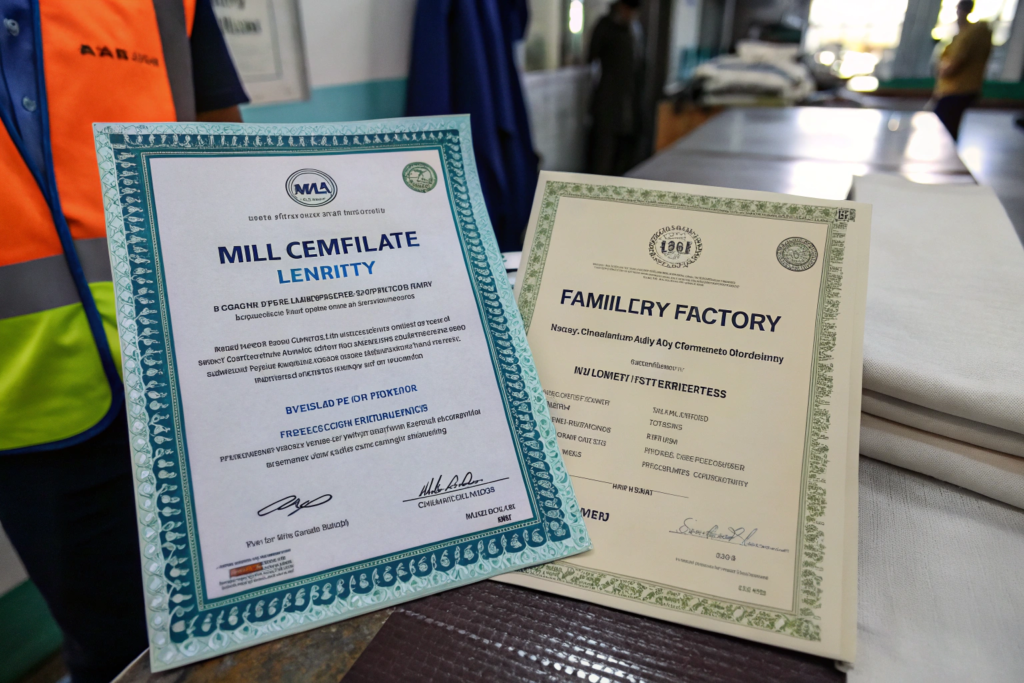
The mill certificate verifies the safety of the textile material itself. The garment factory certificate verifies that the finished article (made from certified materials, threads, and trims) has been produced under a certified quality management system and that the final product also passes safety tests. One does not replace the other; both are required for full-chain assurance.
| Aspect | Mill-Level Certificate | Garment Factory Certificate |
|---|---|---|
| What it Certifies | The raw fabric or textile component (e.g., laminated shell fabric, insulation, lining). | The finished, sewn apparel article (e.g., the complete ski jacket). |
| Focus of Control | Chemical management in dyeing, finishing, coating. | Production control, prevention of contamination, assembly of certified components. |
| Issued To | The fabric manufacturer (the mill). | The garment manufacturer (the factory) or the brand (as the applicant). |
| Your Brand's Risk | High if missing. You lose control over the most complex chemical processes. | High if missing. You have no proof the final assembled product is safe. |
For a brand, the ideal and only secure scenario is to have both. The garment factory (like Shanghai Fumao) should be able to provide you with:
- The mill certificates for all key materials.
- The final product certificate in your brand's name.
This creates a closed, verified loop.
Can a Garment Factory Be Certified Without Certified Mills?
Technically, yes, but it's a high-risk and inefficient path. A factory could submit a finished garment made from uncertified fabrics for testing. If it passes, it gets a certificate. However:
- Cost Prohibitive: Each new fabric would need to be tested as part of the garment, making small batches or fabric changes financially ruinous.
- No Process Control: It doesn't ensure the mill's processes are clean, only that that specific batch passed. The next batch from the same uncertified mill could fail.
- No Supply Chain Visibility: The brand remains in the dark about the origin of its materials.
This is not a scalable or reliable model for performance apparel brands.
How Does This Affect Quality, Consistency, and Sourcing Flexibility?
Choosing a supplier whose mills are certified has direct, positive implications for your product's quality and your operational agility.
Partnering with a garment factory that sources from certified mills guarantees higher material consistency, enables faster and more flexible sourcing (from a pre-qualified material library), and simplifies compliance for future orders and product line extensions. It builds a platform for scalable, responsible growth.
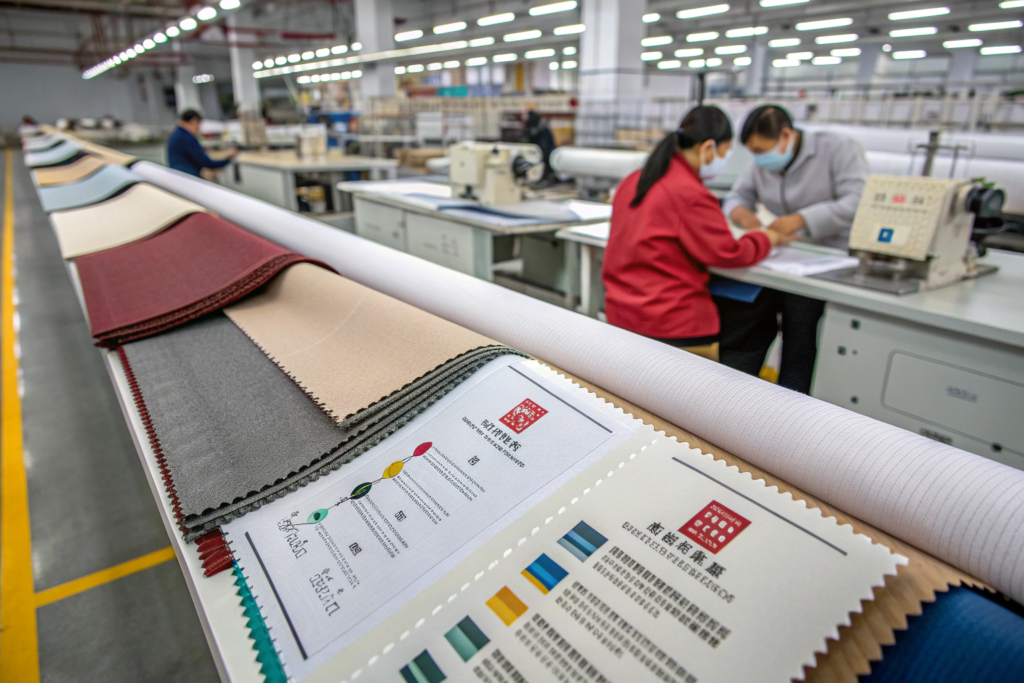
For instance, at Shanghai Fumao, our curated network of certified mills functions as an extension of our R&D department. When a client needs a fabric with specific properties (e.g., a 4-way stretch, 20K waterproof laminate), we can quickly identify 2-3 certified options from our partner mills, provide swatches and certificates, and expedite sampling. This dramatically shortens development time. Conversely, working with a factory that sources uncertified fabric for each job means starting from zero on compliance verification every time, adding weeks of uncertainty and risk.
What About Cost? Is Mill Certification More Expensive?
There is a premium for certified fabrics, but it is a value-based cost, not an unnecessary expense.
- Eliminates Hidden Costs: The premium pays for the mill's investment in cleaner chemistry, wastewater treatment, and audits. The alternative—using cheaper, uncertified fabric—externalizes these costs as environmental damage, worker health risks, and brand liability.
- Improves Total Cost of Ownership: Certified fabrics from reputable mills have better color fastness, durability, and consistency. This leads to fewer production rejects, higher customer satisfaction, and fewer returns. Over the lifecycle of the product, the total cost is often lower.
- Protects Brand Equity: The cost of a single product recall or negative press story about toxic chemicals dwarfs a lifetime of fabric premiums.
Conclusion
The question of your fabric mill's OEKO-TEX® certification is not a minor sourcing detail; it is the fundamental litmus test of your supply chain's integrity. For ski apparel, where performance and trust are paramount, cutting this corner is an unacceptable risk. A certified garment factory is only as strong as its weakest link in the supply chain—and that link is most often upstream at the mill.
Insist on full transparency. Demand the mill certificates. Verify them independently. Partner with garment manufacturers like Shanghai Fumao who are proud to showcase their certified mill partnerships and have built their business on this complete chain of custody. This is how you build ski apparel that performs flawlessly on the mountain and stands up to the toughest scrutiny off it.
Your brand's reputation is woven into the fabric long before it reaches the cutting table. Ensure that foundation is solid. To develop ski wear with unbroken, verified OEKO-TEX® integrity from mill to market, contact our Business Director Elaine at Shanghai Fumao: elaine@fumaoclothing.com.