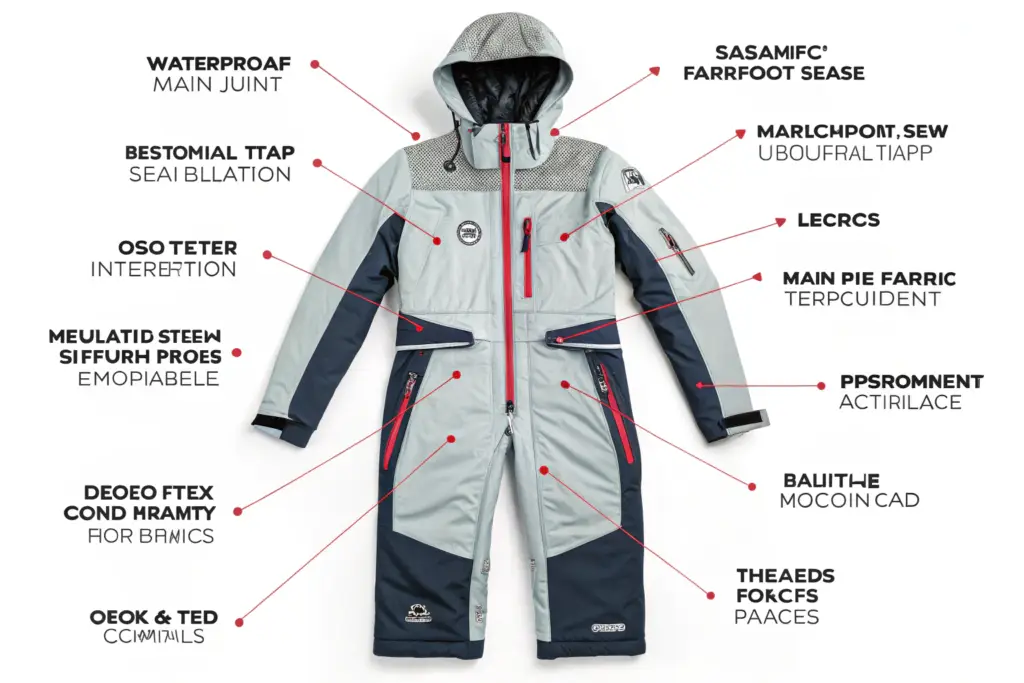
When you’re sourcing high-performance ski suits, every detail matters for speed and safety. You specify premium waterproof zippers, reinforced taping, and durable logos. But here’s a critical question that can make or break your certification claim: Does the OEKO-TEX certification you paid for actually cover all those zippers, trims, and accessories, or just the main fabric? Many brands discover too late that their “certified” suit failed because of an uncertified puller or thread.
Yes, a valid OEKO-TEX STANDARD 100 certification for a finished garment must cover every component that makes up the product, including zippers, pull tabs, buttons, threads, labels, insulation, and even printing inks. The certification is for the “article as a whole,” meaning if any single non-compliant trim is used, the entire product fails the standard. This is especially crucial for competitive ski suits, which are complex assemblies of many technical parts.
Understanding this is the difference between genuine compliance and a costly reputation risk. A zipper pull that a skier might put in their mouth, or a taped seam adhesive against their skin, are direct points of potential chemical exposure. Let’s dive into what “full article” certification truly requires and how to guarantee it.
What Does “Article as a Whole” Certification Actually Mean for a Ski Suit?
The OEKO-TEX principle is simple: If it’s part of the product you sell, it’s part of the test. This is non-negotiable. For a competitive ski suit, this means the certification scope is incredibly broad. It’s not a fabric certificate you can attach to any garment made from that fabric. It’s a specific certificate for that specific finished garment model, made with those specific components from those specific suppliers.
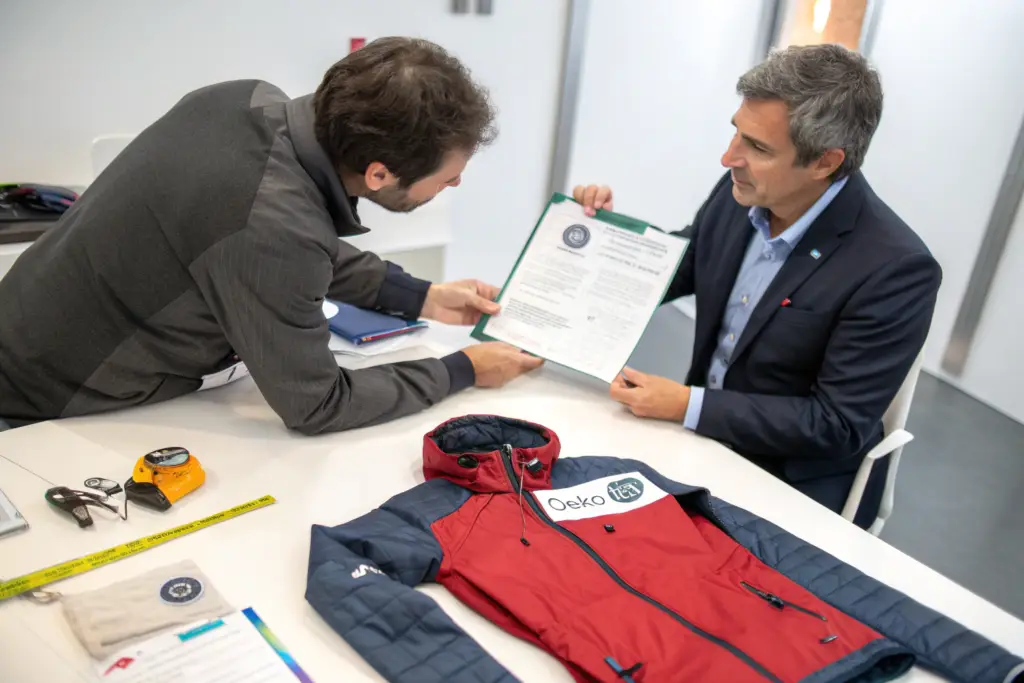
This has major implications for your supply chain. You cannot source a certified fabric from Mill A, a zipper from Supplier B, and insulation from Supplier C, assemble them, and claim OEKO-TEX. The finished suit, with that exact combination of parts, must be submitted for testing and certification. At Shanghai Fumao, we manage this as a full-package manufacturer. For a recent order of 500 competition-grade ski suits for a European brand, we didn’t just provide a fabric certificate. We provided the official OEKO-TEX certificate listing the article number of the finished suit, which is the only document that proves compliance to retailers and consumers.
Which specific trim components are most often overlooked?
Brands focusing only on fabric can miss these critical items:
- Zipper Components: The tape, slider, teeth, and puller of the waterproof zipper.
- Seam Construction: The thermoplastic polyurethane (TPU) or polyurethane (PU) tape used for waterproof seam sealing.
- Thread: The sewing thread, often polyester or nylon.
- Labels: The care/content label and brand label, including the printing ink.
- Reinforcements: Corner patches, abrasion-resistant panels made of different materials.
- Embellishments: Silicone prints, transferred logos, or embroidered logos (including the backing and yarn).
A competitor of one of our clients faced a product recall because the silicone gripper print on the jacket cuff contained a restricted phthalate. The main fabric was certified, but the print was sourced separately and never tested.
How is the testing for a full article conducted?
The certification body requires a complete sample of the finished garment. They will test it as a whole, but they may also cut samples from different components for specific chemical analyses. For example, they might test the zipper tape separately for heavy metals and the printed logo for phthalates. The lab understands the product’s use case—a ski suit is Class II or III (clothing with limited/no direct skin contact), but components that may have oral contact (like a zipper pull) are evaluated with extra scrutiny. This holistic testing is why using a manufacturer with a controlled bill of materials (BOM) is essential. We maintain a library of pre-certified or certifiable trim suppliers, so when we build your BOM, we know every item can pass.
How Can You Verify and Document “Full Article” Coverage?
Trust, but verify. As a brand, you must have a transparent process to confirm that the certification your factory provides is legitimate and covers everything. The wrong document is worse than no document, as it creates false confidence.
The gold-standard proof is the OEKO-TEX Transaction Certificate (TC). This is a unique document issued for a specific batch of finished products. It references the main certificate and includes the batch size, article number, and your company’s name as the customer. When a retailer like REI or Backcountry.com audits you, this is the document they will ask for. It is your legal proof of compliance. We provide a TC with every shipment that leaves our warehouse for OEKO-TEX certified orders. Last year, this practice helped one of our brand partners swiftly resolve a query from a major German distributor, turning a potential delay into a demonstration of superior supply chain management.

What are the red flags in a certification document?
Be wary if your supplier only provides:
- A Component Certificate (e.g., only for the fabric). This does NOT certify the finished garment.
- A very generic certificate that doesn’t list your specific article number or style name.
- A copy of another brand’s certificate with the name blurred out.
Always ask for the certificate number and verify it on the official OEKO-TEX Certification Check database if possible. The certificate should clearly state the product type (e.g., “ski overall”) and the applicable product class (II or III). Any vagueness is a major risk signal. The Consumer Product Safety Commission (CPSC) expects brands to have due diligence documentation for all safety claims, making these certificates critical.
What questions should you ask your manufacturer?
During sourcing, ask these direct questions:
- “Can you provide a sample OEKO-TEX certificate for a similar finished garment you have produced?”
- “Do you source trims (zippers, tapes, threads) from pre-approved, certified suppliers, or do you test them per order?”
- “What is your process for issuing Transaction Certificates for each production batch?”
- “How do you handle a situation where a trim supplier changes their material without notice?”
A competent factory will have clear answers. At Shanghai Fumao, our answer is systematic: We use a vetted supplier list, we conduct incoming material checks against certification documents, and we manage the full article certification as a core service. This system was built after an early lesson years ago when a buckle supplier changed its plastic formulation, jeopardizing a whole shipment. Now, our controls prevent that.
What are the Sourcing Challenges for Certified Technical Trims?
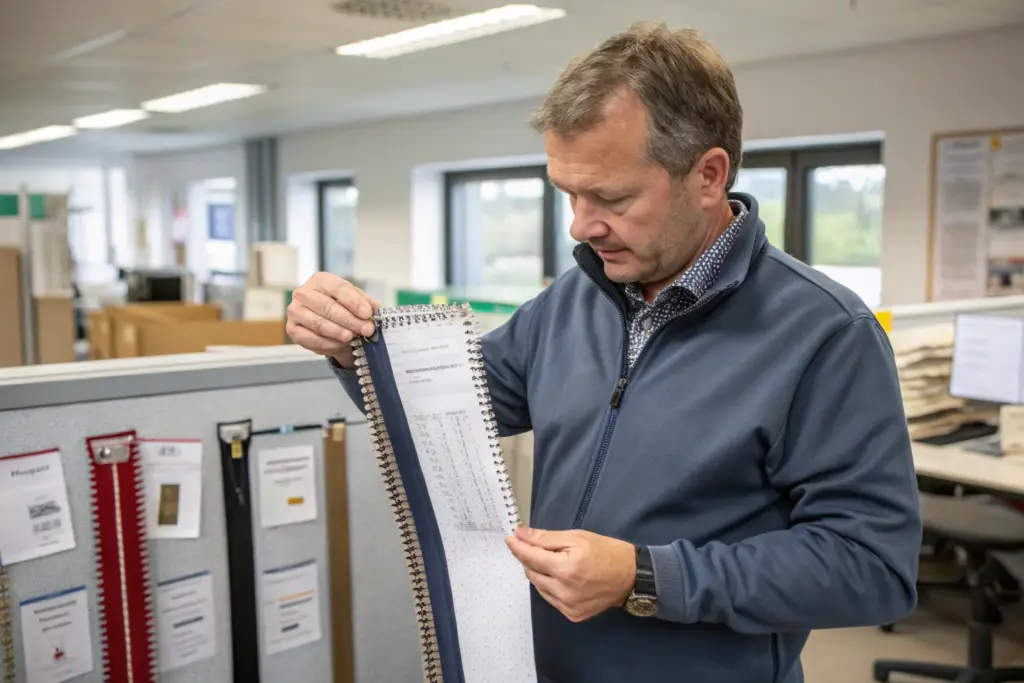
Sourcing OEKO-TEX certified components is harder than sourcing certified fabric. Many small, specialized trim suppliers do not invest in certification themselves. The challenge is finding high-performance components (like aqua-guard zippers or specific seam tapes) that also have compliant chemical profiles.
The solution often involves working with your factory’s established network. Large manufacturers have the purchasing power to request compliance documentation from trim suppliers or to work with larger trim producers who already have certifications. For example, sourcing a YKK zipper that is OEKO-TEX certified is straightforward, as YKK offers compliant product lines. However, a custom-molded, low-profile vent zipper for race suits might come from a smaller specialist. In such cases, the factory must submit that specific zipper for testing as part of the full article application, which adds time and cost. We navigated this for a brand creating an ultra-lightweight suit; we sourced a prototype zipper, included it in the certification sample submission, and only upon successful certification did we approve the supplier for bulk production.
How do you balance technical performance with chemical compliance?
Sometimes, a perfectly performing material (e.g., a specific adhesive for seam tape) may contain restricted substances for enhanced durability. The trade-off must be managed. The process is:
- Identify Alternatives: Your factory should work with suppliers to find compliant alternatives that meet at least 90% of the performance requirement.
- Test and Validate: The alternative must be tested both chemically and for physical performance (peel strength, low-temperature flexibility).
- Communicate with the Brand: Be transparent about any minor performance trade-offs for guaranteed safety.
We faced this with a client needing a highly reflective trim for night skiing safety. The standard reflective tape failed for certain heavy metals. We worked with three suppliers to develop a compliant alternative, performance-tested all three, and presented the best option to the client, who valued safety over a marginal difference in reflectivity.
What role does the factory’s internal QC play?
The factory’s Incoming Quality Control (IQC) is the final gatekeeper. When a shipment of zippers arrives with a component certificate, the IQC team should not just check the quantity and function. They should verify that the supplier’s name and batch number on the certificate match the delivered goods. This prevents a “bait-and-switch” where certified samples are sent for testing, but uncertified bulk goods are shipped. Our IQC team at Shanghai Fumao is trained to cross-check every material’s certification against our approved BOM before it even enters the warehouse. This procedural rigor is what separates a reliable partner from a mere assembler.
How Does This Impact Your Marketing and Liability?
Successfully achieving full-article certification is a powerful marketing story, but it also carries significant legal and reputational weight. You are making a definitive claim to the end consumer. If that claim is false due to a non-compliant trim, the liability falls squarely on your brand.
You can and should market this achievement confidently. It allows you to use the official OEKO-TEX label on the garment and in advertising. This is a strong differentiator against competitors who may only have certified fabric. You can create content titled “Why Every Stitch Matters: Our Full-Article Safety Promise.” However, this marketing must be accurate. Overstating the certification (e.g., claiming it’s “100% non-toxic” rather than “tested for harmful substances according to OEKO-TEX STANDARD 100”) can lead to legal challenges under guidelines like the Federal Trade Commission’s (FTC) rules on environmental marketing claims.

How to communicate this depth of certification to customers?
Your communication should educate:
- On Hangtag: “Certified from fabric to zipper. This entire garment is OEKO-TEX STANDARD 100 certified, meaning every component has been tested for your safety.”
- Online: Include a section in the product description: “Our Full-System Safety: Unlike partial certifications, our OEKO-TEX certification covers the main fabric, insulation, waterproof zippers, seam tape, and even the threads. No detail is overlooked.”
This level of detail reassures sophisticated consumers and builds immense brand authority. It shows you understand and control your supply chain deeply.
What is the liability risk of getting it wrong?
The risks are severe:
- Retailer Rejection: Your goods can be rejected at the destination port or by the retailer, leaving you with unsellable inventory.
- Costly Recalls: If non-compliance is discovered after sale, a recall could devastate your finances and brand reputation.
- Legal Action: In markets with strict product safety laws, you could face fines or lawsuits.
- Certification Revocation: Misuse of the OEKO-TEX label can lead to the revocation of your certificate for all products.
This is why the partnership with a meticulous, transparent factory is not a cost—it’s an insurance policy. At Shanghai Fumao, our systems are designed to protect our clients from these exact risks, allowing them to market with confidence.
Conclusion
For competitive ski suits, OEKO-TEX certification is an all-or-nothing commitment that extends from the largest panel of fabric down to the smallest stitch. The question isn’t just does it cover zippers and trims—it must cover them to be valid. Navigating this requires a factory partner with a systematic approach to material sourcing, rigorous documentation control, and a deep understanding of the “article as a whole” principle.
By verifying certificates, asking the right questions, and marketing the achievement accurately, you can turn this comprehensive compliance into a formidable competitive advantage that speaks to quality, safety, and meticulous craftsmanship.
Ensure your next ski suit line is genuinely certified in every detail. Partner with a manufacturer who understands that true safety has no shortcuts. At Shanghai Fumao, we specialize in full-package, full-article certified production for demanding technical apparel. Contact our Business Director, Elaine, to discuss how we can build your next collection with uncompromising compliance from the ground up. Reach her at elaine@fumaoclothing.com.