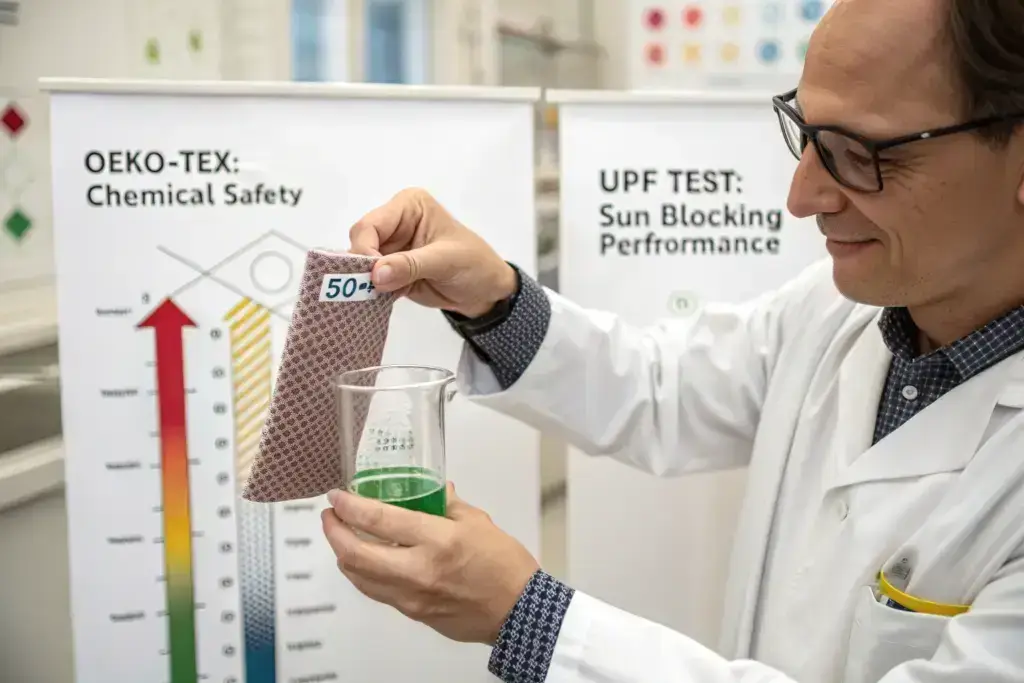
A client recently asked us to develop a UPF 50+ golf sun shirt. Their primary concern was whether the chemical UV-blocking treatment would compromise the OEKO-TEX certification they required for their entire line. This is a critical technical question at the intersection of performance and safety. We sent samples of the proposed treated fabric to the testing institute, and the answer clarified a vital distinction for functional apparel.
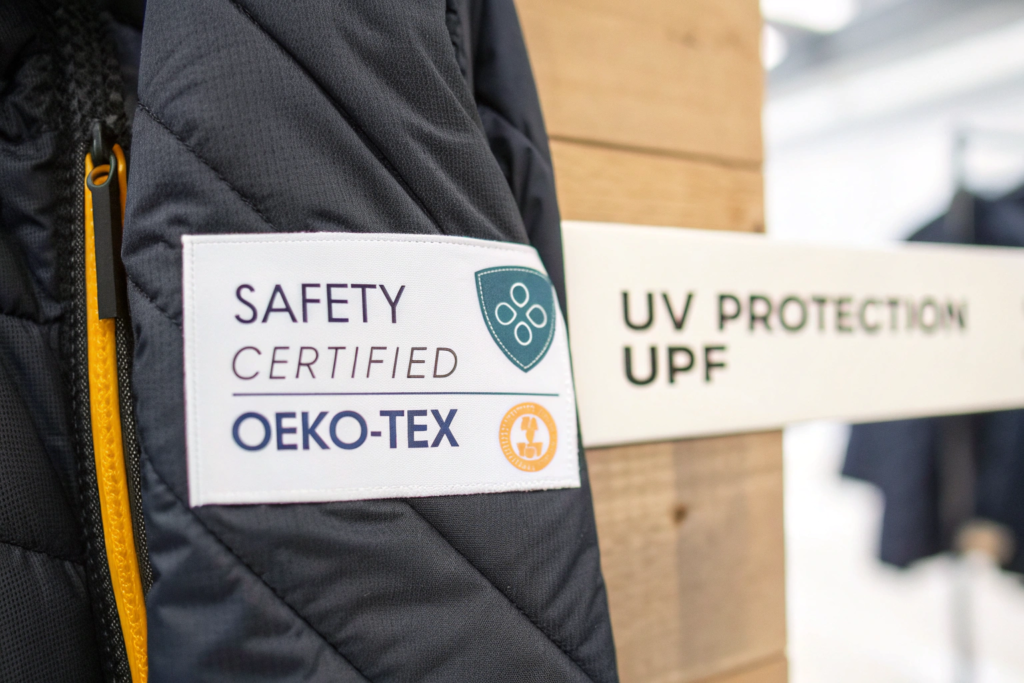
No, the OEKO-TEX STANDARD 100 certification does not specifically test or certify the efficacy of UV protection (like UPF rating). However, it critically DOES test for the safety of the chemicals and substances used to achieve that UV protection, ensuring they are not harmful to human health. The certification covers the safety of the treatment, not its performance.
For golf brands, this means you can have an OEKO-TEX certified sun shirt, but the UPF claim must be validated separately through ISO, AATCC, or AS/NZS standards. The OEKO-TEX guarantee is that whatever is used to block the sun won't harm the wearer's skin. Let's dive into this dual-standard requirement.
How Does OEKO-TEX Evaluate UV Treatment Chemicals?
When a fabric is treated with a chemical finish to enhance its UV-blocking properties, that finish becomes an integral part of the textile. OEKO-TEX STANDARD 100 treats these chemical agents as part of the "finished product" for testing purposes.
The certification's restricted substances list (over 100 parameters) includes categories highly relevant to UV treatments:
- PFAS (Per- and Polyfluoroalkyl Substances): Often used in durable water repellent (DWR) finishes, some of which also claim UV stability. Many PFAS are now strictly regulated or banned under OEKO-TEX.
- Heavy Metals: Certain metal oxides (like titanium dioxide or zinc oxide) are used in physical UV-blocking treatments. OEKO-TEX sets strict limits for extractable heavy metals.
- Formaldehyde and other biocides: Sometimes used in finishing baths.
- Aryl amines & allergenic dyes: These can be present in the dyes used for the fabric, which can be affected by UV treatments.
The laboratory tests for the presence and concentration of these (and other) substances. If the UV treatment chemicals leach or contain prohibited levels, the product will fail—even if its UPF rating is excellent. This is a core component of consumer safety that goes beyond sunburn.

What is the Certification Process for a Treated Fabric?
The process is rigorous and must be initiated by the manufacturer. At Shanghai Fumao, the steps are:
- Submit the Final Product: We submit samples of the finished golf sun shirt, made with the exact fabric, thread, and UV treatment to be used in production.
- Full Disclosure: We must provide the testing institute with a complete list of chemicals used in the treatment process, along with their Safety Data Sheets (SDS).
- Extraction Testing: The lab uses simulated sweat and saliva solutions to extract substances from the fabric, then analyzes the extracts.
- Certification Issuance: If all parameters pass, a certificate is issued for that specific product. The certificate will list the product (e.g., "Men's UV Protective Golf Shirt") but will not state a UPF value.
This process ensures that from a chemical safety perspective, the shirt is safe for prolonged skin contact during a sweaty, sunny round of golf.
How Should Brands Validate UPF Performance Separately?
While OEKO-TEX covers safety, the functional claim of UV protection requires separate, performance-based testing. This is a two-claim product: one for safety (OEKO-TEX) and one for function (UPF rating).
The global standard for testing and rating UPF is ISO 105-B02 (or regionally, AATCC 183 or AS/NZS 4399). This test uses a spectrophotometer to measure how much UV radiation (both UVA and UVB) penetrates the fabric. A fabric must block at least 97.5% of UV rays to achieve a UPF 40 rating, and 98% for UPF 50.
For brands, you need to request a UPF test report from your fabric mill or manufacturer, conducted by an accredited lab. This report is your legal and marketing basis for claiming "UPF 50+." Reputable manufacturers will conduct this test on each new fabric lot, as factors like stretch, color, and moisture can affect the rating.
What Are Common UV Treatment Methods and Their Compliance Hurdles?
Understanding the technology helps in sourcing. The main methods are:
| Treatment Method | How It Works | OEKO-TEX Compliance Considerations |
|---|---|---|
| Chemical Absorbers | Organic compounds that absorb UV radiation. | Must be non-allergenic and not break down into harmful substances. Stability against sweat is key. |
| Physical Blockers | Inorganic particles (e.g., TiO2, ZnO) embedded in fibers. | Must not contain heavy metal impurities. Nanoparticle forms require specific safety data. |
| Fabric Construction | Tight weaves/knits with dark colors provide inherent UPF. | The safest route. Dyes used must still be OEKO-TEX compliant. |
Our experience shows that inherently UV-resistant fabrics (e.g., dense polyester microfibers) paired with OEKO-TEX certified dyes are often the most straightforward path to a compliant high-UPF product. Chemical after-treatments add cost, complexity, and potential re-testing if the treatment formula changes.
Can a Product Lose Its UPF Rating After Washing?
Yes, this is a major concern. Some chemical UV treatments are not durable and wash out over time. This is why performance testing standards often require testing after simulated wear and washing (e.g., 40 washes). A responsible product development process should include wash durability testing for both UPF and chemical safety. We witnessed a case where a shirt's UPF dropped from 50+ to 15 after 20 washes, and the leaching treatment chemicals caused the OEKO-TEX parameters to fail on the washed sample. The brand had to scrap the entire design.
What is the Market Advantage of a Dual-Certified Sun Shirt?
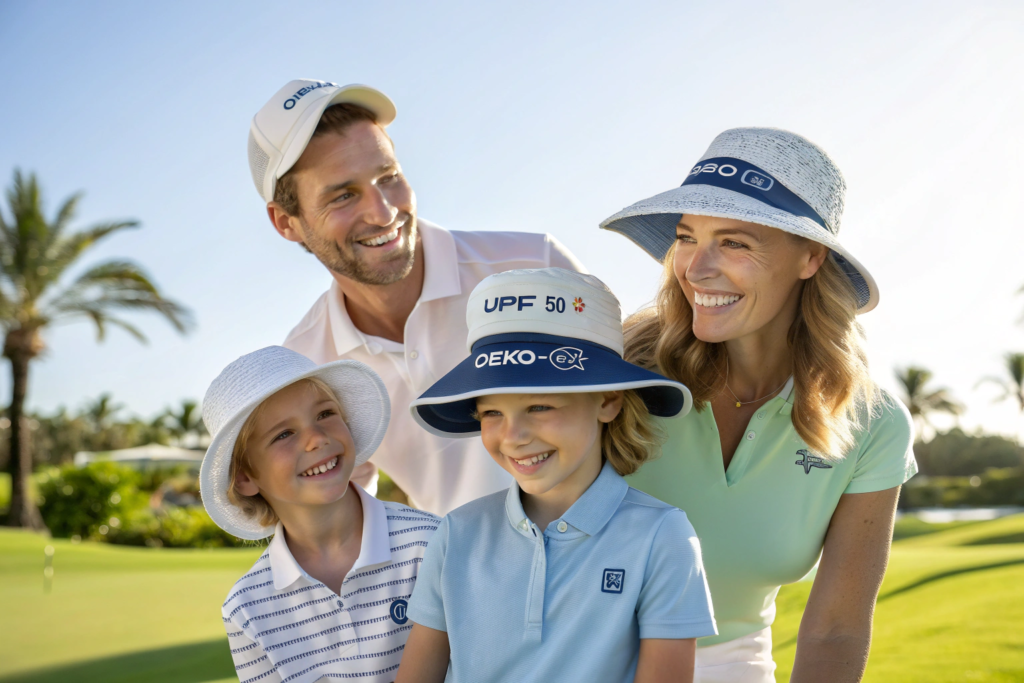
In the competitive golf apparel market, a sun shirt that credibly boasts both OEKO-TEX and a validated high UPF rating commands a significant premium. It answers two fundamental consumer fears: "Will this shirt give me skin cancer?" and "Will the chemicals in this shirt harm me?"
The marketing narrative is powerful: "Maximum sun protection, zero chemical worry. Engineered with OEKO-TEX certified safety and independently verified UPF 50+ technology." This dual claim is especially potent in family-oriented golf markets and regions with high UV indices, like Arizona or Florida.
For pro shops, it reduces liability and boosts customer confidence. They can assure customers that the product is both effective and safe for all-day wear, which is a unique selling proposition that generic sun shirts cannot match.
How to Communicate This Technically to Sales Teams and Consumers?
Simplify the message:
- For Sales Teams: "OEKO-TEX means it's safe for your skin. The separate UPF 50+ test means it blocks over 98% of the sun's harmful rays. We have the lab reports for both."
- For Consumers (on hangtags): "Tested free from harmful substances (OEKO-TEX STANDARD 100) | Independently rated UPF 50+ for superior sun protection."
Provide your sales team with the one-page summaries of both test reports. Transparency builds trust and justifies the price point.
Conclusion
OEKO-TEX certification and UV protection are complementary but distinct attributes for golf sun shirts. OEKO-TEX rigorously ensures the chemical safety of any treatments applied, while UPF testing quantifies the functional performance against solar radiation.
The most reliable and marketable sun shirt results from a deliberate, two-pronged testing strategy during development. Brands must partner with manufacturers who understand this dichotomy and have the technical capability to navigate both standards, providing full documentation.
At Shanghai Fumao, we integrate this dual-validation process into our development pipeline. From selecting inherently UV-resistant, certified base fabrics to managing post-treatment compliance and performance testing, we ensure your sun shirts are both powerfully protective and unquestionably safe. To develop a technically superior and credibly certified sun shirt line, contact our Business Director Elaine at elaine@fumaoclothing.com.