You're on your tenth email thread with a potential supplier. You've asked for details about their chemical safety process. Their replies are vague: "Yes, our fabrics are safe." "We follow standards." You're left with more questions than answers. This communication gap is costly, creating delays, mistrust, and risk. Could a common, third-party benchmark like OEKO-TEX certification actually transform this frustrating dynamic? The answer is a resounding yes.
OEKO-TEX certification directly and significantly improves communication with apparel suppliers by establishing a clear, objective, and verifiable language for product safety. It replaces subjective claims and vague assurances with specific, standardized requirements and documented proof. This framework structures discussions, reduces ambiguity, aligns expectations upfront, and creates a transparent basis for accountability throughout the production cycle.
Think of it not just as a certificate for your product, but as a communication protocol for your partnership. It shifts the conversation from "Do you promise it's safe?" to "Show me the valid certificate for this specific component and explain your process to maintain it." This transforms a potentially adversarial inspection into a collaborative, fact-based workflow.
From Vagueness to Verification: Establishing a Common Language
The core of poor supplier communication is ambiguity. Terms like "eco-friendly," "non-toxic," and "high-quality" mean different things to different people and factories. OEKO-TEX certification erases this ambiguity by providing a globally recognized, technical dictionary. When you specify "OEKO-TEX STANDARD 100, Article Class II," you are using a precise term with a published list of over 100 regulated substances and their exact limit values.
This common language does several things immediately. First, it filters your supplier pool. A factory that is genuinely capable will understand the term, ask for clarification on the Article Class, and begin discussing compliant material options. A factory that is not capable will either not respond in detail or will immediately reveal a lack of understanding. Last quarter, we had a client send us an RFQ they had also sent to five other factories. Only us and one other factory responded with questions about the specific Article Class and requested their target market to advise correctly. The other three sent back generic quotes—an instant red flag the client recognized.
Second, it structures the initial dialogue. Conversations naturally follow a logical path:
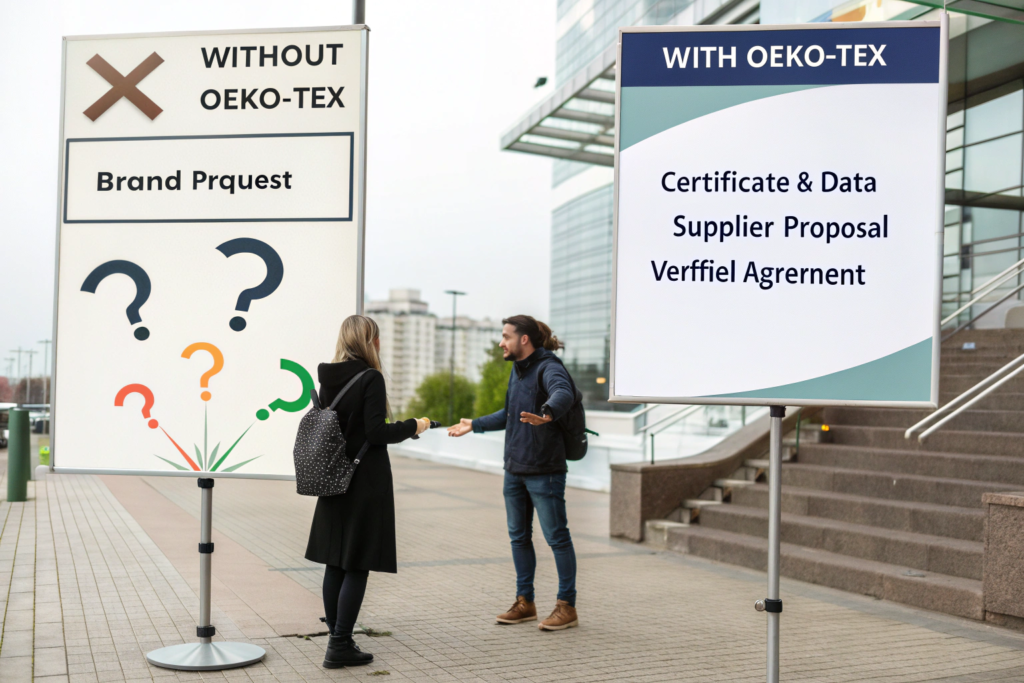
- Brand Requirement: "We need this style in an OEKO-TEX Class I certified French Terry."
- Supplier Response: "Understood. We have three pre-certified fabric options that meet Class I. Here are the swatches, mill certificates, and price differentials. For the rib cuff, we need to source a certified elastic; here are two options."
This replaces a circular conversation about "safety" with a focused conversation about actionable choices and documented evidence.

How Does This Prevent the "Falsified Certificate" Pain Point?
One of the biggest pain points for buyers like Ron is suppliers providing fake or outdated certificates. OEKO-TEX certification directly combats this by being independently verifiable. Every certificate has a unique number. The brand can—and should—immediately check this number in the free, public OEKO-TEX Certificate Check database.
This verification step becomes a standard part of your communication protocol. You can simply state: "Please provide the OEKO-TEX certificate numbers for the proposed fabric and key trims. We will verify them prior to proceeding." This sets a clear expectation of transparency from the first interaction. At Shanghai Fumao, we proactively include certificate numbers in our initial quotations and encourage clients to verify them. This builds immediate trust and short-circuits potential deception.
What Specific Questions Does It Answer Before They Are Asked?
OEKO-TEX pre-answers critical sourcing questions, streamlining Q&A:
- Question: "What chemicals are restricted?"
- Answer: The published OEKO-TEX standard list.
- Question: "How do I know the fabric is safe?"
- Answer: The valid, verifiable certificate from an accredited institute.
- Question: "Are the trims (zippers, buttons) also safe?"
- Answer: They must be included in the certification scope or have their own certificates.
This efficiency is invaluable. It allows both parties to spend communication time on design, fit, and logistics, rather than on foundational safety debates.
- Answer: They must be included in the certification scope or have their own certificates.
Streamlining the Development Cycle: Structured Milestones
Once an order is placed, communication challenges often shift to timelines, changes, and problem-solving. Here, OEKO-TEX certification continues to add clarity by creating natural, structured milestones in the product development and production timeline.
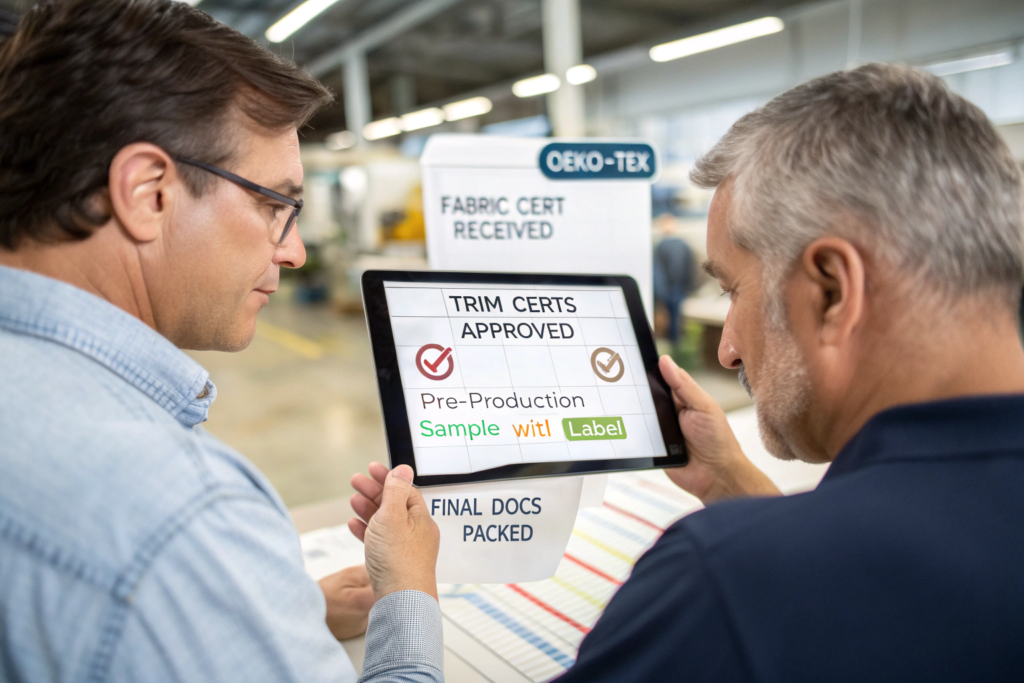
The certification process itself introduces checkpoints. For instance, if using pre-certified fabric, the milestone is "Provide batch-specific fabric certificate." If certifying a final garment, the milestone is "Receive and approve final product test report." These are concrete deliverables that trigger the next phase of work and payment. This prevents the common scenario where a brand assumes safety is being handled, only to discover at shipment that no testing was done.
Furthermore, it clarifies responsibility during changes. Suppose you want to change the color of a thread or the source of an interlining. The communication protocol becomes straightforward: "This new component must be OEKO-TEX certified. Please provide the test report before we approve the change and before it is used in production." This prevents costly last-minute discoveries of non-compliance. We enforce this rigidly in our change order process at Shanghai Fumao, which has saved numerous projects from delays.
How Does It Improve Problem-Solving During Production?
When a quality issue arises—like color bleeding or odor—in a certified product, the communication starts from a shared fact base. Both parties can refer to the test reports that initially passed the fabric. This focuses the investigation. Was it a contamination issue on the factory floor? Was an unapproved chemical introduced during wet processing? The certification parameters act as guardrails, narrowing down the root cause significantly faster than in an uncertified scenario where every chemical input is an unknown.
A real example: a client reported a slight smell on a batch of certified joggers. Because we knew the exact dyes and softeners used were from the approved, certified chemical list, we quickly isolated the issue to a new industrial laundry bag that had off-gassed during packing, not to the garment itself. The resolution (changing packing materials) was found within hours, not days.
Can It Reduce Disputes Over Final Shipment Approval?
Absolutely. Final inspection disagreements often hinge on subjective quality judgments. With OEKO-TEX, a key part of the Final Random Inspection (FRI) is objective: "Is the correct OEKO-TEX label attached?" and "Is the required documentation present in the shipment?" These are yes/no checklist items. By including these as contractual requirements, you remove a layer of potential conflict. The shipment is not complete without them. This objective clarity gives both the brand's QC inspector and the factory a clear, mutual understanding of the release criteria.
Building Long-Term Trust and Partnership Alignment
Beyond transactional efficiency, the greatest communication benefit of OEKO-TEX certification is the cultivation of long-term trust. When a supplier consistently meets the rigorous, transparent requirements of certification, they demonstrate a commitment to professionalism and systematic management that extends beyond mere production capability.
This trust transforms the buyer-supplier relationship. Communication becomes more open and proactive. A certified supplier is more likely to warn you about potential compliance issues with a new material trend or to suggest improvements to your tech pack to ensure certification integrity. They move from being an order-taker to a consultative partner. For example, when a new restriction on PFAS (per- and polyfluoroalkyl substances) was under discussion in the EU, our team proactively informed all our clients using water-repellent finishes, suggesting alternative certified chemistries well in advance of the regulatory deadline.
This alignment is especially valuable for brands that lack in-house chemical expertise. The OEKO-TEX framework allows them to outsource technical due diligence to a trusted, audited system and a partner who speaks that system's language. It elevates the entire conversation from cost and delivery dates to shared values of safety, quality, and risk management.
How Does This Impact Sourcing from Developing Countries?
For brands sourcing from countries like China, Vietnam, or India, communication gaps can be amplified by language and cultural differences. OEKO-TEX certification acts as a universal translator. It is a standardized, visual, and numerical system that transcends language barriers. A certificate number, a limit value in mg/kg, and a test institute logo are understood globally.
It also signals that you, as a buyer, are sophisticated and serious about compliance. This often commands greater respect and attention from factory management. They are more likely to assign a more knowledgeable account manager or technical liaison to your project, directly upgrading the quality of your communication line. We've seen this repeatedly: clients who lead with OEKO-TEX requirements in their RFQ receive a higher level of service from us from the very first contact.
Does Certification Foster Better Crisis Communication?
In the event of a problem—a failed test, a retailer inquiry—having the OEKO-TEX documentation creates a clear communication pathway. Instead of panic and blame, both parties can refer to the documented evidence trail. This facilitates a factual, solutions-oriented dialogue focused on containment and correction, rather than deflection. The presence of a certification shows that due diligence was performed, which can mitigate liability and preserve the business relationship.
Conclusion
OEKO-TEX certification is far more than a label sewn into a garment; it is a powerful communication tool that brings clarity, structure, and trust to the often-opaque buyer-supplier relationship. It replaces subjective promises with objective evidence, transforms vague discussions into precise technical dialogues, and establishes verifiable milestones that keep projects on track. In an industry where miscommunication can lead to missed seasons and damaged brands, it provides a common, credible language that aligns goals and reduces risk.
The improvement in communication is tangible: fewer emails, faster decisions, clearer expectations, and stronger partnerships. It turns sourcing from a stressful game of interpretation into a streamlined, professional collaboration.
Ready to transform your communication with suppliers and build partnerships on a foundation of clarity and trust? Shanghai Fumao is built on this precise model. We use OEKO-TEX certification as the framework for transparent, efficient collaboration with our clients. Contact our Business Director, Elaine, at elaine@fumaoclothing.com to experience how clear communication leads to flawless execution. Visit Shanghai Fumao to learn how we partner with brands to simplify complexity and deliver confidence.