A menswear brand founder from Nashville once told me about a demoralizing moment in his early days. He had sourced 500 units of a beautiful, heavyweight flannel shirt from a factory he found online. The shirt itself was great. The fabric was rich. The fit was solid. But when he opened the box and pulled out the first shirt, his heart sank. The inside back neck had a scratchy, generic white satin tag that said "MADE IN CHINA" in giant block letters. Below it, a cheap printed care label was already peeling at the edges. His brand name was nowhere to be found. He had spent months developing a premium product, a shirt he planned to retail for $98, and the very first thing a customer would see when they tried it on was a tag that screamed "generic import." He spent the next week carefully seam-ripping 500 tags by hand in his living room. He told me, "I built a brand, but the factory shipped me a commodity. The tag told the real story."
Yes, Shanghai Fumao produces men's wear with fully customized tags, labels, and branding elements. We treat brand identification not as an afterthought, but as an integral part of the garment's construction and perceived value. We offer a comprehensive range of custom tag solutions, including woven jacquard main labels, debossed leather patches, screen-printed neck transfers, custom care and content labels, branded hangtags, and interior hem taping. Every tag is produced to your exact design specifications, attached with consistent placement and stitch quality, and integrated into our pre-production approval and quality control process.
A custom tag is not just a piece of fabric with your logo on it. It is the physical signature of your brand. It is the detail that separates a premium product from a generic one in the mind of the consumer. It communicates your brand's attention to detail, your quality standards, and your legitimacy. It can also be a legal requirement, carrying fiber content, country of origin, and care instructions. I want to walk you through the full range of custom tag options we offer, the production process from design to attachment, the quality standards we apply, and the specific considerations for building a complete brand identity inside your men's wear garments.
What Types of Custom Tags Can We Produce for Men's Wear?
A contemporary menswear designer from Brooklyn once sat in my showroom and asked me a question that I now ask every new client. He said, "When my customer puts on my garment for the first time, what do I want him to feel on the back of his neck?" It is a brilliant question. The answer determines the tag type. If the brand is rugged, heritage-inspired workwear, the answer might be a soft, oiled leather patch. If the brand is minimalist, modern tailoring, the answer might be a flat, screen-printed transfer that feels like nothing at all. If the brand is classic, Ivy League-inspired, the answer might be a crisp, detailed woven jacquard label.
The tag type is a branding decision, not just a procurement decision. We offer a full spectrum of custom tag solutions to match your specific brand positioning and product category.
What Are the Options for Woven Labels, Leather Patches, and Printed Tags?
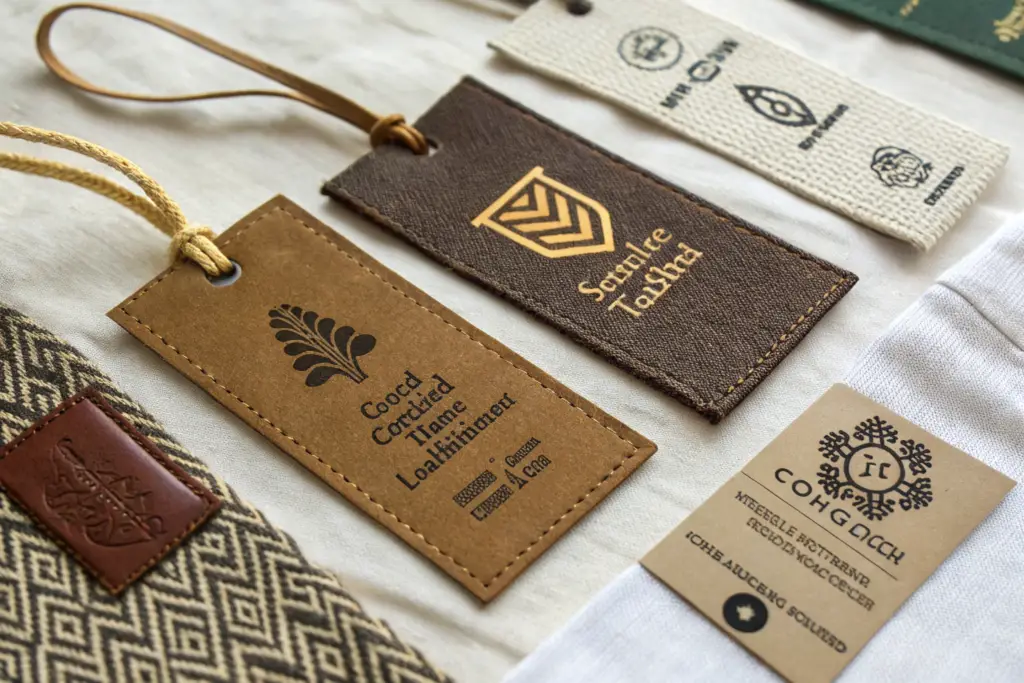
We produce three primary categories of main brand identification tags, each with distinct aesthetic and tactile qualities.
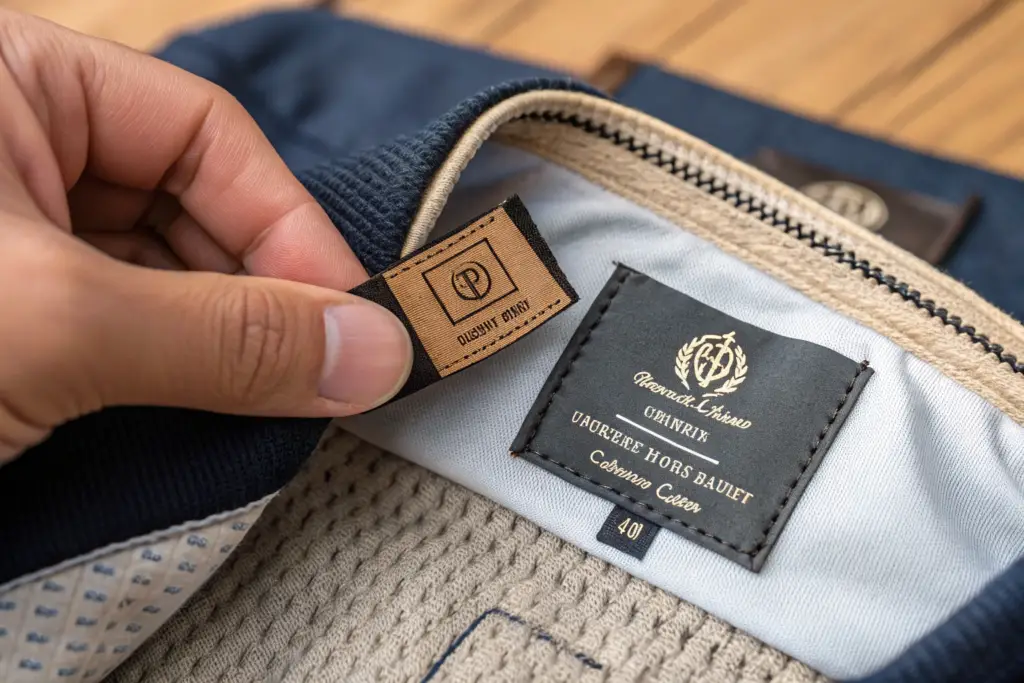
Woven jacquard labels are the classic, premium choice for tailored shirts, trousers, blazers, and polo shirts. They are produced on specialized looms that weave fine polyester or cotton threads into a detailed, textured design. The result is a crisp, dimensional logo that feels substantial and permanent. We offer damask weave for fine detail, satin weave for a smooth, lustrous finish, and taffeta weave for a budget-conscious but still premium option. Thread colors can be matched to your brand's Pantone specifications. Metallic gold or silver thread is available for an elevated look.
Leather patches are the preferred choice for denim, workwear, heritage outerwear, and premium casual bottoms. We source genuine leather, including full-grain cowhide and suede, and offer debossing, the classic indented, tonal look, foil stamping in metallic or matte colors, and screen printing on the leather surface. The patch can be cut to any shape, rectangle, square, shield, circle, and attached with a merrow edge or a folded and stitched border. For a denim brand in Austin, we produced a custom-shield leather patch with a debossed logo and a raw, unstitched edge for a rugged, vintage look.
Printed tags, including screen-printed transfers and direct-to-garment printed labels, are the choice for lightweight knitwear, t-shirts, activewear, and performance polos where a traditional woven label would feel heavy, scratchy, or bulky. The ink is applied directly to the inside of the garment, creating a tagless, seamless feel against the skin. This is increasingly the preference for premium basics and performance wear. The print is soft, durable, and survives repeated washing. Each tag type has a specific use-case. Our role is to guide you to the correct tag type for your product category and brand aesthetic.
Can You Produce Custom Care Labels with My Branding and Legal Info?
Yes. Care labels, the small printed satin or nylon labels containing fiber content, country of origin, care instructions, and RN number, are a legal requirement for garments sold in the United States. They are also a branding opportunity that many brands overlook.
We produce fully customized care labels that integrate your brand's logo, typeface, and visual identity alongside the mandatory legal information. A generic care label looks like a legal disclaimer. A branded care label looks like an intentional part of the garment's finishing. It signals that the brand cares about every detail. We print on soft satin polyester or nylon in a matte finish, using thermal transfer printing that remains legible after 50-plus wash cycles. The information on the label is verified against your provided specifications and the legal requirements of the destination market. For US-bound goods, we ensure compliance with FTC labeling regulations, including the correct fiber content percentages, country of origin marking, and the registered RN number or company name. For European-bound goods, we ensure compliance with EU textile labeling regulations. We can also produce multi-language care labels for brands selling in multiple regions. This detail is easy to get wrong and expensive to fix after production. We manage it carefully.
What Is Our Process for Custom Tag Design and Approval?
A menswear brand owner from Denver once told me about his previous tag ordering experience with another factory. He sent his logo file and said, "Make a woven label, black with silver text, standard size." He received the finished shirts six weeks later. The labels were black, but the text was white, not silver. The weave was a budget taffeta, not the premium damask he assumed. The size was a standard 60mm x 25mm, which looked absurdly small on the back of a size XL flannel. He had no recourse. The order was done. He told me, "I learned that 'standard' means 'whatever is cheapest for the factory.' Never say standard."
Our custom tag process eliminates this ambiguity. It is a structured, documented, approval-gated workflow that ensures the tag you sign off on is the tag you receive in your finished garments.
How Do You Submit Your Logo and Design for Tag Production?
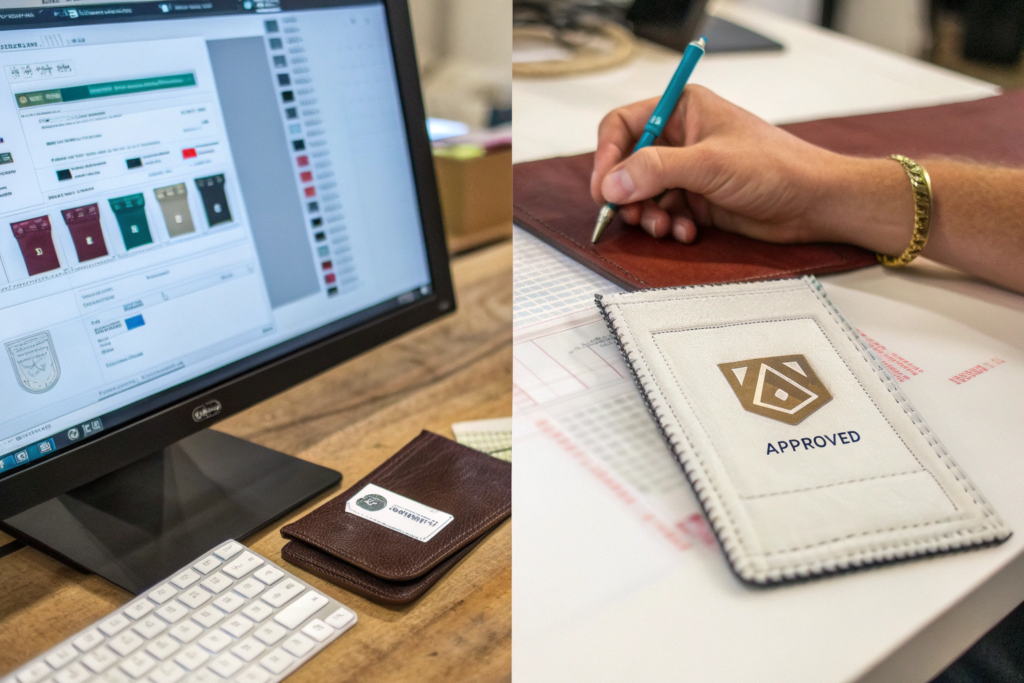
The process begins with your design files and a clear specification brief. You provide your logo in vector format, Adobe Illustrator or CorelDRAW, which is essential for clean, scalable output. You provide your brand's Pantone color references for thread, ink, or foil. You specify the tag type, woven, leather, printed, and the desired dimensions.
If you do not have a finalized tag design, our team can provide templates and design guidance based on your brand's logo and aesthetic. This is a collaborative service. We do not just execute a file. We advise on what works. For a leather patch, we advise on the minimum readable font size for debossing. For a woven label, we advise on the maximum thread count for sharp detail at your specified dimensions. Once the specification is clear, our tag supplier creates a digital proof, a detailed, color-accurate rendering of the final tag. This digital proof is sent to you for initial approval. We do not proceed to physical sampling until the digital proof is approved. This prevents costly iterations on the physical side. The custom label design process is a dialogue, not a one-time submission.
What Physical Samples Do You Approve Before Bulk Production?
After digital proof approval, we produce a physical pre-production sample of each tag type. This is a real, finished tag, produced on the actual material, with the actual thread colors, at the actual dimensions.
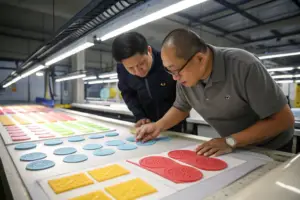
For a woven label, this is a loom sew-out. For a leather patch, this is a finished debossed piece. For a printed neck label, this is a printed transfer on a fabric swatch. We ship these physical samples to you, along with a detailed tag approval form. The form asks you to check and sign off on specific criteria: the material type and color, the thread or ink colors against your Pantone reference, the legibility of text, the dimensional accuracy, and the overall aesthetic. You sign and return the approved form, or you provide specific, annotated feedback for a revision. We will revise and re-sample until you are satisfied. This physical approval process is the critical gate that prevents the "I assumed it would look different" disappointment. For a recent men's shirting program, the client approved a digital woven label proof. When the physical sew-out arrived, the gold metallic thread looked slightly more yellow than expected under their retail lighting. We sourced an alternative gold thread, re-wove the sample, and received final approval. The delay was one week. The alternative was a 2,000-unit order with the wrong gold thread. The physical tag sample approval process is non-negotiable for brand-sensitive orders.
How Do We Attach Tags with Consistent Quality and Placement?
I once inspected a shipment from a competitor factory for a client who was migrating his production to us. The garments themselves were acceptable. The tag attachment was a disaster. Some labels were stitched crookedly. Some had loose thread tails. The care labels on one size were sewn into the left side seam, and on another size, into the right side seam. The placement was random. It looked like the finishing team had no standard, no jig, and no inspection. This inconsistency screams "cheap" to a consumer, even if they cannot articulate why.
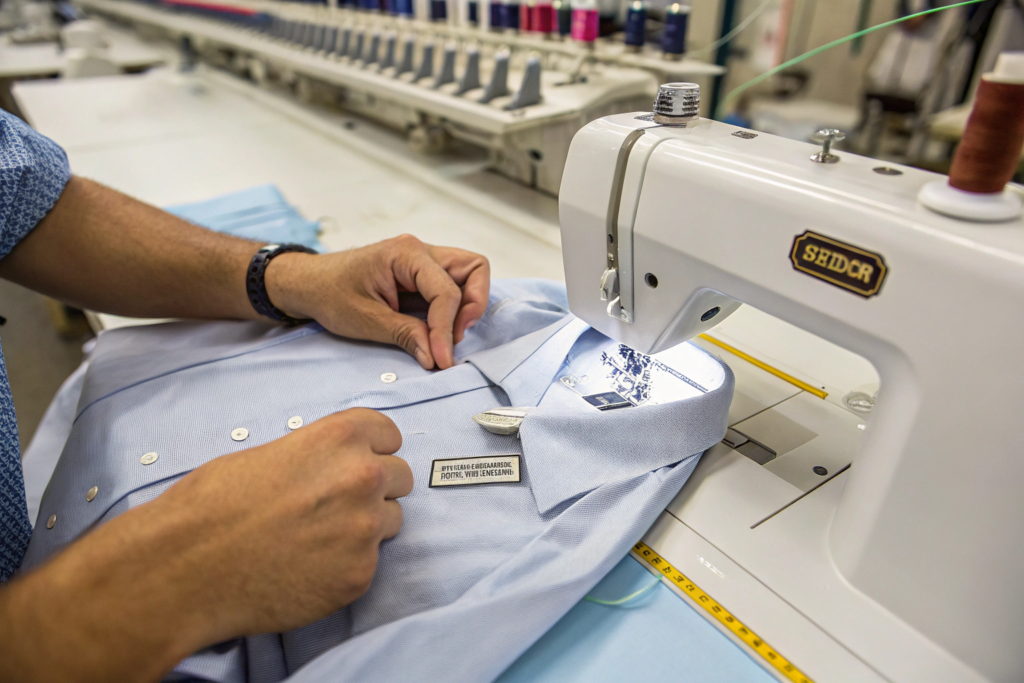
Tag attachment is a precision operation. The placement, the stitch type, the thread color, and the tension must be consistent across every unit in the order. We apply the same engineering discipline to tag attachment as we do to collar setting or pocket attachment.
What Placement Standards Do We Use for Different Garment Types?
Placement is dictated by the garment type, the tag type, and the brand's aesthetic preference, but we enforce standardized, measurable placement for each category.
For the main brand label, the standard placement on a woven shirt is centered horizontally on the inside back neck, 1.5cm below the neck seam. For a polo shirt, it is typically in the same position, or in the inside side seam for a cleaner, more minimal look. For a leather patch on jeans, it is centered on the back waistband, with the bottom edge aligned with the waistband seam. For printed neck labels, the transfer is positioned to sit flat against the wearer's neck without folding over the seam. We use transparent acrylic placement jigs for each tag position. The jig clips onto the garment, providing a hard, physical guide for the sewer. The label is placed against the jig's edge, and the placement is identical every time. There is no freehand guessing. The jig also ensures the label is sewn straight and level, not tilted. Care labels are typically sewn into the left side seam, at a specific distance from the bottom hem. We maintain a library of placement standards by garment category. If you have a specific placement preference, you specify it during the tech pack stage, and we create a custom jig for your order. The tag placement standardization eliminates the single most visible finishing inconsistency.
How Do We Inspect Tag Quality Before Packing?
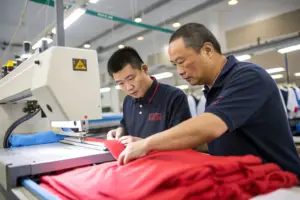
Every tag on every garment is visually inspected by a member of our finishing QC team before the garment is folded and packed. This is a 100% inspection, not a statistical sample.
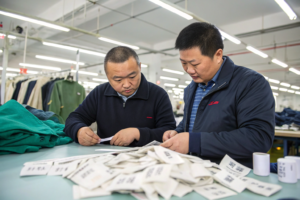
The inspector checks six specific points. First, the correct tag type and design. Is this the approved label, not a previous version or a different client's label? Second, the attachment position. Is it centered, straight, and at the specified distance from the seam? Third, the stitch quality. Are the stitches even, with correct tension, and is the thread color matching the specification? Fourth, the label condition. Is the label itself free from stains, frayed edges, or weaving defects? Fifth, the care label content. Is the fiber content, country of origin, and care information correct and legible? Sixth, the brand label and care label consistency. Do the size, fiber content, and country of origin match between the main label, the care label, and the hangtag? A mismatch between a size L woven label and a size M care label is a costly error that can trigger a retail return. This 100% visual inspection is documented. The inspector initials a quality card that travels with the batch. We have a near-zero tolerance for tag errors. A tag mistake is not a minor defect. It is a brand-damaging failure. The tag quality inspection protocol is the final safeguard in our custom tag process.
Conclusion
A custom tag is the smallest physical component of a men's wear garment, but it carries the largest branding burden. It is the first touchpoint when a customer tries on the garment, and the lasting impression when they hang it back up. At Shanghai Fumao, we produce men's wear with custom tags that reflect the specific brand identity you have built or are building. We offer the full range of tag types, from woven jacquard labels and debossed leather patches to printed neck transfers, each matched to your product category and aesthetic. We manage a structured design and approval process that moves from vector artwork to digital proof to physical sew-out sample, with signed approval at every stage. And we attach and inspect every tag with the same precision jigs, placement standards, and 100% visual QC we apply to the garment construction itself.
If you are launching a new men's wear brand, or rebranding an existing line, and you want your tags to tell the same quality story as your fabric and fit, I invite you to start with a tag sample. Contact our Business Director, Elaine, at elaine@fumaoclothing.com. Send her your logo file and tell her what kind of brand you are building. She will coordinate a physical tag sample pack with your logo on different materials and finishes, along with a placement guide for your specific garment types. Hold the tags in your hand. Feel the weave of the jacquard. Touch the grain of the leather. See your logo in the physical materials. Let the tag speak for your brand before you commit to a single unit of production.