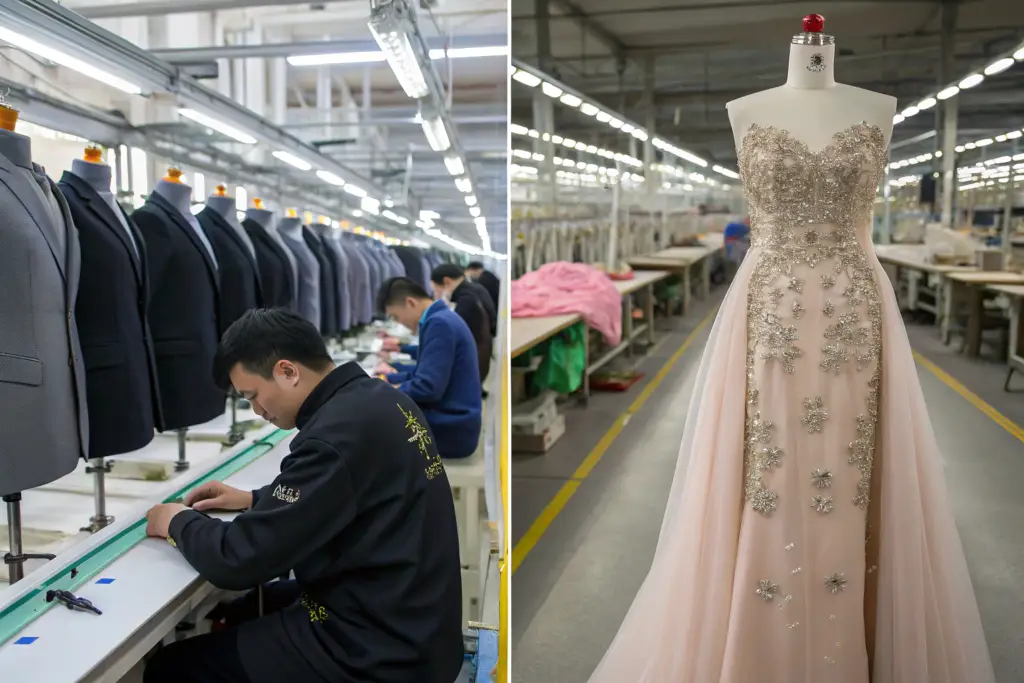
Your brand has two distinct lines. The men's collection is classic OEM: structured button-downs, chinos, and outerwear that need to hit a specific price point with consistent quality across thousands of units. The women's line is a different animal entirely: draped silk dresses, hand-finished embellishments, avant-garde silhouettes that change every season. You are currently managing two separate factory relationships. The OEM factory sends you spreadsheets and bulk-packed cartons. The high-fashion atelier sends you tissue-wrapped samples and handwritten thank-you notes. Managing both is exhausting, inefficient, and prevents your brand from achieving the unified supply chain visibility that your investors and operations team demand.
Yes, a top clothing manufacture can handle both OEM men's wear and high-fashion women's wear under one roof, provided the factory has invested in physically separated production zones, dual-skilled workforce management, and differentiated quality control protocols for each category. The capability does not come from simply running both types of garments on the same line. It requires architectural, operational, and cultural separation within a single management structure.
At Shanghai Fumao, we produce 5,000-unit runs of men's Oxford shirts with the same operational rigor we apply to a 200-unit run of women's silk evening gowns with hand-beaded necklines. This dual capability is not common in the industry, and achieving it required deliberate structural decisions. Let me explain how we built this capability, why most factories fail at serving both markets, and what you should look for when consolidating your OEM and high-fashion production with a single partner.
Why Do Most Factories Specialize in Either OEM or High-Fashion, Not Both?
The factory industry has a structural bias toward specialization. This is not laziness or lack of ambition. It is a reflection of how fundamentally different the two production models are. OEM men's wear manufacturing optimizes for repeatability, speed, and cost efficiency. High-fashion women's wear manufacturing optimizes for flexibility, craftsmanship, and design fidelity. The equipment, the workforce skills, the production line layout, the quality control methods, and the management culture are all optimized for one model at the expense of the other. A factory that tries to run both on the same infrastructure usually produces mediocre results in both categories.
Most factories specialize because the operational DNA of OEM production and high-fashion production are in direct tension. OEM requires standardized processes, minimal variation, and throughput metrics. High-fashion requires process flexibility, tolerance for iteration, and quality metrics that prioritize aesthetic outcome over production speed. A factory that excels at one has usually spent years optimizing systems that are directly counterproductive for the other.
How Does Production Line Architecture Differ Between the Two Models?
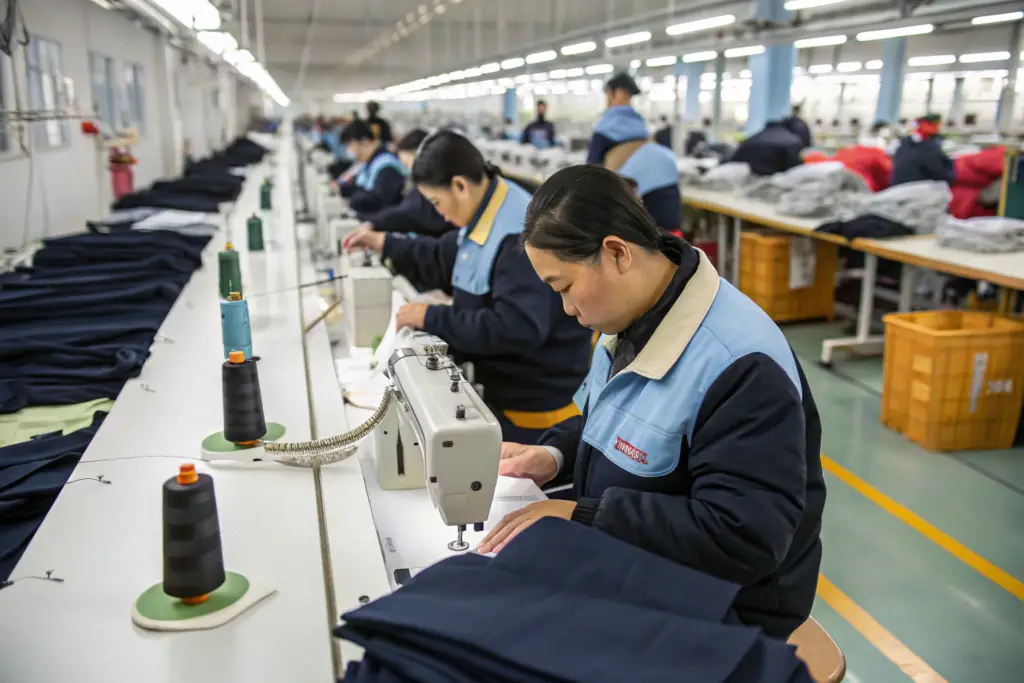
An OEM men's wear line is a straight line. The garment moves from station to station in a linear flow. Station one sets the collar. Station two attaches the sleeves. Station three hems the bottom. Each station performs one operation repeatedly, thousands of times per day. The operator at station two may have spent the last three years doing nothing but setting sleeves on men's dress shirts. The line is balanced so that each station takes the same amount of time, creating a smooth, uninterrupted flow. Efficiency is measured in units per hour. The line is designed to minimize changeover because changeover is downtime, and downtime is the enemy.
A high-fashion women's wear line is not a line at all. It is a cluster of skilled artisans working on individual garments or small batches. The construction sequence may vary by style. The techniques required may vary by fabric and embellishment. The same artisan may handle multiple operations on the same garment because the garment's design coherence benefits from a single skilled hand. Changeover is constant because each style is produced in small quantities. Speed is secondary to precision and aesthetic quality. Putting a high-fashion garment on an OEM line would either destroy the garment's quality or destroy the line's efficiency. Putting an OEM garment in a high-fashion cluster would be economically wasteful, paying artisan-level labor rates for repetitive work that a specialized line operator could perform faster and at lower cost. This garment production line design tension is the fundamental structural reason most factories choose one model and stick to it.
Why Does Workforce Skill Segmentation Create a Management Challenge?
An OEM line operator is a specialist. She performs one operation or a small set of operations at high speed and consistent quality. She is trained to follow standardized work instructions precisely. Variation from the specification is a defect. Her skills are deep but narrow.
A high-fashion sample sewer or production artisan is a generalist. She must be able to handle a wide variety of fabrics, construction techniques, and embellishment methods. She must interpret a designer's intent from a sketch or a draped muslin, not just follow a digitized pattern. She must exercise judgment. Variation from the specification may be a creative improvement. Her skills are broad and deep.
Managing these two workforce types in the same facility requires different supervision styles, different incentive structures, and different career paths. An OEM line supervisor measures output and defect rates. A high-fashion atelier manager measures design fidelity and problem-solving creativity. A factory that treats both workforces identically will frustrate the OEM operators with unnecessary flexibility demands or stifle the high-fashion artisans with rigid process controls. We operate two distinct workforce management systems. Our OEM lines are supervised by production engineers focused on efficiency metrics. Our high-fashion team is led by a head artisan with a couture background who manages by mentorship and quality review. These garment manufacturing workforce strategies operate in parallel under the same HR policies but with different daily management practices.
How Does Shanghai Fumao Structure Its Production Floor for Dual Capability?
The solution to the OEM versus high-fashion tension is physical separation within a unified facility. The two production models cannot share the same physical space without creating interference. The rhythm of an OEM line—fast, steady, machine-driven—disrupts the concentration of artisans performing delicate handwork. The slower, variable pace of high-fashion production blocks the smooth flow of an OEM line. Physical separation allows each model to operate optimally while capturing the shared benefits of centralized material sourcing, quality systems, and logistics.
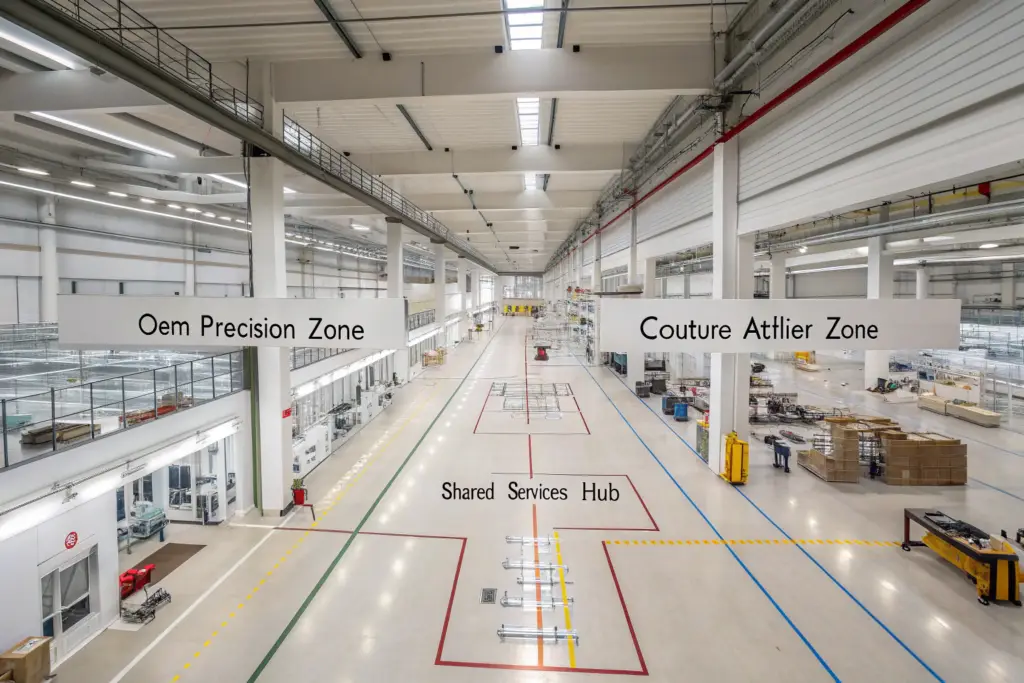
Shanghai Fumao's production floor is architecturally divided into the OEM Precision Zone and the Couture Atelier Zone, connected by a Shared Services Hub. The OEM Zone operates on linear production lines optimized for efficiency and repeatability. The Couture Zone operates on cluster workstations optimized for flexibility and craftsmanship. The Shared Services Hub provides centralized fabric inspection, cutting, digital printing, and quality assurance to both zones, capturing economies of scale while respecting the operational differences.
What Happens in the OEM Precision Zone?
The OEM Precision Zone occupies the larger portion of our factory floor. It houses four of our five production lines, configured in linear layouts with specialized workstations for each operation. This zone handles our men's wear OEM programs: dress shirts, polo shirts, chinos, outerwear, and activewear. The environment is bright, organized, and rhythmically paced. Digital production tracking screens display hourly output against the daily target. Quality inspectors conduct inline checks at designated measurement points.
The workforce in this zone is organized into teams led by production supervisors with engineering backgrounds. They manage throughput, line balancing, and defect reduction. The equipment is specialized for the product categories running on each line. Line One is configured for woven shirts with specialized collar turning and pressing equipment. Line Two handles knitwear with overlock and coverstitch machines. The operators are cross-trained within their category to allow flexibility, but they stay within the OEM Zone. This zone operates on a schedule optimized for delivery reliability. Production orders are planned weeks in advance. Changeover between styles is scheduled and controlled. The culture is precision and predictability. This OEM garment manufacturing discipline ensures that our brand partners receive consistent quality, on-time delivery, and competitive pricing for their volume programs. The zone produces thousands of units per week with defect rates consistently below our AQL 2.5 standard.
What Happens in the Couture Atelier Zone?
The Couture Atelier Zone is physically separated from the OEM Zone by a glass wall and a controlled access door. The environment is quieter, with more natural light and individual workstation lighting. This zone houses our high-fashion women's wear production: silk dresses, embellished evening wear, tailored jackets with complex construction, and avant-garde silhouettes that require draping and hand-finishing. The layout is modular. Workstations can be reconfigured into clusters for specific projects. Dress forms in multiple sizes stand ready for draping. A library of specialty threads, beads, and trims is immediately accessible.
The team in this zone is led by our head artisan, who trained in haute couture ateliers before joining Shanghai Fumao. The sewers and finishers in this zone are multi-skilled artisans, not single-operation specialists. One artisan may handle the entire construction of a complex dress from cut fabric to final press. Handwork stations for beading, embroidery, and hemming are integrated into the zone. Quality review in the Couture Zone is a collaborative process. The head artisan reviews each garment against the designer's reference sample. The review considers not just technical specifications but also drape, proportion, and overall aesthetic effect. Adjustments are made on the spot. This zone operates on a project-based schedule. Each collection is treated as a distinct project with its own timeline and dedicated team. The culture is craftsmanship and design fidelity. This high-fashion garment manufacturing capability allows our brand partners to produce runway-quality women's wear without maintaining a separate atelier relationship. The zone produces smaller quantities—typically 50 to 500 units per style—but each unit receives individualized attention.
The Shared Services Hub is the operational bridge that makes dual capability economically viable. If each zone operated completely independently, the factory would duplicate overhead and lose the scale advantages that make OEM production cost-competitive. The Hub provides centralized services that both zones consume without compromising their operational differences.
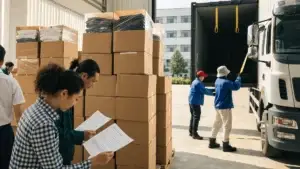
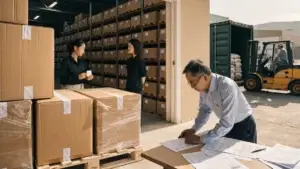
The fabric inspection and storage facility serves both zones. All incoming fabric, whether a 5,000-meter roll of cotton shirting for the OEM Zone or a 200-meter roll of silk charmeuse for the Couture Zone, undergoes the same inspection process for defects, shrinkage, and color consistency. The cutting room uses automated spreading and cutting for large OEM runs and manual cutting for delicate couture fabrics. The digital printing and embroidery equipment serves both zones, programmed with different specifications for volume versus small-batch production. Quality assurance leadership oversees both zones, ensuring that quality standards are appropriate to each product category but consistently applied. The logistics team handles shipping for both zones, preparing bulk-packed OEM cartons and tissue-wrapped couture boxes from the same dock. This shared manufacturing services model captures the efficiency of centralization while respecting the operational autonomy of each production zone. The brand partner experiences a single point of contact, a single quality standard, and a single logistics pipeline, even though their men's shirts and women's gowns are produced in different physical environments.
What Quality Control Differentiation Is Required for Each Category?
A men's Oxford shirt is judged by how precisely it matches the specification. Collar points must measure exactly 7 centimeters. Stitch density must be 10-12 stitches per inch. Button attachment must withstand 15 pounds of pull force. Quality is conformance to measurable standards. A high-fashion silk dress is judged by how beautifully it fulfills the designer's vision. The drape must flow correctly on the body. The hand-finished hem must be invisible from the outside. The overall effect must match the reference sample's aesthetic, not just its measurements. Quality is fidelity to creative intent. These two definitions of quality require completely different inspection protocols, inspector qualifications, and acceptance criteria.
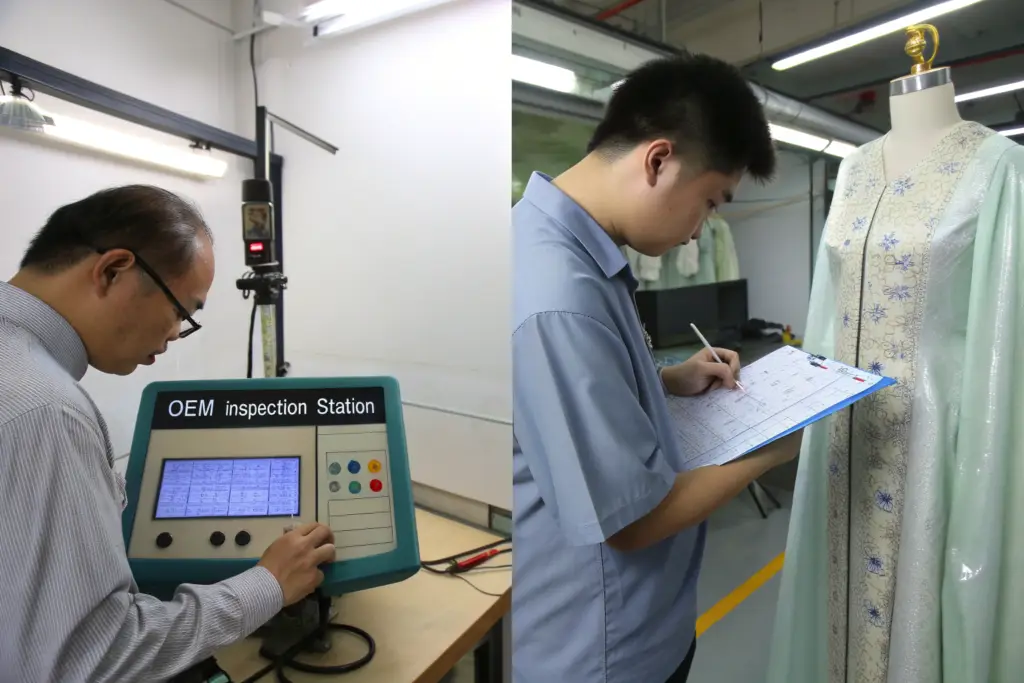
OEM quality control relies on statistical sampling against quantifiable specifications measured with calibrated instruments. High-fashion quality control relies on 100% inspection against aesthetic reference standards evaluated by experienced artisans. A factory serving both markets must operate both QC systems in parallel, with inspectors trained specifically for the category they evaluate.
How Does OEM Inspection Use AQL Sampling and Measurement Data?
OEM quality control follows the AQL (Acceptable Quality Level) sampling methodology. For a production run of 5,000 men's shirts, a statistically determined sample—typically 200 units—is inspected against a defined list of critical, major, and minor defects. Critical defects, such as a broken needle fragment in the garment, trigger automatic rejection of the entire lot. Major defects, such as a misaligned buttonhole, allow a maximum of a specified number in the sample. Minor defects, such as a loose thread, have a higher tolerance.
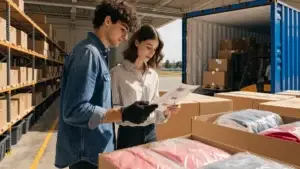
Our OEM inspectors use calibrated measurement tools: digital calipers for seam allowances, stitch counters for stitch density, tension gauges for button attachment strength, and light boxes for visual defect detection. Each inspection result is recorded in a digital quality management system that tracks defect rates by style, by production line, and by operator. This data drives continuous improvement. If the data shows that a specific operator is producing button attachment defects above the acceptable rate, the line supervisor provides targeted retraining. This AQL quality control in apparel methodology is standardized, scalable, and auditable. It provides brand partners with a statistically valid confidence level that the entire production lot meets specifications. The inspection report is shared with the brand before shipment, providing documented evidence of quality conformance.
How Does Couture Inspection Evaluate Aesthetic and Craftsmanship Quality?
High-fashion quality control does not fit the AQL sampling model. A production run of 200 silk gowns is inspected at 100%, not sampled. Every single garment is placed on a dress form or mannequin and evaluated by a senior artisan against the designer's approved reference sample. The evaluation criteria include technical elements—seam finishing, hem evenness, closure functionality—but extend to aesthetic elements that cannot be captured in a measurement specification.
The inspector evaluates drape: does the fabric fall on the body the way the reference sample does? Proportion: are the design elements positioned correctly relative to the wearer's body? Finish: is the hand-stitched hem invisible, and does the beading lie flat without puckering? Overall effect: does the garment achieve the intended emotional and aesthetic impact? These judgments require the eye of an experienced artisan, not just a calibrated tool. The inspection is documented with photographs of each garment on the dress form, annotated with any observations. A minor aesthetic deviation that a measurement-based inspection would miss—a sleeve that drapes slightly differently due to fabric variation within the dye lot—is identified and corrected. This high-fashion quality assurance process ensures that every garment leaving the Couture Zone meets the designer's creative standard, not just the technical specification. For a brand whose reputation rests on design excellence, this level of quality control is non-negotiable.
How Does a Dual-Capability Factory Benefit a Multi-Line Brand?
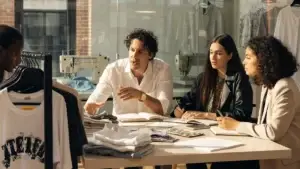
Managing two separate factory relationships creates hidden costs that do not appear on either factory's invoice. The brand's production manager coordinates two sets of sampling timelines, two quality standards, two logistics pipelines, and two communication styles. The brand's finance team reconciles two sets of invoices with different formats and payment terms. The brand's creative director travels to two locations for fit approvals. These coordination costs drain time, money, and organizational energy.
A dual-capability factory consolidates these fragmented workflows into a single partnership. The brand has one point of contact for both product lines. Quality standards are managed within a unified system that differentiates by category but reports consistently. Logistics are coordinated so that OEM and high-fashion shipments can be combined or synchronized. The operational simplification reduces management overhead, decreases communication errors, and provides the brand CEO with a single source of truth for their entire supply chain.
How Does Consolidated Logistics Reduce Cost and Complexity?
A brand producing men's OEM shirts and women's high-fashion dresses in two separate factories pays for two separate shipments. The OEM shipment may arrive on a different vessel, clear customs through a different broker, and deliver to the 3PL on a different truck. The brand's operations team tracks two separate timelines, resolves two separate sets of customs queries, and coordinates two separate receiving appointments. The freight cost is higher because neither factory's volume alone qualifies for the best carrier rates.
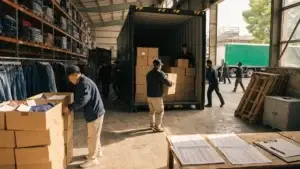
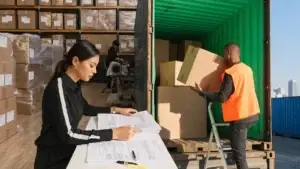
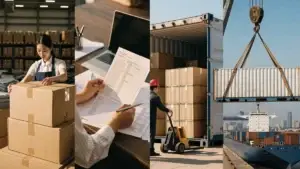
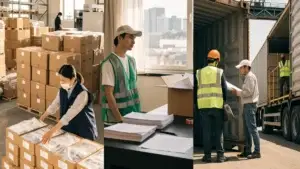
Consolidated logistics under a dual-capability factory allows the OEM and high-fashion orders to ship together in a single container. The combined volume qualifies for better freight rates. A single customs entry is filed. A single delivery appointment is scheduled at the 3PL. The brand's operations team manages one logistics timeline instead of two. For a brand we serve that produces both men's casual wear and women's occasion dresses, combining their shipments reduced their per-unit freight cost by 18% and eliminated an average of three hours per week of coordination time from their operations manager's workload. This consolidated apparel logistics efficiency is a direct financial benefit of dual-capability manufacturing.
How Does a Single Quality Reporting System Improve Brand Consistency?
When OEM and high-fashion production occur in separate factories, quality data lives in separate systems with different formats, different defect definitions, and different reporting cadences. The brand's quality manager spends time translating between the two systems rather than analyzing trends. A pattern of defects that spans both product lines—for example, a trim attachment issue that appears on men's shirts and women's dresses using the same button supplier—may go undetected because the data is siloed.
Under a dual-capability factory with a unified quality management system, all quality data flows into a single platform. The defect taxonomy differentiates by product category, but the underlying data structure is consistent. The brand receives a monthly quality dashboard covering both product lines with comparable metrics. A trim attachment issue is visible across both categories, enabling a single corrective action with the button supplier rather than two separate investigations. This unified quality management capability turns quality data from a fragmented reporting exercise into a strategic asset for the brand's continuous improvement.
Conclusion
A top clothing manufacture can handle both OEM men's wear and high-fashion women's wear, but not by treating them the same. The capability requires intentional architectural separation, differentiated workforce management, and dual quality control systems that respect the fundamentally different definitions of quality in each category. The investment is significant, which is why most factories choose to specialize. For the factory that makes the investment, the reward is the ability to serve multi-line brands as a single, integrated manufacturing partner.
At Shanghai Fumao, the OEM Precision Zone and the Couture Atelier Zone operate as two specialized factories under one roof, connected by shared services that capture efficiency without compromising specialization. Our OEM men's wear partners receive the cost-competitive, delivery-reliable production that their volume programs demand. Our high-fashion women's wear partners receive the craftsmanship, design fidelity, and individualized attention that their creative work requires. Both receive a single point of contact, a unified quality reporting system, and consolidated logistics that simplify their operations.
If your brand produces both volume-driven men's lines and design-driven women's collections, you do not need to maintain two separate factory relationships. You need one factory that has built the structural capability to serve both. Contact our Business Director, Elaine, at elaine@fumaoclothing.com. Share the scope of your men's and women's programs. We will explain how our dual-capability model can simplify your supply chain, reduce your coordination costs, and deliver both the consistent OEM quality and the high-fashion craftsmanship your brand demands.