You're running an apparel business. One day you need to place a reliable, 10,000-piece bulk order for a core collection. The next, you're developing a small, innovative line with custom OEKO-TEX certified fabrics and unique details. The common wisdom says you need two different factories: one for efficient bulk, another for flexible custom work. But managing two supply chains doubles complexity, cost, and risk. So, is it possible for one factory to master both worlds at a high level?
Yes, a sophisticated factory can absolutely handle both bulk wholesale and certified custom orders. The key is not just having separate production lines, but having a deeply integrated operational system with modular workflows, specialized teams, and a unified quality management framework that can scale up for efficiency and scale down for customization without sacrificing compliance or quality.
The real challenge isn't capacity; it's operational intelligence. A factory stuck in a rigid, single-mode mindset will fail at one or the other. But a factory built on flexibility, clear processes, and advanced planning can seamlessly switch gears. Let's examine how this dual capability works in practice and how to identify a partner that truly has it.
What Operational Structure Enables This Dual Capability?
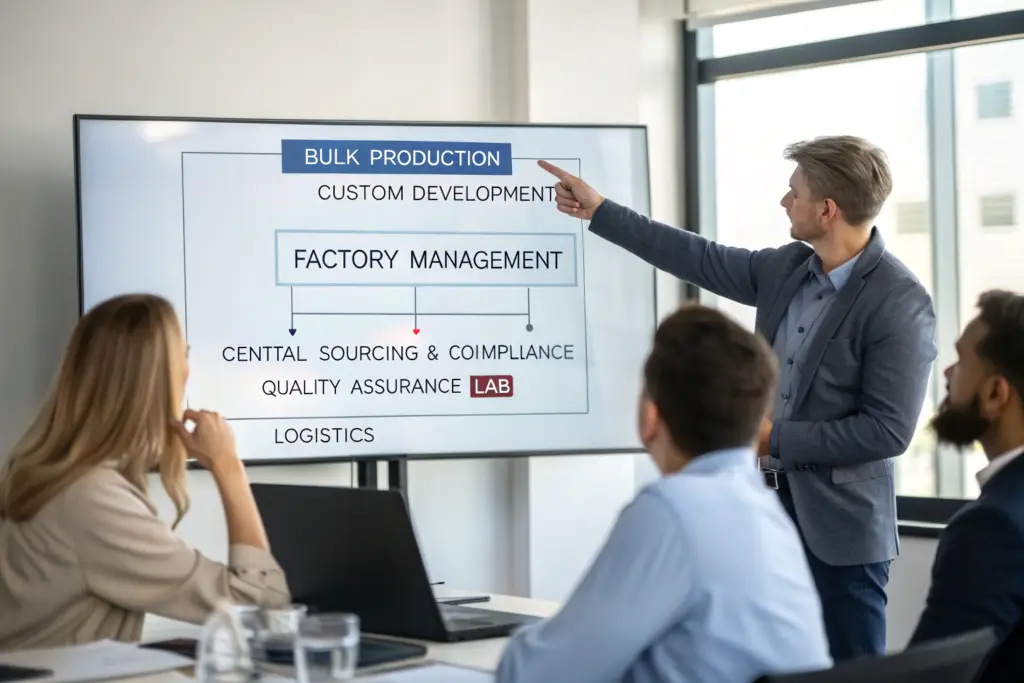
The foundation is organizational design. The factory must have distinct but connected teams for bulk production and custom development, sharing common backend resources like sourcing, compliance, and quality assurance. This structure prevents the slower, detail-oriented custom work from bottlenecking the high-volume lines, and vice-versa.
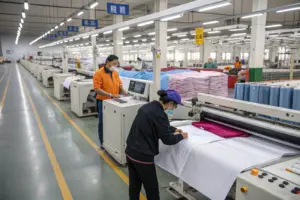
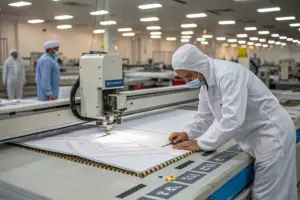
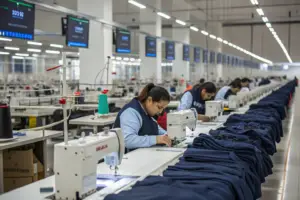
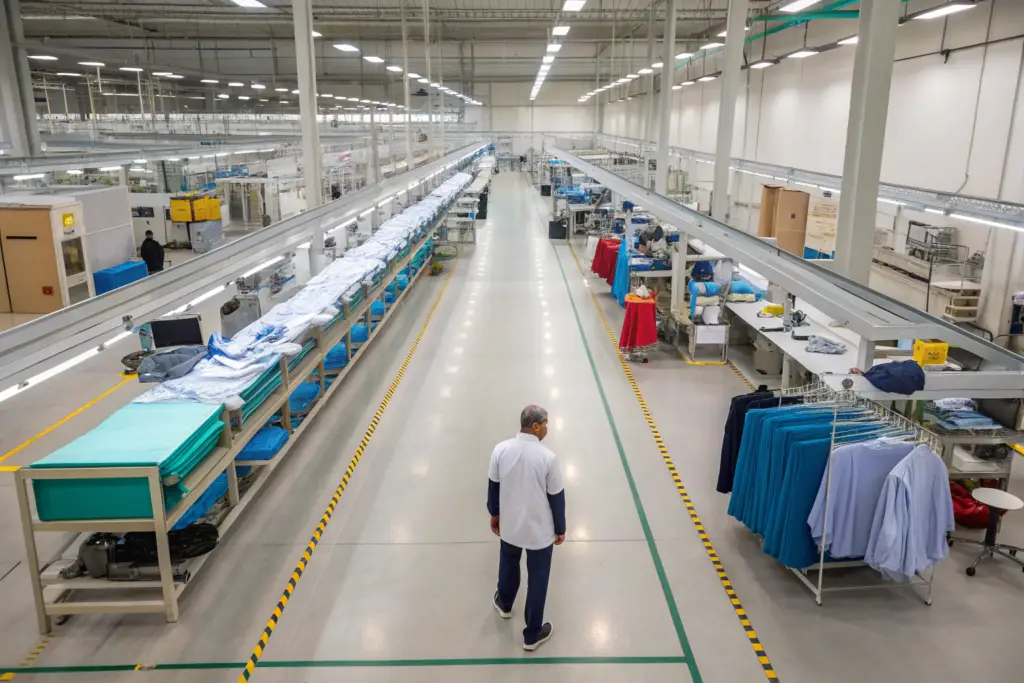
At Shanghai Fumao, we operate with this model. Our Bulk Production Division manages orders from 3,000 pieces and above, with dedicated lines optimized for speed and consistency using techniques like assembly line balancing and standard minute value (SMV) calculations. Our Custom & Development Division is a separate unit with its own sampling atelier, pattern makers, and project managers. They handle orders from 500 pieces up, focusing on complex cuts, custom fabrics, and integrated OEKO-TEX certification management. Crucially, both divisions draw from the same Central Sourcing & Compliance Department, which maintains our master library of certified fabrics and trims. This means a custom order for 800 certified jackets can access the same trusted, pre-vetted materials as a bulk order for 5,000, ensuring consistency and safety across all your product lines.
How do production planning and scheduling work?
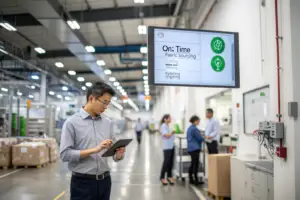
This is managed by a central Production Planning Office (PPO). They use advanced Enterprise Resource Planning (ERP) software to visualize the entire factory's capacity. The PPO treats custom lines as specialized "projects" with their own timelines, while bulk lines are scheduled for long "runs." They strategically slot custom projects into the schedule where they won't disrupt the flow of bulk orders. For example, they might schedule a 2-week custom run of 1,000 intricate vests between two large bulk orders of basic fleece, ensuring both clients get on-time delivery. This requires exceptional forecasting and communication. We provide all clients with a transparent production calendar, showing key milestones for their order, which builds immense trust.
What about minimum order quantities (MOQs)?
A dual-capability factory will have flexible, transparent MOQ policies:
- Bulk Orders: MOQs typically start at 3,000-5,000 pieces per style for standard efficiencies.
- Custom/Certified Orders: MOQs can be as low as 500-1,000 pieces, acknowledging the higher per-unit cost of development, specialized handling, and certification management.
The key is that the MOQ is tied to the complexity and requirements of the order, not a one-size-fits-all rule. We clearly communicate this to clients upfront, so they can plan their collections and budgets effectively. This flexibility is what allows growing brands to start with a custom, certified capsule collection and scale into bulk reorders seamlessly with the same partner.
How Does Quality Control Adapt to Both Scenarios?
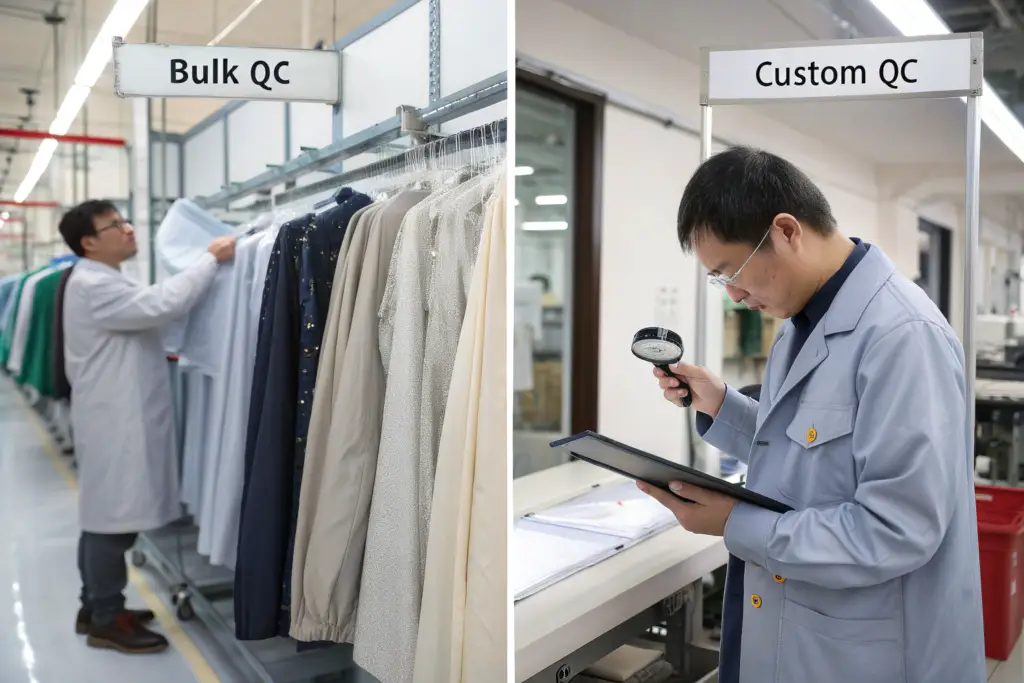
Quality cannot be compromised in either scenario, but the focus and methods differ. A dual-capability factory employs a tiered QC system that applies rigorous checks appropriate to each order type, all under one overarching quality management system (QMS).
For bulk orders, QC is heavily statistical and process-focused. It relies on AQL (Acceptable Quality Level) sampling—inspecting a random sample from the batch to infer the quality of the whole. The focus is on identifying pattern defects, color consistency across thousands of pieces, and sewing consistency. For custom orders, QC is more intensive and individual. It starts at the material incoming inspection, with every single roll of custom, certified fabric being checked against approved lab dips and its OEKO-TEX documentation. Then, in-line QC is more frequent, often checking every 10th piece instead of every 50th, due to the complexity and higher value of each garment. The final inspection might be 100% check for small runs. Our central QC team is trained in both methodologies, ensuring no defect slips through.
How is OEKO-TEX certification managed across both order types?
The certification process is integrated but applied differently:
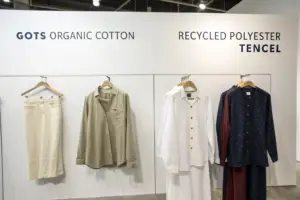
- Bulk Orders: The certification is secured for the article before bulk production begins. The factory's job is to ensure batch-to-batch consistency, meaning every single piece in the 10,000-unit order must match the certified sample. This is managed through strict material control and process discipline.
- Custom Orders: The certification is often part of the development journey. The factory manages the submission of the prototype, coordinates component testing, and secures the certificate. The key here is traceability—ensuring the small batch of custom materials used for 800 pieces is exactly what was certified.
In both cases, the factory's Chemical Compliance Officer (a role we have at Shanghai Fumao) oversees the process, ensuring the correct OEKO-TEX product class is applied and that all transaction certificates are correctly issued for shipment. This centralized expertise is what makes the factory a reliable partner for any certified order, large or small.
Can the same quality standards be maintained?
Absolutely. The quality standard is the same—a flawless garment that meets spec and is safe. The process to ensure that standard is adapted. The bulk line might use more automation (auto-cutters, automated pocket setters) for precision at scale. The custom line relies more on highly skilled artisans for complex operations. Both feed into the same final inspection protocol before packing. The underlying quality management system, often certified to standards like ISO 9001, provides the framework that ensures consistency across all operations.
What Are the Cost and Lead Time Implications?
Understanding the economic and timeline differences is crucial for brand planning. A competent factory will be transparent about these variables, not hide them.
Lead Times:
- Bulk Production: Once materials are ready, production is fast due to streamlined lines. Lead time might be 30-45 days for cutting, sewing, and finishing of a 10,000-piece order.
- Custom Certified Production: The timeline is longer due to development: 70-90 days or more from order confirmation to shipment. This includes time for fabric development/sourcing, sampling, fitting, certification submission, and then smaller-batch production.
Cost Structure: - Bulk Orders: Benefit from massive economies of scale. The cost per unit is low, driven by efficient material usage, optimized labor, and amortized setup costs.
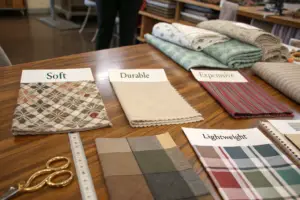
- Custom Orders: Have a higher cost per unit. This covers the R&D (pattern making, multiple samples), higher material costs (smaller minimums from mills), additional handling, and certification fees. It's a value-based cost model.

How can a brand optimize for cost efficiency with one factory?
The strategic advantage of a single factory shines here. You can leverage your bulk relationship for custom advantages. For example:
- Material Consolidation: If your custom line uses a fabric also in your bulk line, you can pool the order to get a better price from the mill.
- Shared Development Costs: Some factory setup costs (like building a basic block pattern) can be shared if your custom designs are variations of your core styles.
- Priority Scheduling: As a valued bulk client, your smaller custom projects may receive favorable scheduling.
We actively work with our clients on such strategies. A sportswear brand we partner with runs two bulk collections and one limited "designer collaboration" capsule annually. We produce it all. Because we know their bulk fabric needs, we were able to source the exclusive printed fabric for their capsule collection from the same certified mill at a much better price than if they had gone to a separate small factory.
What about payment terms?
Terms often differ:
- Bulk Orders: Typical terms are 30% deposit, 70% before shipment.
- Custom Orders: Due to higher upfront costs (fabrics, development), the payment schedule may be more phased: 50% deposit to commence development and material purchase, 50% before shipment.
A trustworthy factory will propose a fair and clear payment schedule that aligns with the cash flow realities of each project type.
How to Vet a Factory's True Dual Capability?
Don't just take their word for it. Due diligence is required to separate marketing claims from operational reality. You need to see proof of both competencies in action.
Request concrete evidence during your sourcing process:
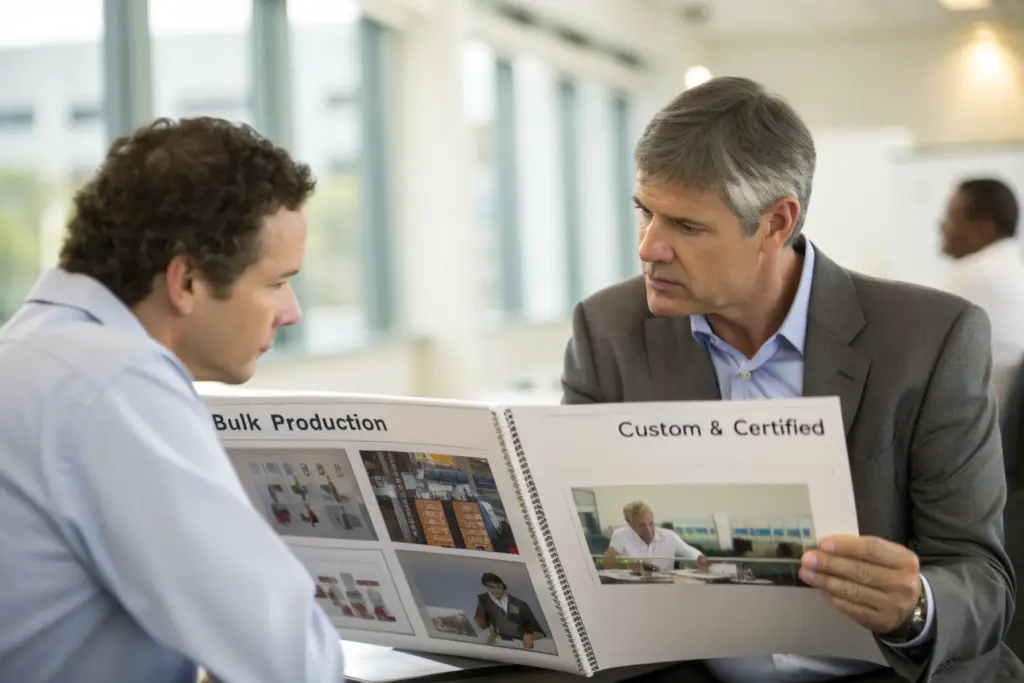
- Ask for Case Studies: Request two specific examples: one of a large bulk order (show me the volume, how you ensured consistency) and one of a small, complex certified order (show me the challenges, how you managed certification and details).
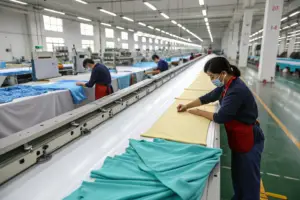
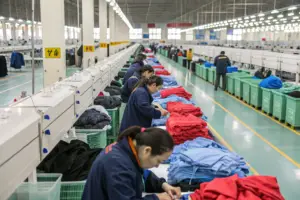
- Request a Virtual Tour: Ask to see both a bulk production floor and the custom development/sampling atelier. Look for organization, different equipment, and dedicated spaces.
- Check Client References: Ask for contacts from two different types of clients: a large distributor or brand that does bulk, and a smaller, design-focused brand that does custom work. Speak to them.
- Analyze Communication: During your inquiry, do they ask probing questions about your volume needs and design complexity? Or do they give generic answers? A capable partner will differentiate their approach from the first conversation.
What are the red flags?
Be cautious if a factory:
- Gives a single, low MOQ for everything: This may indicate they are only geared for small batches and will struggle with true bulk efficiency.
- Cannot show a clear organizational chart separating bulk and custom workflows.
- Has vague answers about OEKO-TEX certification, especially regarding turnkey management for custom orders.
- Provides only one type of client reference.
A true dual-capability partner will be proud to showcase both sides of their business and will have the processes and personnel to back it up.
Why is a unified compliance system a key advantage?
This is perhaps the biggest benefit. When you use one factory for both bulk and custom, your chemical compliance strategy is centralized. The factory's compliance team learns your brand's standards and applies them across all orders. This eliminates the risk of one product line (e.g., your bulk basics) being made with different, potentially non-compliant chemicals compared to your premium custom line. It creates a single source of truth for all your safety documentation, simplifying audits for you and your retailers. This holistic control is a massive operational and reputational advantage.
Conclusion
A factory can indeed excel at both bulk wholesale and certified custom orders, but this requires a deliberate, well-invested operational design. It hinges on having separate but synergized teams, flexible and intelligent planning systems, a scalable quality management framework, and a unified compliance backbone.
For brands, finding such a partner is a strategic unlock. It consolidates your supply chain, builds deeper relationships, ensures consistency across your entire product spectrum, and provides a clear path for growth from experimental small batches to efficient volume production.
If you seek to streamline your operations with a single, versatile manufacturing partner capable of scaling with your vision, look for one with proven systems. At Shanghai Fumao, we have built our platform specifically to serve brands that need both scale and specialization, underpinned by unwavering quality and compliance. Contact our Business Director, Elaine, to discuss how we can be the unified engine for your diverse product needs. Reach her at elaine@fumaoclothing.com.