As a manufacturer who has seen the inside of both winning and failing Olympic-level gear, I can tell you this is the most critical question a serious brand or team can ask. A competitive ski suit is a feat of engineering—a second skin designed for aerodynamics, moisture management, and thermal regulation. But if that skin is laced with chemicals that irritate, distract, or even harm the athlete, every performance gain is negated. The answer isn't a simple yes; it's a question of proof.
Truly competitive ski suits can only be guaranteed free from harmful substances through systematic, third-party verification like OEKO-TEX STANDARD 100 certification, which tests the entire assembled garment—from the outer shell's DWR finish to the inner lining's dyes—against a scientific list of over 100 restricted chemicals, providing the assurance that the suit enhances performance without compromising athlete safety. Trust must be engineered in, not assumed.
Let's dissect why this assurance is non-negotiable for high-stakes performance wear and how to verify it beyond supplier promises.
What Makes a Ski Suit's Chemical Profile Inherently Risky?
The very technologies that make a ski suit competitive introduce chemical complexity. It's a layered system of advanced materials, each treated for specific functions. Without control, this becomes a chemical cocktail.
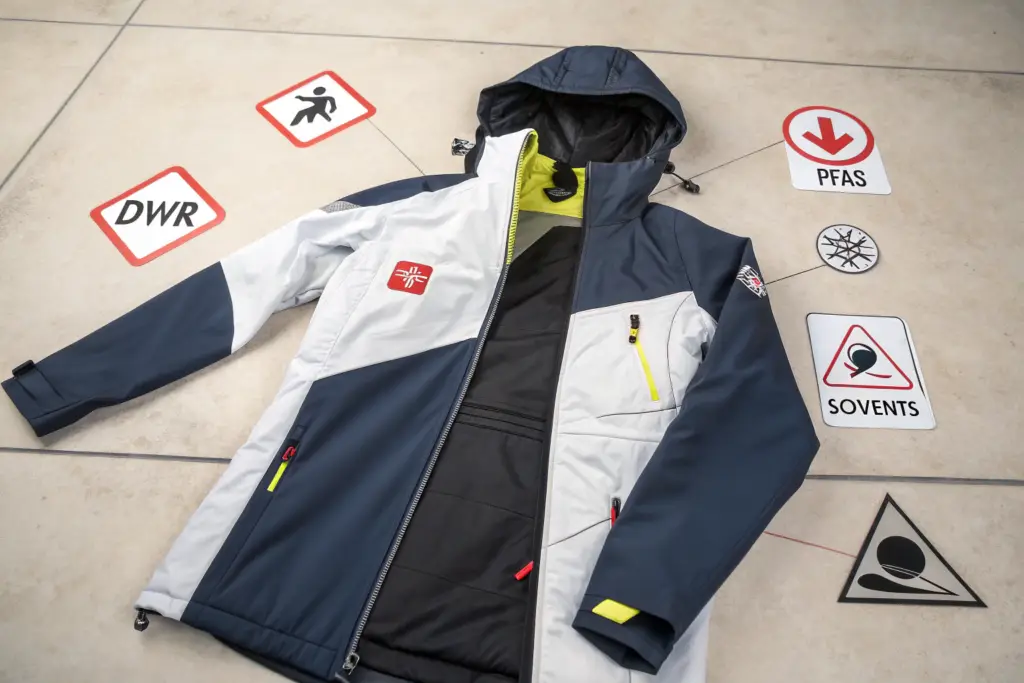
A competitive ski suit's chemical profile is inherently risky due to the high concentration of performance-enhancing treatments: polyurethane (PU) or polytetrafluoroethylene (PTFE) membranes for waterproofing, fluorocarbon-based DWR finishes for water beading, solvent-based adhesives for seam taping, and heavy metal-catalyzed dyes for vibrant, fade-resistant colors—all of which can contain or release restricted substances under stress. Risk is baked into the performance recipe.
Why are Laminates and Bonding Agents a Critical Concern?
The waterproof, breathable membrane is often laminated to the inner fabric using solvent-based adhesives. These solvents, like toluene or DMF, can remain as residues and off-gas, causing headaches or respiratory irritation—a disaster for an athlete's focus and lung capacity at altitude. Furthermore, the plasticizers in polyurethane (PU) coatings can include restricted phthalates. OEKO-TEX certification tests for these specific residues in the final garment. We recall a batch from a fabric mill that passed visual inspection but failed our incoming gas chromatography test for solvent residues; it was rejected because we knew it would never pass OEKO-TEX and could impair athlete performance.
How Can DWR Finishes Undermine an Athlete?
Traditional DWR relies on long-chain PFCs/PFAS. While effective, these are persistent environmental toxins and are increasingly linked to health concerns. For an athlete in intense physical exertion, the suit's proximity to skin and the heat generated could potentially increase exposure. More immediately, improper curing of any DWR can lead to formaldehyde release, causing skin and eye irritation. A certified suit guarantees the use of regulated, safer chemistry (like newer PFC-free formulations) and proper processing to minimize VOC emissions.
How Does Chemical Safety Directly Impact Athletic Performance?
At the elite level, performance is measured in hundredths of a second and mental clarity. Any physical distraction or subclinical health impact is a direct competitive disadvantage.
Chemical safety directly impacts athletic performance by ensuring zero skin irritation that could break focus, preventing respiratory irritation from off-gassing that could reduce oxygen efficiency, and eliminating systemic distractions, allowing the athlete to trust their gear implicitly and focus 100% on their run. The suit must be an ally, not an adversary.

What is the "Cognitive Load" of Unverified Gear?
An athlete wearing unverified gear carries a hidden mental burden: "Will this chafe? Why does it smell funny? Is this rash from the suit?" This is cognitive load that should be spent on technique and conditions. Certified gear removes this variable. National teams we work with explicitly demand OEKO-TEX and other certifications for this reason—they need to eliminate all controllable variables that could affect their athletes' mental state. The peace of mind is a performance tool.
Can Chemicals Affect Thermoregulation or Muscle Function?
While direct causation is complex, skin irritation can increase perceived heat and discomfort, potentially affecting an athlete's thermal regulation strategy. Furthermore, some studies suggest certain chemicals can be endocrine disruptors. While the exposure from a suit is low, for an athlete whose body is their instrument, any avoidable risk is unacceptable. The precautionary principle, enshrined in OEKO-TEX's standards, is paramount in high-performance sports.
What Proof Should You Demand Beyond a Supplier's Word?
In high-stakes sourcing, "trust me" is not a strategy. You need a verifiable chain of evidence. The proof must be objective, current, and specific to the exact product you are buying.
You should demand, as a non-negotiable condition of purchase, a valid OEKO-TEX STANDARD 100 certificate for the finished ski suit model, supporting test reports from an accredited lab, and a full disclosure of the mill's chemical management certifications (like bluesign® or OEKO-TEX STeP) for the key functional fabrics. Proof is a package.

How to Authenticate an OEKO-TEX Certificate?
Every genuine certificate has a unique number. You must:
- Go to the official OEKO-TEX CertCheck website.
- Enter the certificate number and the applicant's name (which should be your factory, e.g., Shanghai Fumao).
- Verify that the listed "Article Description" matches your ski suit (e.g., "Men's Alpine Race Suit, Style #RS2025") and that the validity date covers your production and shipping timeline.
This 2-minute check prevents fraud. We encourage all our clients to do this; it validates our work and builds trust. A certificate for "Polyester Fabric" is NOT sufficient—it must be for the finished garment.
Why Insist on Mill-Level Certifications Like bluesign®?
OEKO-TEX certifies the final product. bluesign® certifies the input chemistry and sustainable processes at the fabric mill. A suit made from bluesign® approved fabric and then OEKO-TEX certified represents the gold standard. It means the harmful substances were never used in the first place, rather than just not being present in the final product above a limit. This is a deeper, more preventive level of assurance. For our top-tier race suits, we exclusively source from bluesign® system partner mills, and we provide that documentation to our clients.
How Does Fumao's Production System Guarantee Purity for Race Suits?
Producing a chemically pure race suit requires a contamination-free manufacturing environment. At Fumao, our dedicated technical wear lines are engineered for this purpose.
Fumao guarantees purity for race suits through a closed-loop production system: using pre-certified materials from partnered mills, operating dedicated "clean" lines where only OEKO-TEX projects run, employing ultrasonic welding where possible to avoid adhesives, and conducting batch-specific final garment testing before release. We treat compliance like a clean-room protocol.
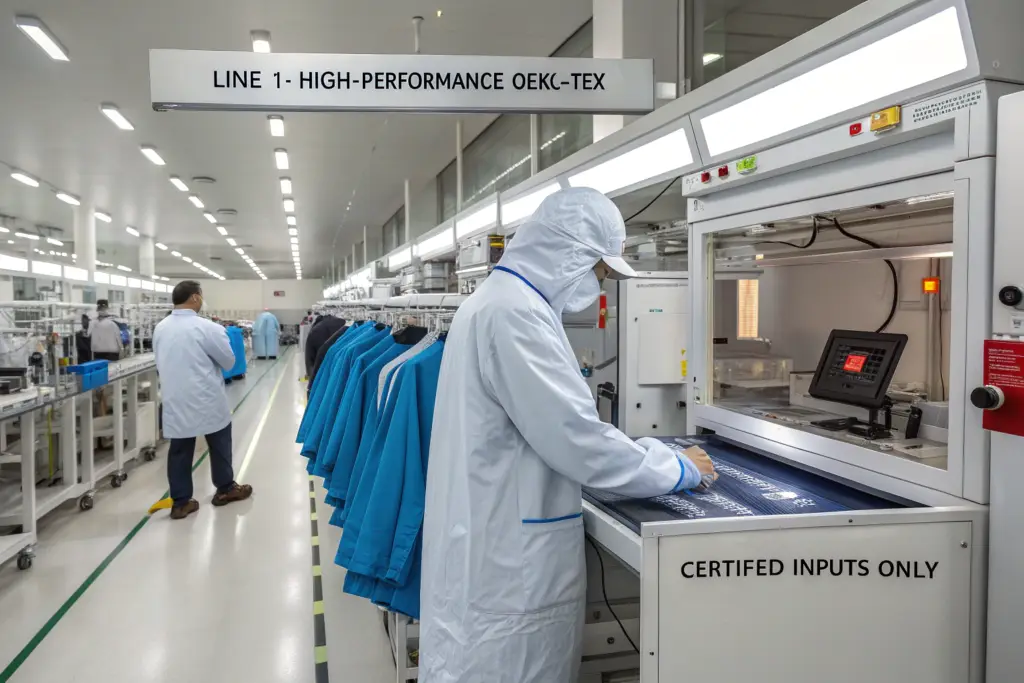
What is Our "Dedicated Line" Protocol for Race Suits?
Line 1 at our facility is reserved for high-performance, certified orders like race suits. It operates under enhanced controls:
- No natural down or high-shedding materials are processed nearby.
- Sewing machine oils and cleaning agents are specifically selected from OEKO-TEX compliant options.
- All thread, tapes, and zippers are stored in sealed kits for each order to prevent cross-contamination.
This protocol ensures that a world-class skier's suit is not compromised by residue from a standard jacket made elsewhere in the facility. We implement the same rigor for our Shanghai Fumao branded production as we do for client brands.
How is Final Validation Performed?
Before shipment, we don't just rely on component certificates. We pull a random finished suit from the production lot and subject it to a suite of in-house quick tests (pH, formaldehyde spot test, odor check). Additionally, we submit samples from each new style and major material lot to an external lab for full compliance testing. The test report, along with the OEKO-TEX certificate, forms the final validation dossier that accompanies the shipment. This two-layer verification is our commitment to delivering on the promise of a safe, high-performance suit.
Conclusion
For competitive ski suits, the question of harmful substances is not a marketing checklist item; it is a fundamental performance parameter. The only defensible answer is one backed by the rigorous, third-party verification of OEKO-TEX certification, supported by a transparent supply chain and a manufacturing process designed to safeguard purity. An athlete's trust, focus, and physical well-being depend on this assurance.
When you commission a race suit, you are investing in more than fabric and stitching; you are investing in a system of chemical integrity. If your standard is "nothing less than certified safe," then your manufacturing partner must be built to that standard. Let us demonstrate how we build that integrity into every seam. Contact our Business Director Elaine at elaine@fumaoclothing.com to discuss developing your next-generation, certified competitive ski suit with Shanghai Fumao. Let's ensure the only thing your athletes feel is the drive to win.