You’re developing a premium insulated ski jacket and considering down for its unparalleled warmth-to-weight ratio. But you’ve also committed to OEKO-TEX certification for safety and marketability. A critical question emerges: Does the natural origin of down insulation make it inherently more compatible with OEKO-TEX standards, or does its complex supply chain introduce unique certification hurdles that synthetic insulation avoids?
Insulated ski jackets with down are not inherently more or less likely to pass OEKO-TEX than those with synthetic fill. The likelihood of passing depends entirely on the chemical treatments applied to the down during processing and the cleanliness of its supply chain. Natural down can be contaminated or treated with restricted substances, while high-quality synthetic fills are manufactured from the outset with controlled, often compliant, chemistry.
The key is understanding that OEKO-TEX certifies the finished article, not the material type. Both down and synthetic insulation present distinct certification challenges. Down’s path to compliance is less about its natural state and more about the rigorous purification and testing it undergoes. Let’s dissect the specific factors that determine a down jacket’s OEKO-TEX success.
What Are the Primary Contamination Risks in Down Insulation?
Down is a byproduct of the poultry industry. In its raw state, it is far from the clean, fluffy material in your jacket. It can be contaminated with a variety of substances that OEKO-TEX strictly regulates, making the washing and testing process absolutely critical.
The major risk categories are:
- Microbial Contaminants: Bacteria, mold, and fungi from the animal and its environment. OEKO-TEX tests for the presence of certain biocides used to control these, which themselves can be restricted.
- Heavy Metals: These can accumulate in the bird’s body from its feed or environment and be present in the feathers.
- Pesticides & Herbicides: Residues from the bird’s feed (e.g., treated grains) or living environment.
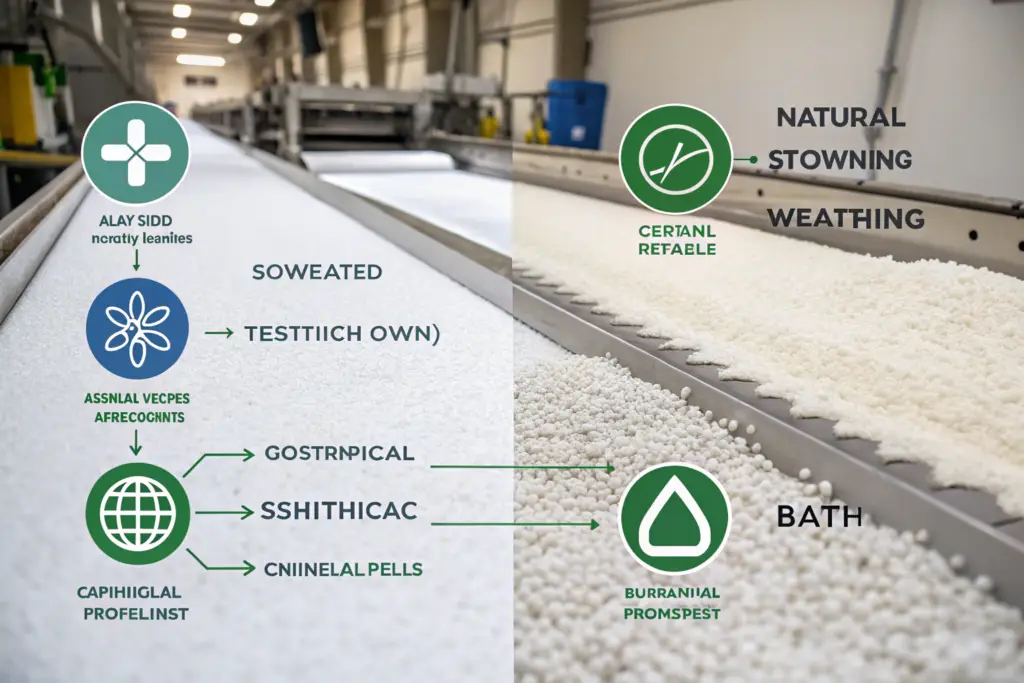
- Processing Chemicals: This is the biggest variable. Down is washed with detergents, rinsed, and often treated with fluorocarbon-based water repellents (like PFCs/PFAS) to restore loft in damp conditions, or with antimicrobial agents. These finishing chemicals must be OEKO-TEX compliant.
At Shanghai Fumao, we only source down from suppliers certified to the Responsible Down Standard (RDS) and who can provide OEKO-TEX compliant down statements or component certificates. This dual requirement is non-negotiable. Last year, we rejected a shipment of down from a new supplier because their provided test report showed traces of a non-compliant antimicrobial agent, despite having an RDS certificate. The RDS ensured ethical sourcing, but only OEKO-TEX testing ensured chemical safety.
How is "clean" down processed for compliance?
High-quality, certifiable down undergoes a multi-stage purification process:
- Multiple Wash Cycles: Using OEKO-TEX compliant detergents in high-temperature water to remove organic matter and soluble contaminants.
- Thorough Rinsing: To ensure no detergent residues remain.
- High-Temperature Drying & Sterilization: Often using steam or hot air to kill microorganisms.
- Compliant Finishing: If a water-repellent treatment is applied, it must use approved PFC-free or compliant C6 chemistry. The same goes for any odor-control treatments.
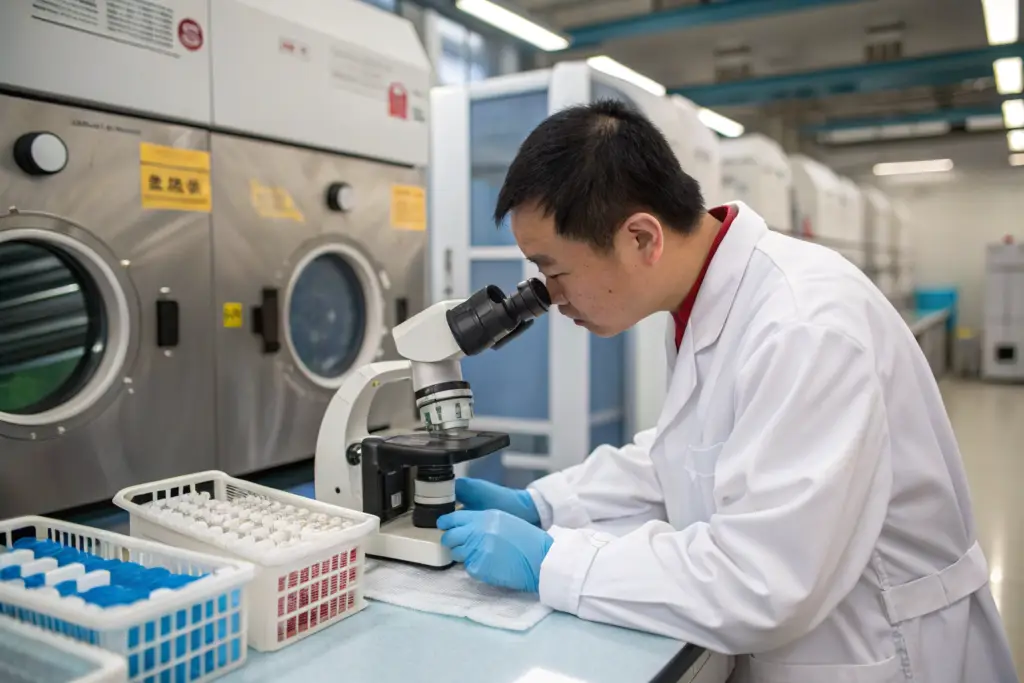
The processor must conduct batch testing on the finished down, measuring parameters like turbidity (cleanliness), oxygen number, and crucially, testing for the absence of restricted substances. The resulting test report is your down’s chemical passport. Without it, you are gambling on your final jacket’s certification.
What is the role of the Responsible Down Standard (RDS) in relation to OEKO-TEX?
RDS and OEKO-TEX are complementary but different. RDS is an ethical and traceability standard focused on animal welfare (ensuring down is not from live-plucked or force-fed birds) and chain of custody. OEKO-TEX is a chemical safety standard. RDS does not guarantee chemical compliance. However, a down supplier invested in RDS certification is typically more professional and transparent, making it easier to obtain the necessary OEKO-TEX test data. We view RDS as a strong indicator of a supplier’s overall quality system, which includes chemical management.
How Do Synthetic Insulation Alternatives Compare for Certification?
Synthetic insulations like PrimaLoft, Thermolite, or generic polyester fills are manufactured from chemical polymers (primarily polyester). Their certification pathway is different but not necessarily simpler.
Because synthetic fibers are created in a factory, their chemistry is theoretically more controllable. The base polymer (PET) is inert. The risks come from:
- Polymer Production Catalysts: Residual heavy metal catalysts (like antimony) from the polymerization process.
- Spin Finishes & Lubricants: Oils and chemicals applied to fibers during spinning to manage static and processing.
- Dyes & Additives: If the insulation is colored or has performance additives (e.g., biocostats, fire retardants).
- Binder Fibers: Many synthetic fills use low-melt binder fibers to create structure. The chemical composition of these binders must be compliant.
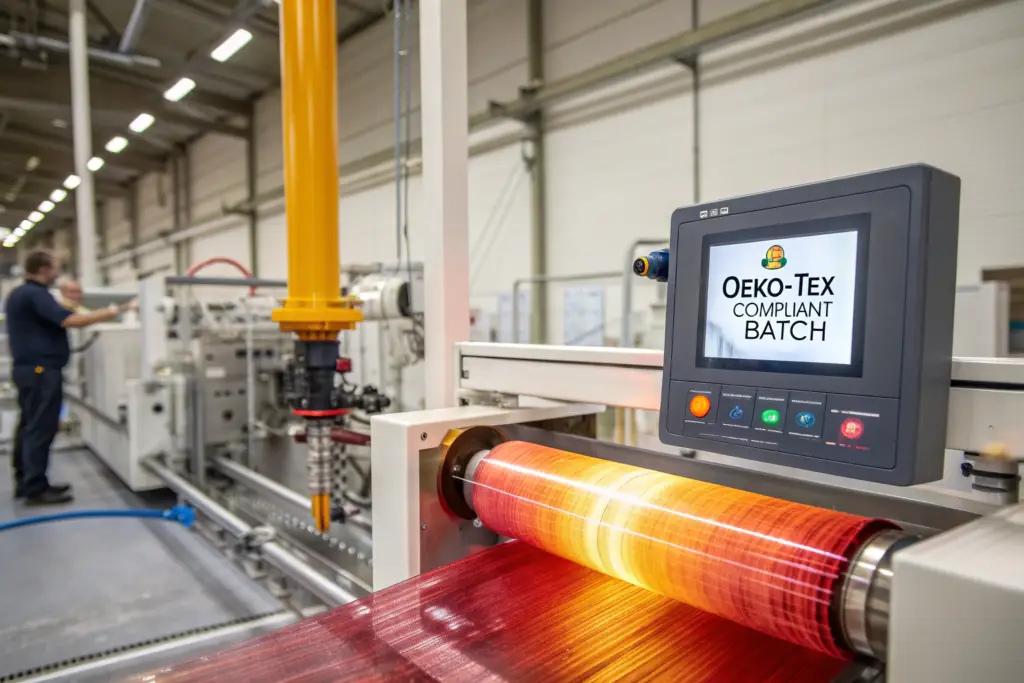
Leading synthetic insulation manufacturers often have OEKO-TEX certified product lines. For example, PrimaLoft offers specific grades that are pre-certified. This can simplify your sourcing, as you can specify the certified grade directly in your tech pack. However, it is not automatic—you must confirm the specific product code is certified.
Is synthetic insulation inherently "safer" or more predictable?
From a certification management perspective, synthetic can be more predictable. A certified grade from a major supplier comes with consistent documentation. There is less batch-to-batch variability compared to a natural product like down, which can vary based on the source flock and washing cycle. This predictability reduces risk and can streamline your factory’s internal quality control. However, low-cost, uncertified synthetic fills from unknown sources can be just as risky as untreated down, potentially containing a cocktail of non-compliant processing chemicals.
What about performance treatments in synthetics?
Many high-performance synthetic insulations are treated for water repellency (to resist clumping when wet) and anti-odor properties. These treatments, like the PFC-free technologies used by leading brands, must be OEKO-TEX compliant. The advantage is that these treatments are typically applied at the fiber manufacturing stage by a single, accountable company, making traceability simpler than in the multi-step down supply chain.
What Additional Jacket Components Interact with the Insulation?
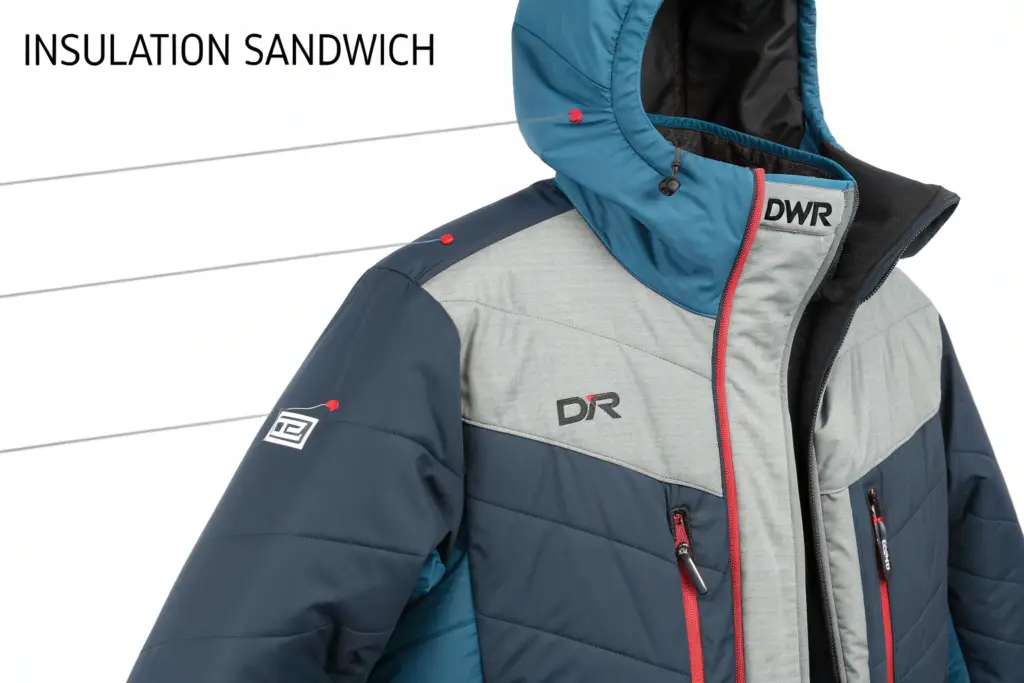
The insulation doesn’t exist in a vacuum. It is housed within a shell fabric and a lining fabric, creating a "sandwich." For the finished jacket to be certified, every component of this sandwich, and how they interact, must be considered.
The key interaction is migration. Could chemicals from the insulation migrate through the inner lining onto the wearer’s skin? Could chemicals from the shell’s DWR treatment migrate inward to the insulation? OEKO-TEX testing of the finished article accounts for this. The laboratory may test a composite sample or test components separately but evaluates the article as an integrated system. This is why using pre-certified components (shell, lining, insulation, thread) from reputable suppliers is the safest strategy. At Shanghai Fumao, our material library is built on this principle. When we construct a tech pack for a down jacket, we select a certified down, a certified shell, and a certified lining, dramatically increasing the first-pass success rate of the final garment’s certification.
How do baffles and construction affect certification?
The fabric used for internal baffles (the walls that keep down in place) must also be certified. Often a lightweight, non-woven or woven polyester, this material is in direct contact with the down and must also be free of harmful substances. Furthermore, the adhesives or thermal welding used in construction (e.g., for seam-sealing in down-proof constructions) must be compliant. A factory experienced in certified down jacket production, like ours, knows to source these often-overlooked components from compliant suppliers as a matter of course.
What is the critical role of the factory's QC in final assembly?
The factory’s Incoming Quality Control (IQC) is the final gatekeeper. When a batch of OEKO-TEX certified down arrives, IQC must verify that the supplier’s test report matches the delivered batch number. They should also perform a simple visual and olfactory check—certified down should be exceptionally clean, white, and odor-free. Any off-odor can indicate microbial growth or chemical residue, which is a red flag. This frontline inspection prevents contaminated material from entering production and jeopardizing the certification of hundreds of finished jackets.
What is the Strategic Sourcing Advice for Brands?
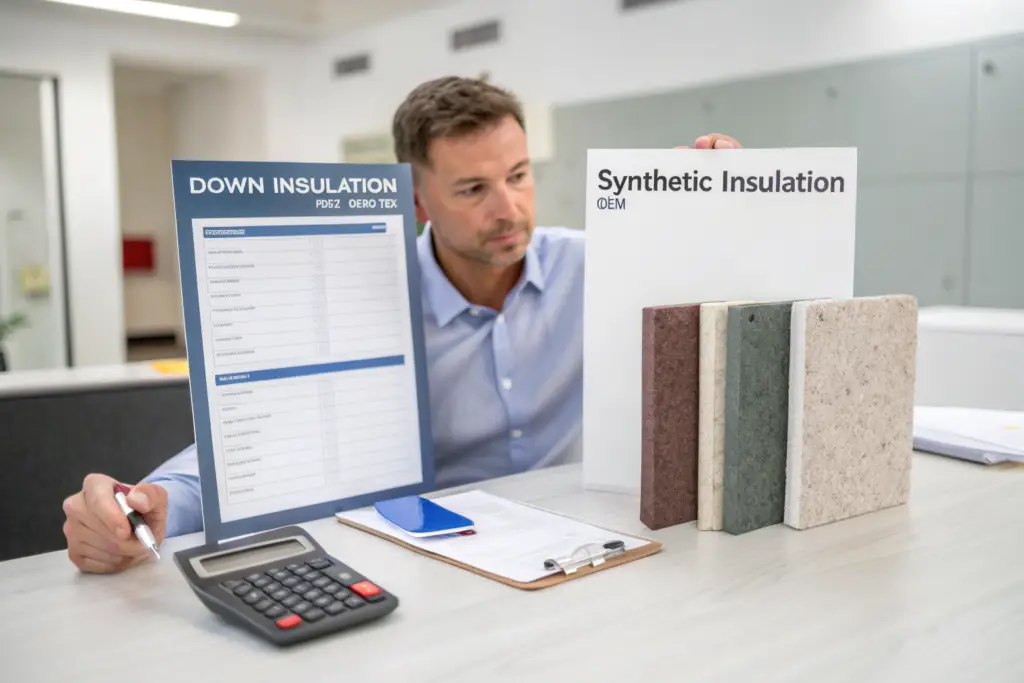
Your choice between down and synthetic should be driven by performance, brand positioning, and cost—not by a false assumption about certification ease. The certification challenge is manageable for both, provided you source strategically.
- For Down: Prioritize suppliers that provide both RDS and OEKO-TEX documentation. Ask for the specific OEKO-TEX test report for the batch you are purchasing. Inquire about their washing process and finishing treatments. Consider using down treated with a compliant, long-lasting water repellent (like HyperDRY from Allied Feather & Down) as it enhances performance and comes from a compliant process.
- For Synthetic: Specify OEKO-TEX certified grades by name (e.g., PrimaLoft Gold Insulation Eco with OEKO-TEX). This removes ambiguity. If using a generic synthetic, you must obtain and review the mill’s OEKO-TEX certificate and test reports before committing.
- For Both: Use a factory with a track record in certified insulated apparel. Their experience in sourcing and assembling these complex systems is invaluable. They will know which suppliers are reliable and how to navigate the certification submission for a multi-component insulated garment.
How does this impact development timeline and cost?
Sourcing certified insulation, especially down with full documentation, may add 1-2 weeks to your development timeline for testing and validation. It will also add a cost premium—for the superior processing of down or the branded, certified synthetic. However, this cost is a direct investment in product integrity and certification success. It should be factored into your cost model. Skipping this due diligence risks a far greater cost: a failed certification test on the finished jacket, leading to rework, delays, or a non-certified product that cannot command a premium price.
What is the final step for jacket certification?
Regardless of the insulation type, the finished jacket must be submitted as a whole. The certification body will test it, potentially taking samples from different areas (shell, lining, insulation). Having all pre-certified components is the best way to ensure a pass. The factory should manage this submission, providing all component certificates to the lab to expedite the process. We handle this entire workflow for our clients, from component vetting to final certificate issuance, turning a complex challenge into a seamless deliverable.
Conclusion
Insulated ski jackets with down are not more likely to pass OEKO-TEX by virtue of being natural. Their success hinges on a rigorously controlled, transparent, and clean supply chain that eliminates biological and chemical contaminants through advanced washing and compliant finishing. Synthetic insulation, while industrially controlled, also requires careful selection of certified grades to ensure compliance.
The decisive factor for OEKO-TEX success is not the choice between down or synthetic, but the choice of qualified, documented suppliers for your insulation and a knowledgeable manufacturer who understands how to integrate all components into a certifiable finished product. By focusing on verifiable chemistry rather than material origin, you can confidently develop high-performance, warm, and safe ski jackets that meet the highest standards.
Ensure your insulated jackets are built on a foundation of verified safety, not assumption. Partner with a manufacturer who masters the chemistry of both down and synthetic insulation. At Shanghai Fumao, our technical expertise and certified supply chain ensure your insulated styles pass OEKO-TEX with confidence. Contact our Business Director, Elaine, to discuss your next premium ski jacket project. Reach her at elaine@fumaoclothing.com.