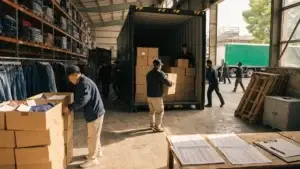
CEOs think differently about sourcing than purchasing managers. A purchasing manager is measured on the unit cost. Their annual review says "reduced cost of goods sold by 8%." They are incentivized to find the lowest FOB price. A CEO is measured on the whole business. Profitability. Brand reputation. Customer retention. Operational simplicity. A CEO sees the full picture. They know that a $5.00 short that generates a 6% return rate and arrives three weeks late is more expensive than a $6.50 short that generates a 1.5% return rate and arrives on time. They know that a factory that answers emails in 24 hours with vague promises is a liability, and a factory that provides a real-time production dashboard is an asset. They know that time spent managing logistics is time not spent on strategy, marketing, and growth.
CEOs prefer Shanghai Fumao's factory-direct denim shorts because a factory-direct relationship eliminates three structural costs that erode margin and consume executive attention. First, it eliminates the intermediary markup of trading companies and sourcing agents, typically 10% to 20%. Second, it eliminates the communication delay and distortion that occurs when information passes through multiple layers, because our dedicated merchandiser communicates directly with the decision-maker. Third, it eliminates the logistics fragmentation of the FOB model, because our DDP shipping bundles everything into a single, predictable cost with a single point of accountability.
I run Shanghai Fumao. I have spent fifteen years sitting across the table from brand owners and CEOs. I understand what they care about. They care about predictability. They care about trust. They care about their time. They want a factory that acts like a partner, not a vendor. In this article, I will explain why the factory-direct model matters, how it reduces costs and risks that do not appear on a purchase order, and what specific outcomes CEOs have achieved by switching to our factory.
What Does "Factory-Direct" Actually Mean in Denim Manufacturing?
The term "factory-direct" is used loosely by many suppliers who are not factories. A trading company with a nice website will call themselves a factory. A sourcing agent who visits a factory once a month will tell buyers they have a factory. The phrase has been diluted to the point of meaninglessness. You need a definition you can verify.
Factory-direct means the company you are speaking to owns the production facility where your shorts will be made. They own the building or hold a long-term lease. They own the sewing machines, the cutting tables, the washing machines, and the testing equipment. The workers on the production line are their employees. The quality control team reports to their management. When you have a question about the inseam stitching on your order, the person you email can walk 50 meters to the sewing line, look at the stitching, and answer you within an hour. That is factory-direct. Anything else is a communication chain with a factory at the end of it, and every link in that chain adds cost, time, and the potential for error.
Let me explain the specific structural differences between a factory-direct relationship and the alternatives.

How Can You Verify That a Supplier Is a Real Factory, Not an Intermediary?
A trading company will tell you they are a factory. Their website will say "Manufacturer." Their Alibaba profile will say "Factory." You need independent verification.
The most reliable verification is a live video tour where you control the camera direction. Tell the contact to walk to the cutting table. Show me the fabric spread on it. Zoom in on the work order taped to the side. What date is on it? A real factory has a cutting table with active work. A trading company will make an excuse. The cutting room is closed for cleaning. The manager with the key is out. The Wi-Fi does not reach that part of the building. These are lies.
The second verification is the business license. Ask for a copy. Look at the "Business Scope" field. It is in Chinese. Use a translation app. Look for the characters 生产 (production) and 制造 (manufacturing). If the scope says 贸易 (trading) or 销售 (sales), you are dealing with a middleman. A real factory's license states plainly that they are authorized to manufacture goods.
The third verification is a third-party audit report. A BSCI or SMETA social compliance audit is conducted at the factory's physical address. The audit report includes photos of the production floor, the dormitory if applicable, and the exterior of the building. Ask for a recent audit report with the factory's name and address on it. A trading company cannot produce this report because the factory they subcontract to is audited under a different name. The supplier factory verification process is standard due diligence. A CEO who skips this step is delegating their supply chain to an unknown entity.
Why Does Eliminating the Middleman Reduce Cost and Communication Errors?
A trading company charges a markup of 10% to 20% on every order. This is their business model. They find buyers, they find factories, and they keep the difference between the price the buyer pays and the price the factory charges. This markup is pure cost to you. It buys you nothing except an intermediary.
Worse than the markup is the communication distortion. You send a technical question to the trading company. The trading company's salesperson does not understand the question. They translate it poorly into Chinese and send it to the factory. The factory's production manager answers in Chinese. The trading company's salesperson translates it poorly back into English and emails you. The answer is confusing. You send a follow-up question. The loop repeats. A conversation that should take one hour takes one week. Details are lost in translation. Errors compound.
When you work directly with our factory, you communicate with a dedicated merchandiser who sits on our production floor. She speaks fluent English and understands garment construction. You ask a question about the wash. She walks to the wash house, speaks to the technician in Chinese, understands the answer, and replies to you in clear English within hours. There is no intermediary. There is no translation distortion. There is no delay waiting for someone else to respond. The direct factory communication advantage is one of the primary reasons CEOs prefer the factory-direct model. It reduces cycle time and eliminates a major source of production errors.
How Does a CEO's Risk Calculation Differ from a Purchasing Manager's?
A purchasing manager manages a budget line. A CEO manages the entire business. The purchasing manager sees the FOB price. The CEO sees the total system cost. This is the fundamental difference in perspective. A CEO asks questions a purchasing manager may not be empowered to ask. What is the cost of a return? What is the cost of a late shipment? What is the cost of my time spent managing supplier problems? What is the reputational cost of a product failure?
When a CEO evaluates a factory, they are not comparing two price quotes. They are comparing two risk profiles. Factory A offers a lower price but a higher probability of quality failures, late deliveries, and communication problems. Factory B offers a fair price with documented quality systems, on-time delivery performance, and direct communication. The CEO chooses Factory B not because the shorts cost more, but because the business risk costs less.
Let me break down the risk-adjusted cost calculation that a CEO instinctively performs.

What Is the Total System Cost of a Cheap, Unreliable Supplier?
The cheap supplier's FOB price is $5.00. The reliable supplier's DDP price is $8.00. The purchasing manager sees a $3.00 savings per unit. The CEO sees a different set of numbers.
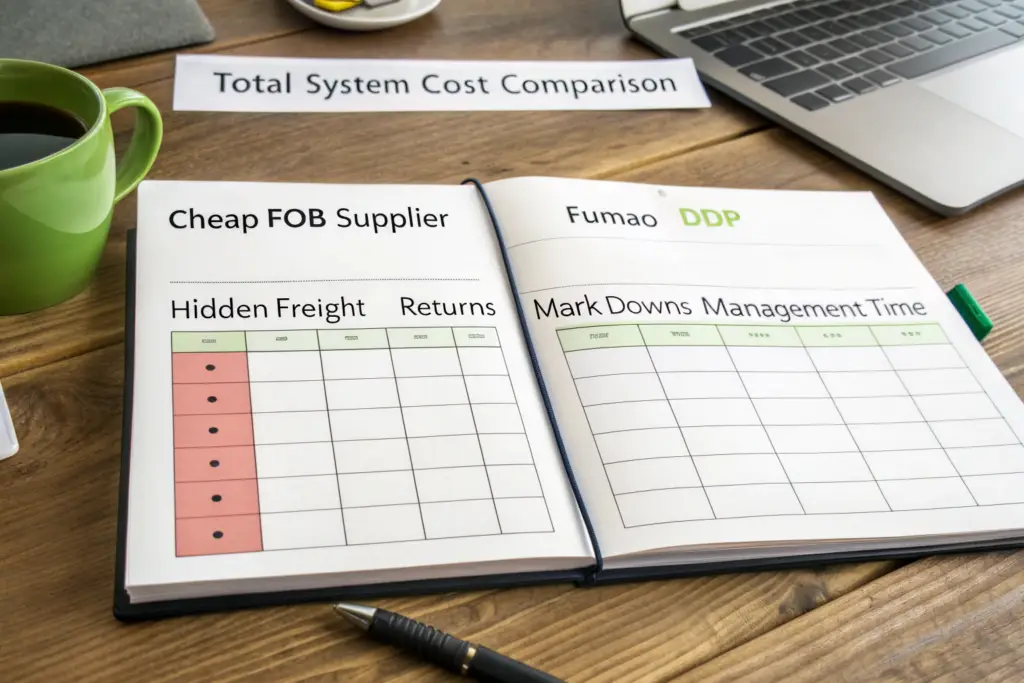
The cheap supplier's actual total cost includes the $5.00 FOB price, plus freight, duty, and logistics that the purchasing manager must arrange, adding $1.50 per unit. The landed cost is $6.50, not $5.00. The cheap supplier has a 6% return rate due to quality defects. On a 5,000-unit order, that is 300 returns. The cost per return, shipping, processing, discounting, is $10. Total return cost is $3,000, or $0.60 per unit ordered. The cheap supplier has a 20% late delivery rate. On a 5,000-unit order, 1,000 units arrive after the peak selling window and must be discounted by 30%. The markdown cost on those 1,000 units at a $48 retail price is $14,400 in lost revenue, or $2.88 per unit ordered. The cheap supplier requires weekly chasing emails and calls. The CEO or their team spends 5 hours per week managing the supplier during the 12-week production cycle. At a $100 hourly value, that is $6,000 in management time, or $1.20 per unit ordered.
The true total cost of the cheap supplier is $5.00 + $1.50 + $0.60 + $2.88 + $1.20 = $11.18 per unit. The reliable supplier's DDP price is $8.00, with a 1.5% return rate, on-time delivery, and minimal management time. The reliable supplier is $3.18 cheaper per unit when the full system cost is calculated. This is the total cost of ownership in supply chain calculation that CEOs perform, either formally or instinctively. The cheapest FOB price is rarely the cheapest total cost.
Why Does Predictable Cash Flow Matter More Than a Slightly Lower Unit Price?
CEOs manage cash flow. A business can be profitable on paper and still fail if it runs out of cash. Unpredictable costs are a cash flow risk. A supplier who quotes FOB but delivers a stack of surprise logistics invoices is injecting unpredictability into the CEO's cash flow forecast.
Our DDP model eliminates cash flow unpredictability on the supply side. The price per unit, delivered, is fixed at the time of order. The CEO knows exactly what their inventory will cost, down to the cent. They can set their retail prices, plan their marketing spend, and forecast their gross margin with confidence. There is no risk of a freight rate spike adding $0.80 per unit. There is no risk of a customs exam adding a $1,200 bill. There is no risk of a demurrage charge adding $300 per day. These risks are ours under DDP. The CEO's cash flow is protected.
This predictability is valuable in itself. It allows the CEO to make investment decisions with certainty. They can commit to a marketing campaign knowing their product margin is secure. They can hire a new team member knowing their cost of goods will not suddenly increase. The predictable supply chain costs value proposition resonates with CEOs because it simplifies their financial planning. A slightly higher unit price with a guarantee is often preferable to a slightly lower unit price with uncertainty.
What Specific Factory-Direct Services Do CEOs Value Most?
CEOs value their time. They value predictability. They value a single point of accountability. When something goes wrong, they want to make one phone call to one person who can fix it. They do not want to navigate a supply chain of five different vendors to find out whose fault the delay was.
Factory-direct means we are that single point of accountability. The fabric, the cutting, the sewing, the washing, the quality control, the packaging, the shipping, the customs clearance, the delivery. One company. One contract. One person to call. If the fabric is late, it is our fault. If the wash is off-color, it is our fault. If the container is delayed at customs, it is our fault. We cannot blame a subcontractor because there is no subcontractor. This accountability is what CEOs are really buying when they choose a factory-direct partner.
Let me explain the specific services that resonate with CEO-level decision-makers.
How Does a Single Point of Accountability Simplify Problem Resolution?
In a fragmented supply chain, a problem becomes a blame game. The shorts arrived with the wrong wash. The sewing factory blames the wash house. The wash house blames the fabric mill. The fabric mill blames the dye supplier. The CEO does not care whose fault it is. The CEO cares that the shorts are wrong and someone needs to fix it.
In our factory-direct model, there is no one else to blame. If the wash is wrong, it is our wash house. We made the mistake. We fix it. We re-wash the shorts at our cost. We expedite the shipment. We communicate the revised delivery date to the CEO within 24 hours. The problem is owned from start to finish by one accountable party.
This single-point accountability reduces the CEO's cognitive load. They do not need to understand our internal processes. They do not need to mediate disputes between our departments. They make one call. "Elaine, the wash on lot 452 is too light." Elaine says "I see the issue. We are re-washing now. The revised ship date is Friday. I will send you the new tracking number by end of day." The conversation takes two minutes. The problem is solved. The single point of accountability in supply chain is a management principle that reduces overhead and speeds up problem resolution. CEOs value this efficiency.
Why Do CEOs Appreciate Direct Access to Our R&D and Quality Teams?
A CEO who is building a brand is a product person at heart. They have a vision for their denim shorts. They want to talk to the people who can make that vision real. Not a salesperson. The pattern maker. The wash technician. The quality manager.
In our factory, the CEO has direct access to these experts. During the development phase, the CEO can have a video call with our head pattern maker. The CEO describes the fit they want. The pattern maker asks specific questions. "You want the front rise at 10 inches with a 1-inch tolerance? You want the leg opening at 22 inches for a size medium?" The conversation is technical, direct, and productive. No salesperson translates. No details are lost.
During production, the CEO can speak to our quality manager. "How is the shade banding looking on lot 452?" The quality manager pulls up the spectrophotometer readings. "Band A is 92% of the lot. Delta E average is 1.1. Well within tolerance." The CEO has data, not reassurances. This direct access builds trust faster than any marketing material. The CEO knows they are not being managed. They are being served. The direct access to manufacturing expertise is a differentiator that factory-direct relationships provide and trading companies cannot replicate. The expertise is inside the factory. The CEO speaks to it directly.
Conclusion
CEOs prefer our factory-direct denim shorts because they have done the math that purchasing managers often cannot do. They have calculated the total system cost. The FOB price. The logistics costs. The return costs. The markdown costs from late deliveries. The management time costs. They have summed those numbers and realized that a reliable factory-direct partner with a fair DDP price is cheaper than a cheap FOB supplier with hidden costs. They have experienced the frustration of communicating through intermediaries and decided that direct access to the pattern maker, the wash technician, and the quality manager is worth more than a small unit price saving. They have felt the anxiety of managing a fragmented supply chain and concluded that a single point of accountability is a risk management strategy, not a luxury.
A CEO's job is to make decisions that maximize the long-term value of the business. Sourcing denim shorts from a factory-direct partner who owns their production lines, employs their own workers, operates their own quality lab, and ships DDP with full accountability is a decision that reduces risk, protects margin, and frees up executive attention for the work that actually grows the brand. That is the calculation.
If you are a CEO or a founder evaluating your denim shorts supply chain, I invite you to test our model. Contact our Business Director, Elaine. She can arrange a direct video call with our pattern maker and quality manager. She can provide a DDP landed cost quote with a guaranteed delivery date. She can show you our real-time production tracking dashboard. Her email is elaine@fumaoclothing.com. At Shanghai Fumao, we do not sell to purchasing managers. We partner with CEOs. There is a difference.