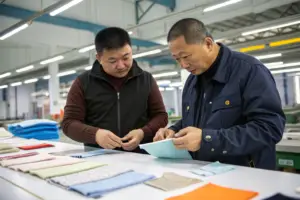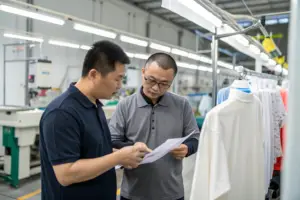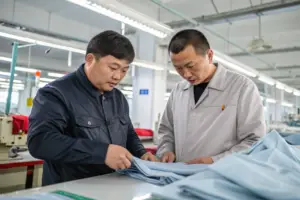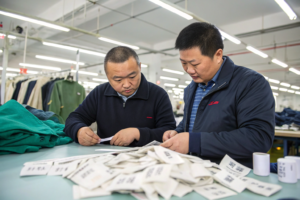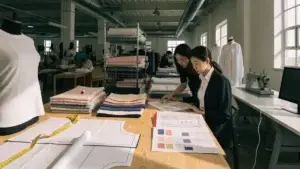
Here's a scenario I've watched play out countless times. A brand owner walks through a tradeshow aisle. They stop at a booth displaying gorgeous floral dresses. The salesperson is polished, speaks perfect English, and promises the moon. The price seems competitive. Six months later, that same brand owner calls me in a panic. The shipment is delayed. The quality doesn't match the sample. And when they demand answers, the trading company agent says, "I'll check with the factory and get back to you." Silence follows. The problem isn't that trading companies are evil. The problem is that they sit between you and the truth. As the owner of Shanghai Fumao, a direct factory operation, I've absorbed the lessons from hundreds of brands who made the switch. Let me walk you through what actually changes when you cut out the middleman.
Direct factory sourcing is generally better than using a trading company for established apparel brands that want lower costs, faster communication, and complete production transparency. A trading company adds a 10-20% markup on every garment. More critically, it creates an information filter. When a quality issue arises on the sewing floor, the factory tells the trading agent, who sanitizes the message, delays the delivery, and then presents a watered-down version to you. Direct sourcing eliminates this dangerous game of telephone. You speak to the person who controls the production schedule.
The choice isn't always black and white. Trading companies serve a purpose for very small orders or brands completely new to importing. But if you're serious about building a scalable apparel business, the direct path almost always wins. Let me explain exactly why.
How Much Does a Trading Company Actually Add to Your Garment Cost?
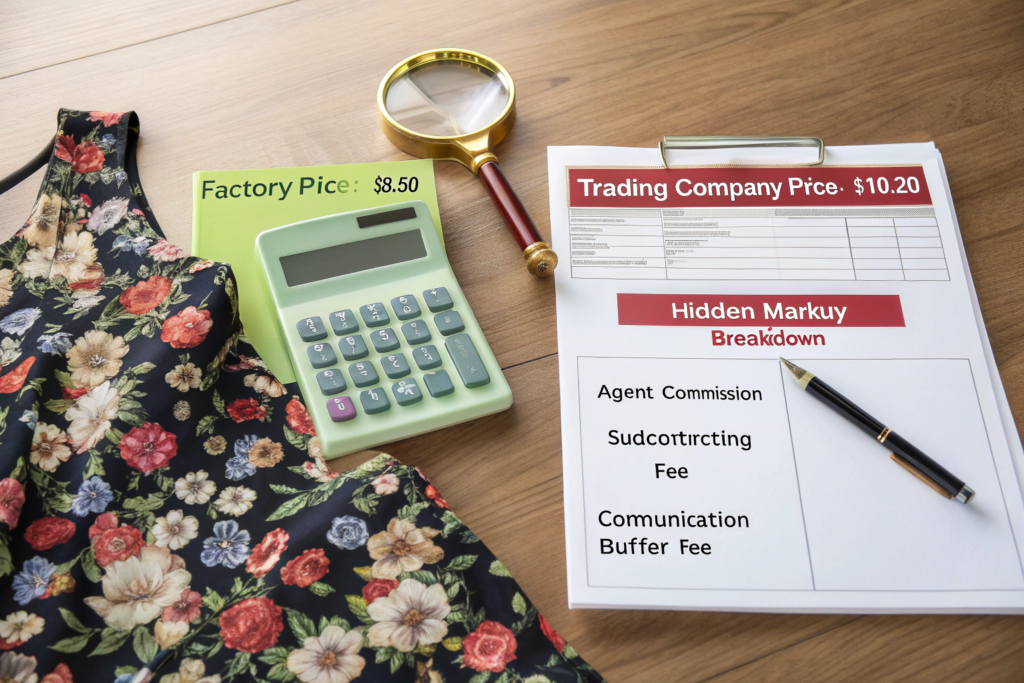
The most obvious difference between a trading company and a direct factory is the price. But it's not just a simple markup. The cost structure is layered and often invisible to the buyer. A trading company typically adds a commission of 10% to 20% on top of the factory's quoted price. This covers their overhead, their sales staff salaries, their office rent, and their profit margin. But here's the part most brands don't realize: the factory also inflates the original quote to the trading company. Why? Because the factory knows the trading company will negotiate them down. So they pad the price. You end up paying a markup on a markup.
Where Is the Hidden Money in a Trading Company Transaction?
The hidden costs go beyond the obvious commission. I've analyzed cost sheets from brands switching to us from trading companies. There are line items that simply don't exist when you buy direct. A "communication coordination fee." A "sample handling surcharge." A "third-party logistics arrangement fee." These are fictional services bundled into the price.
At Shanghai Fumao, when we quote a price for a floral A-line dress, the cost sheet has real numbers: fabric cost per meter, consumption per piece, cutting cost per piece, sewing cost per operation, trim costs, washing cost, and our profit. That's it. Nothing hidden. I remember a specific brand from New York that showed me their previous invoice from a trading company. The dress cost them $12.50 FOB. Our quote for the identical construction, using the same fabric specifications, was $9.80. The $2.70 difference wasn't entirely going to the factory. About $1.80 was pure trading company margin. The brand owner calculated that on an annual order of 15,000 pieces, the trading company relationship was costing them an extra $27,000 per year. That money could have funded an entire new design collection or a marketing campaign.
| Cost Component | Trading Company Model | Direct Factory Model (Shanghai Fumao) |
|---|---|---|
| Factory Base Price | Inflated by 5-8% to allow agent negotiation margin | Quoted honestly, no negotiation buffer |
| Agent Commission | 10-20% added on top | $0 |
| Sample Development | $150-$250 per style plus shipping | Often waived for committed production orders |
| Communication Buffer | Hidden "miscellaneous" fees in the cost sheet | No buffer; transparent line-item breakdown |
| Shipping Coordination | Separate fee or built into the margin | Included in our DDP service at cost |
Does a Trading Company Ever Get a Cheaper Factory Price?
Some brands argue that trading companies have bulk buying power across multiple clients, so they can negotiate lower fabric prices. This is sometimes true. A large trading company that places 500,000 meters of cotton poplin annually might get a slightly better mill price than a factory buying 50,000 meters for one client. However, those savings rarely reach the brand. They get absorbed into the trading company's profit pool.
A direct factory like ours builds long-term relationships with specific mills. We may not buy the absolute largest volume in the country, but we buy consistently, we pay on time, and we give the mill accurate forecasts. This earns us competitive pricing that we pass directly to our clients. For a recent order of 8,000 yards of custom-printed floral fabric, our mill price was within 3% of the price a large trading company allegedly secured. The brand still came out way ahead because there was no agent layer on top.
Can Direct Communication Prevent Production Disasters?
Speed kills in the apparel business, but slow communication kills faster. When you work with a trading company, you send your urgent email about a fit issue. The agent reads it, translates it, calls the factory, waits for an answer, translates the answer back, and emails you. Best case, this takes 24 hours. Real case, it takes 48 to 72 hours if the agent is handling multiple clients. A direct factory responds in hours, not days.
I have a client in Miami who switched to us after a disaster with a trading company. The agent had told them the "fabric was in stock" without actually checking the mill. When the order was ready to cut, the fabric was on a 4-week backorder. The agent had relayed outdated information. With a direct factory, that question goes straight to our procurement manager. She checks the mill's inventory system live and responds within 15 minutes. Accuracy and speed. That's the direct advantage.
What Happens When a Trading Company Conceals a Production Delay?
Trading companies live on commissions. Their worst fear is losing your order. So when a problem occurs at the factory level, their instinct is often to hide it temporarily while they scramble for a solution. They think, "Let me fix this first, then tell the client good news." But the delay compounds. The problem grows larger in the dark.
I recall a situation a new client described to me. Their previous trading company knew the cutting had been delayed by a week due to a machine breakdown. Instead of informing the brand immediately, the agent stayed silent for five days, hoping the factory would catch up. It didn't. By the time the brand was told, the shipment had already missed the vessel booking. The brand had to pay $4,200 for air freight on 800 dresses to avoid missing their retail launch. At Shanghai Fumao, our policy is brutal honesty. If a delay occurs, I tell the client within the hour. I present a revised timeline and a recovery plan. A direct factory has no incentive to hide bad news because there's no middleman reputation to protect. The relationship with the brand is the only thing that matters.
How Does Direct Sourcing Speed Up the Sampling Process?
Sampling through a trading company is painfully slow. The brand sends a tech pack to the agent. The agent sends it to the factory. The factory makes the sample. The factory sends it to the agent. The agent checks it. The agent ships it to the brand. Each handoff adds days. If the sample needs a revision, the cycle repeats.
At Shanghai Fumao, we cut out every unnecessary step. You email your tech pack directly to our sample room supervisor. She reads your comments and asks clarifying questions on the same day. We make the proto sample in 5 to 7 days. We ship it directly to your office via DHL. If you need a fit revision, we get on a video call. You tell us, "Move the waist seam up half an inch." We pin it on the mannequin live. You see the change in real time. The revised sample ships the next day. What took 3 to 4 weeks with a trading company takes 10 days with us. For a seasonal brand, those saved weeks directly translate into more selling time at full price.
Do Trading Companies Actually Provide Better Quality Control?
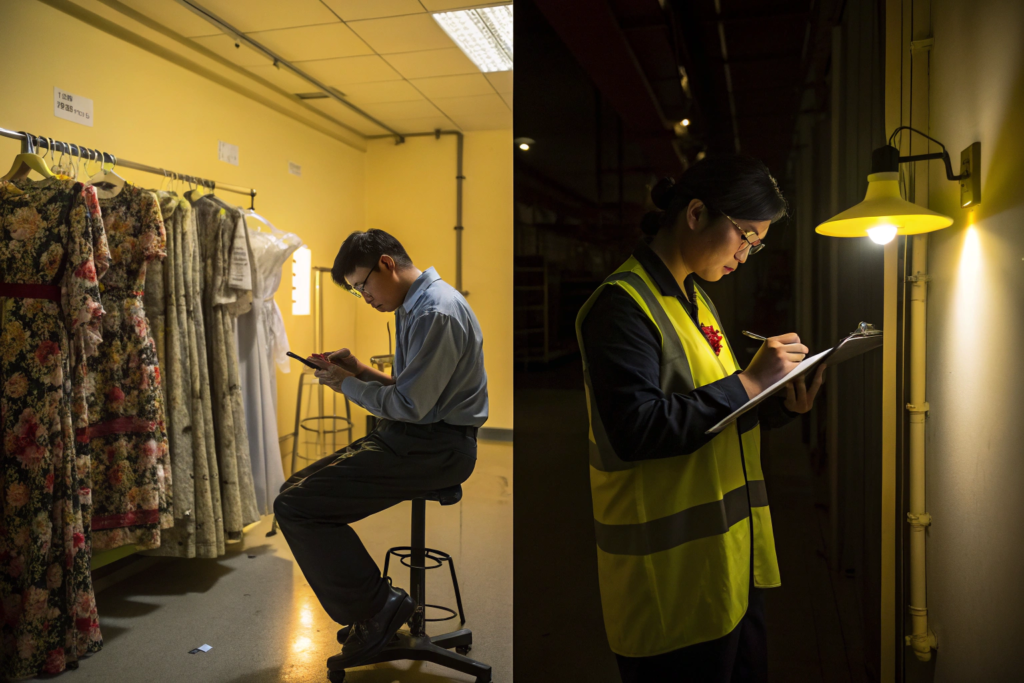
Trading companies often market their "third-party quality control" as a benefit. The argument is that an independent inspector is more objective than the factory checking its own work. In theory, this makes sense. In practice, it often fails. The trading company's inspector is typically a freelancer who visits the factory for a few hours on the day of shipment. They check a statistical sample, write a report, and leave. They have no ongoing relationship with the production line. They weren't there during cutting or sewing. They can catch surface defects, but they miss deep structural problems.
I would argue that a factory's own inline QC team is far more effective, provided the factory is honest. Our QC staff works on the production floor every single day. They inspect the fabric before cutting. They check the stitching at each operation. They measure the garment dimensions during assembly. By the time the final AQL inspection happens, that dress has already been checked at four different stages.
Can a Factory Really Be Objective About Its Own Quality?
This is the central question. Some brands believe a factory will always ship substandard goods to avoid rework costs. That is true for bad factories. A good factory, however, knows that returns and chargebacks are far more expensive than internal rework. A returned shipment from the U.S. costs the factory shipping, duties, rework labor, and often a lost client. It's a disaster.
At Shanghai Fumao, our internal QC team has the authority to stop a production line. They don't report to the production manager. They report directly to me. This separation of power is critical. The production manager's bonus is tied to on-time delivery. The QC manager's bonus is tied to defect rate and customer returns. If those two people reported to each other, quality would lose every time. By keeping them independent, we create a healthy tension. The production manager pushes for speed. The QC manager pushes for perfection. I make the final call when they clash. A trading company's freelance inspector has no such leverage. They can write a report that says "FAIL," but they can't stop the container from being loaded if the factory owner overrides them.
What Specific Defects Do Trading Company Inspectors Often Miss?
Freelance inspectors working for trading companies typically spend 2 to 4 hours at the factory. They check a limited AQL sample, often 125 pieces out of 1,200. They focus on obvious visual defects: stains, holes, broken stitches, measurement deviations. But they miss systemic issues that require process knowledge.
For example, a floral A-line dress might have a perfectly matched print on the outside, but the seam allowance inside is only 0.3 centimeters instead of the specified 0.6 centimeters. After five washes, that seam will fray and burst. A quick external inspection won't catch it. Our inline inspectors measure seam allowances during production. Another hidden issue is needle heat damage. On synthetic floral fabrics, a dull sewing needle generates friction heat, leaving tiny melted holes along the stitch line. They're invisible in standard lighting but open up after washing. Our inspectors replace needles every 4 hours and check for heat damage with a backlight panel. A trading company inspector who shows up on the final day would never find these problems. The damage is already sewn into the dress.
When Might a Trading Company Actually Be the Better Option?
I have spent this entire article arguing for direct factory sourcing because, for the brands I work with, it is overwhelmingly the better path. But fairness demands I acknowledge the situations where a trading company makes sense. Some brands are genuinely not ready to work directly with a factory. Their order volumes are too small. Their designs are too complex and need extensive handholding. Their cash flow can't support a direct factory's payment terms.
A trading company can aggregate small orders from multiple brands to meet the factory's MOQ. They can offer more flexible payment terms because they carry the financial risk on their books. They can also manage multi-product orders across different specialized factories. If you need 200 woven floral dresses, 150 knit sweaters, and 100 denim jackets in one shipment, a trading company can coordinate the three factories for you. A single factory like ours only makes what we specialize in. However, for brands that consistently order 500+ units per style in woven and knit apparel, direct sourcing is the winner every single time.

At What Order Volume Does Direct Sourcing Become Cost-Effective?
This is the question I get most often from startup brands. The honest answer is that direct sourcing with a quality factory like Shanghai Fumao works best when your per-style order reaches 300 to 500 pieces. Below that, the fixed costs of communication, sampling, and shipping documentation eat into the savings.
But don't let that discourage you. If you're at 200 pieces now and growing, start the direct factory relationship early. We're willing to work with smaller brands that show potential and a clear growth trajectory. We'd rather grow together than inherit a brand that's been burned by a trading company and is now suspicious and defensive. I had a client from Denver who started with just 150 units per style three years ago. We supported that volume knowing they had a strong business plan and a solid social media following. Today, they order 2,000 units per style. The trust and communication patterns we built during those small early days now pay dividends every single production cycle.
How Does a Trading Company Handle the Risk of a Failed Shipment?
If a shipment arrives damaged or with a critical quality failure, a trading company has a legal obligation to compensate you, depending on the contract. A factory does too, but enforcing a claim against a factory in China is harder than claiming against a trading company with a U.S. office or agent. This is a genuine advantage for trading companies, at least on paper.
However, the real question is: will the trading company actually pay? I've heard enough stories to be skeptical. Trading companies operate on thin margins. A single large claim can bankrupt them. When faced with a $50,000 quality claim, many trading companies simply dissolve and re-register under a new name. A factory, on the other hand, has physical assets. Our building, our machinery, our inventory. We can't just vanish. Our reputation in the industry is our most valuable asset. Shanghai Fumao has been building that reputation for years. We stand behind our production. If a genuine quality failure is our fault, we issue a credit memo or we re-make the goods. We don't disappear. The key is working with a factory that has a long, traceable history, not a fly-by-night operation.
Conclusion
Direct factory sourcing wins on price, speed, and transparency for apparel brands ready to manage a direct relationship. Trading companies win on convenience and low minimum orders for brands still testing the market. There is no universal answer, but there is a universal truth: the more layers between you and the sewing machine, the more distorted the information becomes.
If you're currently using a trading company and feel frustrated by slow responses, inflated prices, or vague answers about delays, you already know something needs to change. The switch to direct sourcing requires more initiative from your side. You need to be clear in your communication. You need to understand basic production timelines. But the payoff is enormous. You gain control over your supply chain, you protect your margins, and you build a partnership with people who touch your product every day.
At Shanghai Fumao, we've built our entire business around being that accessible, responsive, and honest manufacturing partner that brands struggle to find. We answer emails within hours, we show you your production on video calls, and we never, ever hide a problem. If you'd like to experience what direct factory sourcing feels like, I invite you to contact our Business Director, Elaine. Her email is elaine@fumaoclothing.com. Ask her the hard questions. Ask her about our defect rates, our on-time delivery percentages, or our communication response times. She'll answer with data, not sales talk. Let's build something real together.