A brand owner from Los Angeles sent me an email last year that made me cringe. His entire message was: "Your price is too high. Can you do $9.50?" He gave me no context. No order volume. No design details. No fabric specification. No target retail price. Just a blunt demand for a lower number. I didn't know how to respond. I didn't know if he was ordering 500 units or 5,000. I didn't know if he was comparing my price to a polyester dress from a trading company. His negotiation tactic actually worked against him. He sounded like a novice buyer who didn't understand the value he was being offered. I politely declined to lower the price. He took the cheaper option. He came back six months later after the cheaper dresses arrived late and faded in the wash.
Negotiating prices with a Chinese floral dress manufacturer is not about asking for a discount. It is about building a value equation. You negotiate effectively by demonstrating that you are a professional, long-term partner, not a one-time buyer. You specify your target retail price so the factory can engineer the dress to your margin needs. You negotiate on the total landed cost, not just the FOB price. You offer something in return for a price concession: a higher quantity, a deposit payment, a simplified design, or a multi-season commitment. A good negotiation leaves both parties feeling they have won.
I have been on the receiving end of thousands of price negotiations. I know which approaches build a partnership and which approaches insult a factory's intelligence. Let me show you how to negotiate like a professional buyer who respects the factory's craft and gets the best possible price.
What Should You Do Before You Start Negotiating the Price?
The negotiation begins long before you send the first email. It begins with your own research. A buyer who understands the cost structure of a floral dress, the market price for similar dresses, and their own margin requirements is a powerful negotiator. A buyer who only knows the price they want to pay is at the mercy of the factory's goodwill. Preparation is leverage.
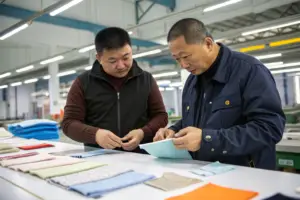
Before negotiating, you must know three things: the approximate cost structure of your dress, the FOB price range for similar dresses in the market, and your own maximum landed cost target based on your retail price and desired margin. Request quotes from at least three factories. Deconstruct the quotes to understand where the cost is allocated. Are you being charged for premium fabric or standard fabric? For French seams or basic serged edges? For custom printing or stock fabric? When you understand the cost, you can negotiate the cost.
I respect a buyer who has done their homework. I can tell within the first two emails whether I am dealing with a professional or a novice. The professional gets a better price because I know they have options and they understand value.

How Do You Estimate the Real Cost of a Floral Dress?
A floral A-line dress is not a mystery. The cost breaks down into four main components: fabric, trims and labels, labor, and factory margin. Understanding these components helps you identify where savings are possible.
Fabric is the largest single cost, typically 40% to 50% of the FOB price. For a custom printed cotton voile dress, the fabric cost might be $7 to $9 per dress. For a polyester crepe dress, $3 to $5. The fabric cost is driven by the fiber, the weave, the print type, and the meterage required.
Trims include the zipper, the buttons, the thread, the labels, and the hangtags. On a simple dress, trims cost $0.80 to $1.50. On a dress with premium Italian buttons and custom-printed labels, trims can cost $3 to $5.
Labor includes cutting, sewing, finishing, pressing, and packing. On a simple A-line dress, labor is $3 to $5. On a complex dress with French seams, a lined bodice, and hand-finished hems, labor can be $6 to $10.
The factory margin is typically 10% to 20%. This covers overhead, equipment, management, and profit.
A $15 FOB floral dress might break down as: fabric $7, trims $1.50, labor $4.50, margin $2. A $10 FOB floral dress breaks down as: fabric $4, trims $0.80, labor $3.20, margin $2. The $5 difference is almost entirely in the fabric and the labor. The cheaper dress has cheaper fabric and simpler construction. Knowing this, you can negotiate intelligently. "Can we use a slightly lighter weight cotton to reduce the fabric cost by $1?" This is a specific, informed request.
Why Should You Compare at Least Three Quotes?
Never negotiate with only one factory. Get quotes from at least three. The quotes will vary. One factory might quote $12.50. Another $15.00. Another $18.00. The variation tells you something.
The $12.50 quote might be from a trading company using low-quality fabric. The $15.00 quote might be from a mid-tier factory using standard fabric. The $18.00 quote might be from a premium factory using GOTS-certified organic cotton with French seams. The prices are different because the products are different. Comparing the detailed breakdowns, if the factories provide them, reveals the differences.
Do not automatically take the lowest quote. Do not automatically assume the highest quote is overpriced. Understand what each quote represents. Then negotiate with the factory that offers the quality level you want.
I had a client who received three quotes for her floral dress. One was $11.00, one was $14.50, and mine was $15.80. She asked me why my price was higher. I sent her the fabric specification. I sent her the seam finish detail. I sent her the QC inspection protocol. She compared them to the $11.00 quote. The $11.00 quote did not specify the fabric weight, the seam finish, or the inspection standard. It was a lower price for a lower-quality, unspecified product. She chose my quote. The due diligence paid off.
How Do You Frame Your Price Discussion for a Win-Win Outcome?
The way you ask for a better price determines the response you get. A blunt demand creates resistance. A collaborative request opens a conversation. The factory representative is a person, not a machine. She wants to feel respected. She wants to feel that the relationship is more than a single transaction. The tone of your negotiation is as important as the content.
Frame your price discussion around partnership, not confrontation. Start by acknowledging the value you see in the factory's work. Then explain your business situation honestly. "I love your sample quality. I want to place a 3,000-unit order. My retail price point is $68, which means my target landed cost is $16.50. Can we work together to engineer the dress to hit that number without sacrificing the quality I love?" This approach invites the factory to be a problem-solving partner, not an adversary.
This is the approach I respond to positively. The buyer has shared her constraints. She has shared her volume. She has complimented the quality. She has made it a shared challenge. I am motivated to find a solution.

What Is the "Target Retail" Negotiation Strategy?
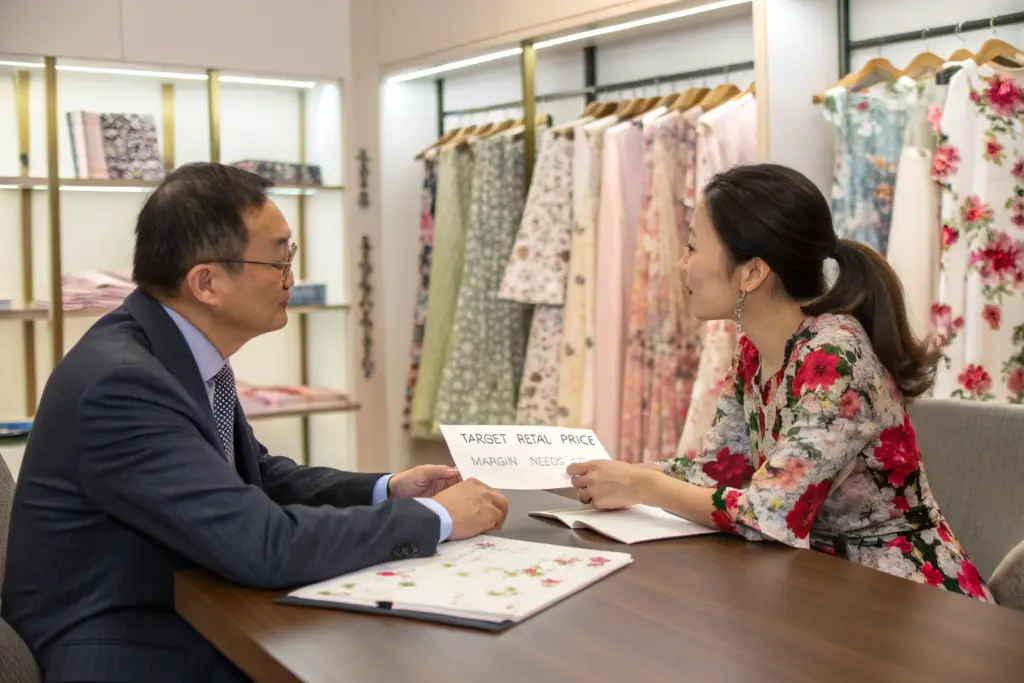
This is the most effective strategy I have seen. Instead of asking for a vague discount, you share your target retail price and your required margin. You ask the factory to reverse-engineer the dress to hit your target landed cost.
Let's say you want to retail the dress at $68. You need a 65% gross margin, which is standard for a boutique brand. Your maximum landed cost is $23.80. You tell me this. You say, "Ron, my business model requires a $23.80 landed cost on this dress. How can we get there?"
Now I look at the dress design. The current FOB is $16.00. With duty and shipping, the landed cost is $18.50. You are already well under your target. You don't need a lower price. You need confirmation that the quality matches your $68 retail price. The negotiation becomes about value, not cost.
Alternatively, if the current FOB is $19.00 and the landed cost is $22.00, we look at the design together. "The fabric is a heavy 200gsm organic cotton. If we switch to a 160gsm, the landed cost drops to $19.80. The drape will be slightly softer. The dress will still be beautiful." You make the decision based on your brand's quality standards. You are in control.
A client in Nashville used this strategy. She shared her spreadsheet with me. I could see her retail price, her margin target, and her marketing costs. I understood her business. I suggested a fabric substitution that saved her $1.80 per unit without changing the look of the dress. She got her target margin. I kept a good client. The transparency created a win-win.
Why Should You Always Mention Future Orders, Even If They Are Uncertain?
Factories value long-term relationships. A one-time order of 2,000 units is a transaction. A projected relationship of 6,000 units over three seasons is a partnership. The price I offer for a partnership is better than the price I offer for a transaction.
Tell me about your brand. Tell me about your growth plans. "This first order is 2,000 units to test the market. If the dress sells, I have two more floral prints ready to go for Fall and Winter. I project 6,000 units total this year." This is valuable information. It changes my pricing calculation.
I might accept a lower margin on the first order to secure the relationship. I might invest more time in the sampling process. I might allocate a better production slot. The promise of future business has real value in a negotiation.
A client in Portland told me her three-season plan during our first call. I believed in her vision. I gave her a 10% discount on her first order because I knew the second and third orders would come. They did come. The discount was an investment in a long-term partnership. It paid off for both of us.
Where Can You Find Realistic Cost Savings Without Hurting Quality?
A cheap dress is easy to make. Use the cheapest fabric. Use the simplest construction. Pay the lowest labor rate. But a cheap dress is not what your brand needs. You need a high-quality dress at the best possible price. The savings must come from smart design choices and supply chain efficiencies, not from cutting corners on quality. There are specific, identifiable areas where costs can be reduced without the customer noticing.
Realistic cost savings come from fabric weight optimization, construction simplification, and supply chain efficiencies. Reducing the fabric weight from 200gsm to 160gsm saves 15% on fabric cost without significantly changing the dress's appearance. Replacing French seams with clean-finished serged seams on an unlined casual dress saves 10% on labor. Ordering fabric in bulk for multiple seasons reduces the per-meter cost. These are engineering decisions, not cheapening decisions.
I help my clients find these savings. It is part of my job as a manufacturing partner.

How Can Fabric Weight and Print Type Affect Your Cost?
The weight of the fabric is measured in grams per square meter, or gsm. A heavier fabric uses more raw material. It costs more. A 200gsm cotton voile might cost $5.50 per meter. A 160gsm cotton voile might cost $4.80 per meter. On a dress that uses two meters of fabric, the saving is $1.40 per dress.
Does the customer notice the difference? On an A-line dress, the drape is determined by the silhouette and the fabric type, not just the weight. A 160gsm voile still has body. It still flares beautifully. It is slightly more sheer in bright sunlight, so a lining might be needed for white or light colors. For darker prints, the lining is unnecessary. The weight reduction is a smart saving.
The print type also matters. A digital print with six colors costs the same as a digital print with two colors because digital printing charges by the meter, not by the color count. But a screen print charges by the color. A six-color screen print is significantly more expensive than a two-color screen print. For small batch orders under 500 units, digital printing is almost always cheaper because there are no screen setup fees. For large orders over 2,000 units, screen printing can be cheaper per meter if the design has few colors.
I advise my clients on print economics. A client in San Diego had a beautiful eight-color floral design. She was ordering 300 units. Screen printing would have cost $12 per meter just for the screens and setup. Digital printing cost $6 per meter with no setup fee. The choice was obvious. She saved $12 per dress on a 300-unit order.
Can You Save Money by Simplifying the Construction?
A dress's construction is the number of sewing operations required to assemble it. Every operation costs labor time. A seam with a French finish requires two passes through the sewing machine. A serged seam requires one pass. The French seam costs twice as much in labor for that seam.
On a casual summer dress that is unlined, a clean serged seam is perfectly acceptable. It is durable. It is neat. It does not fray. The customer rarely notices the difference between a serged seam and a French seam on a casual dress. The labor saving is $0.40 to $0.60 per dress.
On a premium, lined dress, French seams are worth the cost. They are visible when the dress moves. They feel luxurious. The customer who pays $98 for a dress expects French seams. The customer who pays $48 does not. The construction choice should match the retail price point.
I have a detailed construction options sheet I share with my clients. It lists the seam finish options, the hem options, the pocket options, and the labor cost for each. The client chooses the construction that matches their brand's positioning. A transparent cost menu empowers the client to make smart decisions.
What Are the Common Pitfalls to Avoid When Negotiating?
There are negotiation tactics that backfire. They might get you a lower price in the short term. They damage the relationship in the long term. They signal to the factory that you are a difficult, transactional buyer. The factory then treats you as a difficult, transactional buyer. The quality, the communication, and the delivery commitment suffer. The lowest price is not the best price if it comes with a degraded partnership.
The biggest negotiation pitfalls are focusing exclusively on the FOB price while ignoring the total landed cost, demanding price parity with a quote from a lower-quality supplier, threatening to walk away unless a specific number is met, and pushing for a discount after the order has been placed. These tactics damage trust. A professional negotiation is transparent, respectful, and concludes with a clear agreement that both parties are committed to delivering.
I have experienced all of these tactics. They are exhausting. They make me want to work with a different client.
Why Is It a Mistake to Compare Prices Without Comparing Specifications?
A client once sent me a competitor's quote and said, "Match this price or I walk." The competitor's quote was for a polyester crepe dress with a basic serged finish, a stock print, and no quality inspection. My quote was for a GOTS organic cotton voile dress with French seams, a custom print, and an AQL 2.5 inspection. The quotes were not comparable. The products were not the same quality.
Comparing two quotes without comparing the detailed specifications is a rookie mistake. It tells the factory you do not understand what you are buying. It is an insult to the factory's expertise. A professional buyer compares the specifications first. If the specifications are different, the prices will be different. The comparison is meaningless.
If you have a lower-priced quote, ask the factory to help you understand the difference. "I received a quote for $12.50. Your quote is $15.80. Can you help me understand why your dress costs more? I want to make sure I am comparing the same quality." This is a respectful, intelligent question. I am happy to explain the differences. The explanation often convinces the buyer that the higher price is justified. Sometimes, the buyer realizes they are over-specifying the dress and can reduce the cost by adjusting the specifications. The conversation is productive.
What Happens When You Force a Factory to Accept a Price Below Their Cost?
Every factory has a minimum viable price. It is the price below which they cannot make the dress and cover their costs. If you force a factory below this price, one of two things happens. They refuse the order. Or they accept the order and cut corners to survive.
The fabric becomes thinner. The stitching becomes faster and looser. The QC inspection is skipped. The delivery date slips because your low-margin order is deprioritized when a higher-margin order comes in. The factory is not being malicious. It is being economically rational. You forced them into a corner. They are doing what they must to survive.
The price you negotiated is not the price you ultimately pay. You pay with quality failures. You pay with late shipments. You pay with a damaged relationship. The true cost of a price forced below the minimum is higher than the price you thought you saved.
A reasonable negotiation finds a price that works for both parties. The factory makes a fair margin. The client gets a fair price. The relationship is healthy. The quality is consistent. The deliveries are on time. This is the only sustainable outcome. I would rather lose an order than accept a price that forces me to compromise on the quality that defines Shanghai Fumao. My reputation is worth more than a single unprofitable order.
Conclusion
Negotiating with a Chinese floral dress manufacturer is a skill that combines preparation, respect, transparency, and strategic thinking. The preparation comes first. You know your cost structure. You know the market price. You have three quotes. The framing is collaborative. You share your target retail price. You invite the factory to problem-solve with you. The savings are engineering decisions. You optimize fabric weight, construction, and supply chain logistics without sacrificing the quality your customer expects. The pitfalls are avoided. You do not compare unequal quotes. You do not force a price below the factory's minimum. You build a long-term partnership.
A good negotiation ends with a handshake, even if it is a digital one. Both parties feel they have won. You have a dress that hits your margin target. The factory has a fair profit and a promising new client relationship. The dresses are made. They are beautiful. They sell. You reorder. The partnership grows. That is the goal.
If you want to start a negotiation with a factory that respects transparency and partnership, I am ready to talk. Send your design brief, your target retail price, and your order volume to our Business Director, Elaine, at elaine@fumaoclothing.com. She will prepare a detailed, transparent quotation with a cost breakdown. We will walk you through the specification and the pricing logic. We will work with you to engineer a dress that meets your quality standards and your margin requirements. A negotiation is a conversation. Let's start one.