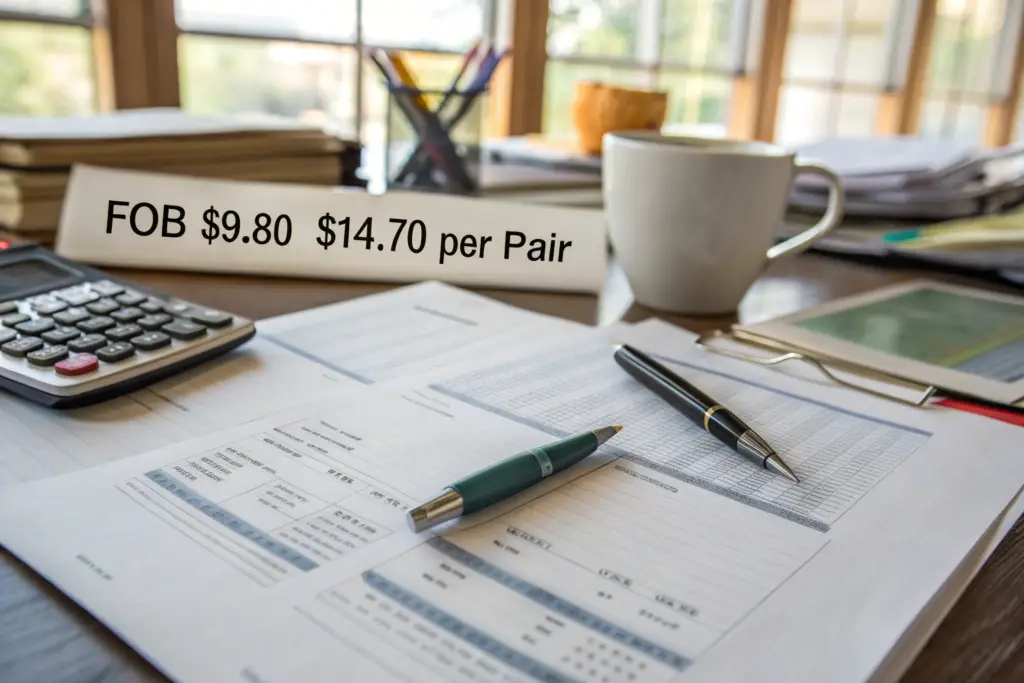
You receive a FOB quote of $9.80 per pair. You multiply by 1,000 units. You add a rough guess for shipping. You set your retail price based on that number. Three months later, your accountant shows you the actual numbers. The true cost per pair, sitting in your warehouse, ready to sell, is $14.70. Your margin has shrunk by 33%. You did not make a bad product. You made a bad calculation. The gap between the FOB quote and the total landed cost is where import profits go to die. You cannot manage what you do not measure, and you cannot measure what you do not know exists.
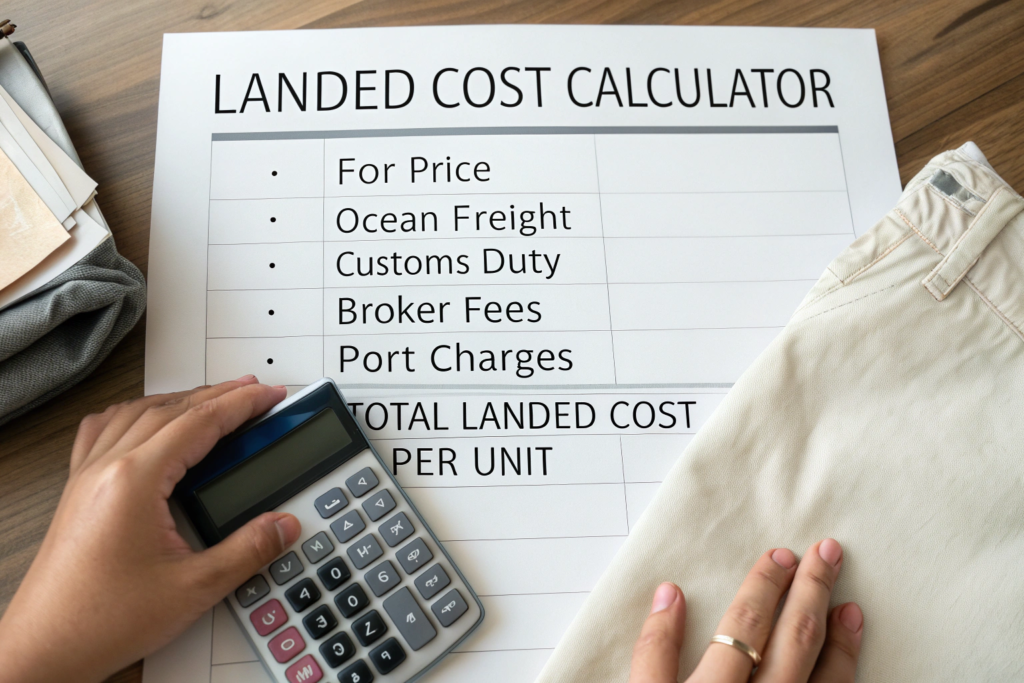
The total landed cost of linen wide-leg pants shipped to the USA is the sum of six components: the FOB price from the factory, the ocean or air freight cost, the customs duties calculated using the correct HTS code, the customs broker and documentation fees, the port and terminal handling charges, and the final trucking delivery to your warehouse. The formula is: Landed Cost = FOB Price + Freight + Duty + Broker Fees + Port Charges + Inland Trucking. Each component has hidden variables that can inflate the final number by 20% to 35% above the FOB quote if not accurately estimated.
My name is Elaine. At Shanghai Fumao, I quote landed costs every day. I have seen the spreadsheet mistakes that cost importers thousands of dollars. I have also seen how a precise landed cost calculation, done before the order is placed, transforms a brand's pricing confidence and margin stability. I want to walk you through each cost component with real numbers, real formulas, and the specific line items that first-time importers consistently miss. By the end of this article, you will be able to build your own landed cost calculator in a spreadsheet and never be surprised by a customs bill again.
What Is the Exact Formula for Landed Cost Calculation?
The landed cost calculation begins with a simple addition formula but becomes precise only when you understand what each component actually includes. Many importers use the formula "FOB + Freight + Duty" and call it a day. This formula will be wrong by 8% to 15% because it omits the handling, documentation, and delivery fees that occur between the port and your warehouse. The correct formula includes every cost required to move the goods from the factory floor in China to your specified delivery address in the United States.
The complete landed cost formula is: Total Landed Cost = (FOB Price × Quantity) + Ocean Freight + Customs Duty + Merchandise Processing Fee + Harbor Maintenance Fee + Customs Bond Cost + Broker Entry Fee + Terminal Handling Charges + Port Security Fee + Inland Trucking + Insurance. Divide the total by the quantity to get the landed cost per unit. For DDP shipments, this entire calculation is condensed into the single DDP price quoted by the supplier, which is why DDP is the superior choice for accurate margin planning.
What Are the Individual Line Items That Make Up a Complete Landed Cost?
Let me break down each line item with real, current estimates for a shipment of 1,000 linen wide-leg pants from Shanghai to a warehouse in Los Angeles, California. These numbers are based on our logistics data from the past twelve months. Actual costs vary by port, season, fuel prices, and your specific broker agreements. Use these as planning estimates, not guaranteed quotes.
| Cost Component | Description | Estimated Cost for 1,000 Units |
|---|---|---|
| FOB Price | Product cost, packed and loaded onto the vessel at Shanghai port. | $9.80/unit × 1,000 = $9,800 |
| Ocean Freight | Container freight from Shanghai to Los Angeles, including fuel surcharge. | $2,800 per 20ft container |
| Insurance | Marine cargo insurance, typically 0.3% to 0.5% of the cargo value. | $40 – $60 |
| Customs Duty | Tariff on linen pants. Rate varies by fiber content and HTS classification. | Typically 7% to 16% of FOB value |
| Merchandise Processing Fee (MPF) | CBP fee for processing the entry. 0.3464% of the entered value. Minimum $27.75, maximum $538.40. | $35 – $50 |
| Harbor Maintenance Fee (HMF) | 0.125% of the entered value for ocean shipments. | $12 – $15 |
| Customs Bond | Annual bond or single-entry bond to guarantee duty payment. | $300 – $500 per year, or $50 – $100 per entry |
| Broker Entry Fee | Fee charged by your licensed customs broker to file the entry documents. | $75 – $150 per entry |
| Terminal Handling Charges (THC) | Port fees for moving the container off the vessel and within the terminal. | $200 – $400 |
| Port Security Fee | Small surcharge for port security. | $15 – $25 |
| Inland Trucking | Delivery from the port to your warehouse. Varies by distance. | $400 – $800 for local LA delivery |
| Storage (if applicable) | If the container is not picked up within the free time. | $50 – $150 per day after free days |
When I add these costs together for a typical shipment to Los Angeles, the total landed cost lands between $13.50 and $15.00 per unit, depending on the duty rate and the inland trucking distance. The FOB price of $9.80 represents only 65% to 72% of the true cost of having the pants in your warehouse. The U.S. Customs and Border Protection importing guide provides official information on the fees and processes involved. Every importer should bookmark this resource.
How Does the HTS Code Determine Your Duty Rate?
The Harmonized Tariff Schedule code is a 10-digit number that classifies your product for customs purposes. The first six digits are international. The last four are specific to the United States. The HTS code determines the percentage duty you pay on the entered value of your goods. Choosing the wrong code can result in overpaying duty or, worse, underpaying and facing penalties on a future audit.
Linen pants are generally classified under Chapter 62 of the HTS, which covers woven apparel. The specific subheading depends on the fiber content and the gender of the intended wearer. Women's or girls' linen trousers typically fall under HTS code 6204.69.2510, with a duty rate that varies based on trade agreements and the specific fiber breakdown. Men's linen trousers fall under a different subheading. The duty rate is not a single fixed number. It is a percentage applied to the entered value, which is typically the FOB price paid to the supplier. If your pants are 100% linen, the duty rate is different than if they are a linen-cotton blend. If the pants contain any synthetic fiber, even a small percentage in the pocketing, the classification and duty rate may change. This is why the fiber composition test I discussed in a previous article is legally and financially critical. I strongly advise you to work with a licensed customs broker who specializes in apparel. A good broker will classify your goods correctly and apply any available duty reduction programs. The HTS search tool from the U.S. International Trade Commission allows you to look up potential codes and duty rates. Use it as a reference, but do not self-classify without professional guidance. A classification error is a liability that can follow you for years.
How Can You Calculate Landed Cost for DDP Shipments?
I have written about DDP shipping extensively in a previous article, but the landed cost calculation for DDP is fundamentally different from the FOB calculation and deserves its own treatment here. When you buy FOB, you assemble the landed cost from multiple invoices after the shipment arrives. When you buy DDP, the landed cost is quoted to you as a single number before you place the order. The calculation is done by the supplier, not by you. Your job shifts from calculating to verifying.
For DDP shipments, the landed cost is the DDP price quoted by the supplier. You do not need to calculate freight, duty, broker fees, or port charges because these are all included in the single DDP price. To verify that a DDP quote is fair, you can reverse-engineer it by estimating the individual cost components and adding them to the supplier's FOB price. A DDP quote that is within 10% of your independent estimate is reasonable. A DDP quote that is 30% above your estimate requires an explanation.
How Do You Reverse-Engineer a DDP Quote to Verify Its Fairness?
A DDP quote should be transparent, not opaque. At Shanghai Fumao, when we quote DDP, we are happy to show the breakdown. The DDP price is simply our FOB price plus our actual logistics costs plus a small coordination margin. A supplier who refuses to show the breakdown may be hiding an excessive logistics markup.
To reverse-engineer a DDP quote, start with the supplier's FOB price. If they only quote DDP and will not provide the FOB component, ask for it directly. A refusal to separate FOB from DDP is a red flag. Once you have the FOB price, add the estimated freight, duty, and fees using the line items I listed in the previous section. Because the supplier ships regularly, their freight rates are often lower than the spot rates you would pay as an individual importer. A supplier quoting DDP at $14.50 per unit, with an FOB of $9.80, is charging $4.70 per unit for logistics. On a 1,000-unit order, that is $4,700 for freight, duty, and all fees. For a 20-foot container from Shanghai to the U.S. West Coast, this is within the reasonable range. The supplier is not giving you a bargain logistics rate, but they are giving you a predictable cost and relieving you of logistics management burden. The value of that burden relief is subjective. For some importers, the simplicity of DDP is worth a small premium. For others, the absolute lowest cost is the priority. The DDP versus FOB cost comparison guide helps you quantify the total cost of each approach, including the often-overlooked cost of your own time spent managing FOB logistics.
What Hidden Costs Does DDP Absorb That You Would Otherwise Pay?
Beyond the obvious line items like freight and duty, DDP absorbs several unpredictable costs that can blindside an FOB importer. Customs exams are the most significant. If CBP selects your container for a random exam, the exam itself costs several hundred dollars. The container must be moved to an exam site, unloaded, inspected, and reloaded. If the exam is a VACIS X-ray scan, the cost is lower. If it is an intensive tailgate exam where the container is fully stripped, the cost can exceed $1,000. Storage fees accrue during the exam period. These costs are billed to the importer of record. Under FOB, that is you. Under DDP, that is us.
Port congestion storage is another unpredictable cost. When the Los Angeles or Long Beach ports are congested, containers sit on the terminal waiting for a trucking appointment. The free storage time, typically three to five days, is quickly exhausted. Daily storage fees apply. These fees can add hundreds of dollars to a single container if the congestion is severe. Under FOB, you pay these fees. Under DDP, we pay them. We also have more leverage to minimize them because our logistics partners move higher volumes and receive priority service. The U.S. port congestion fees and delays tracking shows how these costs can spike unpredictably. DDP transfers this volatility risk from you to the supplier. The DDP price may include a small risk premium for this volatility, but that premium is usually less than the cost of a single congestion event under FOB.
How Do You Build Your Own Landed Cost Calculator Spreadsheet?
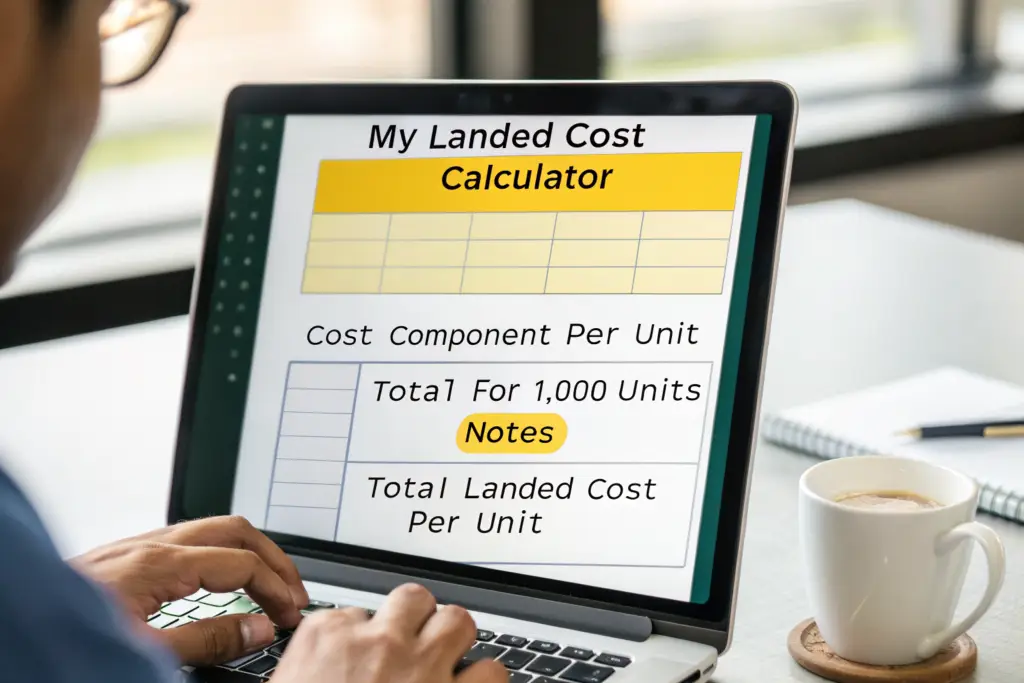
You do not need expensive software to calculate landed cost. A simple spreadsheet is sufficient, provided it includes all the line items and allows you to update variables like freight rates and duty percentages as they change. Building your own calculator has two benefits. First, you gain an intimate understanding of your cost structure, which makes you a better negotiator and a more accurate pricing strategist. Second, you can quickly assess new supplier quotes by plugging in different FOB prices and seeing the true landed cost comparison.
Your landed cost calculator spreadsheet should have columns for the cost component name, the cost per unit, the total cost for the order quantity, and notes on how the cost was calculated. The rows should list every line item from FOB through inland trucking. The final row should sum the total cost and divide by the quantity to produce the landed cost per unit. Key input variables—FOB price, freight rate, duty percentage, and inland trucking distance—should be in separate cells at the top of the sheet so you can change them and see the landed cost update automatically.
What Are the Formulas You Should Use in Each Row?
Here is a simple structure for your spreadsheet, with the formulas in plain English that you can translate into your preferred spreadsheet software.
Create a "Variables" section at the top:
- Cell A1: "Order Quantity" → Cell B1: Enter your quantity, e.g., 1000
- Cell A2: "FOB Price Per Unit" → Cell B2: Enter the FOB quote, e.g., $9.80
- Cell A3: "Ocean Freight (Total Container)" → Cell B3: Enter the freight quote, e.g., $2,800
- Cell A4: "Duty Rate (%)" → Cell B4: Enter the HTS duty rate, e.g., 7.2%
- Cell A5: "Inland Trucking (Total)" → Cell B5: Enter the trucking quote, e.g., $600
| Create the cost rows: | Cost Component | Cost Per Unit | Total Cost | Notes |
|---|---|---|---|---|
| FOB Cost | = B2 | = B2 * B1 | ||
| Ocean Freight | = B3 / B1 | = B3 | ||
| Insurance | = (B2 * 1.005) - B2 | = Total FOB * 0.005 | 0.5% of cargo value | |
| Customs Duty | = B2 * (B4/100) | = Total FOB * (B4/100) | ||
| MPF | = 50 / B1 | $50 | Estimate, capped at $538.40 | |
| HMF | = (B2 * 0.00125) | = Total FOB * 0.00125 | 0.125% of value | |
| Customs Bond | = 75 / B1 | $75 | Single entry bond estimate | |
| Broker Fee | = 125 / B1 | $125 | Per entry estimate | |
| Terminal Handling | = 300 / B1 | $300 | Estimate, varies by port | |
| Inland Trucking | = B5 / B1 | = B5 | ||
| TOTAL LANDED | = SUM(above) | = SUM(above) |
The per-unit landed cost is the sum of all the per-unit costs. Multiply that by your order quantity to get the total landed cost of the shipment. This calculator gives you a number that is accurate within a few percent, which is sufficient for pricing decisions and supplier comparisons. Update the variable inputs for each new quote. Over time, you will build a database of actual costs that makes each new estimate more precise. The small business importing cost calculator resources provide templates and more detailed breakdowns. Start with a simple version and add detail as you gain experience.
How Do You Use the Calculator to Compare FOB and DDP Quotes Accurately?
The calculator reveals the true cost of a FOB quote, which allows you to compare it directly to a DDP quote. A DDP quote is a single number. A FOB quote is the beginning of a calculation. By completing the FOB calculation, you can place both numbers side by side and make a decision based on total cost, not just the appealingly low FOB number.
I have seen importers choose a $7.50 FOB quote over a $13.50 DDP quote, believing they were saving $6.00 per unit. Their calculator, if they had built one, would have shown that the freight, duty, and fees added $5.80 per unit. The true landed cost of the FOB option was $13.30. The $0.20 difference bought them a fragmented logistics chain, customs liability, and weeks of coordination work. The DDP option was objectively the better deal when the full costs were compared. This is the power of the calculator. It strips away the marketing illusion of a low FOB price and reveals the economic reality. Run the calculation for every supplier quote. Share the results with your team. Make landed cost, not FOB cost, the number you use to make sourcing decisions and set retail prices. The total landed cost versus FOB price comparison article explains how this shift in perspective transforms profitability analysis for import businesses. The FOB price is a component. The landed cost is the truth.
How Do Seasonal and Variable Factors Impact Your Landed Cost?
Landed cost is not static. The $13.50 per unit you calculated in January may be $15.80 in August. Freight rates surge during peak shipping season, roughly August through October, as retailers rush to stock inventory for the holiday season. Fuel surcharges fluctuate with global oil prices. Port congestion, driven by labor negotiations, weather events, or unexpected volume surges, can add storage fees that blow a hole in your margin. A sophisticated importer does not calculate landed cost once. They track it continuously and build a buffer into their pricing to absorb volatility.
The three most volatile landed cost components are ocean freight, port storage fees, and inland trucking rates. Ocean freight can double between off-peak and peak season. Port storage fees can appear suddenly if congestion delays container pickup. Inland trucking rates fluctuate with fuel prices and driver availability. To manage this volatility, calculate your landed cost using current spot rates at the time of quoting, add a 5% to 10% contingency buffer for unexpected fees, and, if possible, lock in freight rates with your forwarder or use DDP to transfer the volatility risk to your supplier.

When Is the Best Time to Ship to Minimize Landed Cost?
The cheapest time to ship ocean freight from China to the USA is typically between February and April, and again briefly in November and December. The most expensive time is August through October, the peak retail holiday shipping season. Chinese New Year, which falls in late January or February, also creates a surge of pre-holiday shipping that drives up rates in January.
If your linen pants are for a Spring/Summer retail launch, plan your production so the goods ship in February or early March. The freight rates are lower, and the port congestion is lighter. The goods arrive in March or April, giving you time for warehousing and distribution before the peak May and June selling months. If your goods ship in August, you are competing for container space with every toy, electronic, and apparel importer rushing for the holiday season. Your freight rate will be higher, your container is more likely to be rolled to a later vessel, and your port storage risk is elevated. Schedule your production calendar backward from the optimal shipping window. If the optimal ship date is February 15, the fabric must be in-house by December 15, the order must be confirmed by November 15, and the sampling must be complete by October 15. The earlier you lock your production schedule, the more control you have over your landed cost. The ocean freight rate seasonal trends data shows the historical patterns. Use this data to time your orders and avoid the peak season premium whenever your brand calendar allows.
How Do You Factor a Contingency Buffer Into Your Retail Pricing?
Even the most careful landed cost calculation is an estimate. A surprise customs exam, a port labor slowdown, a fuel surcharge increase—any of these can add $0.50 to $1.00 per unit to your actual costs. If your pricing leaves no room for these variances, they come directly out of your profit. A contingency buffer is not pessimism. It is financial hygiene.
I recommend adding a 5% to 10% contingency line to your landed cost calculation. For a calculated landed cost of $14.00 per unit, a 7.5% contingency adds $1.05, bringing your planning cost to $15.05. Set your wholesale and retail prices based on $15.05. If the actual landed cost comes in at $14.00, the extra margin is a pleasant bonus. If the actual cost comes in at $15.00, your margin is protected. This buffer also gives you pricing flexibility. If a competitor undercuts your price, you have margin room to respond without going negative. If a wholesale account requests a slightly deeper discount, you have room to negotiate. The contingency planning in import costing guide explains how successful importers build buffers into their financial models. A zero-buffer pricing strategy is a gamble. A buffered strategy is a plan.
Conclusion
Calculating the total landed cost of linen wide-leg pants shipped to the USA is the single most important financial discipline for an apparel importer. The calculation begins with a complete formula: FOB price plus ocean freight, insurance, customs duty, merchandise processing fee, harbor maintenance fee, customs bond, broker fee, terminal handling, port security, and inland trucking. Each component has a specific cost, and omitting any one of them produces a landed cost estimate that will, at some point, surprise you with an invoice you did not expect.
You can manage this complexity in two ways. The first is to build a spreadsheet calculator, populate it with current rates, and update it for each shipment. This gives you control and understanding but requires ongoing attention to variable costs. The second is to use DDP shipping, which condenses the entire landed cost into a single, predictable number quoted by the supplier. The DDP price includes a small risk premium, but it transfers the volatility of freight, customs, and port fees to the supplier and frees you to focus on your brand rather than your logistics. Either approach works. What does not work is guessing, or using the FOB price as a proxy for your total cost, or building your retail pricing on a number you have not fully calculated.
At Shanghai Fumao, I help clients navigate this calculation every day. I can provide you with a detailed FOB quote for your specific design, a transparent DDP quote that covers everything to your warehouse door, or a side-by-side comparison so you can see the difference and make an informed choice. Contact me, Elaine, at elaine@fumaoclothing.com. Send me your order specifications and your delivery address, and I will return a complete cost breakdown within one business day. Stop guessing at your margin. Start calculating it.