You send a detailed email to your supplier in China. You ask one question about the pocket placement and another about the fabric shrinkage. Twenty-four hours later, you get a reply. It says, "Yes, dear. No problem." Nothing else. No attachment. No answer to your second question. You feel the frustration rising in your chest. You are not just buying clothes. You are trying to run a business with a launch deadline, a marketing calendar, and retail accounts waiting for their orders. This communication gap is not just annoying. It costs you money, sleep, and sometimes the entire season.
Shanghai Fumao Clothing solves this by replacing the vague, sales-driven “yes boss” communication style with a structured, engineer-led reporting system. We assign a dedicated bilingual production engineer to your account, use a live digital T&A calendar that updates in real time, and mandate a “question-by-question reply” protocol. You never chase for updates because the update finds you first.
My name is Elaine. I am the co-owner here, and I have sat in thousands of negotiation meetings. I have seen the American side of the table and the Chinese factory floor side. The root cause of communication pain is rarely a language problem. It is a structure problem. A sales rep who promises “no problem” to everything is paid to close the order, not to manage the production. Once the deposit is paid, their incentive to give you bad news disappears. So they delay, they soften, they hide. I rebuilt our client-facing process at Shanghai Fumao specifically to destroy this dynamic. I want to show you the exact systems we use, the real consequences of broken communication I have witnessed from the other side, and the specific, actionable protocols you should demand from any Chinese supplier you work with now or in the future.
Why Do Most Supplier Communication Models Fail American Brands?
The standard communication model in a Chinese export factory is the “sales rep as a gatekeeper.” This person sits between you and the production floor. Their job is to attract orders. Their English is usually conversational but technically weak. When you ask a technical question—for example, “Is the inseam felled or overlocked?”—they do not know the answer. They walk to the production manager, who speaks zero English. The manager gives a rushed answer. The sales rep walks back, translates it loosely, and types something that they think you want to hear. This game of telephone consumes days and strips out accuracy.
The model fails because it separates the person talking to the client from the person touching the fabric. A sales rep has no authority to stop a bad cutting decision, and a production manager has no context of what the American end-consumer expects. The information is filtered through a non-technical translator, creating a structural gap where your feedback about a fit issue never reaches the sewing machine operator who can fix it.

How Does the “Sales Gatekeeper” Model Delay Your Critical Decisions?
In 2022, I was consulting for a factory turnaround project, not our own facility but a smaller trading company. I watched a U.S. buyer send a message about a button change. The buyer wanted genuine shell buttons on a linen blazer instead of plastic. The message arrived on a Monday morning Shanghai time. The sales rep read it. She did not understand that “shell” meant a natural material, not a shell shape. She thought it was a style request. She waited until the Wednesday production meeting to casually mention it. The production manager said, “We already installed the plastic buttons.” The sales rep then waited another day before emailing the buyer, “Sorry dear, buttons finished, cannot change.” The buyer had sent the request three full days before the buttons were scheduled to be sewn. The delay in translation, not production speed, killed the change.
I have since instituted a rule for our own account managers. Any specification change email must receive an acknowledgment within two hours and a technical answer within twelve. If the answer requires a fabric test or a cutting trial, the account manager states clearly, “I have forwarded this to our pattern engineer. She will run a test on the marker and I will send you a photo of the result by 10 AM tomorrow your time.” This is not just good service. It is a time-stamped commitment. The principles of agile supply chain communication stress that real-time visibility replaces anxiety with control. A U.S. brand owner should never feel like their email disappeared into a void. At Shanghai Fumao, your point of contact is not a generalist salesperson. It is a product specialist who can read a spec sheet and a sewing line simultaneously. If your current supplier communicates through a single WhatsApp voice note a day, you are being managed, not serviced.
Why Is the Lack of “Bad News” Culture a Hidden Risk?
There is a culturally ingrained politeness in many business interactions in China. Saying “no” or delivering bad news directly is often avoided. A delay happens. The factory hopes they can catch up. So they say nothing. Two weeks pass. The delay is now a month. The American brand owner has already booked a photoshoot and a launch email. The silence, intended to avoid conflict, creates a catastrophic conflict.
I recall a specific project with a menswear brand from Texas in early 2023. They were working with a third-party factory that hit a snag. The dye lot for their signature olive linen was rejected by the quality control team. The factory manager decided to re-dye the fabric but did not inform the brand. Two weeks of silence passed. The brand called me in a panic because their delivery window was closing. I investigated on their behalf. The factory owner said, “We didn’t want to worry them. We were fixing it.” This is a cultural artifact. I train our team to deliver bad news within one business day, bundled with two options for a solution. For example: “Elaine, we found 3% shrinkage on the pre-wash test, which exceeds our 2% standard. We can A) re-cut the pattern with a longer length to compensate, adding 48 hours, or B) re-wash the fabric with a relax treatment, adding 24 hours. Which do you prefer?” This transforms a negative event into a collaborative decision. A study on cross-cultural communication in manufacturing explains how “indirect refusal” cultures clash with “direct expectation” cultures. Your supplier must bridge this gap explicitly. They must have a written protocol for delay notification. If they do not, your marketing calendar is built on quicksand.
What Specific Systems Does Fumao Use to Make Communication Instant and Transparent?
When I set out to fix communication at Shanghai Fumao, I didn’t look at other garment factories for inspiration. I looked at software development teams. Agile project management in tech uses boards and sprints to make work visible. I asked myself, why does a software engineer in California know exactly what a team in Bangalore is coding today, but a fashion brand owner in Chicago has no idea if their pants are being cut or if the fabric has even arrived? The answer was that garment factories treat production status as internal proprietary information. We treat it as a shared asset.
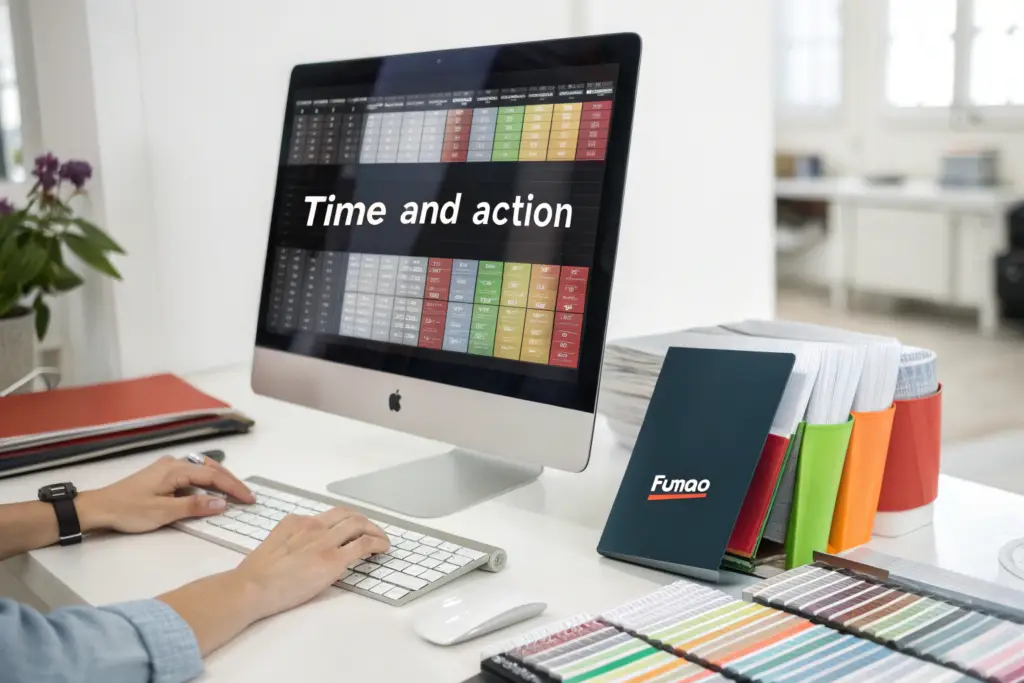
We deploy a live, cloud-based Time & Action (T&A) calendar for every single order, a dedicated Slack or WhatsApp channel with a rule that questions tagged “URGENT” get a video response within four hours, and a pre-production sample review that is recorded as a narrated video, not just sent as a silent parcel. The goal is to make our factory floor transparently visible to your office.
How Does a Live T&A Calendar Eliminate the “Where Is My Order?” Anxiety?
A traditional T&A calendar is an Excel spreadsheet sent once when the order is placed. It is immediately out of date. The fabric arrives three days late, and the Excel sheet still shows the old date. A live T&A calendar is a shared URL that you can bookmark. When our fabric warehouse checks in the linen rolls, the status moves from “Pending” to “Received.” You see that update in real time without asking us. When the cutting room finishes spreading the fabric, the status moves to “Cutting Complete.” You see the percentage completion.
This single tool has eliminated approximately 70% of the routine “just checking in” emails, according to our internal analysis of client communication volume last year. One of our long-term partners, a womenswear brand from Portland, told me last month: “I open the T&A link with my morning coffee. I know more about what’s happening in Shanghai than I do about my local screen printer.” We protect this calendar with a strict data entry rule. The person who operates the machine updates the status. Not a secretary. Not a salesperson. The cutting room supervisor has a tablet. When his team finishes cutting, he taps “Done.” The dyeing master enters the lab dip approval date. The project management visibility in manufacturing philosophy argues that operational data should flow directly from the point of execution to the client dashboard. This collapses the information hierarchy and removes the sales rep as a bottleneck.
Why Does a “Video-Inspection” Protocol Build More Trust Than a Written Report?
A written QC report says, “Minor creasing on left hip.” What does “minor” mean? Is it something you would accept? Is it something your customer would return? Words are abstract. A 30-second video of an inspector holding the exact pant, pointing at the crease, and flexing the fabric to show its severity is concrete. It leaves zero room for interpretation.
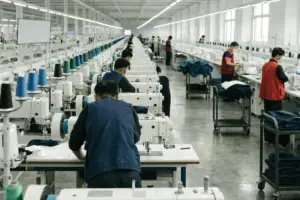
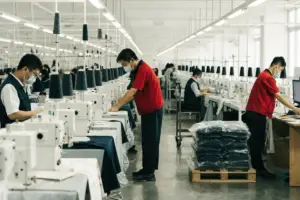
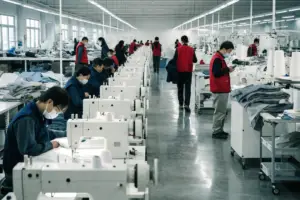
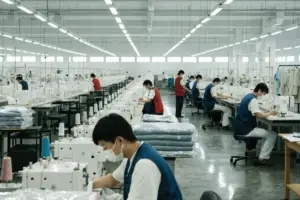
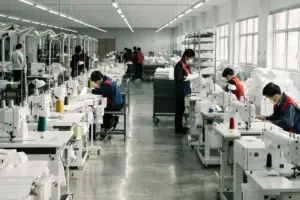
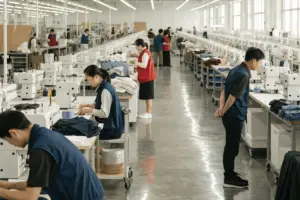
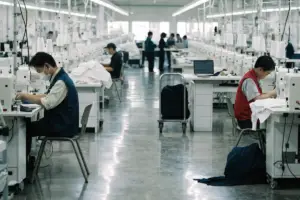
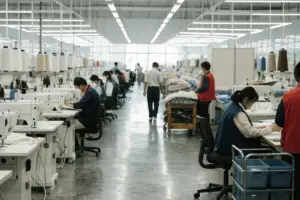
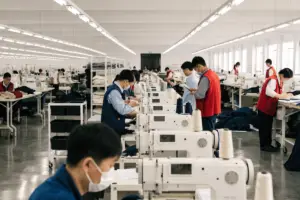
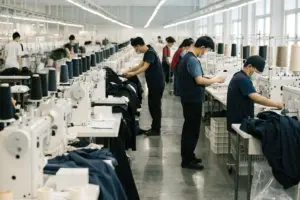
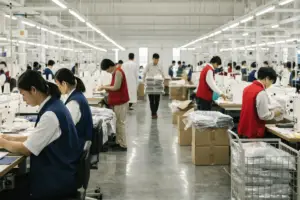
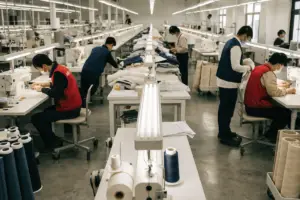
We implemented a video reporting standard eighteen months ago after a misunderstanding with a Chicago streetwear brand. Our written report described the linen’s natural slub texture as “irregular slubs present.” The brand owner panicked, thinking the fabric was defective. We immediately shot a video comparing the production pant to the approved reference sample. He saw that the slubs were identical to what he had signed off on. The panic ended in three minutes. We now proactively send three videos for every order: a pre-production sample review with a fit model walking, an in-line production video showing the sewing floor and a specific operation like the hemming, and a final inspection video narrated by our QC chief. Think of it as a virtual factory tour that is specific to your goods. You see the floor. You hear the machines. You see your product being made. This visual evidence bypasses the language barrier entirely. A picture may be worth a thousand words, but a video is worth a thousand emails.
How Does Structured Feedback Prevent Costly Production Errors?
Feedback without a system is just opinion. When a U.S. brand owner says, “The fit feels off,” a factory can respond in dozens of ways. They might take in the side seam. They might lower the crotch. They might add darts. Without a precise, visual, documented feedback loop, the factory guesses. The guess is often wrong. The second sample arrives, and the fit still feels “off.” Three rounds of sampling pass. The season launch date approaches. You finally approve it with a bad feeling in your gut because you ran out of time. This is how a product that could have been great becomes mediocre.
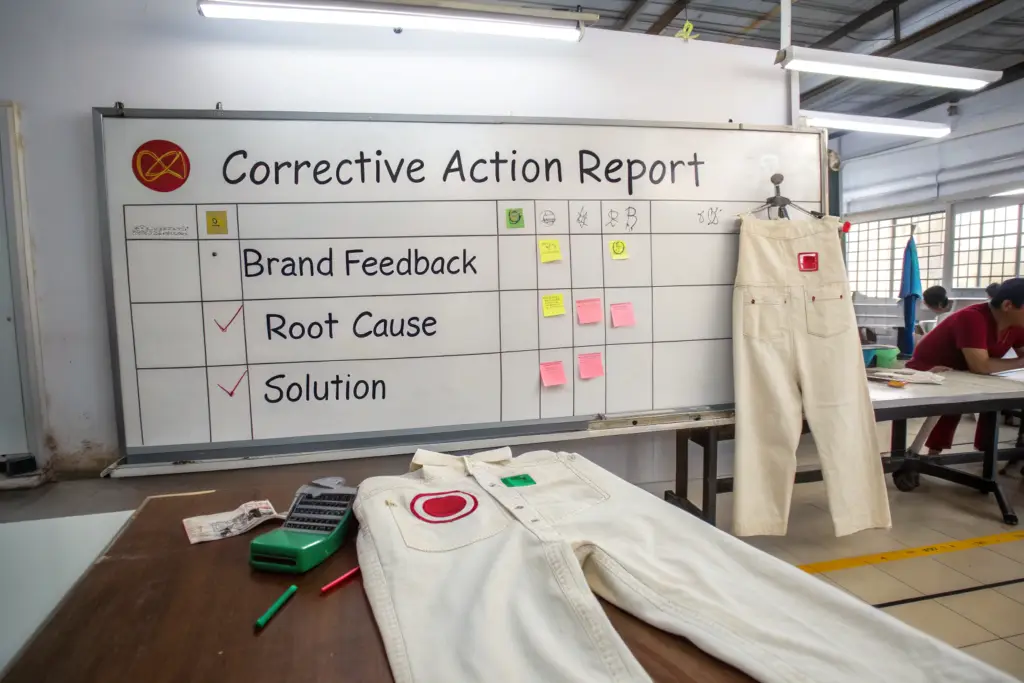
We solve this with a “Tech Pack Amendment” log that tracks every single change in numbered revisions, a mandatory fit-comment overlay where you draw directly on a photo of the sample, and a pre-production sign-off video call where we walk through the final pattern card together in real time. The pattern is never cut until we have a signed digital approval that locks the spec.
How Does a “Visual Overlay” Fit Comment Eliminate Ambiguity?
Words fail to describe a three-dimensional fit problem. “The crotch is too tight” does not tell the pattern maker where to add ease. Does the problem sit at the front rise? The back curve? Is it a width issue or a length issue? I developed a visual overlay protocol after a frustrating sampling round in 2020 with a New York contemporary label. We shipped three samples of a wide-leg linen pant, and each time the fit comment was a written paragraph. The pattern maker, who reads minimal English, relied on a translator who summarized a 100-word email into, “He wants it looser.” The pattern maker added 2cm to the hip. The real issue was the front rise was 1.5cm too short, pulling the fabric at the natural waist.
Now, we send a digital photo of the fit model wearing the sample. The brand owner or designer uses a simple markup tool—even an iPhone photo editor—to draw a line where they want the waistband to sit. They circle the pulling fabric. They write directly on the image: “Drop crotch point here by 1.5cm.” This image goes directly to the pattern maker’s tablet. No translator. No sales rep summary. Visual language is universal. The technical design communication tools industry has evolved to support this exact method. We print this marked-up image and pin it to the pattern. The seamstress sees exactly what the designer wants. This single change cut our sampling revision rounds by an average of 40% across all our accounts last year. Precision replaces poetry in technical communication.
What Is a “Pre-Production Call” and Why Must It Be Mandatory?
Most factories cut the bulk fabric without a final conversation. They assume the approved sample is the gospel. But between the approved sample and the bulk production, small decisions are made. The fabric lot changes slightly. The thread color is matched by eye. The elastic tension is adjusted. These micro-decisions, made in isolation, can deviate the entire production from your expectation.
A pre-production call is a 30-minute video meeting that happens after the bulk fabric is received but before the cutting knife touches it. At Shanghai Fumao, we initiate this call, not the client. We schedule it at a time convenient for the U.S. time zone, often early morning Shanghai time, late afternoon U.S. time. We walk through the PP sample together, holding it up to the camera. We compare the approved swatch to the bulk fabric, holding them side-by-side in the lightbox. We review the trims, the labels, the hangtag placement. We answer one specific question: “Is there any deviation from the approved sample?” If there is, we get a verbal decision on the spot. A pre-production risk assessment methodology saves exponentially more money the earlier it is done. The cost of fixing a mistake during pattern-making is $10. During cutting, it’s $100. During a finished garment, it’s $1,000. During a retail return, it’s $10,000 and a lost customer. This call is your final firewall against cascading errors. If your supplier does not offer this call, demand it. If they resist, they are hiding something.
Conclusion
The communication pain that American clothing brand owners experience with Chinese suppliers is a solvable engineering problem. It is caused by three structural failures: a sales-gatekeeper who filters and delays information, a cultural hesitation to deliver bad news that turns small delays into season-killing crises, and a lack of visual, real-time reporting tools that make the factory floor transparent. The solution is not a nicer sales rep. It is a complete system redesign that connects the U.S. brand owner directly to the production floor through a bilingual product engineer, a live T&A dashboard, and a mandatory video-inspection and pre-production call protocol.
At Shanghai Fumao, we have built this system because we used to be the factory that frustrated our clients, and we decided to become the factory that services them with military precision. We measure our response times. We track our sample approval cycle counts. We hold weekly internal reviews of client feedback on our communication, not just on our sewing quality. Because we know that a perfectly sewn pant that arrives late, or in the wrong color, is a return. If you are tired of chasing your supplier for a simple update, if you want a partner who treats your launch calendar like it is their own, I invite you to experience how we work. Contact me, Elaine, at elaine@fumaoclothing.com. Let me set up a sample video call and show you our live T&A dashboard in action. You can stop guessing what is happening in your supply chain and start watching it in real time.