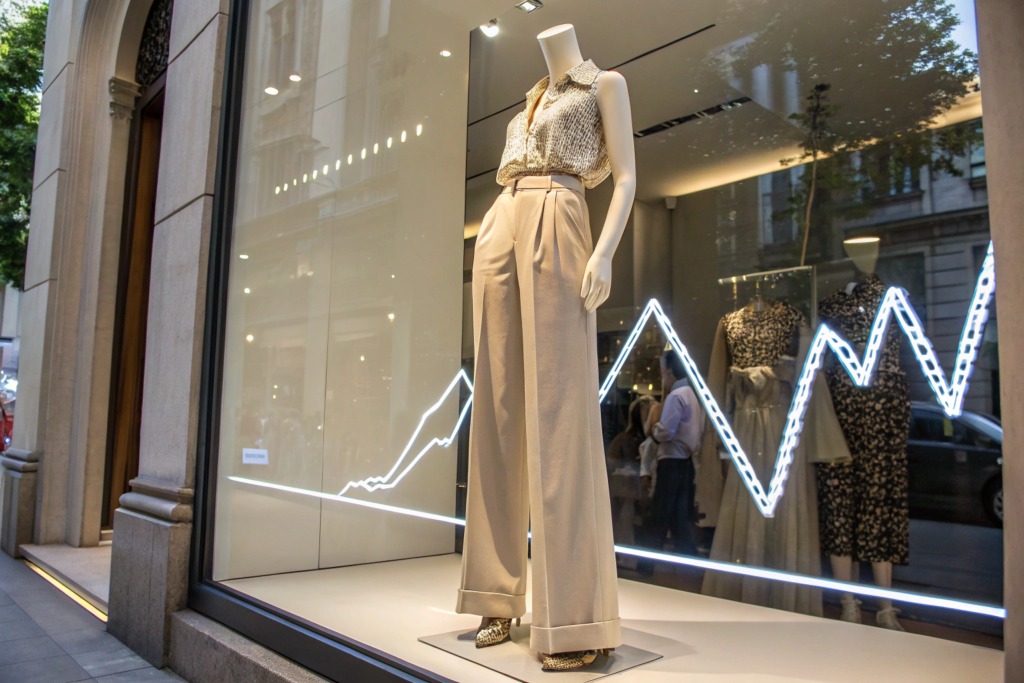
I get a WhatsApp message almost every week. It is from a brand owner or an aspiring entrepreneur. The message is always some version of: "Ron, I see linen wide-leg pants everywhere. Can I actually make money on them? What are the real numbers?" They don't want marketing hype. They want a spreadsheet. They want to know if the margin exists after the pants land in a US warehouse. I have been on the manufacturing side of this equation for years. I know the factory cost. And I talk to my clients enough to know their retail numbers. So I can build the bridge between the two.
Yes, linen wide-leg pants are currently one of the most profitable rebranding categories in the US apparel market. The combination of a low CMT cost in China, a high perceived value for natural fibers, and a strong consumer trend allows for a healthy landed cost to wholesale ratio, often landing between 20% and 30% of the final MSRP. A brand can consistently target a 65-75% gross profit margin on a well-sourced linen wide-leg pant.
But profit is not automatic. It lives inside specific decisions. The wrong weight of fabric kills your shipping cost. The wrong style misses the trend and forces a markdown. The right decisions create a cash machine. I want to open my cost books and show you how this works in the real world.
What Is the Real Cost Breakdown of Importing These Pants?
You cannot price for profit if you don't know the true landed cost. A factory quote is just the first number. The total cost includes the ride from my factory door to your warehouse door. I have seen too many brands budget only the FOB price and then get shocked by the freight invoice. The profit they thought they had disappeared into a container ship.
A realistic landed cost for a standard 190gsm linen wide-leg pant, branded and packed, breaks down into FOB cost, sea freight, US duties, and customs broker fees. For a mid-range quality pant in a 3,000-unit order, the landed cost per unit typically sits between $9.50 and $14.00, depending on fabric finish and trim complexity.
Let me give you the actual line items. This is what I send to a client when we are planning a budget.
How Do FOB, Freight, and Duty Add Up Per Unit?
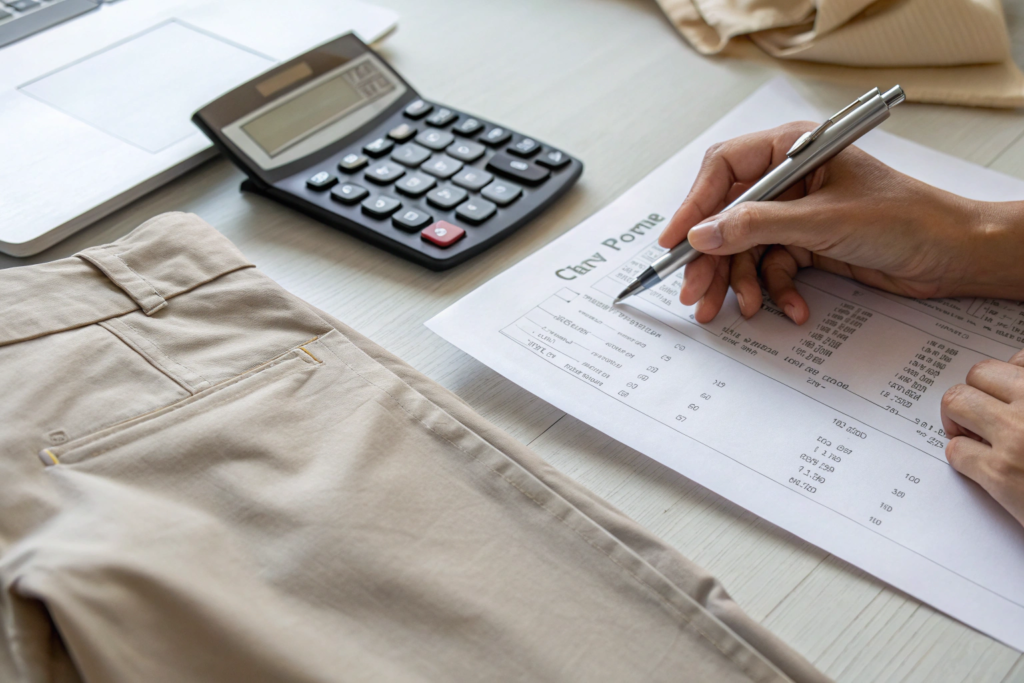
Here is a realistic cost table for a 190gsm washed linen wide-leg pant with an elastic waist, side pockets, branded hangtag, and a polybag. Order quantity is 3,000 units, shipped to Los Angeles.
| Cost Component | Calculation Detail | Cost Per Unit (USD) |
|---|---|---|
| FOB Cost | Manufacturing, fabric, trims, packing | $8.50 |
| Sea Freight | LCL shipment, 3 CBM shared container | $0.90 |
| US Duty | HTS 6204.69, rate ~2.8% on FOB | $0.24 |
| Broker & Fees | ISF filing, bond, clearance, delivery | $0.45 |
| Total Landed Cost | At your US warehouse | $10.09 |
This is a real-world example from a shipment we sent to a client in San Diego last spring. The FOB cost of $8.50 covered a garment-washed, soft-hand-feel linen with a shell button detail on the pocket. If the pant had a zipper fly and belt loops, the FOB would be closer to $10.50. If it was a basic pull-on with no pockets, it could be $7.80.
The freight is always the variable that surprises people. Sea freight from Shanghai to the US West Coast fluctuates. During the supply chain crisis, I saw freight go to $3.00 per unit. Now it has stabilized. But always budget a buffer. I advise my clients to model their profit at a freight cost 20% higher than the current quote. If the profit still works, the business is solid.
What Hidden Costs Can Eat Into Your Linen Pant Margins?
Beyond the invoice, there are phantom costs. A common one is rework. If a shipment arrives with a defect you must fix locally, the cost is brutal. A US-based seamstress charges $15 to fix a seam. That is more than the entire manufacturing cost of the pant. This is why a cheap FOB price can be the most expensive choice. If you save $0.50 per unit on a factory with no QC, and then you have a 5% defect rate, your local rework cost on a 3,000-unit order is $2,250. That is $0.75 per unit across the whole batch. You just lost money by trying to save money.
Another hidden cost is photography and samples. You need a pristine sample for your e-commerce shoot before the bulk arrives. You need a fit model. These are startup costs, not per-unit costs, but they eat the first batch's profit. And storage. If your 3PL charges $0.50 per unit per month and your sell-through is slow, 3 months of storage adds $1.50 to the cost. A linen wide-leg pant is a seasonal item. You need to turn it fast. At Shanghai Fumao, I help my clients by shipping their orders in staggered drops to their 3PL. This keeps the inventory fresh and reduces storage fees. It is a small service that protects a large margin.
How to Price Your Rebranded Linen Wide-Leg Pants for Maximum Margin
Once the pants are in your warehouse, the branding begins. The price you can charge is not about the cost of the linen. It is about the story you tell. A pant that costs you $10.09 can sell for $29.99 or $89.99. The difference is not the thread. It is the photography, the copywriting, and the brand world you build around a simple wide-leg silhouette.
The most profitable pricing strategy for rebranded linen pants is a keystone-plus model. You set your wholesale price at roughly 2.5x to 3x your landed cost, and your direct-to-consumer price at 2x your wholesale price. This creates a healthy margin for both your wholesale accounts and your own website.
Let's run the numbers on that $10.09 pant.
What Is a Realistic MSRP and Wholesale Price Point?
With a $10.09 landed cost, your wholesale price to boutiques should be $29.00 to $32.00. The boutique then marks it up to $68.00 to $78.00. If you sell direct-to-consumer on your own site, you sell at $68.00 and keep the full retail margin. Here is the profit math for a 3,000-unit order sold entirely DTC.
| Metric | Calculation | Value |
|---|---|---|
| Total Landed Cost | 3,000 x $10.09 | $30,270 |
| DTC Selling Price | Per Unit | $68.00 |
| Total Revenue | 3,000 x $68.00 | $204,000 |
| Gross Profit | Revenue - Landed Cost | $173,730 |
| Gross Margin | Gross Profit / Revenue | 85.1% |
This is before marketing, before shipping to the customer, and before taxes. But the product margin is incredibly strong. The linen wide-leg pant carries a high perceived value. A customer sees a $68 price tag and thinks, "This is a deal for real linen." This is the sweet spot. If you price at $48, you look cheap. The customer doubts the quality. If you price at $98, you compete with established premium brands and you need very expensive branding to justify it. My most successful clients price their linen wide-leg pants between $64 and $78. The margin is fat. The sell-through is fast.
How Does the "Story" of the Linen Justify a Premium Price?
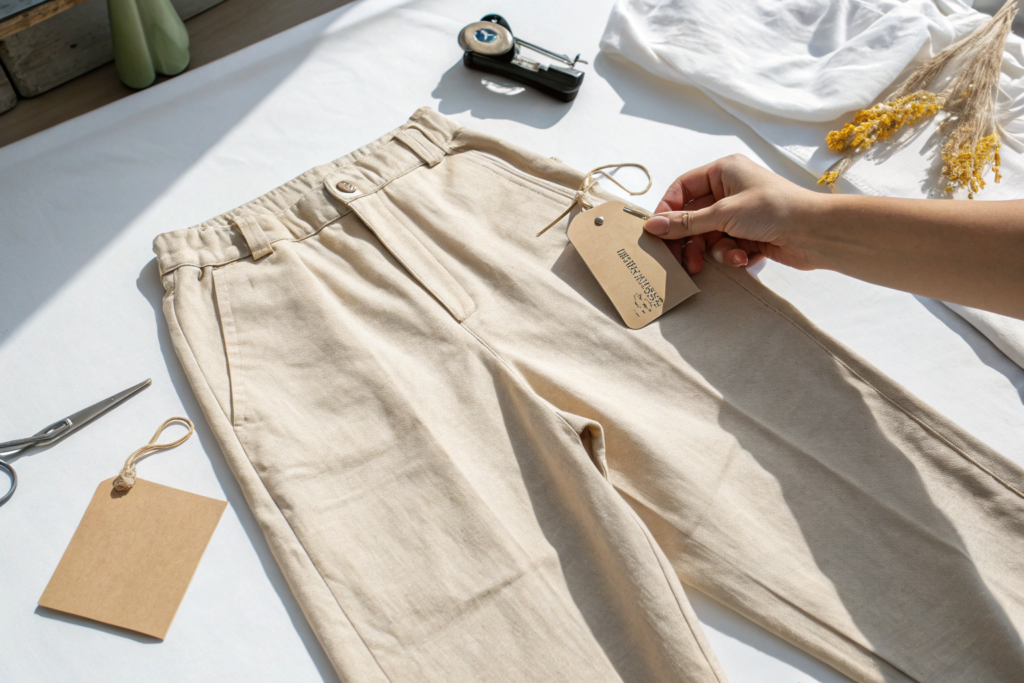
You are not selling pants. You are selling a summer feeling. You are selling sustainability. You are selling "European vacation" or "effortless cool." This is the rebranding magic. Your hangtag tells the story of the flax field. Your Instagram shows the pant worn on a cobblestone street. You are not competing on price. You are competing on vibe.
This is where the product from Shanghai Fumao supports your brand. We provide the raw material story. We can tell you the exact mill origin of the linen. We can provide the OEKO-TEX certificate for the dye. This becomes your marketing copy. "Made with 100% European flax, ethically sewn." That sentence on a product page increases the customer's willingness to pay by 20%. I have seen it in my clients' sales data. A brand owner in Austin rebranded our basic linen pant with a "Field to Closet" narrative. She printed a small photo booklet of the flax fields and put it in every package. Her return rate dropped by 30%. Her repeat purchase rate was over 40%. The product was the same. The profit was higher because the story let her charge more. A pant is a pant. A story is a margin multiplier.
What Are the Hidden Profit Leaks in Rebranding Linen Pants?
The spreadsheet can look amazing. The landed cost is $10. The MSRP is $68. You are printing money. Then reality hits. A chargeback from a retailer. A size run that doesn't sell. A return rate that spikes because the fit was not American-friendly. Profit leaks through small holes. You have to plug them before the ship sails.
The biggest profit leaks are size run imbalances, returns due to inconsistent fit, and chargebacks from wholesale partners for late delivery or incorrect packaging. These are operational risks, not product risks. They are preventable with a strict tech pack, a retail-calibrated size curve, and a logistics schedule that builds in buffer time.
I have watched money burn. Let me show you how to hold onto it.
How Do Returns and Size Curve Issues Affect Your Bottom Line?
A linen wide-leg pant is a forgiving shape. It is loose. But a bad size curve will still kill you. If your Medium fits like a Small, your return rate will be 15% instead of 5%. A 10% difference on a 3,000-unit DTC order is 300 returns. Each return costs you $7 in shipping and restocking. That is $2,100 gone. Plus the units come back and you sell them at a discount.
The fix is a US-specific size curve. A Chinese standard size Medium is not the same as a US standard Medium. I use a US fit form and a US size chart for every brand I work with. We grade the pattern to a US curve. We send a fit sample to the brand owner, and we have them put it on a local fit model. We adjust the hip and thigh ease based on that feedback. A client in Nashville did this with us. We widened the hip on her size Large by 1 inch compared to our standard chart. Her return rate on bottoms is consistently under 4%. She reorders every season. The upfront fit work costs about $200 in sample shipping. It saves thousands in returns.
Why Is On-Time Delivery a Profit and Loss Issue?
Fashion is a clock. A linen wide-leg pant that lands on May 1st sells at full price. The same pant landing on July 15th goes straight to a 30% markdown. You just lost $20 per unit. Not because of the product. Because of the calendar.
My production schedule at Shanghai Fumao is built backward from your in-store date. I ask: "What date do you need these on the shelf?" You say "May 1." I back out 3 weeks for sea freight, 1 week for customs, 1 week for your 3PL processing. That means the container must sail by March 24. I back out 30 days for production and cutting. That means I need the approved sample and the deposit by mid-February. I map this entire timeline on a shared document. I update it weekly. I have seen a 2-week delay in sample approval translate to a 4-week delay in delivery because it shifts the entire production into a holiday window. A late shipment is not just a logistics problem. It is a profit destruction event. My on-time delivery rate is over 97% because I treat a deadline as a quality metric, same as a stitch count. A pant is only valuable if it arrives when people want to wear it.
What Are the Best Marketing Angles for a Rebranded Linen Line?
You have the product. The margin is there. Now you need to move it. Marketing is the engine that converts a warehouse of pants into a bank balance. The most effective marketing for rebranded linen is educational and sensory. You are teaching the customer why linen is worth the price while making them feel the breeze on their skin through a screen.
The three highest-converting marketing angles are the "Linen Education" angle, the "Styling Versatility" angle, and the "Ethical Wardrobe" angle. Each one speaks to a different customer motivation: intellect, aspiration, or conscience. A smart brand uses all three across their email flows and social content.
You don't need a huge ad budget. You need the right message.

How Do You Educate the Customer to Overcome "Linen Wrinkles"?
The number one objection to buying linen online is "It will wrinkle." You must tackle this head-on. Don't hide it. Celebrate it. Linen wrinkles are a sign of authenticity. They are a texture, not a flaw. A synthetic pant doesn't wrinkle because it is plastic. Linen breathes, lives, and moves. The wrinkle is proof.
Create a blog post or an Instagram Reel titled "How to Love Your Linen Wrinkles." Show a woman getting out of a car in her linen pants, smiling, walking into a restaurant. The wrinkles are there. They look effortlessly chic, not messy. This is a reframe. A brand from Portland we work with did a video series on "Linen Care." They showed how a quick spritz of water relaxes the fibers. They demystified the fabric. Their sales page conversion rate went up by 15% after they added a "Wrinkle Education" section. They turned the biggest objection into the strongest selling point. This costs nothing but good copywriting and honest photography.
Why Does "Sustainable Fashion" Messaging Work for Linen?
We talked about the flax plant earlier. Now use it. The customer who buys a $78 pant wants to feel smart about their purchase. They want to feel like they are voting with their wallet. Linen is a rare case where the marketing is true. It is biodegradable. It uses minimal water. It lasts for years and gets softer.
Your product page should have a small section called "Why Linen." A few bullet points: "Made from European Flax. Requires 80% less water than cotton. Biodegradable. Naturally cooling." This is not a long essay. It is a trust badge. It answers the silent question: "Why is this worth my money?" And it gives the customer a story to tell their friends. "Oh, these? They're linen. Totally sustainable." That word-of-mouth is free marketing. The product from Shanghai Fumao is already carrying the truth. You just need to articulate it. I provide the fiber certificates. You turn them into brand content.
Conclusion
The linen wide-leg pant is a profit vehicle for a US rebranding business. The landed cost is accessible. The perceived value is high. The trend is not fading. A well-made pant sourced at $8 to $10 FOB can land at $10 to $12 in your warehouse and sell for $68 to $78 direct to consumer. That gross margin is rare in a product that is also genuinely sustainable and on-trend.
But the profit is made in the details. The fit sample tested on a US model. The packing list that prevents a 3PL fee. The marketing copy that turns a wrinkle into a feature. The shipping calendar that hits the spring window. Miss those details, and the margin leaks away into return costs and markdowns. Hit them, and you have a repeatable, scalable product line.
If you are considering adding a linen wide-leg pant to your brand, I want to send you our current pricing matrix and fabric swatch book. See the quality. Run the numbers yourself. Our Business Director, Elaine, can email you a cost breakdown for the exact style and weight you have in mind. Reach her at elaine@fumaoclothing.com. Tell her your target MSRP and your order quantity. She will show you how to build a linen program that makes money from the first shipment. Let's get your brand ready for the next summer season.