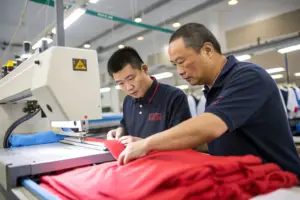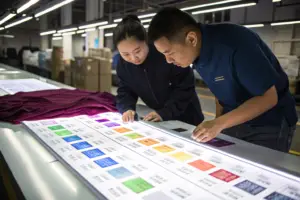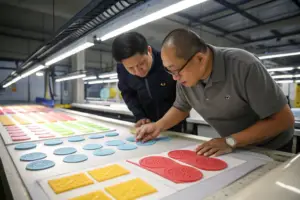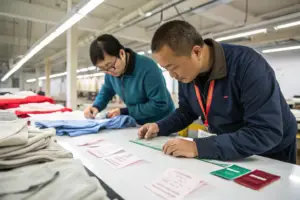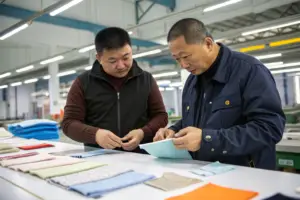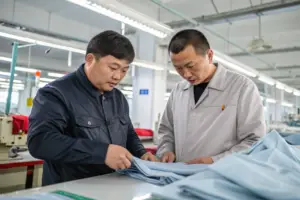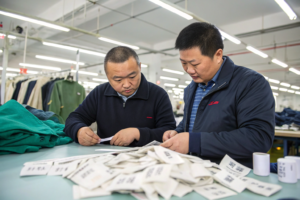
A startup founder from Denver once told me about the moment he learned the most expensive lesson of his brand's early days. He had received a set of fabric swatches from a supplier. They felt soft. The colors looked vibrant on his screen. He approved them with a one-word email: "Looks good." Six weeks later, 800 units of his signature hoodie arrived. The fabric was thin, pilled after three washes, and the color was noticeably different from the swatch. He had no recourse. The supplier simply said, "You approved the swatch." What he had not done was test the swatch. He had looked at it. He had touched it. He had not subjected it to a single objective evaluation. That omission cost him his entire first production run and nearly killed his brand before it launched.
You check Shanghai Fumao's fabric quality before sampling through a five-step objective evaluation protocol: request a physical swatch pack with our in-house lab test report, conduct your own physical burn and stretch tests, verify our certifications on the issuing body's public database, ask for a bulk fabric video inspection against your approved standard, and for high-stakes orders, commission an independent third-party lab test from SGS or Intertek. We facilitate every step of this process. We do not ask you to trust our claims. We provide the physical evidence, the verifiable data, and the independent testing pathways for you to validate our fabric quality yourself before you commit to a single sample, let alone a production order.
The pre-sampling phase is your moment of maximum leverage. You have not yet committed to sampling costs or production timelines. This is the time to be ruthlessly objective. A fabric that feels lovely in a swatch can fail catastrophically in a washing machine, under ultraviolet light, or against a child's skin. Your job is to surface those failures now, on a small piece of cloth, not later, on 3,000 finished garments. Our job is to give you the tools, the data, and the access to do exactly that. I want to walk you through the specific, actionable protocol.
What Should You Request from Us Before You Approve a Swatch?
A technical designer from a US outdoor brand once gave me her personal pre-sampling checklist. She said, "I need four things before I approve any fabric. The physical swatch, obviously. A lab report that I can read. A certificate that I can verify on my own. And a picture of the fabric on the roll in the factory, not a studio photo. If a supplier gives me all four without me having to chase them, they go to the top of my list. Most suppliers give me one, the swatch, and I have to fight for the other three." Her checklist is exactly right. A supplier's willingness to provide objective, verifiable data before an order is placed is a powerful trust signal.
Before you invest in sampling, you should receive a comprehensive fabric qualification package from us. This package is not a sales brochure. It is a set of objective data points and physical references that you can independently evaluate.
What Is Included in Our Physical Swatch Pack?
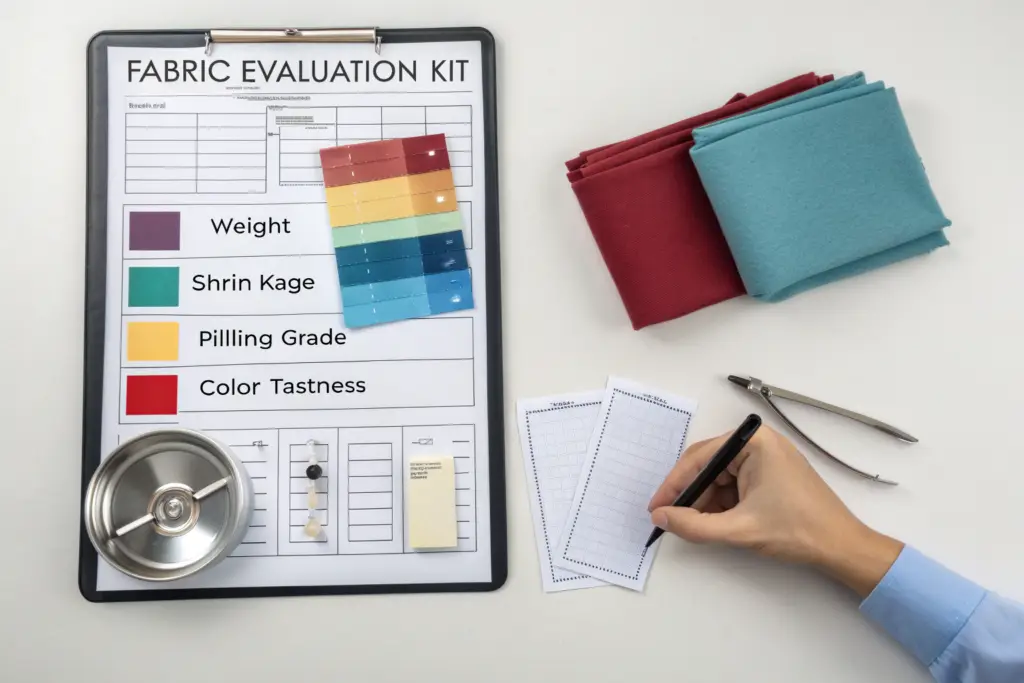
When you request a fabric evaluation, we send a physical swatch pack via courier. This is not a single, random cutting. It is a structured evaluation tool.
The pack includes an A4-sized swatch of each fabric you are considering, large enough for you to feel the drape, stretch the fabric, and conduct your own burn or wash tests. It includes a smaller, wallet-sized set of color swatches showing the available color range for that fabric, each labeled with our internal color code and the Pantone reference. It includes a printed copy of our latest in-house lab test report for that specific fabric batch. This report contains the measured values for fabric weight, fiber content verification, dimensional stability after multiple washes, pilling resistance grade after Martindale abrasion testing, color fastness to wash, light, and crocking, and any relevant chemical safety data, such as OEKO-TEX certification details. You can touch the fabric, stretch it, hold it up to the light, and simultaneously read its objective performance data. This is the foundation of an informed decision. A physical fabric swatch evaluation replaces subjective hope with objective data.
How Do You Read and Understand Our Lab Test Report?
Our in-house lab test report is designed to be transparent and comparable. The data is presented against the relevant international testing standard, AATCC for US orders, ISO for European orders.
Here is a guide to the key metrics you should check on the report:
| Test Parameter | Standard Referenced | What to Look For | Red Flag |
|---|---|---|---|
| Fabric Weight (GSM) | ASTM D3776 / ISO 3801 | Matches your specification. Tolerance +/- 5%. | More than 5% below specified weight. |
| Dimensional Stability | AATCC 135 / ISO 6330 | Shrinkage < 5% for knits, < 3% for wovens. | Shrinkage > 5% in either direction. |
| Pilling Resistance | ASTM D4970 / ISO 12945-2 | Grade 4 or higher at specified rubs. | Grade 3 or below, indicating visible pilling. |
| Color Fastness to Wash | AATCC 61 / ISO 105-C06 | Grade 4 or higher for shade change and staining. | Grade 3 or below, indicating noticeable fading. |
| Seam Slippage | ASTM D1683 / ISO 13936 | < 2mm seam opening at specified load. | Seam opening > 2mm, indicating seam weakness. |
The report shows the actual measured value and the pass/fail result against the standard. If you are unsure how to interpret a specific parameter, ask Elaine. She will explain it in plain language. A supplier who is transparent with their testing data is demonstrating confidence in their product. A supplier who is vague about test results is hiding something. The fabric test report interpretation is a skill every brand owner should develop. It protects your inventory investment.
What Simple Tests Can You Perform on the Swatch Yourself?
A childrenswear brand owner from London once told me she has a "kitchen table test" she performs on every new fabric swatch before she even looks at the lab report. She does a burn test to verify the fiber content. She washes the swatch in her home machine three times to check shrinkage. She rubs it against itself to see if it pills. She stretches it and lets it relax to check recovery. She said, "The lab report is the professional opinion. My kitchen table test is my personal reality check. If the fabric fails my test, I do not care what the lab report says." Her instinct is scientifically sound. Simple, at-home tests provide immediate, visceral data that a lab report, however accurate, cannot fully communicate.
We encourage you to test our swatches yourself. A fabric that we claim is 100% cotton should burn like cotton. A fabric we claim has 5% shrinkage should not turn a large swatch into a handkerchief after a hot wash.
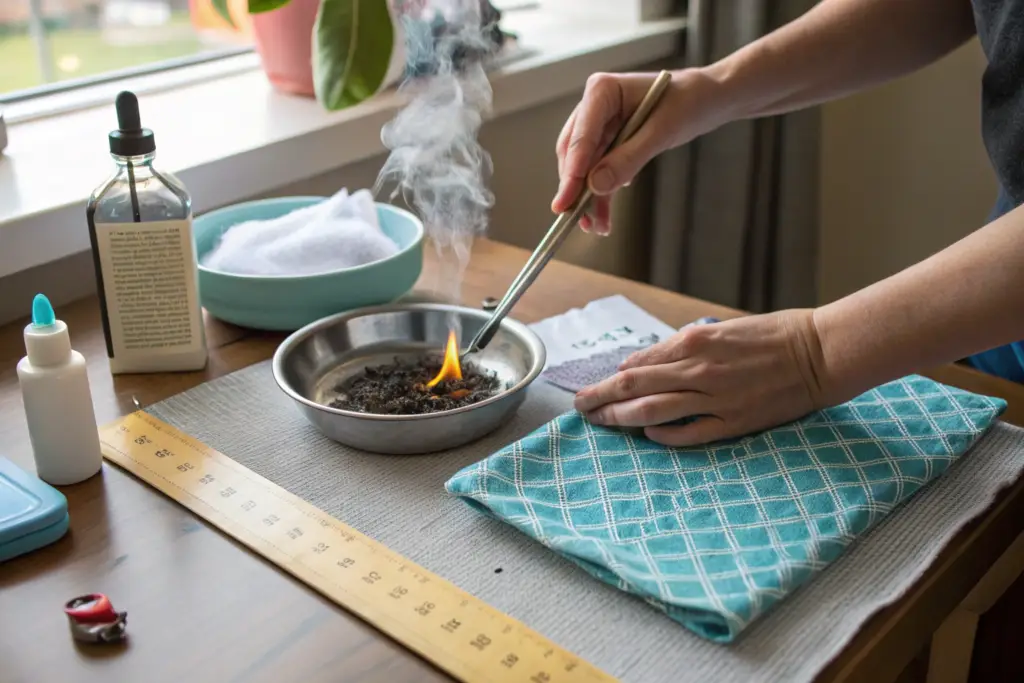
How Do You Perform a Burn Test for Fiber Verification?
The burn test is a quick, simple method to verify the general fiber content of a fabric. It is not a replacement for a lab's chemical analysis, but it will instantly reveal a gross misrepresentation.
Take a small cutting of the fabric, about 2cm by 2cm. Hold it with tweezers over a non-flammable dish, a metal or ceramic bowl. Light the edge with a lighter. Observe the flame, the smoke, the smell, and the ash residue. Cotton and other plant fibers burn quickly with a yellow flame, smell like burning paper, and leave a fine, grey, powdery ash. Wool and silk burn slowly, smell like burning hair, and leave a crushable black ash. Polyester and other synthetic fibers shrink away from the flame, melt, smell like burning plastic, and leave a hard, black, plastic bead that cannot be crushed. A fabric labeled "100% Cotton" that melts into a hard bead is clearly a synthetic blend, and the supplier has either lied or is sourcing from a dishonest mill. The fabric burn test is a simple, powerful fraud detection tool.
How Do You Test for Shrinkage and Pilling at Home?
To test for shrinkage, cut a precise 20cm by 20cm square from the swatch. Mark the dimensions on the fabric with a permanent marker. Wash the swatch in your home washing machine using the hottest water setting and the most aggressive cycle you expect your end consumer to use. Tumble dry on high heat. Re-measure the square. Calculate the percentage change. If the 20cm side is now 19cm, the shrinkage is 5%. This real-world test is often more aggressive than the lab test, which uses standardized, controlled conditions. It tells you how the fabric will perform in your customer's actual laundry room.
To test for pilling, cut two swatches. Rub them vigorously against each other, face-to-face, for about 100 cycles. You can also rub the fabric against a rough surface like denim. Observe the surface. Are small fuzzy balls forming? This is a crude but effective simulation of the mechanical abrasion the fabric will experience during wear. If the fabric pills significantly under this hand test, it will almost certainly pill in real-world use. These at-home fabric quality tests give you a personal, empirical basis for your sourcing decision. They are not a substitute for lab testing, but they are an essential complement.
How Can You Verify Our Certifications Independently?
A distributor from Seattle once shared his "Three-Minute Certificate Check" with me. He takes the certificate a supplier sends him. He does not read it. He goes directly to the issuing body's website, types in the certificate number, and waits for the result. He told me, "I have caught three fake certificates in the last two years. The PDF was beautiful. The database said 'no record found.' In all three cases, the supplier had some excuse. The database was down. The new certificate was not updated yet. The number was for their other factory. I ended the relationship immediately. A certificate I cannot verify is a lie." His method is foolproof. It takes the supplier out of the verification loop entirely.
We provide our certification numbers specifically so you can perform this independent check. We do not want you to trust our PDF. We want you to trust the independent, third-party database.
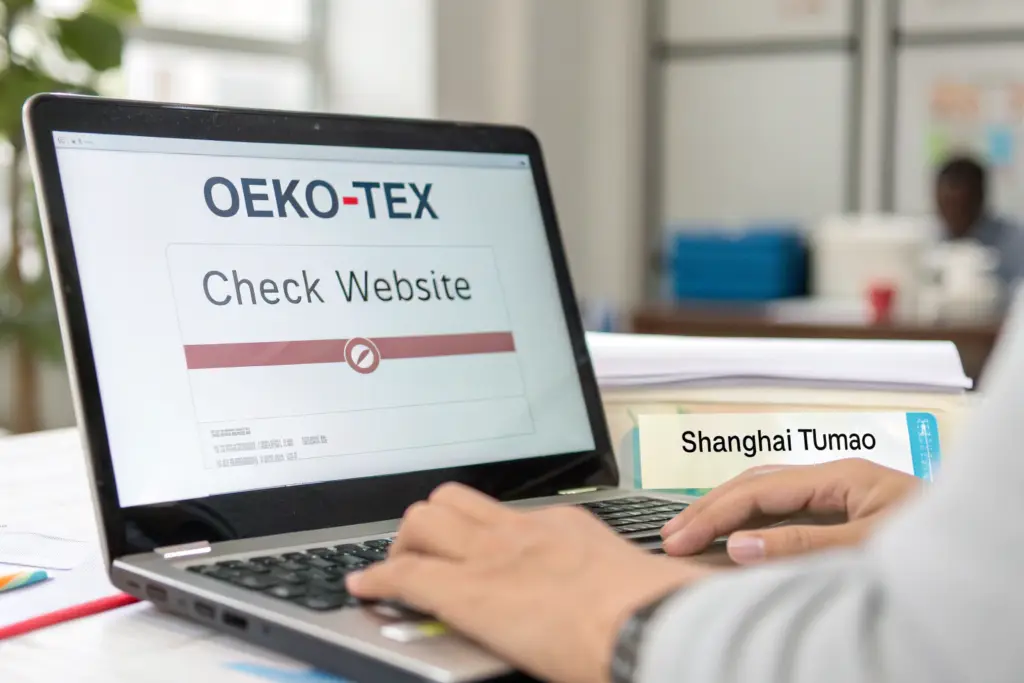
How Do You Check an OEKO-TEX Certificate Online?
We provide our current OEKO-TEX Standard 100 certificate number and a direct link to the official OEKO-TEX label check website. You navigate to the website yourself, do not click a link in our email, type the link into your browser.
Enter our certificate number in the search field. Click search. The database will return the registered certificate holder's name, which must be Shanghai Fumao Garment Co., Ltd. It will show the certified product class, Class I for baby products, Class II for direct skin contact. It will show the valid-until date. Check all three data points. If the company name does not match our legal entity exactly, the certificate is not ours. If the class does not match your product's end-use, the certificate is not applicable. If the date is expired, the certificate is no longer valid. This verification takes two minutes. It is the definitive check. The OEKO-TEX label check website is available in English and multiple other languages.
How Do You Verify a GOTS Organic Certification?
For GOTS-certified organic orders, we provide two certification numbers. The Scope Certificate number proves our factory is certified to handle GOTS goods. The Transaction Certificate number will be provided for your specific order.
You can verify the Scope Certificate on the GOTS public database. Search for our company name or the certificate number. Verify the certification body, the scope, and the validity. The Transaction Certificate verifies the organic status of your specific batch. This is the critical document for your organic marketing claims. A supplier who only offers a Scope Certificate and cannot provide a TC for your specific order is likely passing off conventional cotton as organic. Always demand the TC. The GOTS public database is the authoritative source for verification.
Can You Commission Independent Third-Party Fabric Testing?
A brand owner preparing for a large retail chain order once asked me, "Your in-house lab report is great, but my buyer requires an SGS report. Can you send the fabric to SGS?" My answer was an immediate yes. I did not hesitate. I did not offer excuses. I gave him the process and the timeline for third-party testing. He later told me that my unhesitating "yes" was the moment he decided to place the order. It demonstrated that our internal quality claims were backed by a willingness to be audited by the most demanding external standard.
The ultimate pre-sampling verification is an independent third-party lab test from a globally recognized testing company. This removes any potential concern about the objectivity of an in-house lab report.
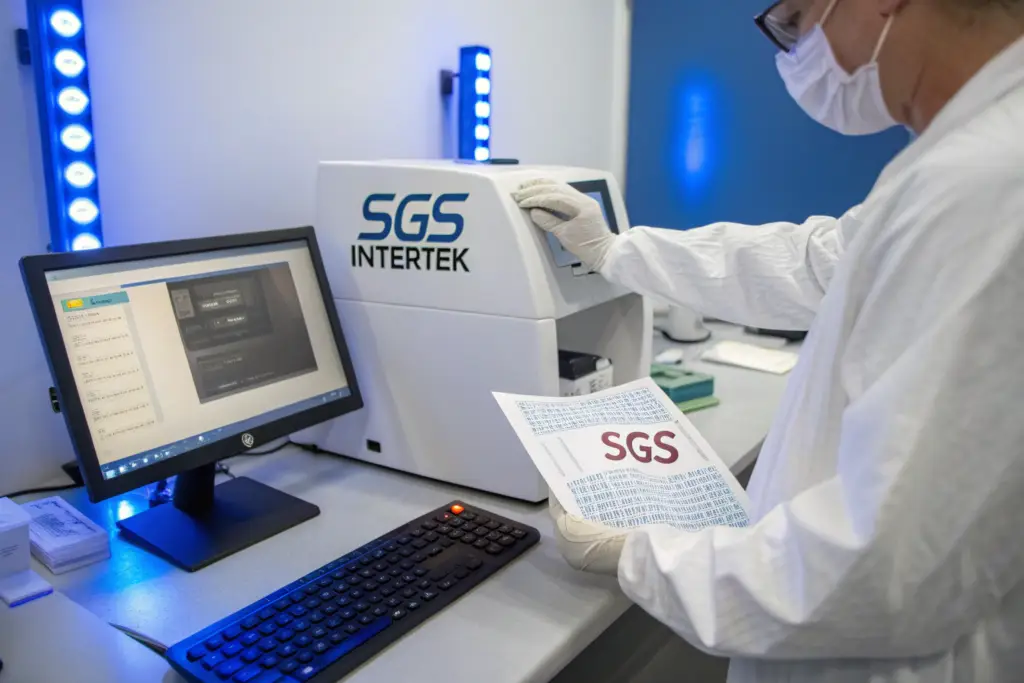
How Does the Process Work for SGS or Intertek Testing?
You request third-party testing. We send the specific fabric swatches, randomly sampled from the bulk fabric intended for your order, directly to an SGS or Intertek laboratory. You specify the tests you require. We manage the submission and the payment, or you can pay the lab directly, your preference.
The lab tests the fabric to the international standards you specify. They issue a formal, branded test report. This report is sent directly to you, or to both of us. The report is independently verifiable with the lab. This is the gold standard of fabric verification. It costs several hundred dollars per test battery and adds one to two weeks to the pre-production timeline. For a large order, a children's product requiring regulatory compliance, or a high-value brand launch, it is a wise investment. We facilitate this process smoothly because we are confident our fabric will pass. A supplier who resists independent testing is revealing a quality risk. A supplier who welcomes it is demonstrating quality confidence. The SGS textile testing services and Intertek textile testing services are globally recognized and accepted by all major retailers.
What Specific Tests Should You Commission for Your Product?
The tests you commission depend on your product type, fabric, and end-use. For a basic cotton t-shirt, you might commission fiber content verification, dimensional stability, color fastness to wash, and pilling resistance. For a children's sleepwear product, you must commission flammability testing to CPSC 16 CFR Part 1610 or 1615/1616. For an outerwear jacket, you might add waterproof rating, breathability, and color fastness to light.
We can advise you on the appropriate test battery for your product, based on the destination market's regulatory requirements and the specific performance claims you intend to make. A customized testing protocol ensures you are not paying for irrelevant tests, but that you are covering all legal and performance-critical parameters.
Conclusion
Checking fabric quality before sampling is the single most important due diligence activity a brand owner can perform. It is the moment you move from subjective hope to objective evidence. You are not being difficult or untrusting. You are being a responsible business owner protecting your brand, your inventory investment, and your customer relationships. At Shanghai Fumao, we do not just tolerate this pre-sampling scrutiny. We encourage it. We provide the physical swatch pack with the in-house lab report. We send you enough fabric to perform your own burn, shrink, and pill tests. We give you our live certification numbers so you can verify our credentials independently on the official databases. And if your order warrants it, we will send our fabric to SGS or Intertek for independent, accredited third-party testing, on your instructions.
The fabric is the foundation of your product. Test it now, or pay for its failure later. If you are considering our fabrics for your next collection, I invite you to start the evaluation process today. Contact our Business Director, Elaine, at elaine@fumaoclothing.com. Tell her your product category and your performance requirements. She will send you a curated swatch pack with the corresponding lab reports, our current certification numbers, and a quote for any third-party testing you wish to commission. Hold the fabric in your hands. Burn it. Wash it. Stretch it. Check the certificate numbers. Let the physical and digital evidence give you the confidence to move forward.