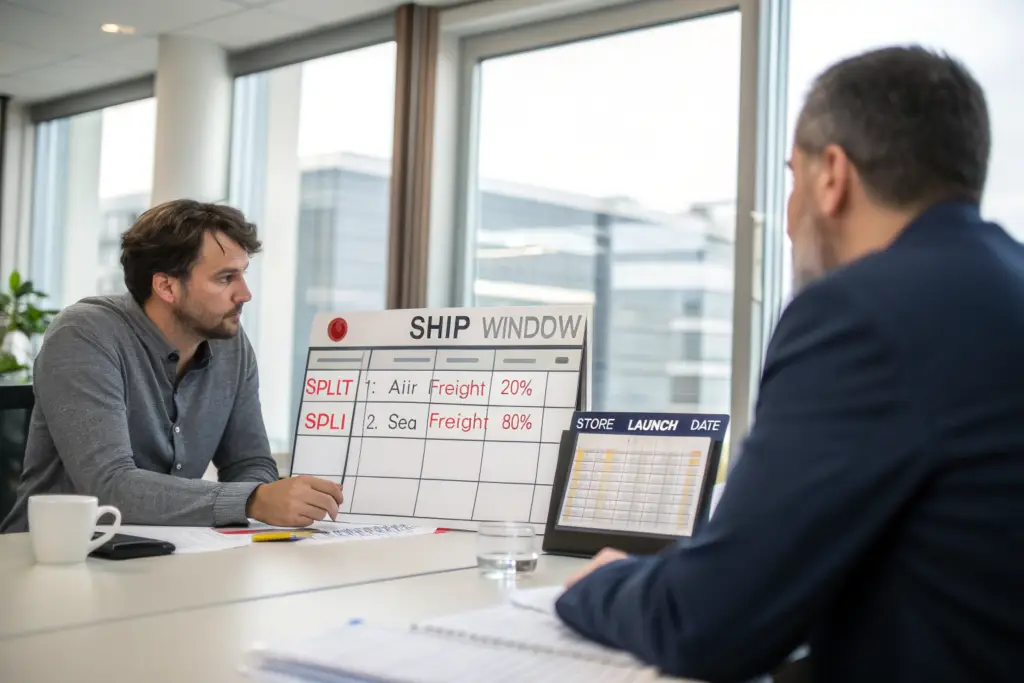
A brand owner once asked me if split shipping was worth the hassle. I told her about a customer of ours who had a $120,000 order of winter coats for a major department store. The store’s delivery window was strict: a $5,000 penalty per day for late delivery. The brand could not afford to wait for the full container to be ready. We agreed on a split shipment. We air-freighted 20% of the order, the best-selling sizes and colors, to arrive exactly on the store’s launch date. The remaining 80% came by sea three weeks later. The air freight cost an extra $4,200. The penalty for missing the launch date would have been $35,000. The split shipment was not a cost. It was an insurance policy that saved the brand $30,000 and the retail relationship.
To aggressively negotiate highly favorable split shipping terms for massive wholesale B2B orders, you must stop treating split shipping as a favor you ask from the factory and start presenting it as a mutually beneficial financial transaction. The factory benefits from split shipping because it smooths their cash flow and warehouse pressure. You negotiate aggressively by offering to pay for the "speed premium" on the first split (the air freight or fast-sea cost) in exchange for the factory absorbing the warehousing and consolidation costs on the second split. You anchor the negotiation with a specific "Flash-Replenish" ratio, typically 20/80 or 30/70, where the smaller split is the high-margin, high-urgency inventory that protects your buyer’s launch date. The key leverage point is your willingness to commit to the full order volume upfront. Factories will agree to complex logistics if the total volume is guaranteed. Split shipping is not a logistical complication. It is a cash flow and risk management strategy disguised as a delivery schedule.
Most brands accept the factory’s standard shipping terms as non-negotiable. "One order, one shipment" is presented as the only way. This is not true. Split shipping is a standard practice among sophisticated, high-volume buyers. It allows you to get fast-selling styles onto shelves while the rest of the order is in transit, dramatically reducing your inventory holding costs and your risk of missing a critical selling window. I want to share the exact negotiation framework and contractual language that will get you these terms.
How Do You Structure a “Flash-Replenish” Split to Instantly Protect Your Retail Buyer’s Launch Date?
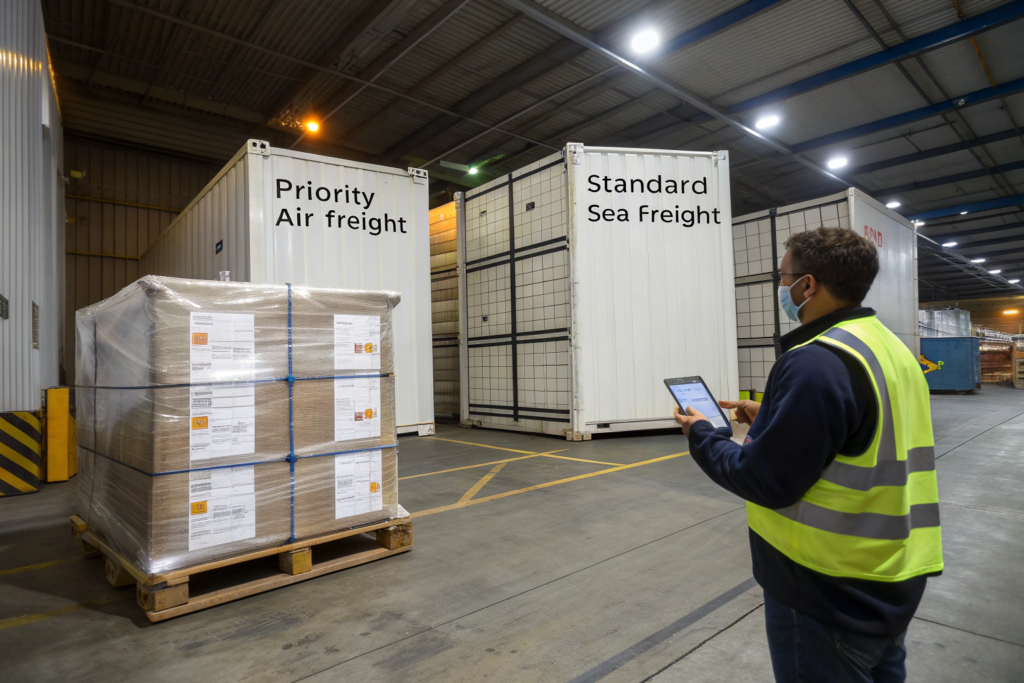
I remember a brand that launched a new collection at a major trade show. The orders were huge. The brand had promised delivery in 6 weeks. The factory’s lead time was 8 weeks. The brand was facing a breach of contract with multiple retailers. We sat down and built a "Flash-Replenish" split. We identified the 25% of the order that represented the "store opening package," the minimum inventory each retailer needed to set up their window displays and initial racks. We pulled that 25% from the production line early, quality-checked it, and air-freighted it. It arrived in week 6. The stores launched on time. The remaining 75% arrived by sea in week 10. The brand kept its promise, and the retailers never knew there was a production delay.
A Flash-Replenish split is a structured delivery strategy where a small, high-priority portion of the order is shipped by air or fast-sea to meet a hard launch date, while the remaining volume follows by standard, lower-cost sea freight. To negotiate this, you must present the factory with a "Prioritized Picking List." This list specifies the exact styles, colors, and sizes for the first split. The factory benefits because they can invoice the first split immediately, improving their cash flow. You negotiate the cost split: you pay the freight differential on the first split (because you are getting the speed benefit), and the factory absorbs the standard freight on the second split. This framework protects your retailer relationships, avoids late-delivery penalties, and keeps your total logistics cost within budget. The first split is your insurance policy. The second split is your volume margin.
The critical element is the Prioritized Picking List. If you do not specify exactly what goes in the first split, the factory will ship whatever is easiest to pack. You will receive a random assortment that does not match your retail buyers’ needs. The list must be granular: 15 units of Style A in Black, Size M; 20 units of Style B in Navy, Size L. This is the document that turns a random split into a strategic market protection tool.
How Do You Calculate the “Launch Protection” Volume That Must Be Air-Freighted?
The Launch Protection Volume is the minimum number of units each retail location needs to create a credible in-store presentation. For a boutique, this might be 6-12 units. For a department store concession, this might be 30-50 units. Multiply this by the number of retail locations, and you have your first split volume. This is not a random number. It is a calculated minimum to protect the brand’s physical retail presence. Shipping less than this volume means the store will look understocked, which damages the brand’s perceived value.
Why Should You Offer to Pay the “Freight Differential” on Split One in Exchange for the Factory Holding Your Stock for Split Two?
The factory’s primary objection to split shipping is the cost of storing the remaining inventory while the first split is in transit. You overcome this by offering to pay the air freight premium, and explicitly asking the factory to absorb the holding cost for the second split. This is a fair trade. The factory gets faster payment on the first shipment and avoids the risk of you canceling the remainder. The holding cost for a few weeks is minimal for them compared to the value of the guaranteed order volume.
What Is a “Payment Against Partial Shipment” Clause and How Does It Transform Your Cash Flow Cycle?
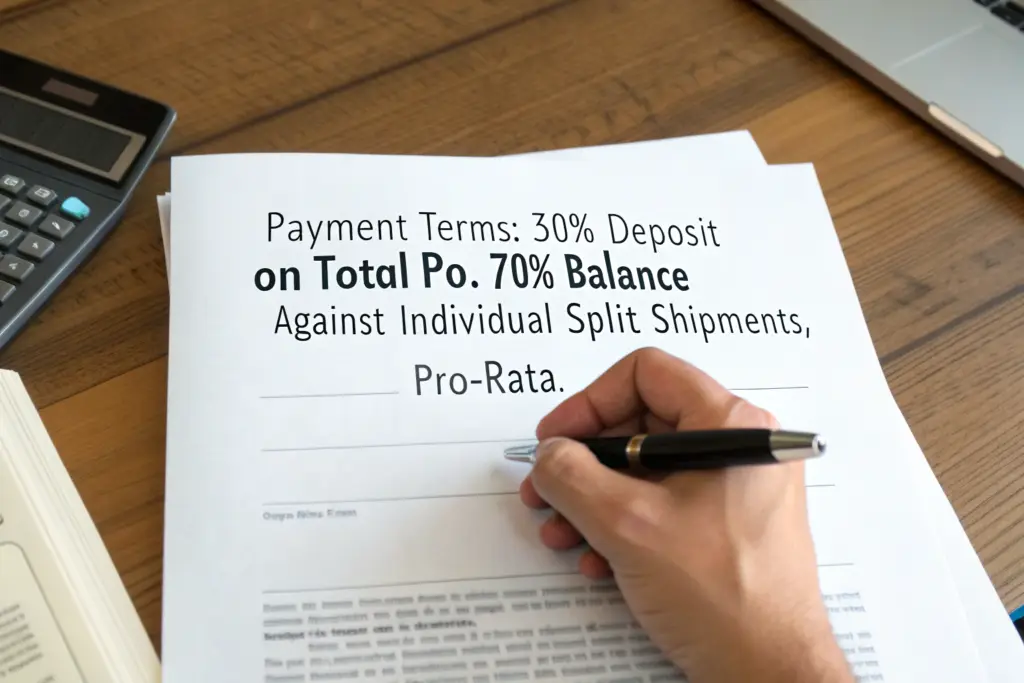
A traditional factory contract demands 30% deposit upfront and 70% balance before the entire order ships. For a $100,000 order, the brand must pay $70,000 before a single garment reaches their warehouse. With a split shipment and a Payment Against Partial Shipment clause, the brand pays 70% of the value of each split when that split ships. If the first split is 25% of the order, the brand pays only $17,500 to release those goods. The remaining $52,500 stays in the brand’s bank account, earning interest or funding marketing, for an additional three to four weeks until the second split ships. This transforms the brand’s cash flow cycle.
A Payment Against Partial Shipment clause is a contractual term that links payment to the delivery of value, not to the entire order volume. Instead of paying the full 70% balance before the first container leaves, you pay 70% of the value of each individual shipment when that shipment is ready. This means you are paying for goods only as you receive them. The factory is protected because they receive pro-rata payment for each shipment. You benefit from a dramatically improved cash conversion cycle. The cash you hold back can be used to fund the marketing campaigns that will sell the inventory. This clause is negotiated by framing it as a risk-sharing mechanism. You are committing to the full order volume, which is valuable to the factory. In exchange, you ask for payment terms that match the delivery schedule.
This clause is particularly powerful when combined with split shipping. The factory sees that you are a serious, high-volume buyer. The partial payment structure demonstrates financial sophistication. Most factories will agree once they understand that the total payment is the same; only the timing has shifted.
How Do You Word This Clause to Legally Protect Both Parties in an International Trade Contract?
The clause should read: "Buyer shall pay 30% of the total Purchase Order value as a deposit. The remaining 70% balance shall be paid on a pro-rata basis against each individual shipment. For clarity, if a shipment represents 25% of the total order value, the balance payment due prior to that shipment’s release shall be 25% of the 70% balance, not the full 70% balance. Payment shall be made against presentation of the Bill of Lading or Air Waybill for each respective shipment." This language is clear, allocates risk fairly, and is enforceable.
What Is the “Hold-Back” Strategy to Ensure the Second Split Ships Without Factory Delay?
A subtle but powerful negotiation point is to hold back a small portion of the final payment, perhaps 5%, until the second split ships. This gives the factory a financial incentive to complete and ship the remaining order on time. Without a hold-back, the factory has already received the majority of the payment and may deprioritize your second split in favor of a new client’s urgent order.
How Can You Consolidate Multiple Purchase Orders into a Single “Rolling Split” Program for the Entire Season?
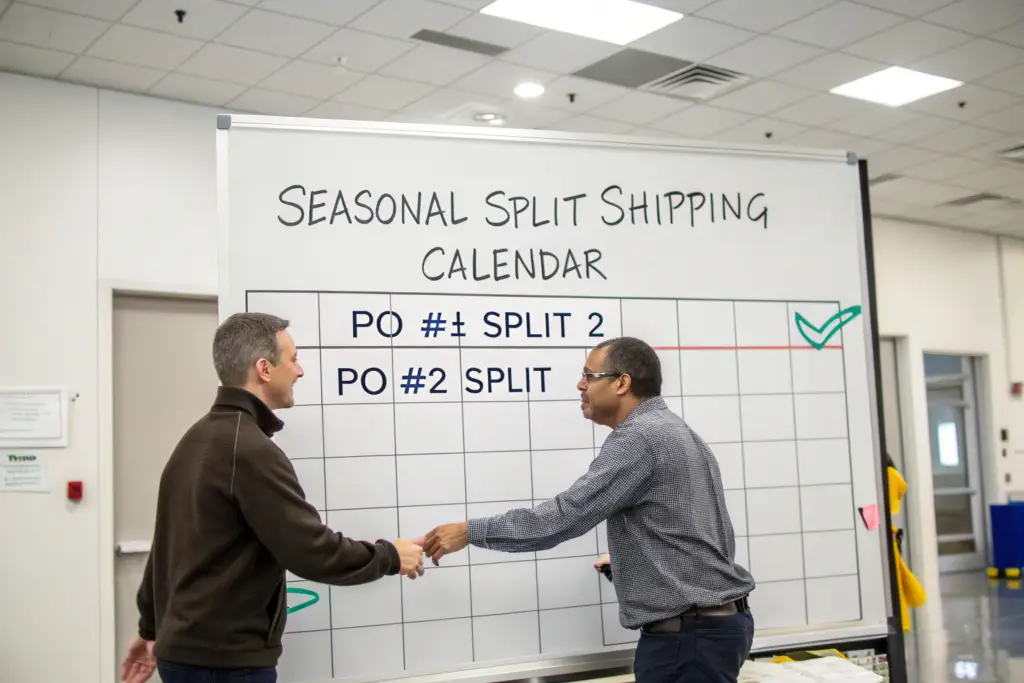
A brand owner I worked with used to place four separate purchase orders per season. Each order had its own negotiation, its own deposit, its own shipping schedule. It was chaotic. We consolidated her four orders into a single "Seasonal Split Program." She committed to the total seasonal volume upfront. We agreed on a phased delivery schedule: Split 1 in August, Split 2 in September, Split 3 in October, Split 4 in November. The deposits were consolidated. The shipping was optimized. Her administrative overhead dropped by 70%. The factory could plan its raw material purchasing and production capacity months in advance. She received priority production slots because her volume was guaranteed.
A Rolling Split Program is a seasonal contract that consolidates multiple purchase orders into a single, phased delivery agreement. The brand commits to a total seasonal volume upfront, and the factory commits to a pre-agreed split delivery schedule. This transforms the buyer-supplier relationship from a series of transactional, one-off orders into a strategic, planned partnership. The brand benefits from priority production scheduling, consolidated deposits, and significantly reduced administrative costs. The factory benefits from guaranteed capacity utilization and predictable cash flow. You negotiate this by presenting your seasonal forecast as a single, large-volume opportunity. You ask for the split shipping schedule to be built into the master production plan before the season begins. This is the most advanced form of split shipping negotiation, and it is the standard operating model for the most successful brand-factory partnerships.
The Rolling Split Program is the ultimate expression of a mature supply chain partnership. It aligns the interests of the brand and the factory completely. The brand gets the inventory flexibility they need. The factory gets the volume commitment they need. Both parties plan together, execute together, and win together.
How Do You Present a “Seasonal Volume Commitment” Letter to Anchor Aggressive Split Shipping Terms?
The letter is a simple, signed document that states: "Subject to acceptable quality and delivery terms, [Brand Name] commits to a minimum seasonal production volume of [X units / $X value] with [Factory Name] for the [Season] season." This single document changes the negotiation dynamic. You are no longer a small buyer asking for a favor. You are a strategic partner offering guaranteed business. In return, you ask for the split shipping terms that protect your business. The factory owner will weigh the guaranteed volume against the logistical complexity and will almost always accept the deal.
What Is the “Master Production Schedule” Meeting and How Does It Lock In Your Split Dates Months in Advance?
A Master Production Schedule meeting is a planning session held 90 days before the season begins. The brand owner and the factory production manager sit down with the forecast, the fabric lead times, and the retail launch dates. They agree on the specific split dates, the volume per split, and the shipping methods. These dates are written into the production contract. Once the MPS is locked, the factory’s raw material purchasing is triggered, and the production slots are reserved. The brand can plan their marketing and retail activations with certainty.
Conclusion
Aggressively negotiating favorable split shipping terms is not about squeezing the factory. It is about aligning incentives and managing risk across the entire supply chain. The Flash-Replenish split protects your retail launch date. The Payment Against Partial Shipment clause protects your cash flow. The Rolling Split Program protects your entire seasonal inventory investment.
The brand that lost $35,000 to a late delivery penalty could have protected that launch with a $4,200 air freight split. The math is simple. The execution requires preparation, a clear Prioritized Picking List, and the willingness to present the negotiation as a mutual benefit, not a demand. Factories want volume commitment. Give them that commitment, and they will give you the logistics flexibility you need to protect your brand.
At Shanghai Fumao, we regularly structure split shipments for our high-volume brand partners. We understand the financial and marketing imperatives behind the request. We offer flexible freight solutions, including air freight, fast-sea, and deferred sea consolidation. Our warehouse can hold finished goods for the second split at no additional charge for our committed partners.
If you have a large seasonal order and want to explore a split shipping strategy, we are ready to help. At Shanghai Fumao, we will work with you to build a prioritized picking list, a phased delivery schedule, and a payment plan that matches your shipments. Contact our Business Director, Elaine, at elaine@fumaoclothing.com. She can share a sample split shipping contract template and a seasonal production calendar. Let’s build a shipping strategy that protects your launch dates and your cash flow.