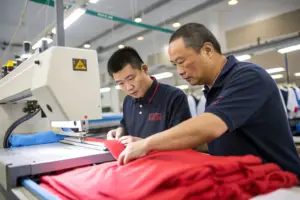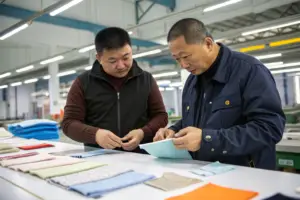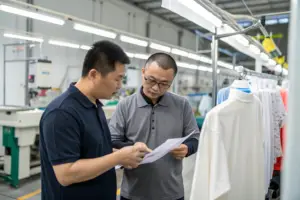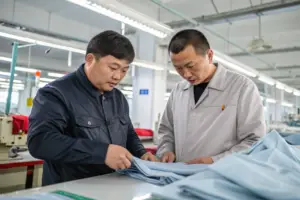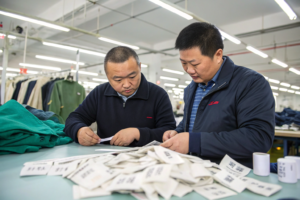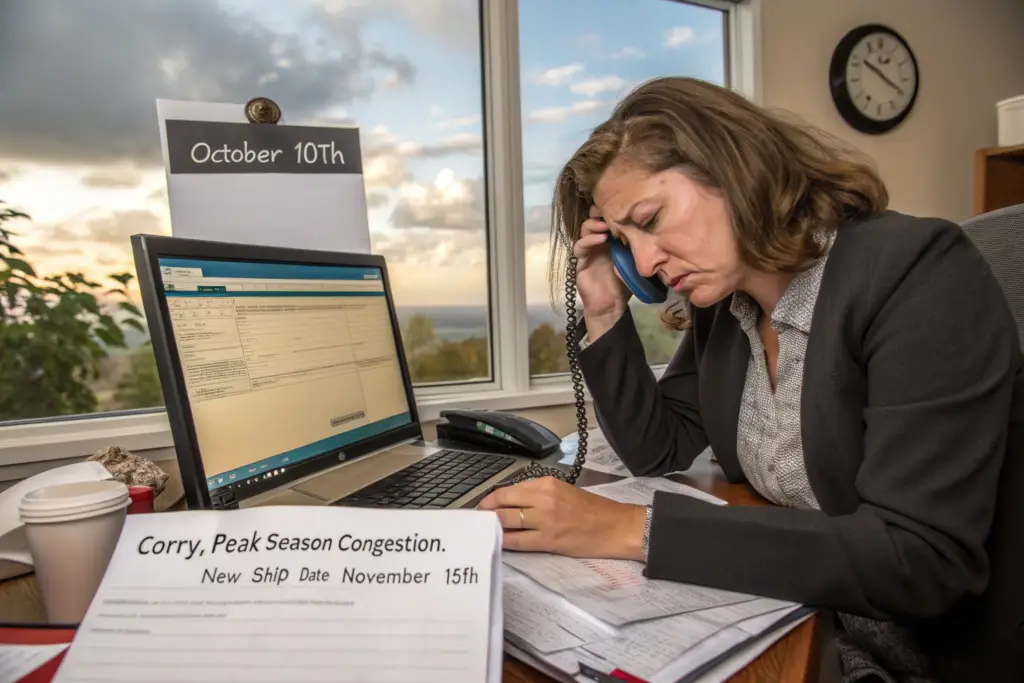
A brand owner from New York once called me on September 15th in a state of controlled panic. She had placed a 2,000-unit order for a holiday collection with her previous supplier. The confirmed ship date was October 20th. On October 10th, the supplier emailed her: "Sorry, peak season congestion. New ship date November 15th." Her holiday collection was now scheduled to arrive after Black Friday. The entire season was lost. She was calling me not just to vent, but to understand if there was any factory on earth that could actually deliver during the chaotic months of September through November. She had been burned so many times she had started to believe that "peak season delay" was an unavoidable natural disaster, like a hurricane. It is not. It is a planning failure.
Shanghai Fumao ensures on-time delivery during peak seasons through a disciplined, three-layer system: pre-season capacity locking that reserves your production slot months before the peak, a raw material pre-stocking program that eliminates supplier delays for common fabrics, and a peak-season production protocol that includes dedicated overflow lines, pre-trained temporary worker pools, and mandatory daily progress stand-up meetings. Peak season reliability is not about heroic last-minute effort. It is about engineering the bottlenecks out of the system before the pressure begins.
Peak season, typically July through October for holiday and winter collections, is when the entire global apparel supply chain is under maximum stress. Fabric mills are overloaded. Freight rates spike. Workers are in high demand. The factories that fail during this period are the ones that treat peak season as a normal period, just busier. They accept more orders than their capacity. They rely on just-in-time raw material deliveries that collapse when mills are backed up. They hire untrained temporary workers who produce inconsistent quality. Our approach is fundamentally different. We treat peak season as a distinct operational event that requires a distinct, pre-planned operational system. I want to walk you through exactly how this system works.
What Is Pre-Season Capacity Locking and Why Does It Matter?
I once asked a factory owner at a trade show how he managed peak season. He shrugged and said, "I take all the orders I can get. I sort it out later." That single sentence explained why his factory had a reputation for chronic delays. He was not managing capacity. He was gambling on it. He accepted orders based on hope, not on a calculated, hard-capped allocation of machine hours and labor. His "sort it out later" strategy meant some clients inevitably got pushed into the next month, missing their selling windows. He had accepted their deposits knowing, deep down, he did not have the real capacity to deliver.
Capacity locking is the antidote to this gambling mentality. It is a hard, mathematical limit on the volume of orders we accept for a given delivery window, based on a conservative calculation of our actual, sustainable daily output.
How Do We Calculate and Reserve Your Production Slot?
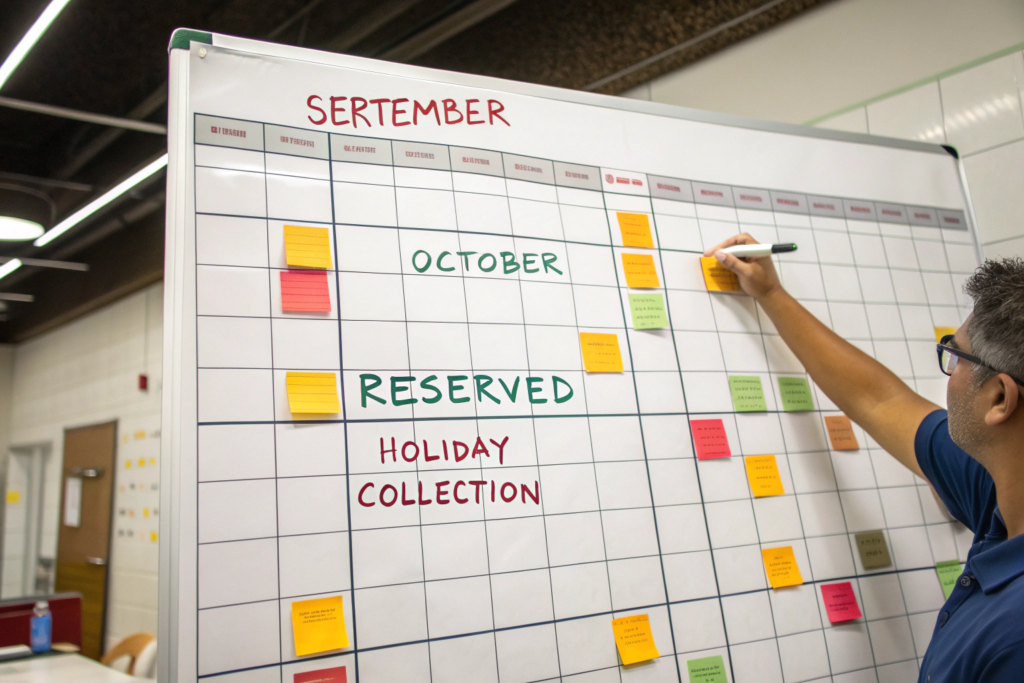
Our production planning begins with a precise, data-driven calculation of our maximum sustainable daily capacity across all five production lines, accounting for product complexity mix, not just a simple unit count.
A line producing complex woven blazers has a lower daily unit output than a line producing basic knit polos. We do not plan based on an average. We plan based on the specific product mix already committed. We use a production planning software that models the machine hours, labor hours, and specific skill sets required for each order in the pipeline. When you approach us for a peak-season order, we input your product specifications, quantity, and required delivery window into this model. The model tells us exactly how many available machine hours and skilled labor hours remain in that window. If the capacity exists, we offer you a firm production slot, confirmed with a capacity reservation agreement. If the window is full, we tell you honestly that we cannot accept the order for that delivery date. We do not accept an order and hope a slot magically opens up later. This honesty can be disappointing in the short term, but it builds long-term trust. We have had clients return to us the following season, earlier in the planning cycle, specifically because we refused to overpromise and underdeliver. The capacity planning model ensures that every order in our system has a physically possible production path. This is the foundation of peak-season reliability.
What Is a Capacity Reservation Agreement and How Does It Protect Your Dates?
A capacity reservation agreement is a formal, signed document that commits a specific production capacity to your order, even before all design details are finalized. It is a mutual commitment. We commit the machine time and labor allocation. You commit the order volume and a nominal reservation deposit.
This agreement has three critical functions during peak season. First, it removes your order from the speculative pipeline and places it into the locked production calendar. Your slot is no longer available to other clients. Second, it triggers our raw material pre-stocking process. Because we know the approximate fabric type and quantity you will need, we can begin securing greige fabric inventory from our mill partners before your final color and finish selections are made. This is a significant lead-time buffer during peak season when mills are backed up. Third, it establishes a hard deadline for your design finalization. The agreement specifies a "design freeze date," the date by which we need your final tech pack, fabric selections, and logo artwork. This discipline protects both of us. You have a clear, contractual delivery window. We have a clear, contractual requirement for timely design input. The reservation agreement transforms peak-season production from a chaotic, first-come-first-served scramble into a planned, sequenced, and resourced operation. Ask our Business Director, Elaine, about a production slot reservation for your next peak-season collection. The conversation should start months before the season, not weeks.
How Do We Pre-Stock Raw Materials to Avoid Supplier Delays?
A children's wear brand owner once told me about the moment she lost faith in her previous supplier. It was September 5th. Her production was scheduled to start September 10th. She received a one-line email: "Fabric mill delayed. New delivery October." The mill, overwhelmed with peak-season orders, had simply pushed her supplier's order to the back of the queue. The supplier had not ordered the fabric in advance. They had waited until they received her deposit, and then placed the mill order. By then, the mill's lead time had already doubled. Her production was dead before it started.
Raw material delays are the most common root cause of peak-season delivery failures. The factory that waits for the client's deposit to order fabric is already behind. The factory that pre-stocks fabric based on forecasted demand is insulated from the mill's peak-season chaos.

Which Fabrics Do We Keep in Stock for Immediate Use?
We maintain a permanent inventory of our most commonly requested, versatile fabric qualities. These are materials we have identified through years of experience as the workhorses of apparel collections, consistently specified by our diverse client base.
Our standard in-stock fabric library includes 200gsm and 260gsm cotton-spandex single jersey, 280gsm and 320gsm brushed-back French terry, 220gsm pique for polos, and a standard cotton-twill for woven bottoms. We stock these in greige form, meaning they are knitted or woven but not yet dyed. This allows color flexibility. When a peak-season order is confirmed, we can pull the required greige fabric from our warehouse immediately, send it to our partner dye house for the specific color, and have dyed fabric ready for cutting within days, not weeks. This pre-stocking eliminates the entire fabric knitting and finishing lead time from the critical path during peak season. For a client ordering 1,500 hoodies in our in-stock 320gsm French terry, the fabric is physically in our warehouse. The mill is not involved in the peak-season timeline. This is a structural speed advantage that a just-in-time-ordering factory cannot match. If your collection can be built on these in-stock fabric platforms, your peak-season delivery risk drops dramatically.
How Do We Manage the Dyeing Bottleneck During Peak Months?
Dye houses are the single most congested node in the textile supply chain during peak season. Every factory is sending them fabric for custom colors. Lead times that are normally two weeks can stretch to five or six weeks. We manage this bottleneck through a combination of advance booking, preferential partner status, and in-house color management.
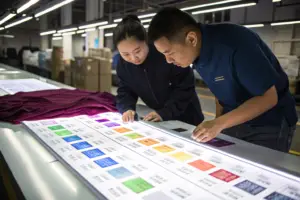
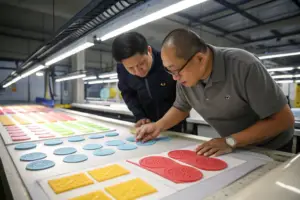
We do not send fabric to the dye house only when an order is ready. We book dye house capacity in advance, based on our forecasted peak-season volume. We have long-standing partnerships with specific, high-quality dye houses that prioritize our orders because of our consistent, high-volume business and our reputation for precise, ready-to-process submissions. We also reduce the dye house's workload and rework rate through our in-house color management. We do not send a vague "navy blue" request. We send a precise digital color standard, a spectral data file from our spectrophotometer, and a physical lab dip swatch that has already been approved by the client. The dye house is executing a precise, documented target, not interpreting a subjective description. This precision reduces the likelihood of a rejected dye lot and a re-dye, which is a major source of peak-season delay. For clients using our in-stock greige fabrics, the dyeing process is often the only raw material lead time component. By pre-booking capacity and submitting precise, approval-ready color specifications, we compress this lead time to its absolute minimum. The dye house management strategy is a critical, often invisible, component of peak-season reliability.
What Internal Protocols Keep Production on Track During High Demand?
A production manager who joined us from another factory once told me about the difference he observed in his first peak season with us. At his previous factory, peak season was a blur of shouting, overtime, and frantic firefighting. Problems were discovered at the end of the day, or the end of the week, when it was too late to recover. At Shanghai Fumao, he was surprised by the calm. The pace was intense, but the rhythm was controlled. The difference, he realized, was the daily stand-up meeting and the real-time production tracking system. Problems were surfaced at 9:15 a.m., not 6:00 p.m.
Internal protocols during peak season are designed to create a short feedback loop between plan and reality. The goal is to detect a deviation within hours, not days, and to correct it before it compounds into a delay.
What Is a Daily Production Stand-Up and How Does It Catch Delays?
Every morning at 8:45 a.m., during peak season, each production line holds a 15-minute stand-up meeting. The line supervisor, the QC inspector for that line, the cutting room representative, and the production planner attend. No chairs. The standing posture keeps the meeting focused and brief.
The team reviews three data points. First, yesterday's actual output versus the daily target. A shortfall of even 5% is discussed. Was there a machine breakdown? A fabric quality issue? An absenteeism spike? Second, today's target and any special instructions. Is there a style changeover? A specific quality focus area based on yesterday's inspection data? Third, a forward look at the next 48 hours. Are all required trims in stock for the next cutting lay? Is the embroidery station prepared for a complex logo run? Any issue that threatens the daily output target is assigned an owner and a resolution deadline within the meeting. It is not deferred to a weekly review. For a recent peak-season order of corporate uniforms, the stand-up identified that the automated pocket-setting machine had a 0.5mm alignment drift, causing pockets to be placed inconsistently. The issue was caught on a Wednesday morning, affecting 120 units sewn the previous afternoon. The machine was recalibrated by 10 a.m. The 120 affected units were reworked by noon. Without the daily stand-up, the drift might have continued for three days, affecting 600 units and requiring a massive, schedule-disrupting rework effort. The daily stand-up meeting is our primary early-warning system.
How Do We Scale Our Workforce Without Sacrificing Quality?
Peak season requires a larger workforce. The standard industry approach is to hire temporary workers, give them minimal training, and accept a higher defect rate as the cost of volume. Our approach is different. We have a pre-trained, "warm" temporary workforce.
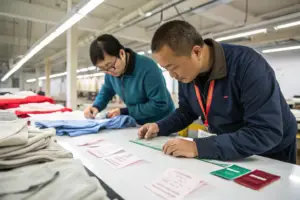
We maintain a pool of trained workers who are on retainer for peak-season periods. These are individuals who have worked with us in previous peak seasons, who know our quality standards, our production systems, and our specific machinery. They are not cold hires. They are recalled, experienced team members. We also have a dedicated training line that operates during the off-peak months. New hires are trained on standard operations, quality expectations, and our specific production methods during the slower period. When peak season arrives, these trained workers are integrated into the main production lines with minimal disruption. For specialized operations like embroidery or complex seam construction, we only use our permanent, senior operators. The temporary workers handle simpler, standardized tasks under the supervision of experienced line leaders. We also increase our in-process QC inspection frequency during peak season. An inspector who normally checks every 50 units will check every 30 units during peak periods. This increased sampling rate catches any quality drift caused by the faster pace before it affects a large quantity of goods. The seasonal workforce management model ensures that peak-season volume does not trigger a peak in defect rates.
How Do We Plan Logistics Differently for Peak Season?
I remember a conversation with a freight forwarder during the post-pandemic shipping crisis. He told me, "There are two types of clients during peak season. The ones who book space three weeks in advance and pay a fair rate. And the ones who call me five days before their goods are ready and pay triple the rate, if they can find space at all. The first group gets their goods on the water. The second group gets to explain delays to their customers." That conversation crystallized our logistics philosophy. In peak season, shipping capacity is a scarce, expensive resource that must be secured in advance, just like production capacity.
Peak-season logistics planning is not a downstream afterthought. It is an integral part of the production timeline, planned and booked concurrently with the cutting and sewing schedule.
Do You Pre-Book Freight Capacity for the Holiday Rush?
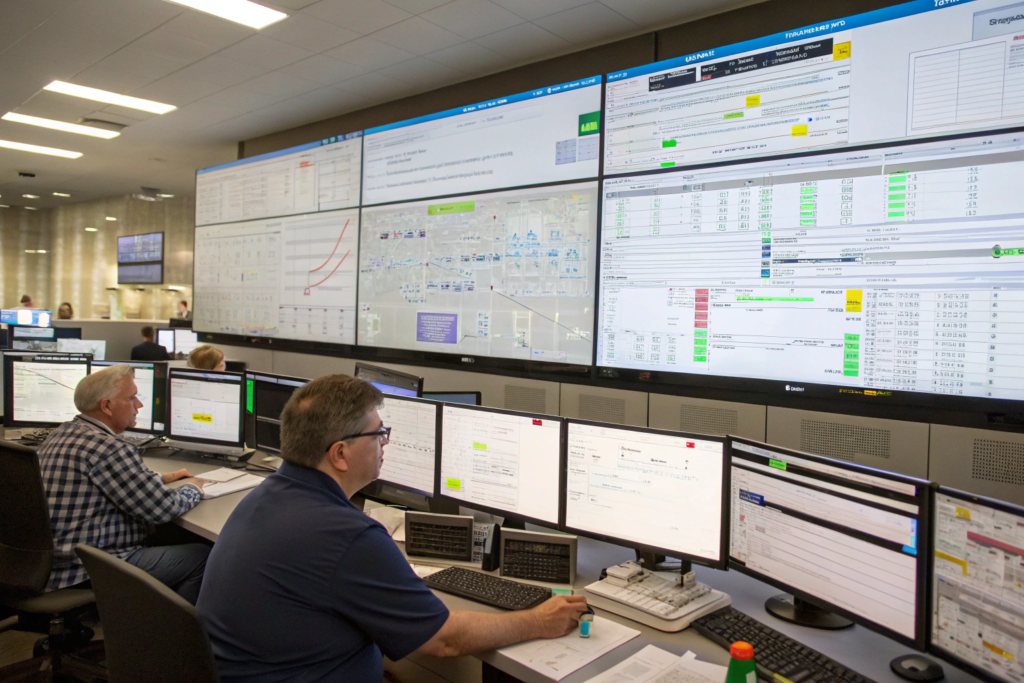
Yes. As soon as a peak-season production slot is confirmed, our logistics team calculates the estimated cargo-ready date and pre-books freight capacity with our shipping partners. This is a hard reservation of container space or air freight pallet position.
For sea freight, we pre-book space on specific vessels, with specific departure dates, for the estimated volume. This pre-booking gives us rate stability and guaranteed space, even when the spot market is chaotic and overbooked. For clients with pre-agreed air freight contingency plans, we also pre-alert our air freight partners of the potential volume, ensuring priority loading if the acceleration option is triggered. This forward booking discipline means that when a client's goods are packed and ready, the container is already waiting. The truck to the port is scheduled. The customs documentation is pre-filed electronically. The goods move from our packing station to the vessel on a planned, scheduled, and confirmed path. There is no gap, no waiting for space, no sitting in a warehouse accumulating dust and demurrage risk. This freight pre-booking strategy is a simple, disciplined practice, but it is shocking how many factories delay freight booking until the goods are physically packed, by which time peak-season space has evaporated.
What Contingency Plans Exist If a Port Is Congested?
Port congestion, particularly at major US West Coast ports, is a well-documented peak-season risk. We do not treat it as an unforeseeable surprise. We plan for it with pre-agreed routing alternatives and escalation triggers.
For US-bound orders, we discuss the port of entry strategy with the client during the order planning phase. We have the option to route through Los Angeles/Long Beach, the standard route, but also through alternative ports like Oakland, Seattle, or even East Coast ports via the Panama Canal, depending on the final delivery address. We monitor port congestion indices and shipping line schedules continuously during peak season. If our primary port is experiencing berthing delays exceeding 48 hours, we present the client with the alternative routing option, the cost difference, and the revised delivery estimate. The decision is the client's, but the analysis and the option are pre-prepared. We also have a pre-negotiated agreement with our freight forwarder for priority container unloading and drayage, meaning our containers are moved off the terminal and onto a truck faster than non-priority cargo. This minimizes the demurrage risk even at a congested port. The port congestion contingency plan is a standard component of our peak-season logistics management. It is discussed and documented before the goods leave our factory, not improvised while a container sits stranded on a dock.
Conclusion
On-time delivery during peak season is not a stroke of luck or a superhuman effort. It is the logical outcome of a system designed to anticipate and neutralize the specific, predictable bottlenecks of the busiest months of the year. We lock production capacity based on a conservative, calculated maximum, refusing to overbook. We pre-stock standard greige fabrics and pre-book dye house capacity to decouple our raw material supply from the overwhelmed mill market. We run daily stand-up meetings and deploy a pre-trained, recalled workforce to maintain quality and pace without the chaos of cold hiring. And we pre-book freight capacity with pre-agreed port contingency plans, ensuring the goods move from our floor to your door on a secured, scheduled path. Peak season is a stress test of a factory's entire management system. A factory that fails the test was never in control.
If you have been burned by peak-season delays in the past and are looking for a manufacturing partner who treats the holiday rush as an engineering challenge, not a recurring nightmare, I invite you to start planning early. Contact our Business Director, Elaine, at elaine@fumaoclothing.com. Even if your designs are not yet finalized, she can discuss capacity reservation for your delivery window, our in-stock fabric options, and our peak-season logistics plan. Secure your spot in our production calendar before it fills. Let us show you what a planned, calm, and on-time peak season actually feels like.