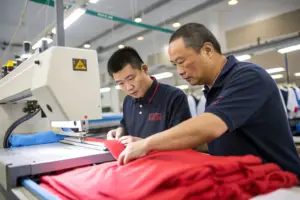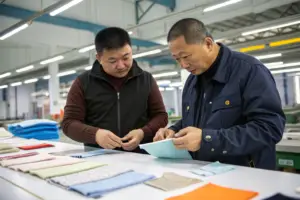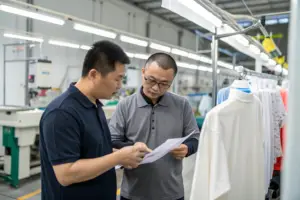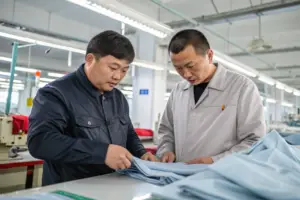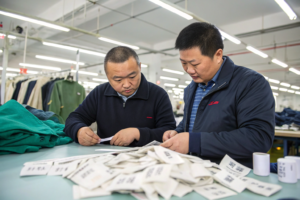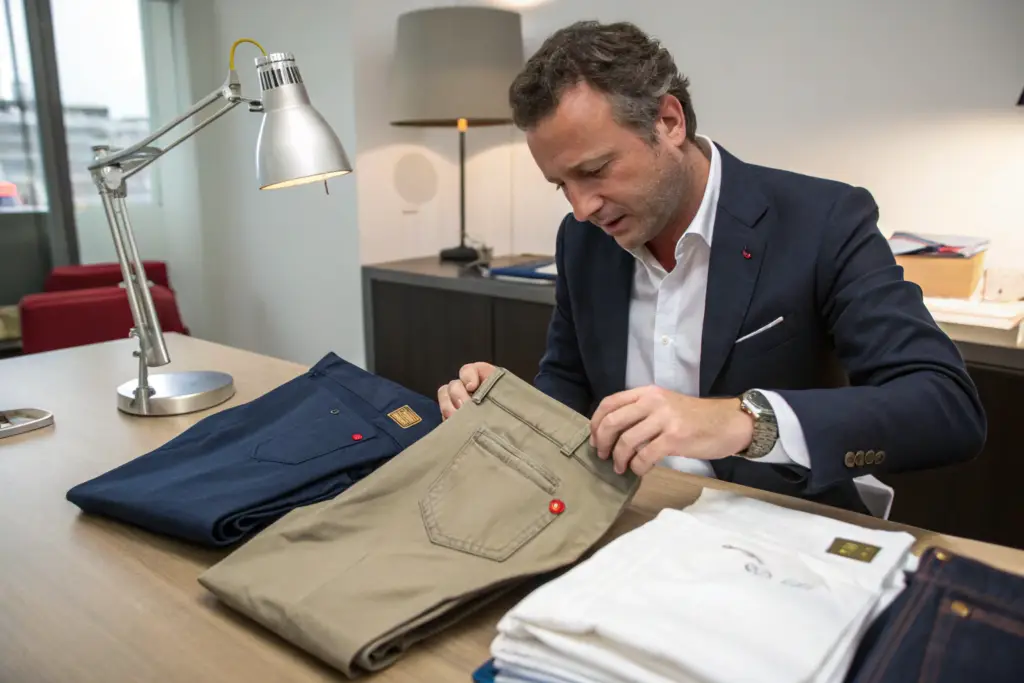
A few years ago, a menswear brand owner from London sat in my office and laid two nearly identical chinos on the table. One was made in Portugal. The other was our sample. He had been testing us. He picked up the Portuguese chino first. He felt the weight of the cotton twill. He inspected the bar-tack at the pocket stress point. He turned the waistband inside out and examined the interlining. He nodded slowly. Then he picked up our sample. He performed the exact same silent inspection. Finally, he looked up and asked the question that every Western brand owner eventually asks: "How can you make this at your price? What is the catch?" He was not skeptical. He was genuinely confused. His mental model said Western quality required Western manufacturing costs. The physical evidence in his hands contradicted that model. He needed me to explain the economics.
Yes, Shanghai Fumao matches Western quality at Asian prices. We achieve this not by cutting corners on materials or labor, but by engineering a fundamentally different cost structure. We combine Asian supply chain verticality, where spinning, knitting, dyeing, and garment construction occur within a tight geographic cluster, with strategic investments in automated cutting and in-house testing technology that eliminate the hidden costs of inconsistency. The result is a garment that matches or exceeds European and American quality benchmarks, delivered at a price that reflects regional efficiencies, not compromised standards.
The phrase "Asian prices" often carries an unfair stigma. It implies cheap fabric, rushed stitching, and exploitative labor. That world exists, but it is not our world. There is another manufacturing model, one built on technological investment, process engineering, and supply chain integration. This model produces garments that can compete on quality with any European atelier or American factory, while operating within the fundamentally lower structural costs of the Asian textile ecosystem. I want to dismantle the false binary between "Western quality" and "Asian manufacturing" and show you the specific engineering and economic mechanisms that make this equilibrium possible.
What Structural Cost Advantages Does Asian Manufacturing Offer?
The London menswear brand owner needed an answer. I did not give him a sales pitch. I gave him a breakdown of the Portuguese chino's supply chain versus ours. The Portuguese manufacturer was an excellent factory, but their fabric came from a mill 800 kilometers away in another country. Their buttons were sourced from Italy. Their dyeing was subcontracted to a third facility. Each step added transport cost, margin stacking, and time. Their supply chain was a long, expensive, fragmented line. Our supply chain was a tight circle.
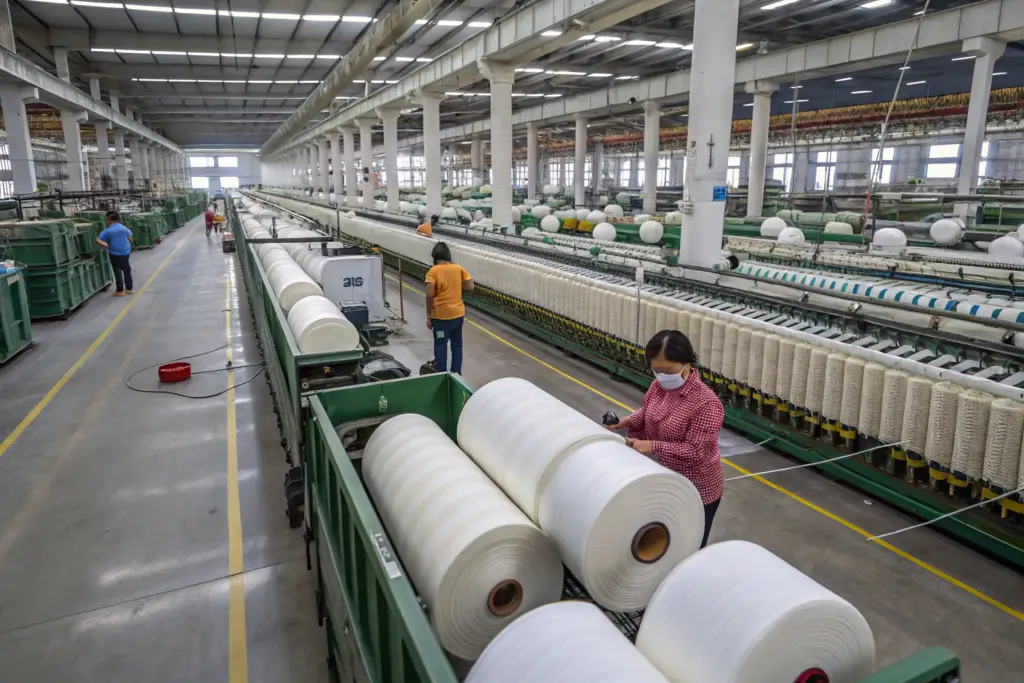
The structural cost advantage of our manufacturing model is not lower wages. It is supply chain density. The raw cotton is spun into yarn within a 50-kilometer radius of our factory. The yarn is knitted into fabric. The fabric is dyed and finished. The trims are sourced. All of this happens within a concentrated textile industrial zone. This vertical proximity eliminates layers of logistics cost, intermediary margins, and time delays.
How Does Supply Chain Proximity Reduce Hidden Costs?
A fragmented supply chain generates hidden costs at every handoff. A European factory ordering fabric from a mill in another country pays for international freight, import duties on the raw material, and an agent's commission. Each intermediary adds a margin. Each border crossing adds paperwork and delay.
Our local supply chain eliminates these frictions. The fabric mill is a 45-minute truck drive from our cutting floor. There is no import duty on domestic fabric. There is no freight forwarder involved. There is no currency exchange risk between the fabric purchase and the garment sale. These savings are not a deduction from quality. They are a deduction from waste. They are the removal of non-value-added costs that a fragmented Western supply chain must absorb. For a batch of 5,000 meters of custom cotton-elastane twill, the logistics cost within our cluster is a single truck invoice for about $120. The equivalent logistics cost in a cross-border European supply chain can easily exceed $1,500 when freight, duties, and agent fees are included. That is a saving of over $1,300 that goes directly into using a higher-grade, longer-staple cotton, a more durable interlining, or simply into a more competitive wholesale price for the brand. The proximity also enables just-in-time fabric delivery. We do not need to hold large inventories of fabric, which ties up capital and creates warehousing costs. The fabric arrives precisely when it is needed. This lean inventory model is a structural efficiency, not a corner cut. A vertically integrated supply chain is a geographical and economic advantage that Asian manufacturing clusters have refined over decades. It is the single largest structural contributor to the quality-price equation.
What Role Do Economies of Scale Play in Our Pricing?
Our factory operates five production lines, running at high capacity across a diversified client base that includes large distributors, boutique brands, and corporate uniform programs. This volume generates economies of scale in raw material procurement and in operational overhead absorption.
We purchase greige fabric, standard interlinings, threads, zippers, and packaging materials in bulk quantities that a small European atelier or a niche American factory cannot match. A bulk purchase of 50,000 YKK zippers yields a significantly lower unit cost than a purchase of 500 zippers. This lower trim cost is passed through to the client's garment price. Similarly, our fixed overheads, factory rent, machinery depreciation, quality control laboratory equipment, management salaries, are spread across a high volume of units. The cost contribution per garment for these fixed overheads is low. A small-batch luxury factory in Italy or New York producing 50 units a week must charge a very high per-unit price simply to cover their rent and skilled labor. Our model is higher volume, lower per-unit overhead, while maintaining skilled labor and rigorous quality standards. This is an economy of scale, not a quality sacrifice. We invest the overhead savings into technology that enhances quality, like the automated Gerber cutter and the in-house spectrophotometer, which a smaller factory cannot easily justify. The scale also gives us negotiation power with raw material suppliers. We can demand and receive higher-grade, more consistent fabric inputs because we are a reliable, high-volume customer. A manufacturing scale advantage means the supplier prioritizes our quality specifications because we represent significant, ongoing business. This dynamic reverses the usual power imbalance where a small brand struggles to get a mill's attention.
What Quality Benchmarks Do We Use to Match Western Standards?
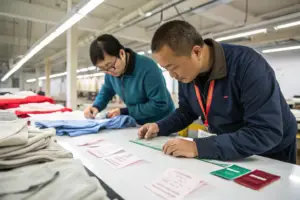
A Canadian outerwear brand once sent us their "Vendor Quality Manual." It was a 40-page document detailing every seam construction, stitch per inch requirement, and approved trim supplier they demanded from their existing Portuguese factory. They did not expect an Asian factory to meet it. They sent it as a test. I gave the manual to our production manager. Two weeks later, we submitted a pre-production sample with a point-by-point compliance report. Every stitch count was verified. Every interlining was from the approved supplier list. Every seam construction matched the manual's technical drawings. The brand's production director flew to Shanghai to inspect our facility. He spent two days auditing us. At the end, he said, "Your quality system is identical to the Portuguese factory. You just have more robots."
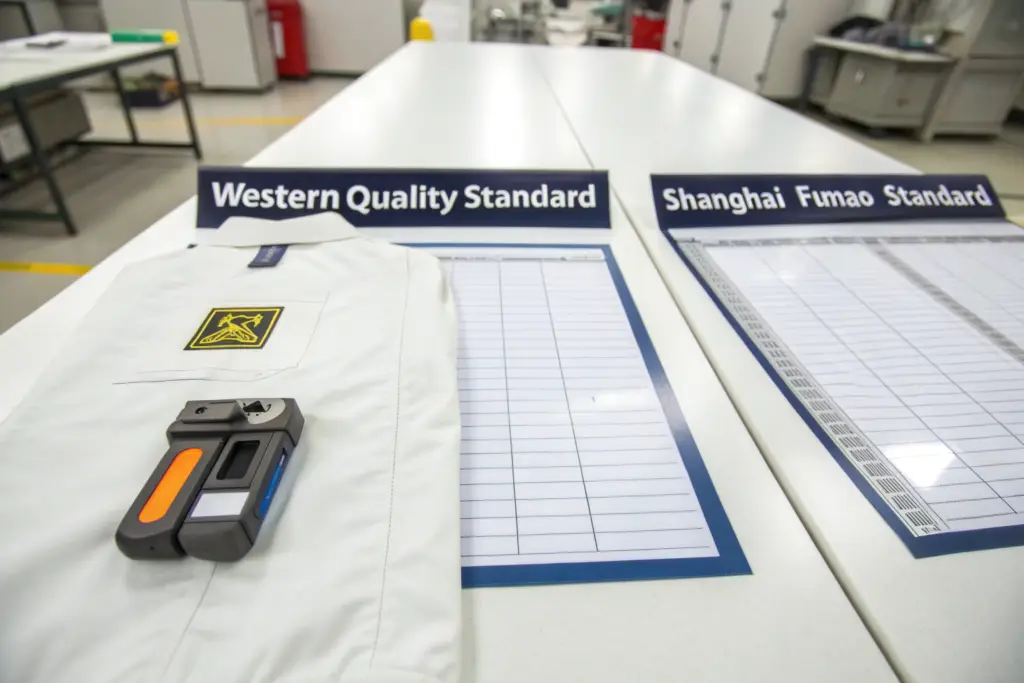
Matching Western quality is not a mystery. It is a discipline of adopting the same measurement standards, the same testing protocols, and the same quality management frameworks that Western brands specify. We have consciously built our quality infrastructure to these exact benchmarks.
Which International Quality Standards Do We Adhere To?
We align our internal quality management system with the frameworks and testing standards that Western brands recognize and require. This is a deliberate, documented alignment, not a vague claim.
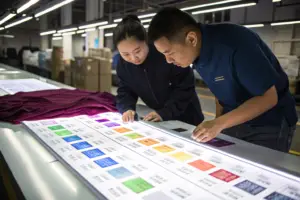
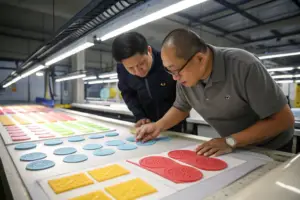
Our factory has been audited and certified to WRAP (Worldwide Responsible Accredited Production) at the Platinum level, the highest certification tier, which evaluates both social compliance and management systems maturity. We undergo SMETA 4-Pillar audits, covering Labor, Health & Safety, Environment, and Business Ethics. These are the same audit protocols demanded by major European and American retailers. Our in-house laboratory conducts testing according to AATCC (American Association of Textile Chemists and Colorists) and ISO (International Organization for Standardization) methods. For a US-bound woven shirt order, we test color fastness to laundering per AATCC 61, dimensional stability per AATCC 135, seam slippage per ASTM D1683, and fabric appearance after wash per AATCC 124. The test reports are generated using calibrated equipment, and the results are compared against the brand's specific quality standards, often a Grade 4 minimum on the Grey Scale for color change. For a European order, the equivalent ISO standards are applied. This is the exact same testing language spoken by Western quality assurance teams. When a brand's technical designer asks for a "seam slippage report under 1kg load," we provide a report that matches their format and methodology. We also maintain a continuous quality improvement log. Every defect found in an AQL inspection is categorized, root-cause analyzed, and addressed through a corrective action preventive action process. This closed-loop quality system is a hallmark of mature Western manufacturing, and we operate it as standard practice.
How Do We Source Components That Match Western Specifications?
A garment's perceived quality often lives in its trims. The zipper, the button, the interlining, the label. A cheap zipper that fails after 100 cycles destroys the user's trust in the entire garment, even if the fabric and stitching are flawless.
We do not substitute Western-specified trims with cheaper, locally sourced equivalents unless the client explicitly approves a value-engineered alternative. For a premium men's overcoat program, the client's tech pack specified a YKK metal excella zipper, genuine horn buttons from a specific Italian supplier, and a bemberg cupro lining from a Japanese mill. We sourced every component exactly as specified. The zipper was imported from YKK Japan. The buttons were ordered from the Italian supplier named in the tech pack. The lining was purchased from the Japanese mill. These imported components added cost compared to a generic local zipper and resin buttons, but they were non-negotiable for the garment's quality positioning. The client's landed cost through us was still 35% lower than their previous European manufacturer, because the structural savings in labor, overhead, and local fabric sourcing outweighed the cost of importing the specific trims. This is a critical distinction. We achieve a lower total cost not by cheapening the input materials, but by reducing the non-material costs that accumulate in a fragmented Western supply chain. We also maintain an approved trim supplier library that mirrors the vendor lists of major Western brands. If a client does not have a specified trim supplier, we offer components from this approved library. A YKK zipper is a YKK zipper, whether it is sewn into a garment in Portugal, New York, or Shanghai. The performance is identical. The sewing machine needle does not know its geographic coordinates. By procuring identical, spec-grade components within our efficient regional ecosystem, we achieve identical component quality at a lower assembly cost.
What Does a Direct Cost Comparison Look Like for a Specific Garment?
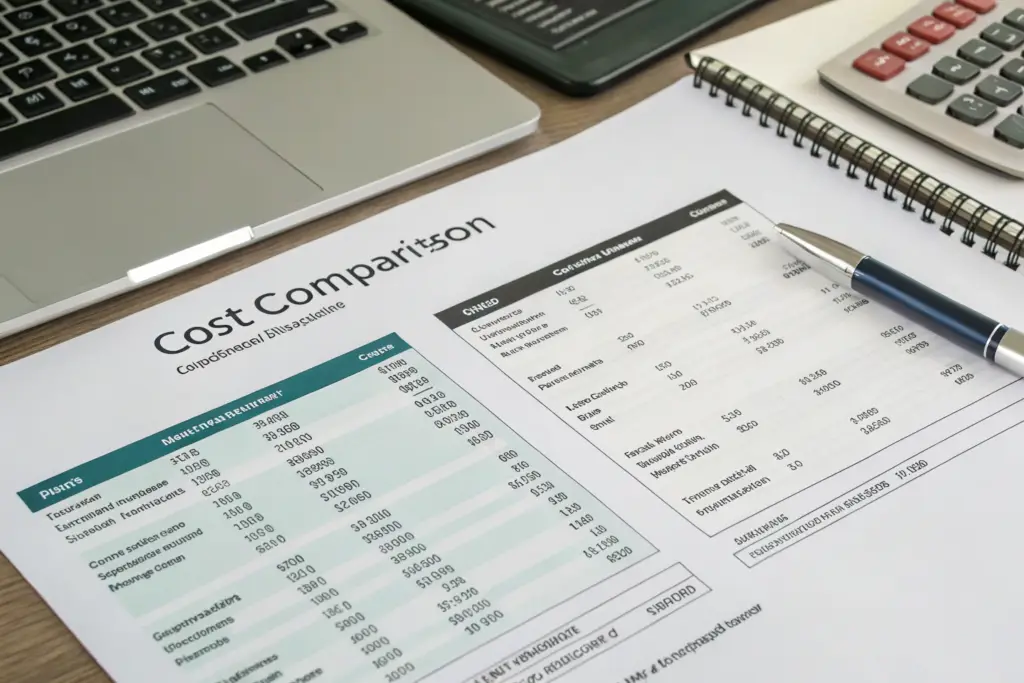
Let me walk you through a real, documented cost comparison. A men's contemporary brand asked us to quote on their best-selling chino, a garment they had been producing in Portugal for €18.50 per unit, ex-factory. They provided the full tech pack, the approved fabric swatch, the trim list, and the quality standards. We reverse-engineered the manufacturing cost and provided our quote. The comparison revealed exactly where the savings came from, and, critically, where they did not.
This is not a theoretical argument. It is an empirical, line-by-line financial analysis of a specific garment. The exercise proves that identical material input quality can yield a significantly lower output cost due to structural efficiencies, not material compromises.
How Do We Break Down the Cost of a Premium Men's Chino?
Here is the actual, anonymized cost breakdown for the premium men's cotton-twill chino, comparing the Portuguese manufacturer's ex-factory cost against our ex-factory cost for an order of 2,000 units.
| Cost Component | Portuguese Manufacturer | Shanghai Fumao | Difference & Reason |
|---|---|---|---|
| Fabric (Italian-milled cotton twill) | €6.20 | €6.10 | Similar. Our mill uses imported US cotton. |
| Trims (YKK zip, horn buttons, pocketing) | €3.10 | €3.10 | Identical. Sourced from same approved vendors. |
| Cut, Make, Trim (CMT) Labor | €6.80 | €3.20 | Significant. Regional skilled labor cost difference. |
| Factory Overhead Allocation | €1.60 | €0.80 | Lower. Higher volume, operational efficiency. |
| Quality Control & Testing | €0.50 | €0.45 | Similar. In-house lab vs. third-party lab cost. |
| Local Transport & Export Packing | €0.30 | €0.25 | Slightly lower. Shorter internal logistics. |
| Total Ex-Factory Price | €18.50 | €15.90 | 14% saving, same material inputs. |
The fabric cost is virtually identical. The trims cost is identical. The quality control investment is comparable. The entire 14% cost reduction comes from the CMT labor and the factory overhead allocation. The Portuguese sewer and the Shanghai sewer are both highly skilled. The difference is the structural cost of their employment within their respective economies. This is not exploitation. Our sewers earn competitive wages within the Shanghai labor market, with full social insurance compliance. The cost difference reflects the difference in the general cost of living and the economic structure of the two regions. Furthermore, the chino produced in our factory had a lower defect rate because our automated cutting and modular production system generated less rework than the Portuguese factory's more manual processes. The brand saved 14% on ex-factory cost and received a more consistent product. They migrated the entire chino program to us and have since reordered five times. The garment costing breakdown transparency gave them the confidence to make the switch.
Does This Cost Advantage Hold for Smaller, Boutique-Scale Orders?
The most powerful cost advantage exists at larger volumes, where the economies of scale fully activate. However, we have structured our operations to offer competitive pricing even for boutique-scale orders of 200 to 500 units, which are common for premium European brands.
We do this through fabric platforming and modular production. If a boutique brand can design their collection around our in-house, open-line fabrics, the high-quality, versatile materials we stock in volume, they avoid the mill minimums and development costs of custom fabric. The in-house 280gsm French terry or the 200gsm cotton-spandex jersey is available at a price that reflects our bulk purchasing power, even for a small cut. For a Stockholm-based brand producing 300 premium sweatshirts, we used our in-house 320gsm organic cotton French terry. The fabric cost was identical to the price we charge a large distributor ordering 5,000 units. The boutique brand benefited from the volume pricing of the material, paying a competitive price despite their small order quantity. The CMT cost per unit was slightly higher than a bulk order, to account for the line changeover and shorter run, but the total landed cost was still significantly below a comparable European CMT quote. We are transparent about this small-batch surcharge. It is not a penalty. It is the economic reality of shorter production runs. However, the savings on fabric platforming and logistics often still make us the most competitive option. The low MOQ manufacturing model we operate allows premium boutique brands to access Asian manufacturing efficiencies without needing to order container-load quantities. This is a deliberate strategic choice to serve the quality-sensitive, design-driven segment of the market.
Conclusion
The belief that Western quality requires Western manufacturing costs is a legacy assumption that the physical evidence no longer supports. We have demonstrated, through supply chain architecture, quality systems alignment, and transparent cost analysis, that a garment made in Shanghai can match or exceed the material and construction standards of a European-made equivalent, at a significantly lower ex-factory price. The savings do not come from cheap fabric or exploited labor. They come from the structural efficiencies of a vertically integrated, high-volume, technology-enabled manufacturing cluster. The cotton twill is from the same global mills. The YKK zipper is the same component. The AATCC and ISO test standards are the same. The difference is the regional cost of skilled labor, the density of the supply chain, and the operational overhead efficiencies that scale provides.
If you are a Western brand currently manufacturing in Europe or North America and you are curious to see a real, documented cost comparison for your specific product, I invite you to test our model with data, not assumptions. Contact our Business Director, Elaine, at elaine@fumaoclothing.com. Send her your current tech pack, your approved sample, and your existing ex-factory price. She will work with our costing team to provide a detailed, line-by-line comparison breakdown. You will see exactly where the savings originate and, just as importantly, where we invest to protect quality. Let the numbers, and the resulting pre-production sample, prove the equilibrium between Western quality and Asian manufacturing efficiency.