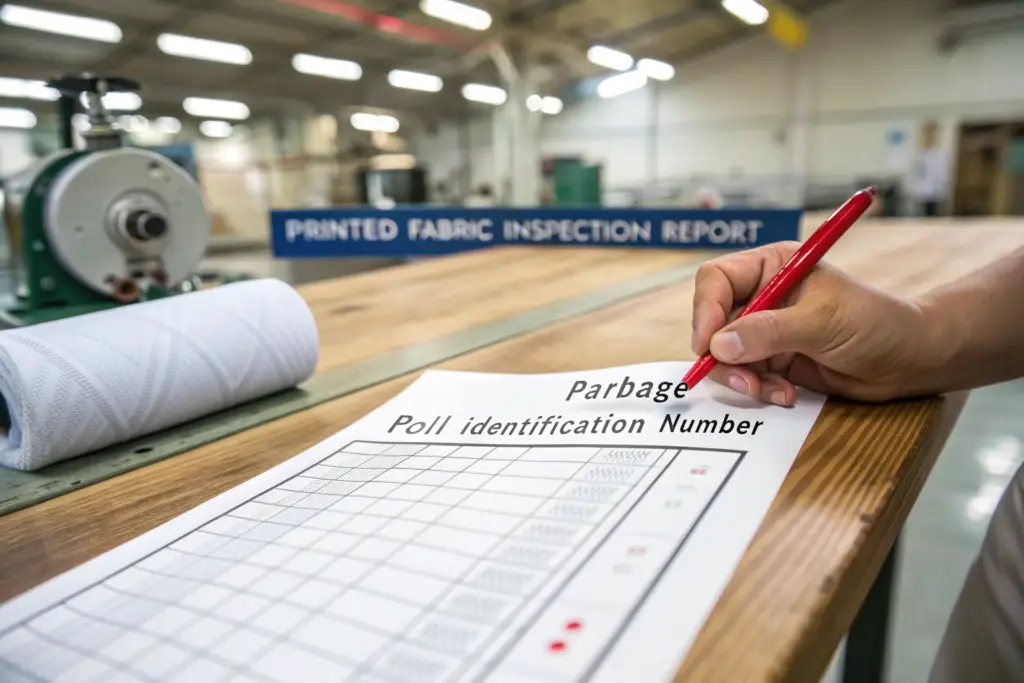
A brand owner I work with once approved a fabric lot based on a single sentence from his supplier. The supplier’s email read: "Quality is good, no major issues." The brand owner took that as clearance to cut 2,000 meters of cotton shirting. Three weeks later, the finished shirts started coming off the sewing line with random holes. Not large holes. Pinhead-sized holes that only appeared when the fabric was stretched over a collar stand. The holes were invisible on the inspection table. The fabric had been inspected, but the inspection had been visual only. No mechanical stretch test. No lightbox examination. The "no major issues" report was not a lie. It was simply incomplete. The brand owner lost $6,400 in fabric, labor, and lost production time because he did not know how to read the report he never actually received.
You correctly read and fully interpret a fabric inspection report by understanding the four key sections that every professional report must contain: the identification header that verifies the roll matches your purchase order, the four-point system scoring table that quantifies defect severity, the defect map that shows where specific flaws are located on the roll, and the mechanical test results that verify shrinkage, colorfastness, and tensile strength against your specifications. A report that contains only a pass or fail grade without the underlying data is not a real inspection. It is an opinion. You need the data to make a risk-based decision: accept the lot, reject the lot, or accept with a penalty discount for the defective yardage. The inspection report is a decision-making tool. Read it correctly, and it protects your production from fabric that will fail in the sewing line or on the retail floor. Read it incorrectly, or do not read it at all, and you are gambling with your brand’s quality and your company’s cash.
Most brand owners treat fabric inspection reports as a formality. They glance at the pass or fail grade and file the document. This is a mistake. The report contains information that can save a production run, negotiate a discount, or identify a systemic supplier problem before it affects multiple orders. I want to share exactly how we structure our fabric inspection reports at Shanghai Fumao, how we train our brand partners to read them, and how you can use this knowledge to protect your own production.
What Are the Four Critical Sections of a Professional Fabric Inspection Report?
A brand owner once showed me the inspection report his previous factory had provided. It was a single page. It had the roll number, a column of numbers, and the word "PASS" in green letters at the bottom. That was the entire report. No defect descriptions. No defect locations. No mechanical test data. No comparison to the approved standard. The report was not a quality document. It was a marketing document designed to reassure the brand owner without providing any actual information. A professional fabric inspection report looks completely different. It is typically four to six pages. It contains specific data in standardized formats. Every number on the page corresponds to a physical measurement taken on a specific roll at a specific time by a specific inspector. The data is auditable. The inspector’s name is on the report. The date and time of inspection are recorded. The calibration status of the testing equipment is noted.
The four critical sections of a professional fabric inspection report are the roll identification and traceability section, the four-point system defect scoring section, the defect location map section, and the mechanical and chemical test results section. The roll identification section verifies that the inspected fabric matches the purchase order and the approved lab dip. The defect scoring section quantifies the total penalty points per 100 square meters and determines whether the roll passes or fails. The defect map section shows the linear position and description of every defect found, allowing the cutting room to plan around major flaws. The test results section provides the shrinkage percentage, colorfastness grade, and tensile strength measurements that predict how the fabric will perform in production and in the customer’s washing machine. A report missing any of these four sections is incomplete. A brand owner who accepts an incomplete report is making a production decision with blind spots.
The four sections work together to give a complete picture. The identification section ensures you are inspecting the right fabric. The scoring section tells you if the fabric meets the quality threshold. The defect map tells you where the problems are. The test results tell you how the fabric will behave. Each section answers a specific question. Together, they answer the only question that matters: "Should I cut this fabric or reject it?"
How Does the Roll Identification and Traceability Section Prevent a Supplier from Shipping Inferior Substitute Fabric?
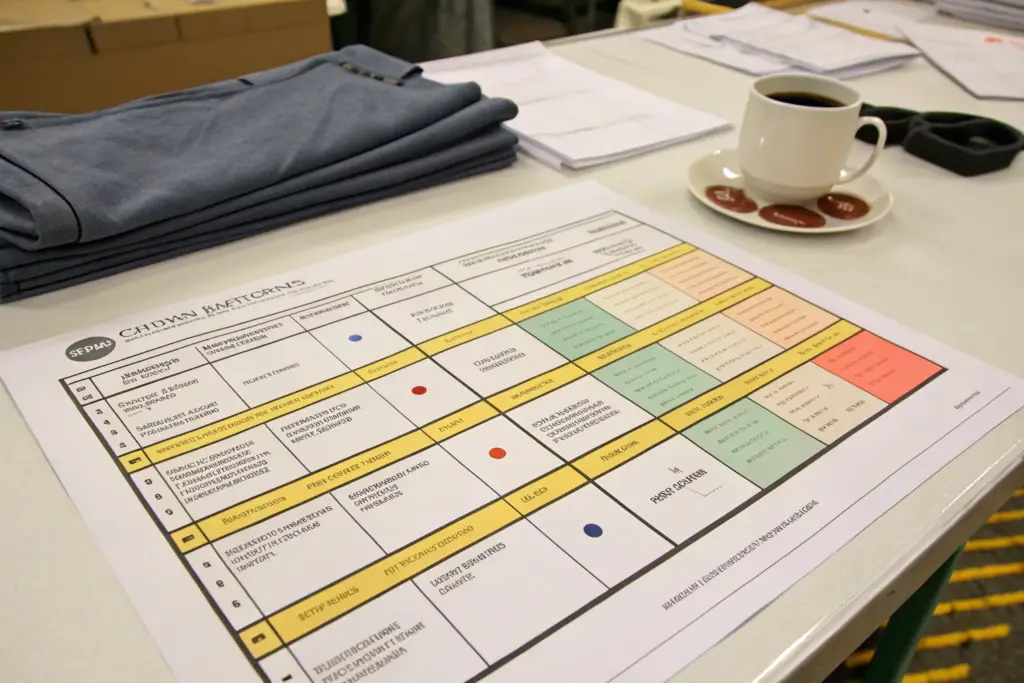
The roll identification section must contain the supplier’s name, the mill’s name, the fabric article number, the purchase order number, the roll number, the roll length in meters, the roll width in centimeters, the dye lot number, and the date of inspection. Every roll should have a physical barcode or label that matches the information in the report. The inspector verifies this match before beginning the inspection. This section prevents the most common form of supplier fraud: shipping a lower-quality fabric that looks similar to the approved sample. Without strict roll identification, a supplier can ship a different dye lot, a different fabric batch, or even a completely different article number, and the brand will only discover the switch when the garments are already cut and sewn. The fabric traceability standards in textile manufacturing require that every roll be uniquely identifiable and traceable back to the mill’s production records. A report that does not include the dye lot number is not providing full traceability.
What Does the Defect Point System Actually Measure and How Is the Pass or Fail Threshold Determined?
The four-point system is the global standard for fabric inspection. It assigns penalty points to defects based on their length. A defect of 3 inches or less scores 1 point. A defect of 3 to 6 inches scores 2 points. A defect of 6 to 9 inches scores 3 points. A defect over 9 inches or a hole scores 4 points. The total points per 100 square meters of inspected fabric are calculated. The standard acceptable threshold is 40 points per 100 square meters for woven fabrics and 30 points per 100 square meters for knit fabrics. A roll that scores above the threshold fails inspection. A roll that scores below passes. The four-point system is defined in the ASTM D5430 standard for fabric inspection. A report that uses a different system or does not specify the system being used is not following an auditable standard. The point score is a summary metric. It is useful for comparing rolls and for setting acceptance criteria with suppliers. It is not a substitute for reviewing the individual defects.
How Do You Interpret the Defect Map and Understand the Real Impact of Each Flaw on Your Garment?
A brand owner I work with once accepted a fabric roll with a four-point score of 28, well within the acceptable threshold. The roll passed inspection. When the cutting room spread the fabric and began cutting, they discovered that three of the four defects were clustered within the first five meters of the roll. The remaining 95 meters were clean. However, the cutting markers were for a large-size garment that required the full roll width. The clustered defects meant the first five meters were unusable for the main body pieces. The cutting room could only use the fabric for smaller components like pocket bags and collar stands. The usable yield was significantly lower than expected. The four-point score did not capture the defect clustering. Only the defect map revealed it.
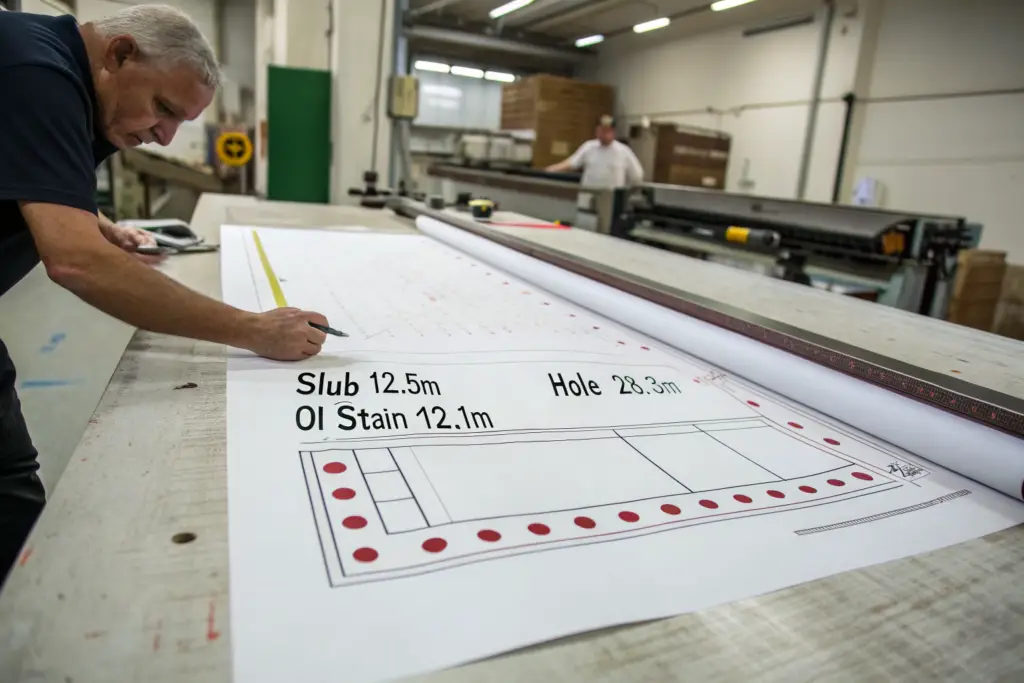
The defect map is a linear diagram of the fabric roll that shows the exact meter position and type of each defect. You interpret it by looking at three patterns: defect clustering, defect type concentration, and defect position relative to the selvedge. Defect clustering, where multiple defects are concentrated in a short length of fabric, can make that section entirely unusable for large pattern pieces even if the overall point score is acceptable. Defect type concentration, where the same type of defect appears repeatedly, indicates a systemic problem at the mill. Defect position near the selvedge is less damaging for garments with narrow pattern pieces than defects in the center of the roll, where the main body pieces are cut. The defect map allows the cutting room to plan the marker layout to minimize fabric waste. Without the map, the cutting room discovers defects in real time, which causes line stoppages and material waste.
The defect map is the operational tool. The four-point score is the purchasing tool. The score tells you whether to pay the supplier. The map tells you how to use the fabric. A brand that receives only the score and not the map is flying blind in the cutting room.
What Is the Difference Between a “Major” and “Minor” Defect and How Do They Affect Your Cutting Yield Differently?
A major defect is a flaw that renders the garment unsellable at full price. A hole, a tear, a large oil stain, a dye streak, a severe printing defect. A garment cut from fabric with a major defect in a visible area will be rejected at final inspection, marked as a second, or returned by the customer. A minor defect is a flaw that is visible upon close inspection but does not render the garment unsellable. A small slub, a slight yarn variation, a minor color inconsistency, a small pick fault. A garment with a minor defect may pass final inspection but could generate a customer complaint. The distinction matters for cutting decisions. A major defect must be cut around entirely. The fabric containing the defect is scrap. A minor defect may be acceptable if it falls in an inconspicuous area of the garment, such as an underarm, an inner facing, or a hem allowance. The defect classification guidelines from ASTM provide a framework, but the final classification depends on the brand’s quality standards and the garment’s end use. A minor slub that is acceptable on a casual t-shirt may be unacceptable on a luxury dress shirt.
How Can a Defect Map Help the Cutting Room Recover Usable Fabric from a Barely Failed Roll?
A roll that scores 42 points, two points over the 40-point threshold, is technically a failed roll. The supplier should replace it. However, if the replacement would delay production by four weeks and the brand needs the fabric now, the defect map can guide a recovery strategy. The cutting room manager reviews the map. If the defects are all located near the end of the roll or along one selvedge, the manager can adjust the marker layout to place smaller pattern pieces, collar bands, cuffs, pocketing, in the defective zone and save the clean fabric for the main body pieces. The defective section is cut out and scrapped. The clean fabric is utilized. The recovery strategy converts a failed roll into a partially usable roll. The cost of the scrapped fabric is charged back to the supplier. The production schedule is preserved. This strategy is only possible with an accurate defect map. The cutting room defect recovery techniques are a standard practice in professional garment manufacturing.
What Mechanical and Chemical Test Results Should You Demand and How Do You Read Them?
A brand I manufacture for produces performance polo shirts. Two years ago, they received a fabric lot that looked perfect. The color matched the Pantone reference. The hand feel was correct. The four-point inspection score was 12, excellent. The fabric was cut and sewn into 600 shirts. After the first wash, the shirts shrank 8% in length. The brand’s size tolerance was 3% shrinkage. Every shirt was now a full size too short. The customer returns were immediate and devastating. The fabric had been visually inspected but not mechanically tested for shrinkage. The brand owner had not asked for the shrinkage test report. The supplier had not provided it. The $8,000 production run was a total loss. The brand now requires a full mechanical test report for every fabric lot before cutting begins.
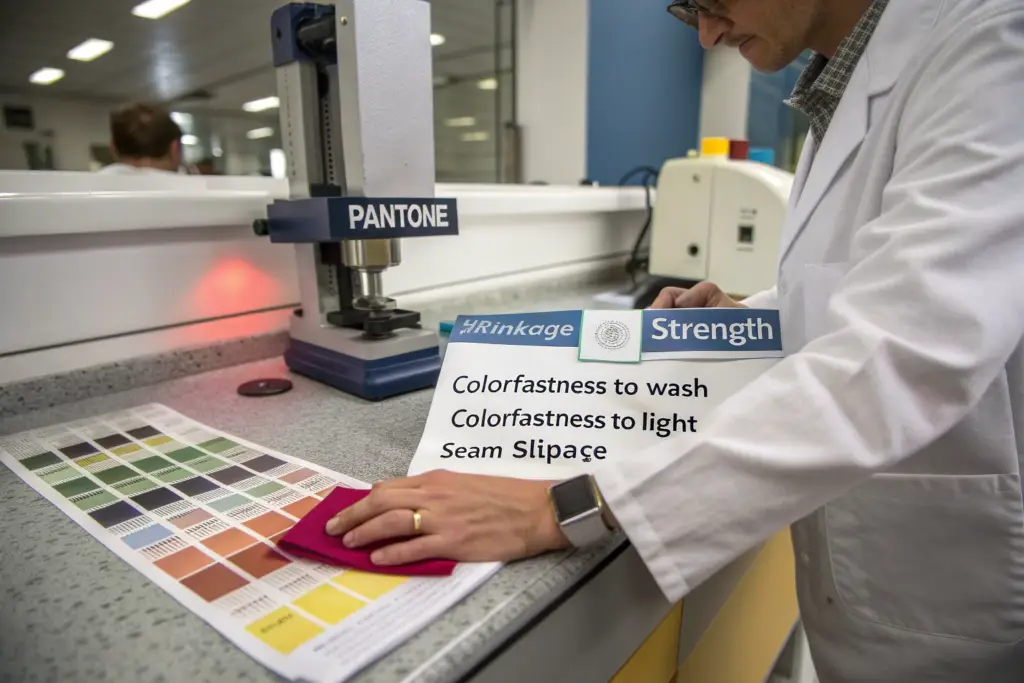
You must demand four mechanical and chemical test results for every fabric lot: shrinkage, colorfastness to laundering, colorfastness to light, and tensile or seam strength. The shrinkage test measures the percentage of dimensional change after washing and drying. A result above 3% for woven fabrics or 5% for knits is a failure for most apparel categories. The colorfastness to laundering test measures how much color bleeds or fades after washing. A grade of 4 or higher on the AATCC gray scale is acceptable. The colorfastness to light test measures how much color fades after exposure to UV light. A grade of 4 or higher is acceptable for most apparel. The tensile strength test measures the force required to tear the fabric. The result is compared to the minimum specification for the fabric type. These tests predict how the fabric will perform in the customer’s possession. A fabric that passes visual inspection but fails mechanical testing will generate returns, complaints, and brand damage. The test results are not optional. They are the scientific validation of the fabric’s quality.
The test reports must come from a qualified laboratory, either the mill’s in-house lab, the factory’s lab, or an independent third-party lab like Intertek or SGS. The reports must include the test method used, the test result, the pass or fail criterion, and the date of testing. A verbal assurance from the supplier that "the fabric is good" is not a test report.
How Do You Read a Shrinkage Test Report and Decide If the Fabric Is Safe to Cut?
A shrinkage test report will show the percentage of dimensional change in the warp direction, length, and the weft direction, width, after a specified number of wash and dry cycles. The test method is typically AATCC 135 for woven fabrics or AATCC 150 for knits. The report will show the before-wash measurements, the after-wash measurements, and the calculated shrinkage percentage. A negative percentage indicates shrinkage. A positive percentage indicates growth. For a woven cotton shirting, the acceptable shrinkage is typically 2% to 3% in the warp direction and 1% to 2% in the weft direction. If the report shows 4% warp shrinkage, the fabric is not safe to cut as-is. The pattern must be adjusted to add length to compensate, or the fabric must be re-processed with a compressive shrinkage treatment. The shrinkage testing standards from AATCC are the global reference. A brand that cuts fabric without reviewing the shrinkage report is betting that the fabric is stable. The bet is often lost.
What Does a Colorfastness Grade of 4 Versus 4.5 Actually Mean for a Garment That Will Be Washed 20 Times?
The colorfastness grade is determined by comparing the tested fabric to a gray scale that ranges from 1, severe change, to 5, no change. The difference between a grade of 4 and 4.5 is visible to a trained eye but may not be visible to a consumer. However, the cumulative effect over 20 washes is significant. A fabric with a grade of 4.5 will show minimal visible fading after 20 washes. A fabric with a grade of 4 will show slight but noticeable fading. A fabric with a grade of 3.5 will show obvious fading that the consumer will notice and may return the garment for. For premium apparel, the minimum acceptable grade for colorfastness to laundering is 4. For colorfastness to light, which measures fading from UV exposure, a grade of 4 is also the minimum. A fabric that scores 3.5 on light fastness will fade visibly after one summer of wear. The AATCC gray scale for color change provides the standard reference. A supplier who cannot provide colorfastness test results is not a professional textile supplier.
Conclusion
A fabric inspection report is not a bureaucratic formality. It is a risk management tool that protects your production run from defective materials. The four sections of the report, roll identification, defect scoring, defect mapping, and mechanical test results, each provide a specific type of information that you need to make a sound cutting decision. The roll identification ensures you received what you ordered. The defect scoring quantifies the overall quality level. The defect map shows you where the problems are so you can plan around them. The mechanical test results predict how the fabric will perform after the customer takes it home.
A brand that accepts a verbal "quality is good" from a supplier is operating on trust. Trust is valuable. Data is more reliable. The brand that demands a complete inspection report, reviews the four sections, understands the defect map, and verifies the mechanical test results is operating on evidence. Evidence protects margins. Evidence prevents the $6,400 hole-in-the-fabric disaster and the $8,000 shrinkage disaster. Evidence turns fabric sourcing from a gamble into a managed process.
At Shanghai Fumao, we provide a complete fabric inspection report with every bulk fabric lot we purchase on behalf of our brand partners. The report includes all four sections, uses the ASTM D5430 four-point system, includes a linear defect map, and includes mechanical test results for shrinkage, colorfastness, and tensile strength from a qualified laboratory. We do not charge extra for this service. It is part of our quality control system because we believe our brand partners should never have to guess whether their fabric is good.
If you want to see a sample fabric inspection report, or if you want us to review a report you received from your current supplier, we can help. At Shanghai Fumao, we will walk you through our inspection report format, explain how we score defects, and show you how we use the defect map in our cutting room. Contact our Business Director, Elaine, at elaine@fumaoclothing.com. She can send you a redacted sample report from a recent production order and a one-page guide to reading the four key sections. Do not cut another meter of fabric without understanding the report that tells you what you are cutting. Your brand quality depends on it.