
Two years ago, a brand owner I work with was burning $4,000 a month on professionally shot model campaigns. The photos were beautiful. The lighting was perfect. The models looked like they belonged in a magazine. The problem was that her target customers, college students and young professionals, did not engage with them. The likes were flat. The comments were generic fire emojis. The sales did not move. She made a radical decision. She stopped producing her own content entirely. She emailed her 200 existing customers and asked them to send photos of themselves wearing her clothes in their real lives. She offered a $30 store credit for any photo she used. Within three weeks, she had 140 authentic photos. She posted three customer photos a day. Her engagement rate tripled. Her conversion rate from social media traffic doubled. Her marketing cost dropped to $900 a month in store credits. The same clothes. A completely different result. The only thing that changed was who held the camera.
You seamlessly incorporate authentic user generated content into your apparel brand marketing by building a systematic content sourcing engine that converts paying customers into volunteer content creators. You do this by sending a post-purchase email that invites the customer to share a photo with a specific hashtag in exchange for a store credit or discount code. You curate the best submissions and feature them across your product pages, your social media feeds, your email campaigns, and your paid advertisements. You always ask permission and always credit the creator by name or handle. You never use a customer's photo without their explicit consent. The result is a marketing library that grows with every sale, costs a fraction of professional production, and converts better than studio photography because consumers trust real people more than they trust brands. Authentic UGC is not a supplement to your marketing strategy. It can replace your entire content production budget if you build the sourcing system correctly.
User generated content is not a trend. It is a structural shift in how consumers evaluate products. A customer considering your brand does not want to see how the garment looks on a six-foot model under studio lighting. They want to see how it looks on someone with their body type, in their city, in natural light. UGC answers the question studio photography cannot: "What will this actually look like on me?" I want to share the exact system we have seen our most successful brand partners use to build UGC engines that run themselves.
How Do You Build a Systematic UGC Sourcing Engine That Runs on Autopilot?
A brand owner I advised was manually messaging every customer who posted a photo of her brand. She would send a DM, ask for permission, wait for a reply, download the photo, and upload it to her website. She spent six hours a week on this process. She had 40 UGC photos on her site. I showed her how to automate the entire workflow. She set up a post-purchase email that went out seven days after delivery. The email invited the customer to post a photo with a specific hashtag and upload it through a submission form on her website. The form automatically captured the photo, the customer's Instagram handle, and their agreement to the usage terms. The approved photos were automatically added to a gallery on her product pages. Six months later, she had 600 UGC photos on her site. Her time investment was 30 minutes a week reviewing submissions. The system scaled without her labor.
You build a systematic UGC sourcing engine by creating an automated post-purchase email sequence that requests content at the exact moment the customer is most excited about their purchase. The email goes out 5 to 10 days after delivery, once the customer has had time to wear the garment and form a positive impression. It offers a clear incentive: a discount code, store credit, or entry into a monthly giveaway. It provides simple instructions and a direct link to a submission form. The form collects the photo, the customer's social handle, and their explicit consent to use the content in your marketing. The backend of the system automatically organizes submissions, tracks which photos have been approved, and pushes approved photos to your website gallery and your social media scheduling tool. The brand owner's role is reduced to a weekly 30-minute review of new submissions to approve or reject. The engine runs on the customer's excitement, not on the brand owner's labor.
The timing of the request is everything. An email sent immediately after purchase asks for content before the customer has even tried on the garment. An email sent three months later arrives when the excitement has faded. The 7-day window captures the customer at peak enthusiasm, when they are most likely to want to show off their new purchase.

What Is the Exact Post-Purchase Email Sequence That Generates the Highest Volume of Quality Customer Photos?
The sequence has three emails. Email one, sent seven days after delivery, is the primary request. The subject line is "Show Us How You Style It – Get $20 Off Your Next Order." The body shows three examples of real customer photos, demonstrating the style and quality the brand is looking for. It clearly states the incentive, the instructions, and the submission deadline. It includes a direct link to the submission form. Email two, sent ten days after delivery, is the reminder for non-responders. The subject line is "Still Time to Share Your Look & Claim Your $20." It is shorter and creates mild urgency. Email three, sent fourteen days after delivery, is the final ask. The subject line is "Last Chance: $20 Store Credit Waiting for You." It converts the stragglers. The three-email sequence typically generates a submission rate of 5% to 12% of customers, depending on the brand's community engagement level and the quality of the incentive. The post-purchase email sequence for UGC is the most reliable method for building a steady content pipeline.
How Do You Design a Submission Landing Page That Captures Legal Consent Alongside the Image?
The submission landing page must serve two functions simultaneously: make it easy for the customer to upload their photo, and capture their explicit legal consent to use the photo. The page design is minimal. A headline: "Share Your Look." Upload your photo below and we will feature you on our site and social media." A file upload button. A field for the customer's Instagram handle or name. Below the checkbox, a link to the full usage rights terms. The thank-you page confirms the submission and provides the discount code. The automated email notification sends a copy of the terms to the customer for their records. The UGC legal consent best practices are straightforward. You need explicit, documented permission. The submission form provides it.
Where Should You Place Customer Photos on Your Website to Maximize B2B and DTC Conversion Rates?
A brand owner I work with added a "Customer Photos" section to her product pages. She placed it directly below the main product images, above the product description. The section showed six customer photos of the specific product the visitor was viewing. The results were immediate and dramatic. The product pages with customer photos had a 17% higher conversion rate than the product pages without. The average order value increased by 9%. Customers who interacted with the UGC gallery spent 40% longer on the page. The reason was simple. The customer photos answered the questions that studio photos could not. "How does this dress look on someone who is not a model?" "How does this jacket fit on someone with broad shoulders?" "What does this color look like in natural light?" The customer photos provided the visual proof that converted hesitation into purchase.
You place customer photos in three high-impact locations on your website to maximize conversion. First, on the product detail page, directly below the main product images, labeled "Styled by Our Community" or "How Our Customers Wear It." This placement catches the visitor at the moment of product evaluation, when they are deciding whether to add to cart. Second, on a dedicated UGC gallery page linked from the main navigation, labeled "Community" or "See It Styled." This page serves as a discovery tool for visitors who want to see how real people wear the brand before browsing specific products. Third, on the homepage, as a dynamic feed of recent customer photos that updates regularly. This shows first-time visitors that the brand has an active, engaged community. Each customer photo should be clickable, linking either to the specific product the customer is wearing or to the customer's original social post. The UGC placement strategy transforms your website from a catalog into a community.
The placement is not decoration. It is a conversion tool. A visitor who sees a customer photo that looks like them, similar body type, similar age, similar style, makes the purchase decision faster and with more confidence. The UGC gallery is the most powerful sales tool your website has, and it costs you a fraction of what you spent on studio photography.
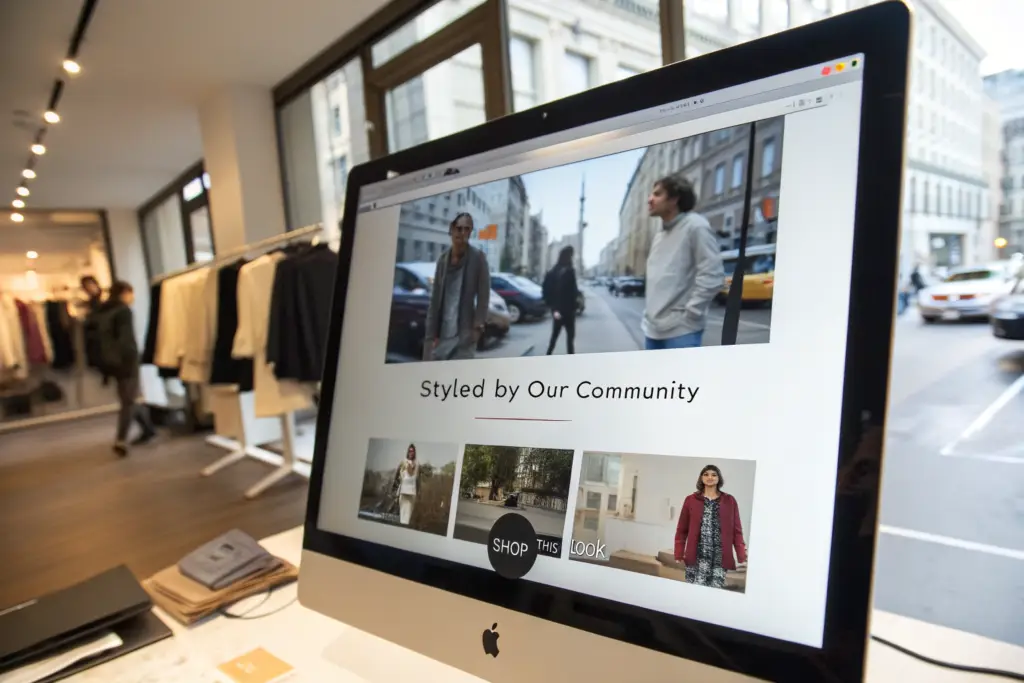
Why Should Customer Photos Be Placed Above the Fold on Product Pages, Even Above the Brand's Own Campaign Imagery?
The area above the fold is the first thing a visitor sees when the product page loads. It is the most valuable real estate on the page. Most brands fill it with studio product shots. The data suggests this is a missed opportunity. A study of user behavior on e-commerce product pages found that visitors who viewed customer photos in the primary image gallery were 24% more likely to add to cart than visitors who only viewed studio images. The customer photos answer the authenticity question before the visitor has to scroll. They see a real person wearing the garment and think, "Okay, this is what it actually looks like." The studio photos serve a purpose: they show the garment clearly and professionally. The customer photos serve a different purpose: they build trust. Trust must be established early in the page experience. Placing customer photos above the fold, in a scrollable gallery or a secondary image slot, establishes trust before the visitor has time to form doubts.
How Does a "Shop the Look" UGC Gallery Specifically Drive Wholesale Buyer Confidence?
Wholesale buyers evaluate a brand differently than consumers. They are not asking, "Will this look good on me?" They are asking, "Will this sell in my store?" A UGC gallery provides evidence that the answer is yes. When a wholesale buyer sees dozens of real customers wearing the brand, styling it in different ways, and looking genuinely happy, they see market validation. They see that the brand has an engaged customer base. They see that the product photographs well in real life, not just in a studio. They can envision their own customers reacting the same way. We advise our brand partners to include a "Community" or "Customer Love" section in their wholesale line sheet and their B2B portal. The section shows a curated selection of the best customer photos, demonstrating sell-through proof. A brand owner who shared her UGC gallery with a department store buyer told me the buyer cited the customer photos as a key reason for placing the order. The buyer said, "I can see this brand has a real following. The customers are doing your marketing for you." The UGC as wholesale buyer proof is a powerful, underutilized tool.
What Are the Golden Rules for Repurposing Customer Photos Without Damaging Brand Trust?
A brand owner I know made a mistake that cost her a loyal customer. She took a customer's photo from Instagram, cropped out the customer's face, and used it in a Facebook ad without asking. The customer saw the ad. She was furious. She posted a public complaint. The brand owner apologized, removed the ad, and offered a $100 gift card. The customer accepted the apology but never bought from the brand again. The lesson was expensive. UGC is not free content. It is borrowed trust. Misusing it destroys the trust it was meant to build.
The golden rules for repurposing customer photos are: always ask for explicit permission before using a photo, always credit the creator by name or handle in every placement, and never alter the photo beyond minor cropping or color correction without the creator's approval. You do not own a customer's photo just because they posted it publicly or used your hashtag. You must obtain their consent before using it in your marketing. The consent should specify where the photo will be used: website, social media, email, paid ads. The creator should have the right to revoke consent at any time. These rules are not just ethical. They are increasingly required by consumer protection laws in multiple jurisdictions. A brand that treats customer content with respect builds deeper customer loyalty. A brand that treats it as free stock photography burns the community that sustains it.
The permission is the foundation. Without it, you are operating on borrowed time and borrowed goodwill. With it, you have a content partnership that benefits both parties. The customer gets recognition and a reward. The brand gets authentic content. Both parties win.

What Specific Language Should a Brand Use to Request Photo Rights That Protects Both Parties Legally and Ethically?
The request language must be clear, specific, and easy to understand. It should not be buried in dense legal jargon. A simple, effective request reads: "We love your photo and would like to feature it on our website, social media, and marketing emails.
The language specifies the usage scope, the credit policy, and the revocation right. It does not claim ownership of the photo. It requests a limited, revocable license. The legal framework for UGC usage rights should be reviewed by a qualified attorney. The key principle is informed consent. The customer must understand what they are agreeing to.
How Can You Compensate Customers Fairly for High-Performing Images Without Breaking Your Marketing Budget?
Cash is effective but expensive. Store credit achieves similar results at a fraction of the cost. A tiered compensation model works well. For a photo used on the website or social media, the customer receives a $20 to $50 store credit. For a photo used in a paid advertisement that generates significant performance, the customer receives a $100 to $250 store credit or a free product from the next collection. For a photo that becomes a top performer, generating substantial sales, the customer receives a $500 cash prize and is invited to become a paid brand ambassador. The tiered model rewards the customers whose content drives the most value, while keeping the baseline compensation affordable. The brand's cost for a UGC photo used on the website is $20 in store credit, which costs the brand roughly $6 to $10 in actual product cost. Compared to $500 to $1,500 for a professional model shoot, the UGC economics are compelling. The UGC creator compensation models are fair and sustainable. The customer feels valued. The brand gets affordable content. The model scales.
Conclusion
Seamlessly incorporating authentic user generated content into your apparel brand marketing is not about finding the perfect photo. It is about building the perfect system. A post-purchase email sequence that requests content at the right moment. A submission form that captures legal consent. A website placement strategy that puts real customer photos in front of potential buyers at the moment of decision. A set of ethical rules that protect the trust between the brand and its community.
The brands that do this well stop being content producers and become content curators. Their customers become their creative team. Their marketing library grows with every sale. Their conversion rates improve because the content is more trustworthy than anything a studio could produce. And their marketing costs drop because the content is paid for with store credit, not cash.
At Shanghai Fumao, we support our brand partners' UGC efforts by producing garments that photograph well in real life. A garment that looks good under studio lighting but wrinkles badly after one wear will not generate positive UGC. A garment that holds its shape, drapes well, and looks better with age will generate an endless stream of customer photos. The manufacturing quality is the foundation on which the UGC strategy is built.
If you are building your brand's UGC engine and want a manufacturing partner who delivers the consistent quality that inspires customer photos, reach out to us. At Shanghai Fumao, we will show you how our quality control processes ensure your garments look as good on your customers as they do in your samples. Contact our Business Director, Elaine, at elaine@fumaoclothing.com. She can share examples of how other brand partners have built their UGC programs and discuss how our production consistency supports authentic customer content. Your customers are your best photographers. Equip them with garments worth photographing.