You are designing a line of daily wear for toddlers. You are not just choosing a color or a print; you are choosing a material that will be in constant, intimate contact with the most sensitive, permeable, and precious skin imaginable. A toddler cannot tell you that a fabric is "breathable" or "hypoallergenic." They can only cry in discomfort, or develop a rash, and you will have lost the trust of their parent forever. A pediatric dermatologist and textile specialist once told me, "A toddler's skin is not just a smaller version of an adult's. It's a fundamentally different, more absorbent, and more vulnerable organ. A fabric that feels 'a little scratchy' to you can cause a painful, full-body eczema flare-up on a six-month-old. You must choose their clothing with the care you would choose a medical dressing."
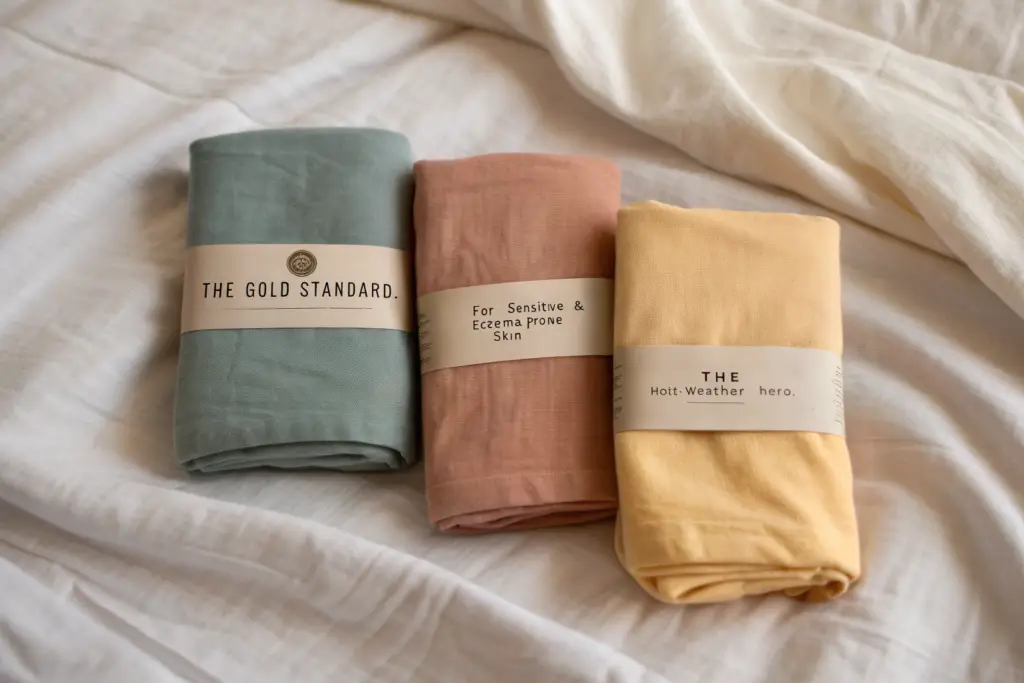
Choosing a skin-friendly fabric for a toddler's daily wear is a science of fiber, weave, and certified chemistry. The absolute, non-negotiable priorities are: 1) Choosing an Inherently Soft, Breathable, and Hypoallergenic Fiber (with GOTS-certified organic cotton being the undisputed gold standard, and Tencel Lyocell being the premium solution for actively sensitive or eczema-prone skin), 2) Demanding a Textile Chemistry Guarantee (specifically an OEKO-TEX Standard 100, Class I certification, which is the strictest human-ecological safety standard for baby products), and 3) Specifying a Soft, Flat, and Seamless Construction (using flatlock seams and soft, tagless labels to eliminate the physical sources of chafing and irritation against the skin).
At Shanghai Fumao, we manufacture toddler and kids' wear with an obsessive focus on these principles. Our entire material compliance program is built to provide our B2B partners with the verified, certified, and documented assurance that their products are not just beautiful, but profoundly safe and comfortable for the most vulnerable wearers. Let me explain the exact criteria you must use.
Why Is Certified Organic Cotton the Undisputed Gold Standard for a Toddler's Sensitive Skin?
The term "organic cotton" is used loosely in the market, but for a toddler's skin, only a fully certified organic cotton provides a verifiable guarantee of safety and quality. The critical distinction is the certification. GOTS (Global Organic Textile Standard) is the only certification that covers not just the farming of the raw fiber, but every single step of the subsequent processing—the spinning, the weaving, and crucially, the dyeing and finishing—ensuring that no toxic, irritating chemicals are introduced at any stage.
GOTS-certified organic cotton is the gold standard because it guarantees purity and safety throughout the entire supply chain. It verifies the cotton was grown without synthetic pesticides, GMOs, or defoliants. Crucially, a GOTS certification also mandates which chemicals can be used during the dyeing and finishing process, ensuring the final fabric is free from the common irritants like formaldehyde, heavy metals, and allergenic disperse dyes that are present in conventional cotton processing. This is not just a softer fabric; it's a chemically safer one.
A brand we work with that produces premium toddler basics was asked by a major US retailer to prove their "organic" claim. Because we manufactured their line using a fully GOTS-certified supply chain, we were able to provide the complete, unbroken paper trail of Transaction Certificates (TCs) from the certified farm to our factory. The retailer approved the line immediately. A brand using an uncertified "organic" cotton would have been rejected. The certification is the passport to the premium, conscious parent market. This is the power of a fully certified GOTS supply chain .
What Specific Harsh Chemicals Are Used in Conventional Cotton Processing That GOTS Prohibits?
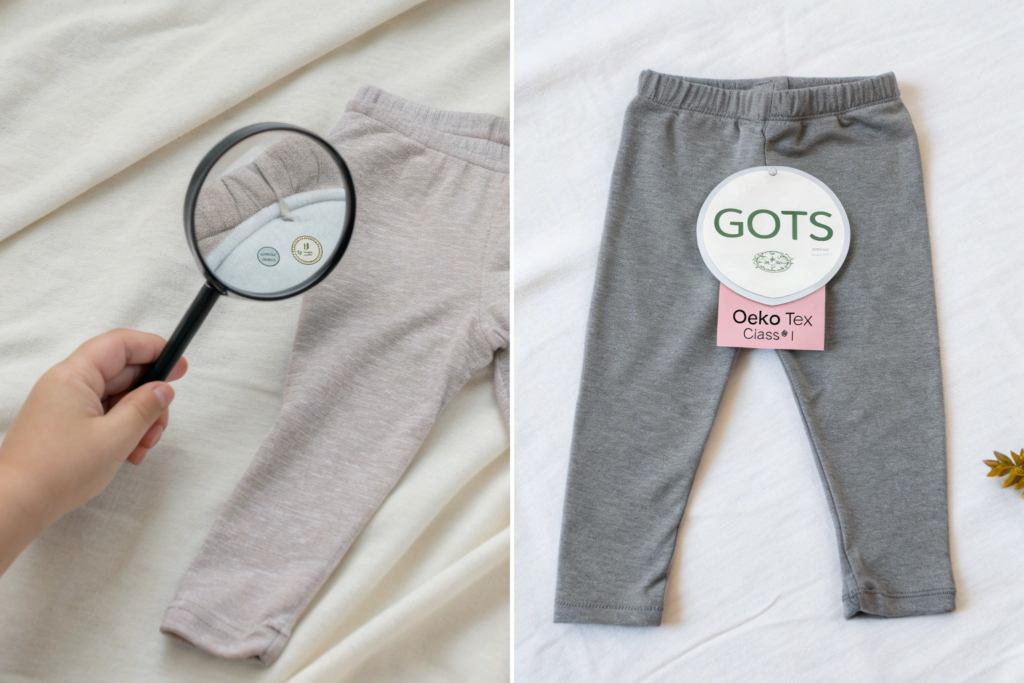
Conventional cotton processing can involve a cocktail of chemicals that are not benign on a baby's skin. These include formaldehyde , which is used in some easy-care and anti-shrink finishes and is a known skin and respiratory irritant; heavy metals , which can be present in some synthetic dyes; and chlorine bleach, which is used to whiten the fabric and can leave irritating residues. GOTS explicitly prohibits the use of these and hundreds of other toxic inputs, providing a chemical safety net that conventional processing does not.
How Does OEKO-TEX Standard 100, Class I Add an Extra Layer of Certified Chemical Safety?
While GOTS certifies the organic process from field to finished fabric, OEKO-TEX Standard 100 is a rigorous, independent product certification that tests the final fabric for a comprehensive list of over 100 harmful substances. Class I is the strictest category, specifically for items for babies and toddlers up to 36 months, where the testing limits are the most stringent due to the vulnerability of the wearer who mouths and chews on their clothing. It is the ultimate, independent proof of chemical safety. We require this certification for all our toddler and baby fabric trims .
When Is Tencel Lyocell a Clinically Superior Choice for Actively Sensitive or Eczema-Prone Skin?
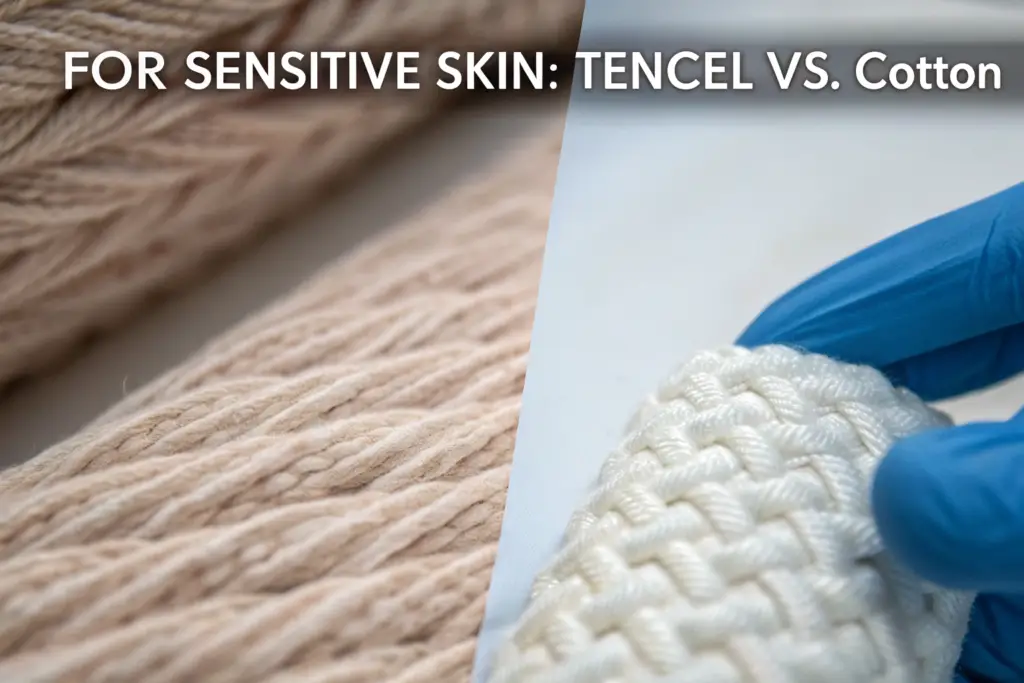
For a toddler with actively sensitive skin, eczema, or a tendency to rashes, even a high-quality organic cotton can sometimes be slightly too rough. The microscopic structure of a conventional cotton fiber is flat, twisted, and ribbon-like, with tiny surface irregularities that can act as micro-abrasives, triggering a reaction on hyper-sensitive skin. In these cases, a fiber with a fundamentally smoother, rounder, and more uniform physical structure is a clinically superior choice.
Tencel Lyocell is clinically superior for sensitive and eczema-prone skin because of its uniquely smooth, round, and uniform fiber surface. Unlike cotton, which has a rough, ribbon-like shape with microscopic barbs, Tencel fibers are as smooth as silk. This prevents the micro-abrasion that can trigger a flare-up on compromised, sensitive skin. Tencel is also more breathable and hydrophilic than cotton, managing moisture more effectively and keeping the skin drier, which further reduces the risk of irritation. It is the dermatologist's preferred choice for children with severe skin sensitivities.
A brand we work with launched a "Sensitive Skin" toddler line, using a specific, lightweight Tencel Lyocell jersey. The marketing was built around the specific, physical smoothness of the fiber. The response from parents of children with severe eczema was overwhelming and emotional. They had finally found a fabric that their child could wear for a full day without scratching. The brand's success was built on a deep, functional understanding of fiber science. This is the power of choosing an engineered fiber for a specific medical-grade need .
How Does Tencel's Superior Moisture Management Help Prevent Toddler Heat Rash and Eczema Flare-Ups?
Heat rash (prickly heat) and many eczema flare-ups are triggered by sweat trapped against the skin. Tencel is more hydrophilic (water-loving) than cotton, meaning it more efficiently absorbs and wicks moisture vapor away from the skin's surface and releases it into the air. This active moisture management keeps the skin's microclimate cooler and drier, directly removing the environmental trigger for many common toddler skin irritations.
Why Is the OEKO-TEX Class I Certification Just as Critical for a Tencel Garment?
The fiber itself is naturally clean, but the processing is still critical. Even a beautiful, natural-origin fiber like Tencel can be processed into a fabric using harsh, irritating dyes and finishing chemicals. You must still demand an OEKO-TEX Standard 100, Class I certification for the final Tencel garment to guarantee that the finished product is chemically safe for a baby or toddler. The certification is always the final, non-negotiable safety checkpoint, regardless of the fiber.
How Do Construction Details Like Flatlock Seams Become a Physical Guarantee of Comfort?
A soft, chemically safe fabric is the essential first step, but it can be completely betrayed by the physical construction of the garment. A prominent, raised, and abrasive internal seam can be a source of constant, painful chafing against a toddler's delicate skin. A toddler cannot tell you the seam is scratching them; they will simply become fussy, irritable, and will refuse to wear the garment. The final, and equally critical, step is to specify construction details that are as gentle as the fabric itself.
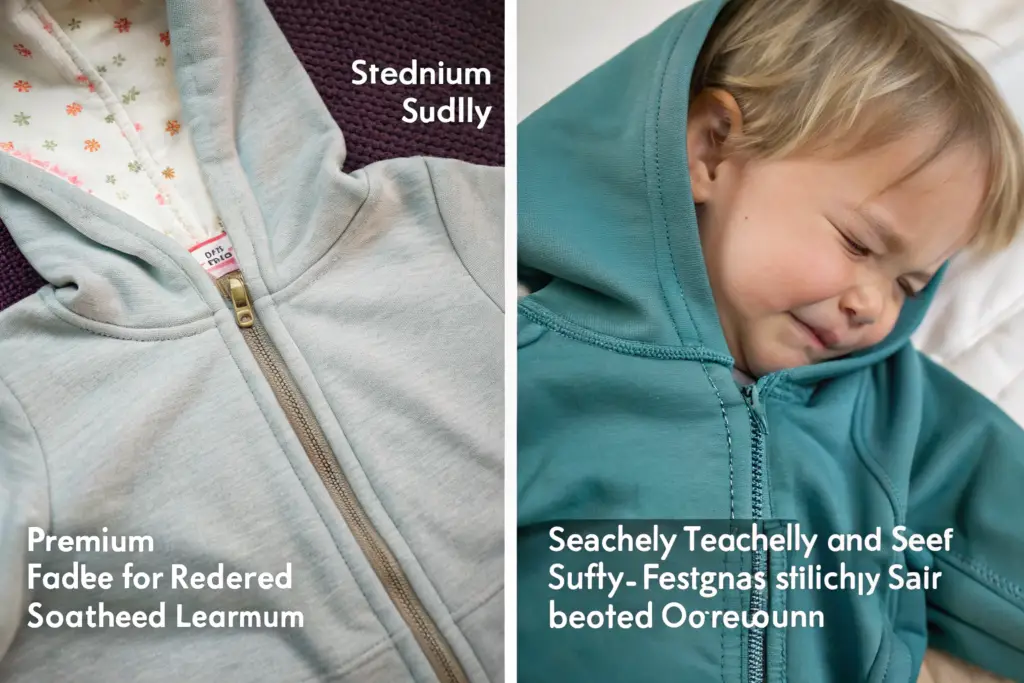
Flatlock seams and tagless labels are the physical guarantees of comfort against a toddler's skin. A standard overlock seam creates a raised, abrasive ridge. A flatlock seam, by contrast, is sewn so that both sides of the seam lie flat and smooth against the skin, with no raised edge to cause friction or chafing. Similarly, a scratchy, satin tag at the back of the neck is an immediate irritant. A soft, tagless heat-transfer or woven label eliminates this source of irritation entirely. These are non-negotiable construction details for any toddler garment.
A brand we work with made a simple, powerful change to their toddler line. They switched all main seams from a standard overlock to a flatlock seam, and they moved the size label from a scratchy tag to a soft, printed label. The reduction in customer complaints about "itchiness" and "red marks" was immediate and dramatic. The change added a small incremental cost, but it gave them an unassailable, demonstrable, and marketable quality advantage. This is the power of anatomically considerate garment engineering .
What Is the "Touch Test" for Evaluating a Seam Against a Toddler's Skin?
It is a simple, human sensory test. Turn the garment inside out. Close your eyes and gently run your fingertips along every main seam. Ask yourself: does this feel soft and smooth, or can I feel a distinct, hard, raised edge? If you can feel an edge, a toddler's far more sensitive skin will be irritated by it. The fabric must feel uniformly soft, without any distinct seam bumps. This test is our standard for toddler comfort QC .
Why Is a Soft, Printed "Tagless" Label an Essential, Non-Negotiable Detail for Toddler Garments?
A child's back of the neck is one of the most sensitive areas of their body. A small, scratchy, sewn-in satin label is a guaranteed irritant. A parent will often have to cut it out, which can leave a sharp, plastic edge that is even worse. A soft, screen-printed or heat-transfer "tagless" label is completely smooth and has zero texture. It is the simplest, most effective way to eliminate a major source of toddler clothing discomfort. This is our standard recommendation for all kids' wear production .
How Does Fumao's Toddler-Focused Model Guarantee a Perfectly Safe and Comfortable Garment?
We know that manufacturing for toddlers is a profound responsibility, and we do not treat it lightly. Our entire process—from fiber sourcing to final construction—is engineered to meet the unique, non-negotiable demands of the most sensitive wearer. We provide our B2B partners with the verified documentation and the quality-obsessed manufacturing that allows them to build a brand that parents can trust completely.
Fumao's toddler-focused model guarantees a safe and comfortable garment by integrating material science, certified chemistry, and considerate construction. We source GOTS organic cotton and OEKO-TEX Class I certified Tencel from trusted mills. We use flatlock seams and tagless labels as our default construction standard for all toddler apparel. We provide a complete, digital "Compliance & Comfort File" for every collection, giving you the irrefutable, documented proof that your products are safe, soft, and built for a child's delicate skin.
A new brand partner who was launching her first toddler line told me, "I was so anxious about getting the safety and the softness right. Your team didn't just send me swatches; you sent me the certificates, walked me through the seam construction, and showed me how the tagless label feels on the skin. You made me feel like I had a partner who understood that this isn't just fashion; it's a promise to a parent." That is our purpose. To be the expert, transparent, and deeply responsible partner that empowers you to build a brand that parents trust and children love to wear. This is the heart of our toddler and kids' wear specialty .
How Do We Source and Vet Our Trims (Buttons, Snaps) to Ensure They Are Chemically Safe and Choke-Proof?
This is a critical, specialized skill in toddler wear. All metal components, like snaps and zippers, must be tested and certified lead-free. For any decorative component, we must ensure it is securely attached to withstand a toddler's pull and tugs. We have a specific supplier vetting process and an incoming QC protocol dedicated to these safety-critical trims. This is a core part of our toddler product safety program .
What Documentation Do You Provide to Prove a Garment's "Skin-Friendliness" to a Retail Buyer or an Anxious Parent?
We provide a comprehensive "Toddler Skin-Safe Pack" for your order. This includes the valid GOTS and OEKO-TEX Class I certificates for the main fabric, any trim-specific safety test reports, and a document detailing our in-house seam construction and labeling standards. This gives you the objective, verifiable proof to confidently answer any question from a retailer or a worried parent. This is our commitment to radical transparency in kids' wear .
Conclusion
Choosing a skin-friendly fabric for a toddler's daily wear is a discipline of material science, certified chemistry, and physical engineering. It is about selecting an inherently soft and safe fiber, demanding independent proof of its chemical purity, and constructing the garment in a way that is physically non-abrasive against the most delicate skin imaginable.
At Shanghai Fumao, we have built a specialized, responsible, and transparent manufacturing model around these principles. Our vertically-integrated approach to quality, compliance, and comfort provides our B2B partners with the confidence and the verifiable proof they need to build a brand that is cherished by parents and safe for their most precious customers.
If you are ready to build a toddler wear line on a foundation of certified safety and uncompromising comfort, let's talk. Our Business Director, Elaine, can walk you through our compliance and comfort standards. Please email Elaine at: elaine@fumaoclothing.com.