
Three months ago, I sat across from a client in a coffee shop in Los Angeles. He ran a successful wholesale brand selling men's woven shirts. He had 120 SKUs in his line sheet. He was proud of the variety. I asked him a simple question: "Which 20 SKUs made you 80% of your profit last season?" He paused. He guessed. "Probably the blue oxfords and the white linens." I pulled out my laptop. I showed him a quick analysis of his order history with us. The data said something different. The Chambray Blue shirt was #1. The Olive Green Linen was #3. The white linen was #11. He had been betting his open-to-buy dollars on the wrong colors and the wrong fabrics based on his gut. AI is not here to replace your taste. It is here to protect you from your own bias.
Leveraging AI driven analytics to optimize your wholesale clothing catalog means using machine learning algorithms to process historical sales data, competitor pricing, and real-time search trends to answer three critical questions. Which products should you double down on? Which products should you kill before they drain your cash? And what is the optimal price point for each SKU in your line sheet? AI transforms catalog curation from an artistic guessing game into a data-driven profit protection exercise.
You are a business owner. You understand sales cycles. You know that dead stock is a mortgage payment sitting on a warehouse shelf. You source from China because you need competitive prices to rebrand and distribute in the USA. At Shanghai Fumao, I watch brands succeed and fail based almost entirely on their Catalog Efficiency. This article is about using the new generation of affordable AI tools to make sure your catalog is lean, mean, and profitable.
What Is AI Driven Catalog Optimization for Apparel Wholesale?
Many of my clients hear "AI" and think of robots sewing buttons. That is automation. AI in catalog management is different. It is Pattern Recognition.
AI driven catalog optimization for apparel wholesale is the application of machine learning models to structured data sets—your past invoices, your B2B portal clicks, and public trend data—to generate prescriptive actions. These actions include identifying "Hero SKUs" that should never be out of stock, flagging "Zombie SKUs" that are consuming cash flow, and suggesting "Gap SKUs" that your current catalog is missing based on what retail buyers are actually searching for.
Think of AI as a very fast, very objective junior merchandiser who never sleeps and never falls in love with a particular shade of purple just because it is their favorite color.
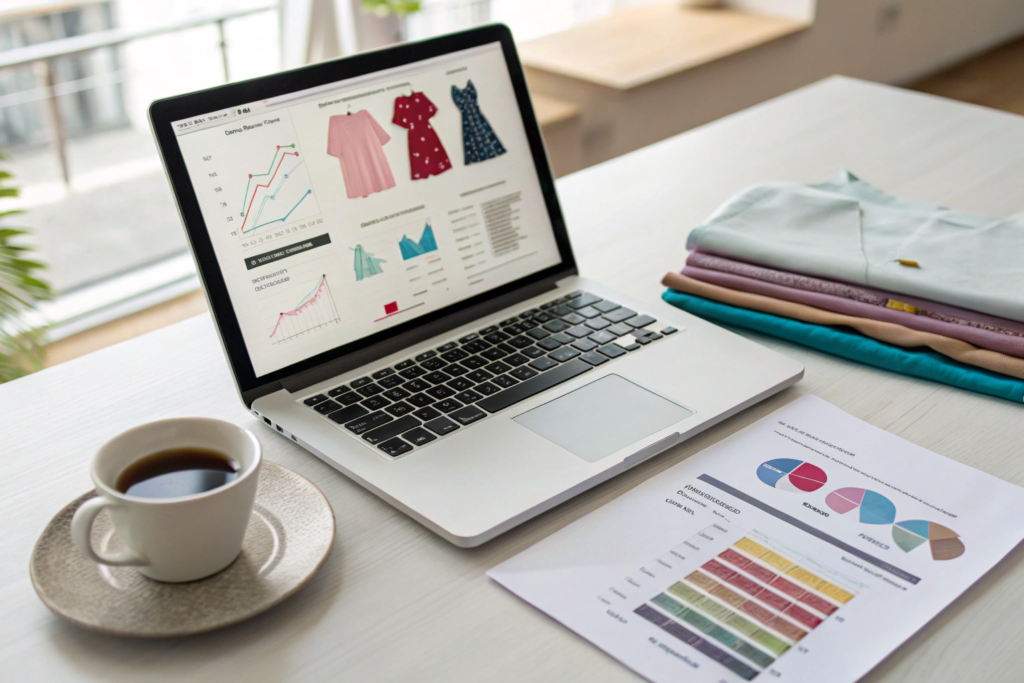
How Is AI Different from Traditional Excel Based Sales Analysis?
You probably already look at a spreadsheet. You sort by "Total Units Sold." You reorder the top 10 items. That is Descriptive Analytics. It tells you what happened.
AI provides Predictive and Prescriptive Analytics. It tells you what will happen and what you should do.
Here is a comparison table based on my experience helping clients plan production at Shanghai Fumao:
| Feature | Traditional Excel Analysis | AI Driven Analytics |
|---|---|---|
| Time Horizon | Backward Looking. Last season's data. | Forward Looking. Next season's prediction. |
| Granularity | Style level (e.g., "The Linen Shirt"). | Attribute level (e.g., "The Olive Linen Shirt with Mother of Pearl buttons"). |
| Anomaly Detection | Manual. You might miss a slow decline. | Automatic. AI alerts you that "Navy Blazer" sales are down 15% vs. market trend. |
| Competitor Context | None. | Scraped and indexed. AI knows if you are priced 20% above market for a similar garment. |
| Action | "We sold 500. Order 500 again." | "Demand signal rising for 'Relaxed Fit.' Reduce 'Slim Fit' order by 10%." |
A Concrete Example:
Last year, I reviewed a client's spreadsheet. It showed Total T-Shirt Sales: 5,000 units. He planned to reorder the same assortment: 50% Black, 30% White, 20% Navy.
I ran his data through a basic AI forecasting tool connected to Google Trends and his Shopify wholesale data. The tool flagged that "Sage Green T-Shirt" search was up 60% among his specific B2B buyer demographic. It also flagged that his Black T-Shirt sell-through rate had dropped from 85% to 70% over three seasons.
AI Prescription: Reduce Black by 15%. Introduce Sage Green at 10% of the buy.
Result: The Sage Green sold out at full margin in 4 weeks. The reduced Black order prevented 300 units of potential markdown inventory.
What Types of Data Do AI Catalog Tools Actually Need?
AI is a hungry beast. It needs clean data. If you feed it garbage, it spits out garbage.
Here is the minimum viable data set you need to leverage AI for wholesale catalog optimization:
-
Historical Sales Transactions (Minimum 2 Years):
- SKU Number
- Units Sold
- Sell-Through Rate (%) (More important than units sold. Units sold just tells you volume. Sell-through tells you velocity.)
- Discount Depth (Did you sell it at 50% off or full price?)
-
Product Attribute Taxonomy:
This is where most small brands fail. You cannot just label a product "Shirt." You must tag it:- Silhouette: Slim Fit, Relaxed Fit, Boxy Fit.
- Fabric: 100% Cotton, Linen Blend, Tencel.
- Color Family: Blue, Green, Neutral.
- Price Point Tier: Good, Better, Best.
-
Customer Segmentation:
- Boutique (1-2 stores) vs. Small Chain (3-10 stores) vs. Online Only.
- Region: Northeast vs. West Coast. (A quilted jacket sells in Maine in September. It sells in San Diego in January. AI learns this regionality).
At Shanghai Fumao, we provide our clients with a Product Data Sheet export that includes all the technical attributes (fiber content, yarn count, wash type). This structured data is the fuel for their AI merchandising engines.
How to Use AI to Predict Wholesale Bestsellers Before You Produce Them?
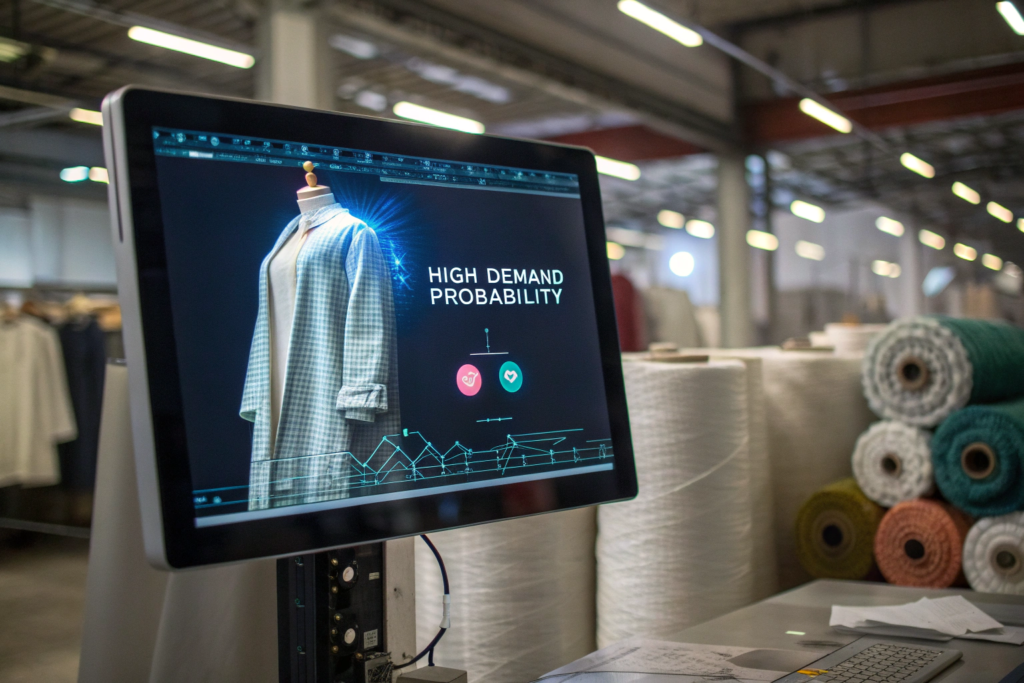
This is the holy grail. If you could know with 80% certainty which of your 30 new samples will be a hit before you commit to 3,000 yards of fabric and 8 weeks of production, you would be unstoppable.
AI predicts wholesale bestsellers by analyzing the correlation between specific product attributes and market success signals. These signals include B2B search query volume on platforms like Faire and NuORDER, wholesale marketplace bestseller lists, and early-stage social media engagement with similar aesthetic content. AI can quantify the "virality coefficient" of a design feature before you cut a single piece of fabric.
You do not need a crystal ball. You need a data feed.
Which AI Tools Can Analyze B2B Wholesale Platform Trends?
There is a new generation of tools built specifically for wholesale brands. They do not just look at Instagram likes. They look at Wholesale Buyer Intent.
Tool Category 1: Wholesale Marketplace Intelligence
Platforms like Faire and NuORDER are where thousands of US boutiques place their orders. AI tools (some built into the platforms, some third-party) can aggregate anonymized data to show:
- Rising Search Terms: "Search volume for 'Linen Blend Blazer' up 45% month-over-month."
- Category Momentum: "Dresses are slowing. Knit Sets are accelerating."
Tool Category 2: Competitor Catalog Scraping
Tools like Jungle Scout (originally for Amazon) are now being adapted for B2B. They can scrape a competitor's wholesale line sheet (if public) and estimate:
- Assortment Depth: How many styles do they have in "Wovens" vs. "Knitwear"?
- Price Architecture: What is their average wholesale price for a cotton poplin shirt?
Tool Category 3: Social Listening for B2B
This is different from B2C. You are not listening to teens on TikTok. You are listening to Boutique Owners on LinkedIn and Instagram. AI can parse the comments of retail buyers on trade show posts.
- Example: AI detects 50 boutique owners commenting on a specific trade show post: "Love this but need it in Petite Sizing."
- Action: You add Petite to your catalog. You have just solved a problem before your competitor even knew it existed.
I use a combination of these signals. When I see "Washed Satin" rising on both Faire search and Pinterest Predicts, I call my clients and say, "Book your Washed Satin fabric now. The mills are going to get busy."
Can AI Analyze My Own Sample Room Feedback Data?
Yes. And this is a hidden asset you already own but probably ignore.
The Data You Have:
When you show a new collection to your top 10 retail buyers at a trade show or in your showroom, you get feedback. Usually, it is verbal and forgotten. "I love the shape, but the sleeve is too long." "I wish this came in Navy."
The AI Application:
Use a simple Voice-to-Text Transcription tool (like Otter.ai) to record your buyer meetings (with permission). Feed the transcript into an AI analysis tool (like ChatGPT's Advanced Data Analysis or a custom GPT).
The Prompt:
"Analyze this transcript of 10 buyer meetings. Extract all mentions of specific products. Summarize the top 3 requested changes and the top 3 most loved features. Output as a table."
Sample Output:
| Product | Positive Mentions | Requested Change | Sentiment Score |
|---|---|---|---|
| The Wyatt Jacket | "Fabric is amazing" (8 times) | "Shoulder too wide" (6 times) | Mixed (Fit Issue) |
| The Luna Dress | "Perfect for weddings" (12 times) | "Needs pockets" (9 times) | Positive (Fixable) |
The Action:
- Wyatt Jacket: Before bulk production, we narrow the shoulder by 1.5 cm. The jacket becomes a bestseller.
- Luna Dress: We add pockets. The sell-through increases by 22%.
This is AI turning anecdotal chatter into Actionable Pattern Changes. At Shanghai Fumao, we encourage clients to share this kind of feedback before we lock the production pattern. A 1.5 cm change in the sample room costs $50. Fixing 5,000 units of finished goods costs $25,000.
How to Use AI to Price Your Wholesale Catalog for Maximum Margin?
Pricing is where emotion and math collide. You love the garment. You think it is worth $68 wholesale. The market might think it is worth $48. AI removes the emotion.
AI optimizes wholesale pricing by dynamically analyzing competitor SKU-level pricing, your own historical price elasticity data, and real-time freight and duty costs. It ensures you are not leaving margin on the table by pricing too low, and you are not killing your sell-through by pricing too high.
This is critical for DDP (Delivered Duty Paid) shipping from China. Your landed cost fluctuates with exchange rates and container spot prices. If you set a fixed catalog price in January for August delivery, you might be losing money by June.
What Is Dynamic Price Optimization for B2B Apparel?
Dynamic pricing does not mean changing the price on your website every hour like an airline. In wholesale, it means Scenario Planning.
The AI Approach:
You upload your Landed Cost Model into an AI spreadsheet tool.
- Fabric Cost: $3.20
- Trim Cost: $0.80
- Cut & Sew Labor: $2.50
- Freight (Estimated): $0.45
- Total Landed: $6.95
Traditional Markup: $6.95 x 2.5 = $17.38 Wholesale.
AI Enhanced Markup:
The AI analyzes 15 similar garments from 5 competitors. It sees that the Market Ceiling for this category is $19.50. It also sees that your brand has a 4.8 Star Quality Rating (higher than the 4.5 average).
AI Recommendation: "Competitor average is $17.40. You have a quality premium of +5%. Recommended Price: $18.25."
That is an extra $0.87 per unit of pure margin. On an order of 5,000 units, that is $4,350 that you would have left on the table if you just used a flat 2.5x multiplier.
The Reverse Scenario:
AI also tells you when to Discount Early. If the AI detects that "Slim Fit Chino" sell-through is below 15% in Week 1 of wholesale market, it might recommend a 5% Early Bird Discount to stimulate reorders before the fabric is cut. This is much cheaper than sitting on 1,000 units of dead stock 6 months from now.
How to Optimize MOQs Based on AI Demand Forecasting?
You know the pain. The factory says, "Minimum Order Quantity is 300 units per color." You want to offer 6 colors. That is 1,800 units. Your cash flow says you can only afford 1,200 units.
AI Solves the MOQ vs. Variety Trap.
The AI Model:
AI analyzes last season's data and finds:
- Color Concentration: 68% of your sales came from the Top 2 Colors.
- Tail Effect: Colors 5 and 6 accounted for only 8% of sales but consumed 33% of your SKU count.
AI Prescription for This Season:
- Core Colors (Navy, Oatmeal): Order 400 units each (Above MOQ to ensure stock). Reason: 95% probability of sell-through.
- Seasonal Colors (Sage, Terracotta): Order 200 units each (Meet MOQ minimum). Reason: 65% probability of sell-through.
- Risky Colors (Lavender, Coral): KILL. Do not order. Reason: 20% probability of sell-through.
This is how you use AI to Concentrate Capital. You take the money you saved by not ordering Lavender and you put it into Navy. Navy sells out. You have cash to reorder. Lavender does not clog your warehouse.
At Shanghai Fumao, we work with clients on Flexible MOQ Strategies. If the AI says a color is risky but the client wants to test it, we can sometimes run a Group Buy with another client using the same fabric base. This splits the MOQ risk. AI helps identify which colors are worth this extra effort.
How to Automate Catalog Performance Monitoring with AI?
You have launched the catalog. You are busy selling. You do not have time to manually track 50 SKUs every week. This is where AI acts as your Autopilot.
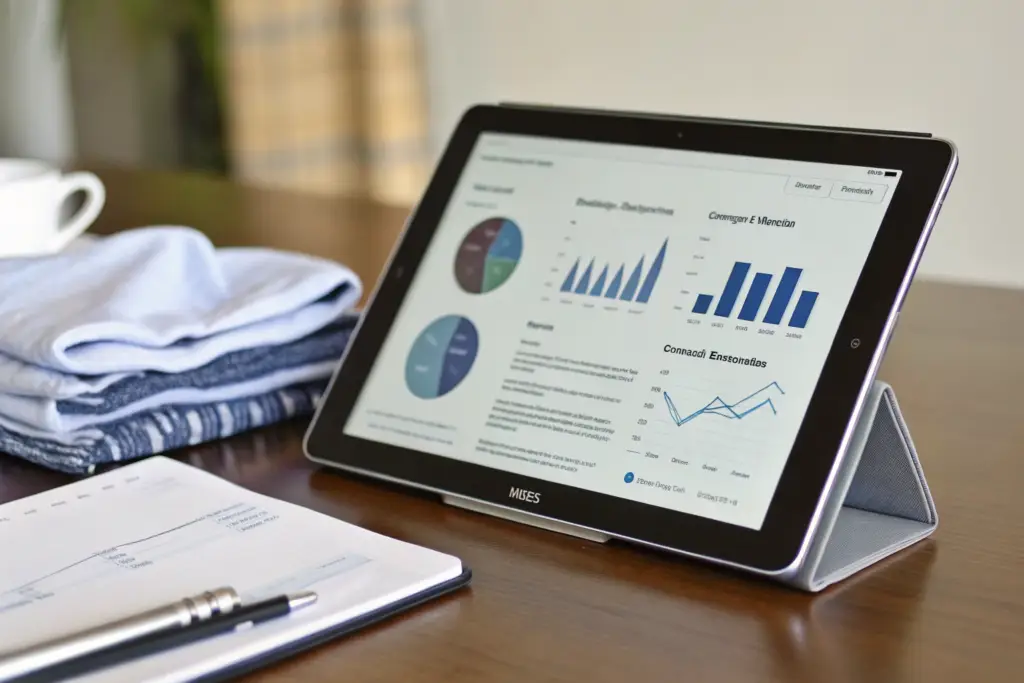
Automating catalog performance monitoring with AI means setting up a system of alerts and weekly digests that flag anomalies and opportunities without requiring you to log into a complex dashboard daily. The AI watches the numbers so you can watch the big picture.
You need to know three things: What is dying? What is exploding? What is missing?
How to Set Up AI Alerts for Slow Moving Stock?
Slow moving stock is a silent killer. It takes up warehouse space. It accrues storage fees. It ties up cash.
The AI Alert Workflow:
- Connect Data Source: Link your inventory management system (e.g., Cin7, Skubana) to an AI analytics tool via API or scheduled CSV export.
- Define Thresholds: Set a rule. "Alert me if any SKU has a Sell-Through Rate below 10% after 4 weeks of being active in the catalog."
- Automated Email/Slack Notification:
Subject: ALERT: SKU #4021 (Olive Utility Pant) - Low Velocity
Body: "This SKU is 62% below the category average for Week 4 sell-through. Recommended Action: Offer 15% discount to clear inventory before end of season storage fees apply."
The Financial Impact:
Last season, a client had 200 units of a printed rayon shirt that was not moving. The traditional method would be to notice it 3 months later during a quarterly review. By then, the season was over. They would have to sell it for $9 (below cost).
With the AI alert, they caught it at Week 4. They ran a Flash Wholesale Sale for email subscribers only. They sold 150 units at a 15% discount. They still made a 20% margin. The remaining 50 units were manageable. The AI saved them roughly $1,800 in lost margin on that one SKU.
Can AI Help Me Plan My Next Season's Assortment Architecture?
Yes. This is the final output of a mature AI catalog process. It is called Assortment Planning.
The Manual Way: You sit with a blank Excel sheet and a headache. You guess that you need "20 tops, 10 bottoms, 5 dresses."
The AI Way: The AI analyzes your last 3 seasons and the current market trend data. It outputs a Recommended Assortment Grid.
Example AI Output (Fall Season):
| Category | Last Year Units Sold | AI Recommended Change | Reasoning |
|---|---|---|---|
| Woven Tops | 2,000 | Increase by 15% | Market demand for "Going Out Tops" up 22% (Source: Faire Data). |
| Knitwear | 3,500 | Decrease by 5% | Unseasonably warm forecast for Q4 (Source: Weather Analytics API). |
| Outerwear | 1,500 | Hold Flat | Stable demand. Focus on Lightweight Jackets over heavy coats. |
| Dresses | 1,000 | Introduce 2 New Styles | "Midi Dress" search up 40% among your wholesale accounts. |
The Value to You:
This grid gives you a Negotiating Framework for factory conversations. You can come to Shanghai Fumao and say, "My AI analysis says I need to shift 15% of my volume from Knitwear to Woven Tops. Can we adjust the production line allocation?"
This is much more effective than saying, "I don't know what to make. What do you think is popular?"
AI empowers you to be the Conductor of the Orchestra, not just a musician hoping the song sounds good.
Conclusion
AI driven analytics is not about removing the human touch from fashion. It is about removing the costly guesswork. It is about making sure that the creative energy you and your designer poured into that Olive Green Linen Shirt actually gets a chance to live on a store shelf, rather than dying in a markdown bin because you made too many White shirts and not enough Sage ones.
We have walked through the practical applications. We saw how AI shifts analysis from backward-looking Excel tables to forward-looking attribute predictions. We examined how AI tools can scan wholesale marketplaces to identify the exact terms buyers are using to search for products like yours. We looked at how AI can fine-tune your pricing to capture an extra $0.87 per unit, which compounds into thousands of dollars of pure margin. And we explored how automated alerts can rescue slow-moving stock before it becomes a total loss.
In the competitive landscape of US wholesale apparel, the brands that win are not necessarily the ones with the best taste. They are the ones with the best Information Asymmetry. They know something their competitors do not. AI gives you that edge. It tells you to bet on Chambray Blue when everyone else is betting on White.
At Shanghai Fumao, we see ourselves as more than just a cut-and-sew operation. We are a data node in your supply chain. We provide the structured product data and the flexible production capabilities that allow you to pivot when the AI tells you to pivot. With our five production lines in China and our DDP shipping to North America, we can help you execute a data-driven catalog strategy with speed and precision.
If you are ready to stop guessing and start knowing what your wholesale catalog should look like, let's talk. Our Business Director, Elaine, can walk you through how our production process supports an agile, AI-informed brand.
Email: elaine@fumaoclothing.com