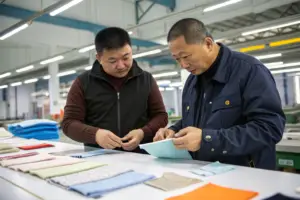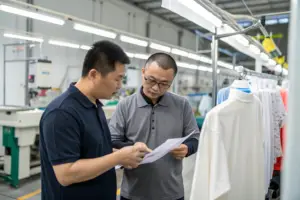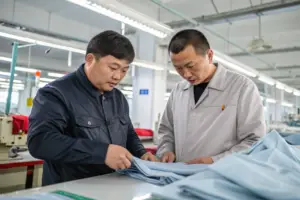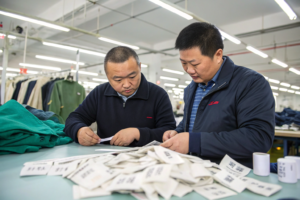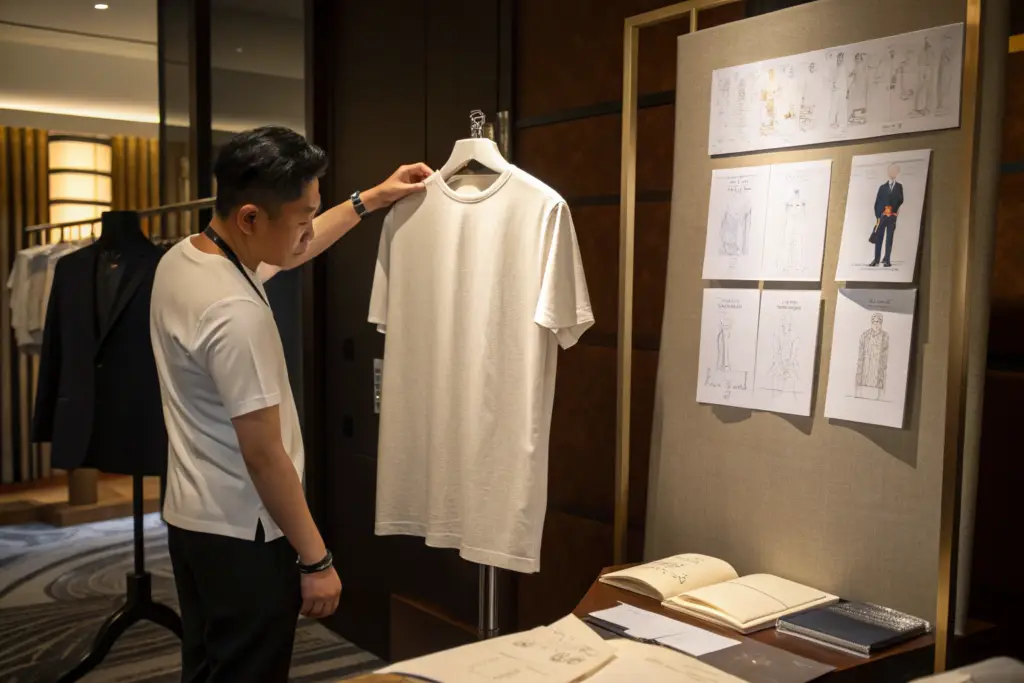
I have worked with many American brands. Some start with a simple idea. They want to import a basic garment at a low cost. Then they want to sell it at a premium price. The gap between those two points is where value is created.
The question is always the same. How do you take a low-cost imported garment and make it feel expensive? How do you convince a customer to pay three times what the garment cost to make?
I remember a client from New York. He found a factory in China making simple cotton t-shirts. The cost was $4 per piece. He wanted to sell them for $48. I told him that was possible. But he could not just put his label on the same t-shirt. He had to transform it. He had to add value at every stage. The fabric, the fit, the finishing, the packaging. Every detail had to communicate premium quality.
He listened. We worked together. He upgraded the fabric to combed cotton. We added a tailored fit with reinforced seams. We used custom labels with care. We packaged each shirt in tissue paper with a branded box. His customers paid $48. They felt the value. The shirts sold well.
As the owner of Shanghai Fumao, a Chinese apparel manufacturer with five production lines, I have helped many clients make this transformation. Turning a low-cost imported garment into a premium retail product is not about hiding the cost. It is about adding perceived value. It is about making the customer feel that they are buying something special.
In this article, I will share the strategies that work. I will show you how to upgrade fabric, improve construction, enhance finishing, and create premium packaging. I will give you real examples from my clients who have successfully made this transformation.
The fabric is the foundation. No matter how good the construction, a garment made from cheap fabric will always feel cheap. Upgrading the fabric is the most impactful change you can make.
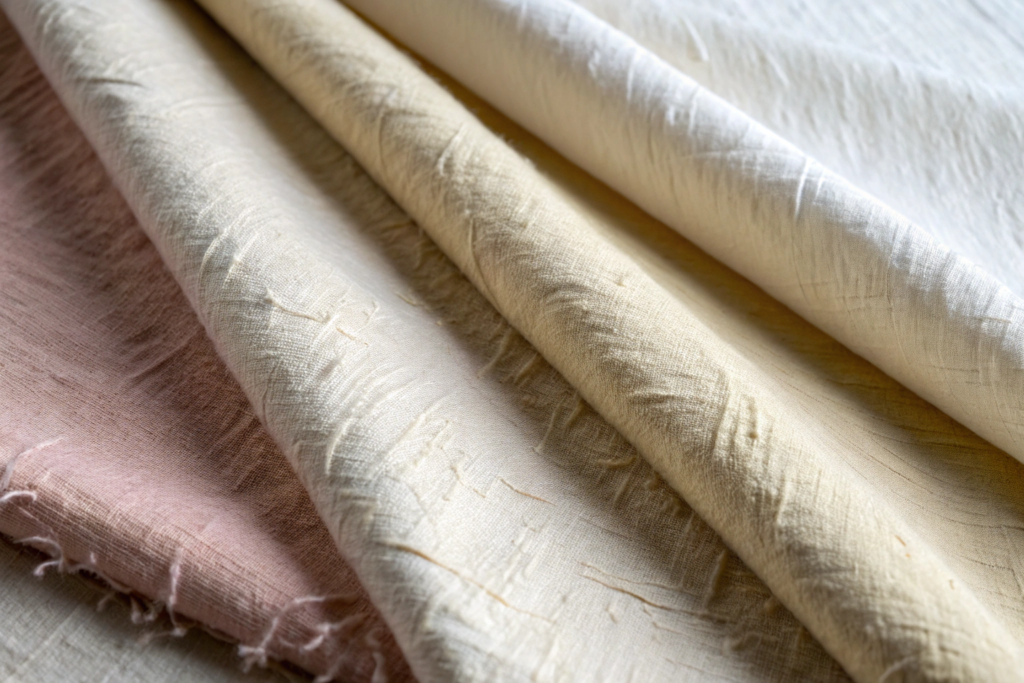
The difference between a basic garment and a premium garment often starts with the fiber quality and the fabric construction.
| Fabric Type | Basic Version | Premium Upgrade | Why It Feels Premium |
|---|---|---|---|
| Cotton | Regular cotton, open-end spun | Combed cotton, ring-spun, or Supima | Softer, smoother, more durable. Feels luxurious against skin. |
| Cotton Jersey | Standard jersey, 150 GSM | Compact cotton jersey, 180-200 GSM | Heavier weight feels substantial. Drapes better. |
| Linen | Standard linen, coarse texture | Pre-washed linen, finer weave | Softer feel. Reduced wrinkling. More comfortable. |
| Knits | Basic single jersey | Pima cotton, modal blend, or bamboo | Silky hand feel. Better drape. Feels more expensive. |
| Denim | Basic indigo denim | Selvedge denim, organic cotton, or stretch with high recovery | Authentic appeal. Better fit retention. |
| Synthetics | Basic polyester | Recycled polyester, nylon with softener | Better hand feel. Sustainability story. |
I had a client from Los Angeles who wanted to launch a premium t-shirt line. He initially planned to use standard cotton jersey. I showed him the difference between standard cotton and combed cotton. Combed cotton removes short fibers. The result is smoother, stronger yarn. The fabric feels softer and looks better.
He chose combed cotton with a 180 GSM weight. The t-shirts felt substantial. They did not feel flimsy. He priced them at $58. His customers loved them. He told me the fabric upgrade was the best investment he made.
Why does fabric weight matter for perceived quality?
Fabric weight sends a signal to the customer. A lightweight, flimsy fabric feels cheap. A heavier, substantial fabric feels premium. The customer does not know the GSM number. But their hand knows the difference.
For a t-shirt, 120-140 GSM feels basic. 160-180 GSM feels substantial. 200 GSM feels heavyweight and premium.
For a woven shirt, 80-100 GSM feels lightweight and summery. 110-130 GSM feels crisp and premium.
For a sweater, lightweight knits can feel cheap. A dense, substantial knit feels expensive.
A client from Chicago was producing a basic hoodie. The standard fabric was 280 GSM fleece. It was fine. But it felt like every other hoodie. We upgraded to 380 GSM French terry with a brushed interior. The weight difference was noticeable. The hoodie felt substantial. The client raised his price from $45 to $68. Sales increased. The higher perceived quality justified the higher price.
Fit and construction are where premium brands separate themselves. A basic garment is cut loose and sewn quickly. A premium garment is tailored. It fits better. It is constructed with care.
Fit is about proportion. A premium garment fits the body in a way that flatters. It is not too tight. It is not too loose. It is designed for the target customer.
| Fit Element | Basic Approach | Premium Approach | Perceived Value |
|---|---|---|---|
| Shoulder seam | Standard placement | Aligned with shoulder bone | Cleaner look. Better drape. |
| Armhole | Large, loose armhole | Smaller, tailored armhole | Less gaping. More flattering. |
| Waist | Straight cut | Slight contour or darts | Better shape. More feminine or athletic fit. |
| Sleeve length | Standard length | Adjusted for the silhouette | Proportion looks intentional. |
| Overall silhouette | One size fits all approach | Specific fit for target market | Customers feel the garment was made for them. |
At Shanghai Fumao, we work with clients to develop fit blocks based on their target customer. We use fit models with Western proportions. We adjust patterns based on feedback. The result is a fit that feels custom.
A client from Texas was selling basic button-down shirts. They fit okay. But they did not feel special. We worked with her to develop a new fit block. We narrowed the shoulder. We added darts at the back for a cleaner silhouette. We adjusted the sleeve length. The new fit was noticeably better. Her customers commented on how well the shirts fit. She increased her price by 30%.
What construction details signal quality to customers?
Customers may not know the technical terms. But they notice construction details. A clean seam. A reinforced collar. A neatly finished hem. These details communicate care and quality.
| Construction Detail | Basic Approach | Premium Approach | What the Customer Notices |
|---|---|---|---|
| Seams | Standard lockstitch | Flat-felled seams or French seams | Clean interior. No loose threads. |
| Collar | Basic collar with fusible interfacing | Collar with sewn-in interfacing, collar stays | Collar stays crisp after washing. |
| Buttonholes | Standard buttonholes | Hand-finished or reinforced buttonholes | Buttons feel secure. No fraying. |
| Hem | Single-fold hem | Double-fold or blind stitch hem | Clean finish. Looks intentional. |
| Lining | No lining or cheap lining | Fully lined with high-quality lining | Garment feels substantial. Drapes better. |
| Trims | Standard buttons, zippers | Custom buttons, YKK zippers, branded trims | Small details feel special. |
I had a client from Seattle who wanted to create a premium denim jacket. The basic construction was fine. But it did not feel special. We added custom metal buttons with her logo. We used heavy-gauge thread for contrast stitching. We added a custom woven label at the back neck. The small details transformed the jacket. She sold it for $180. The cost of the upgrades was $4 per jacket. The retail price increase was $60. The return on investment was clear.
How do finishing touches and trims create a luxury feel?
Finishing touches are where you add the final layer of value. Trims, labels, and small details tell the customer that this garment was made with care. These are the details that create the "aha" moment when a customer looks closely.
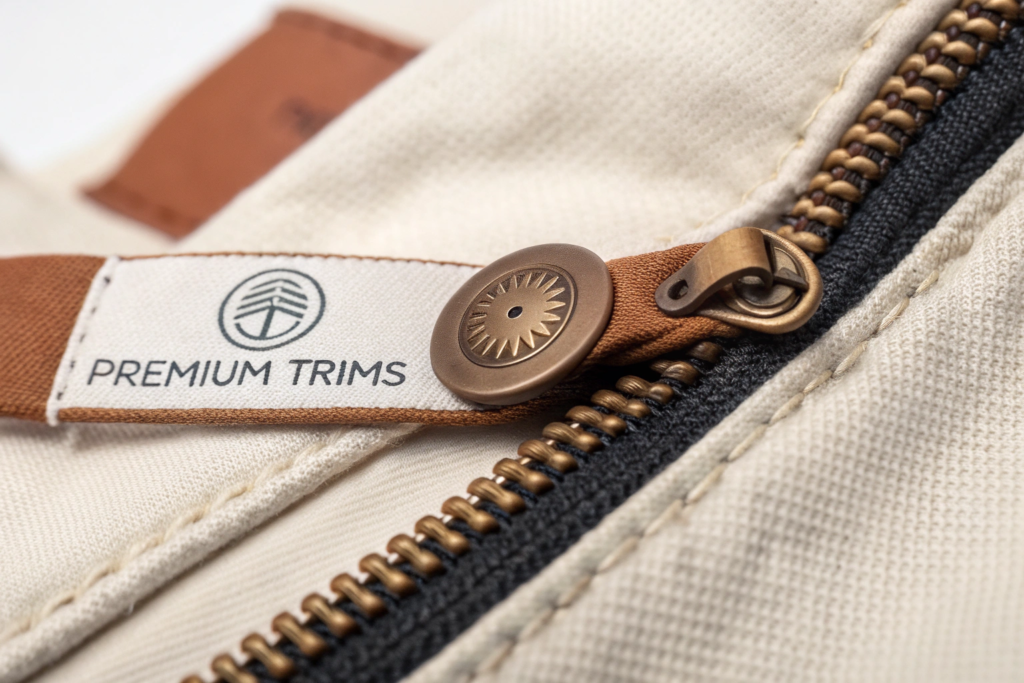
Trims are the jewelry of the garment. They catch the eye. They feel good in the hand. They communicate quality.
| Trim Type | Basic Option | Premium Upgrade | Impact |
|---|---|---|---|
| Buttons | Plastic, generic | Metal, corozo nut, mother-of-pearl, or custom-molded | Weight and texture feel substantial. |
| Zippers | Generic, plastic teeth | YKK, metal teeth, or concealed zippers | Smooth operation. Durable. Brand recognition. |
| Thread | Standard polyester | Heavy-gauge contrast thread, tonal matching | Visible stitching becomes a design feature. |
| Labels | Basic woven label | Custom leather patch, silicone label, or embossed label | Tactile quality. Unique brand expression. |
| Drawcords | Basic cotton cord | Branded aglets, premium cord with metal tips | Small detail shows attention. |
| Elastic | Standard elastic | High-retention elastic with branded casing | Better fit retention. Lasts longer. |
A client from Boston was producing joggers. The basic version had a standard drawcord with plastic tips. We upgraded to a premium cotton cord with metal aglets engraved with her brand initials. The cost increase was $0.50 per garment. Her customers noticed. She received comments about the "beautiful drawcord." She used that detail in her marketing photos.
Why does packaging matter for perceived value?
The garment is the product. But the packaging is the first interaction. A garment that arrives in a poly bag feels basic. A garment that arrives in tissue paper, with a branded box or dust bag, feels premium.
| Packaging Element | Basic Approach | Premium Approach | Customer Perception |
|---|---|---|---|
| Primary packaging | Poly bag | Tissue paper, dust bag, or branded box | Unboxing feels like an experience. |
| Labels and tags | Generic hang tag | Custom hang tag with brand story, care instructions, and QR code | Adds storytelling. Feels thoughtful. |
| Carton | Plain brown box | Branded carton with custom inserts | Even the shipping box communicates care. |
| Extras | Nothing | Thank you card, care instructions, small gift | Creates emotional connection. |
A client from Denver sold premium cashmere sweaters. The sweaters were beautiful. But they arrived in a plain poly bag. The experience felt flat. We added tissue paper, a branded dust bag, and a handwritten-style thank you card. The cost was $2 per order. Her customers started posting unboxing videos on social media. The packaging became a marketing asset.
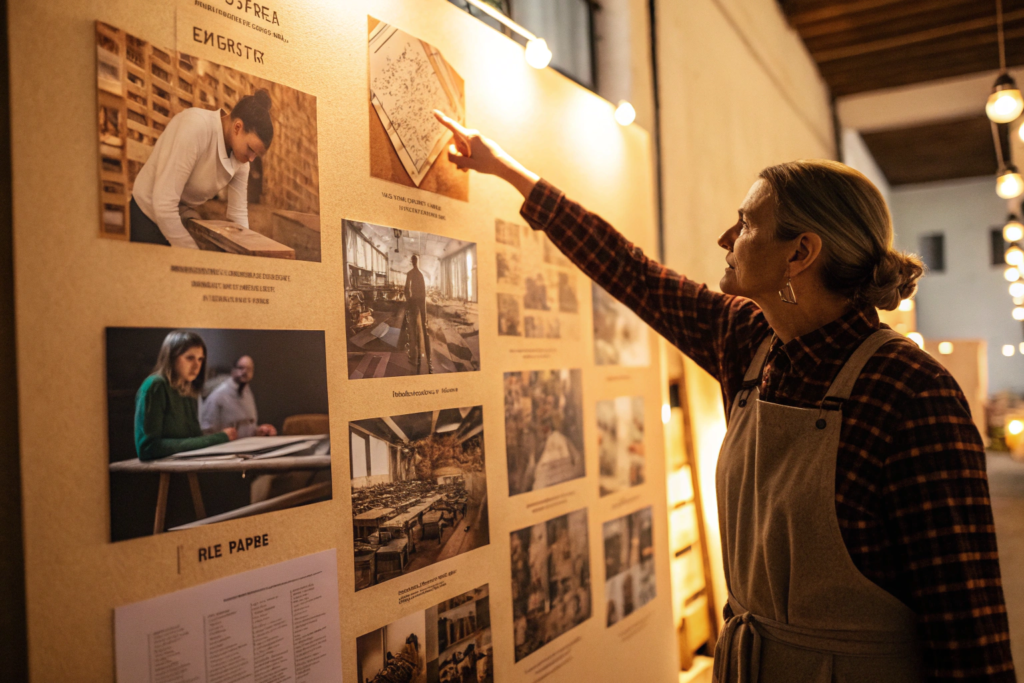
Price is not just about cost. Price is about perceived value. A brand story creates that perceived value. It tells the customer why this garment is worth more. It connects the product to emotions, values, and identity.
What elements make a compelling brand story for imported goods?
Your customers know the garment was imported. That is not a secret. The question is whether the import story adds value or subtracts value.
A compelling story turns "made in China" from a liability into an asset. It focuses on craftsmanship, heritage, or ethical production.
| Story Element | What to Highlight | Example |
|---|---|---|
| Craftsmanship | Skilled artisans, traditional techniques, attention to detail | "Hand-finished by master sewers with 20 years of experience." |
| Material sourcing | Premium materials, sustainable sourcing, unique fibers | "Made from organic Pima cotton grown in Xinjiang." |
| Ethical production | Fair wages, safe working conditions, certifications | "Proudly produced in a WRAP-certified facility." |
| Heritage | Family-owned factory, generational expertise | "Our factory has been crafting garments for three generations." |
| Sustainability | Eco-friendly processes, recycled materials, reduced water usage | "Dyeing process uses 50% less water than industry standard." |
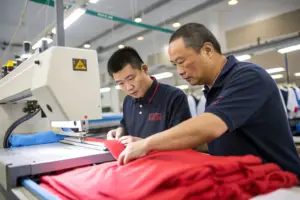
At Shanghai Fumao, we help our clients tell their story. We share photos of our factory. We explain our quality process. We provide documentation of our WRAP certification. We help clients understand the details that make their garments special.
A client from California built her entire brand around ethical production. She used our WRAP certification as proof of fair labor practices. She shared photos of our factory on her website. She told the story of the workers who made her garments. Her customers paid a premium because they trusted the story.
How do you communicate quality through marketing?
The story needs to be communicated. Use your marketing materials to highlight the details that make your garment premium.
- Product photography: Show close-ups of seams, buttons, and labels. Use natural lighting. Show the garment on a model with good fit.
- Product descriptions: Describe the fabric, the fit, and the construction details. Use words like "hand-finished," "custom hardware," and "premium weight."
- Social media: Share behind-the-scenes content. Show the factory. Show the materials. Show the people.
- Packaging inserts: Include a card that tells your brand story. Explain why the garment is special.
A client from Miami did this well. Her product photos showed close-ups of the custom buttons and the clean seams. Her descriptions mentioned the "heavy-weight combed cotton" and the "reinforced collar." Her customers felt confident in the quality before they even received the garment.
How to balance cost upgrades with retail price positioning?
Upgrading a garment costs money. You need to balance the cost of upgrades with the retail price you can achieve. The goal is to add more perceived value than actual cost.
Not all upgrades deliver the same return. Some upgrades are highly visible. They directly impact perceived value. Others are invisible. They matter for durability but not for the initial purchase decision.
Here is a framework for prioritizing upgrades:
| Upgrade Category | Cost Impact | Perceived Value Impact | Priority |
|---|---|---|---|
| Fabric quality | Medium | Very High | Highest priority |
| Fit refinement | Low (development cost) | Very High | Highest priority |
| Visible trims (buttons, zippers) | Low to Medium | High | High priority |
| Construction details (seams, hems) | Low to Medium | Medium | Medium priority |
| Labels and branding | Low | High | High priority |
| Packaging | Low | Medium to High | Medium priority |
| Invisible details (interlinings, reinforcements) | Low | Low (long-term durability) | Low priority for initial purchase |
A client from Texas used this framework. She upgraded her fabric to combed cotton. She refined the fit. She added custom buttons. The total cost increase was $3.50 per garment. She raised her retail price by $20. Her customers perceived the value. Her margins improved.
Before committing to large volumes at a higher price point, test the market. Start with a smaller run. Use the upgraded garment as a premium tier within your existing collection. See how customers respond.
Test methods:
- Pre-orders: Offer the premium version for pre-order. If customers are willing to pay before seeing the product, you have validation.
- Limited release: Release a small batch of the upgraded garment. See how quickly it sells.
- Price tiering: Offer both a basic version and a premium version. See which sells better at the higher price point.
- A/B testing: Test the premium version with a subset of your email list or social media followers.
A client from Seattle tested a premium hoodie with a limited release of 200 units. She sold out in three days. She knew the market accepted the price. She placed a larger order for the next season.
Conclusion
Turning a low-cost imported garment into a premium retail product is about adding value at every stage. It starts with fabric. Upgraded fibers and weights feel better. It continues with fit. Tailored proportions flatter the body. It extends to construction. Clean seams and reinforced details signal quality. It finishes with trims and packaging. Small details create the "aha" moment. And it is all supported by a compelling brand story that justifies the price.
At Shanghai Fumao, we help our clients make this transformation. We offer fabric upgrades. We develop custom fit blocks. We source premium trims. We produce custom packaging. We share our story so clients can share theirs.
If you are ready to take your imported garments from basic to premium, I invite you to work with us. Let us discuss your vision. Let us find the upgrades that will create the most value for your brand.
Please contact our Business Director, Elaine, to start the conversation. You can reach her at elaine@fumaoclothing.com. She can show you samples of fabric upgrades, custom trims, and premium packaging. She can help you build a collection that your customers will love at a price that works for your business.