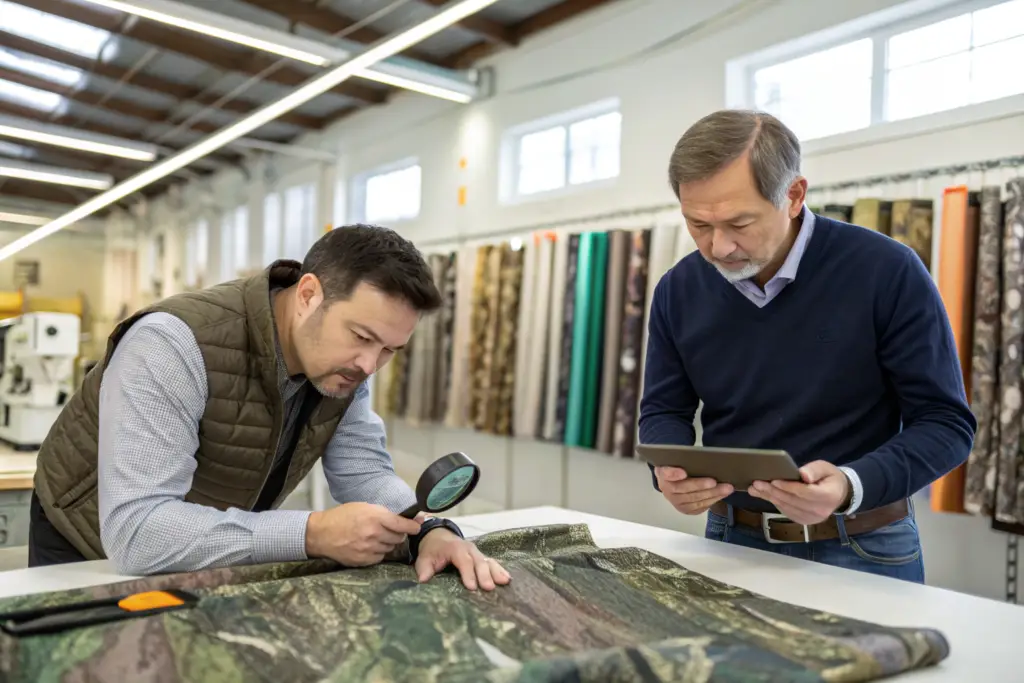
I made a mistake in 2019 that cost a client from North Carolina his entire fall season. He needed Mossy Oak Break-Up Country caps and shooting accessories. We are strong in cut-and-sew, but caps require specialized equipment. I vouched for a partner factory I had used for basic blanks. I did not audit their specific experience with licensed camouflage. The brim stitching was crooked. The pattern alignment on the panels was off by 4 millimeters. The client rejected the entire order at final inspection. I flew to Ningbo and sat at that cap factory for three days until they re-cut the order with air freight at their cost. We saved the relationship, but I learned a hard lesson. Reliability is not general. It is specific to the product and the pattern.
Assessing a manufacturer for Mossy Oak accessory production requires moving beyond generic BSCI audits and price lists. You must evaluate three distinct competencies: their specific history with the Mossy Oak licensing compliance team, their technical capability to print or weave fine-detail breakup patterns on non-apparel substrates like nylon webbing or neoprene, and their willingness to sign binding liability clauses for pattern distortion. A factory that makes excellent t-shirts can fail catastrophically on a Mossy Oak gun case.
I am the owner of Shanghai Fumao. We do not make caps or hard accessories in-house. When my clients need these items to complete their brand assortment, I do not guess. I qualify partners specifically on their Mossy Oak reliability metrics. In this guide, I will give you the exact checklist I use. I will show you the questions to ask, the documents to demand, and the red flags that signal a vendor is about to miss your season.
What specific licensing compliance proofs should you demand first?
I am always surprised when buyers tell me, "The factory said they are licensed." They accept a verbal assurance. Mossy Oak, like Realtree, is a valuable intellectual property. The brand owners do not give licenses lightly. They audit. They inspect. They require annual renewal. If your factory is using an old license that expired in 2023, your goods are counterfeit. You own the liability, not the factory.
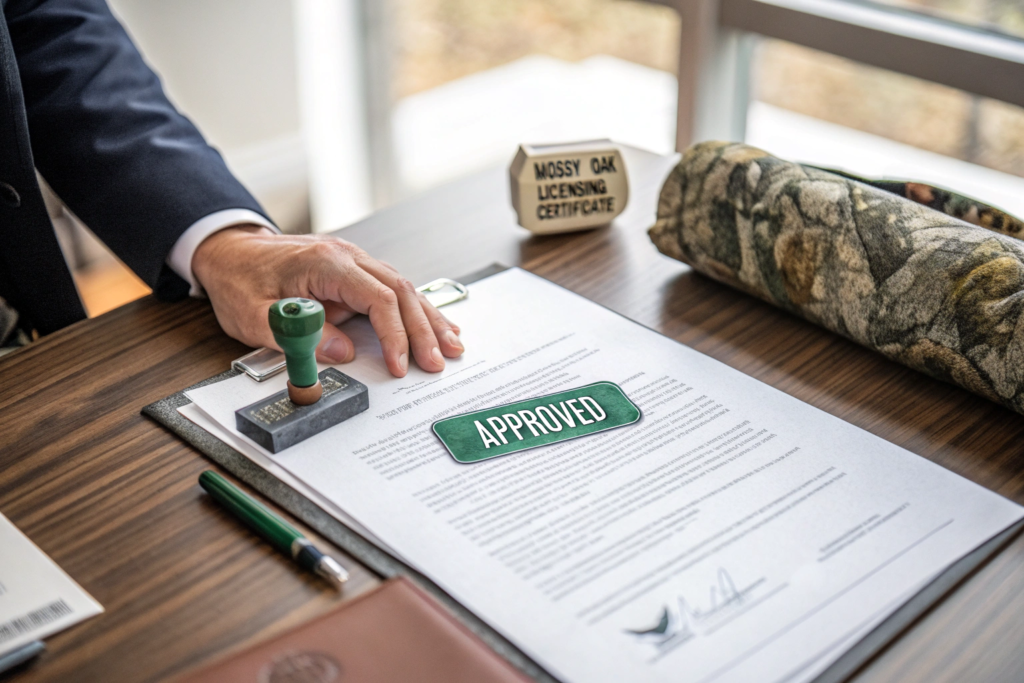
You must demand a current, valid Licensing Certificate issued directly by Haas Outdoors, Inc. (Mossy Oak). This certificate must list your specific factory name and physical address. It must specify the product categories authorized. Accessories are often a separate endorsement from apparel. Do not accept a certificate that says "apparel" if you are making dog collars. The certification must match the commercial invoice.
A client from Alabama asked me to vet a vendor for Mossy Oak dog beds last year. The vendor showed me a license. It looked authentic. I called the licensing contact at Mossy Oak. The vendor was authorized for woven shirts only. They were not authorized for home goods. They were planning to produce the beds anyway, hoping the license plate on the shirt line would cover them. The client avoided a cease-and-desist letter and a 100% inventory write-off. You can verify active licenses directly through the Mossy Oak Business Licensing Portal. Use it. It takes five minutes and saves your season.
How do you verify the license is tied to the correct legal entity?
Factories change names. They open new shell companies to hide poor audit scores. You must cross-reference the license with the factory's Business License issued by the State Administration for Market Regulation. The unified social credit code must match. If the license says "Ningbo Textile Co., Ltd." but the invoice comes from "Ningbo Textile Export Ltd.," you have a problem. The exporter may be a trading desk renting space in the licensed building. They are not authorized to produce Mossy Oak. We recently helped a Texas-based hunting accessories brand untangle this. The trading company lost the license. The factory kept it. We shifted the contract to the factory entity and saved the reorder.
What is the difference between a "printer license" and a "brand license"?
This is a nuanced point that causes major seizures. Some factories hold a Printer Authorization. This means Mossy Oak allows them to print the pattern and sell the fabric by the yard to other licensed brands. It does NOT mean they can manufacture finished goods and sew your label inside. If you buy finished hats from a printer, you are technically manufacturing without a license. Customs may detain your shipment for "counterfeit IP." Always confirm: "Are you authorized to produce finished consumer goods, or are you authorized only to print rolls?" If the answer is the latter, you still need your own brand license or a subcontractor endorsement.
How does substrate compatibility affect Mossy Oak pattern durability?
Mossy Oak patterns are highly detailed. They rely on micro-printing of leaves, twigs, and shadow lines to create the "break-up" effect. If you print this pattern on a stretchy cotton jersey, the ink absorbs and flexes. If you print it on a slick, high-tenacity nylon for a tactical vest, the ink sits on top. It scratches. It flakes. It fails.
The reliability of a manufacturer is directly proportional to their experience with your specific substrate. A factory that only prints on 100% cotton will destroy your Mossy Oak accessory program if you move to polyester webbing, waterproof oxford fabric, or TPU-coated zipper pulls. The ink formulation changes. The curing temperature changes. The stretch percentage changes. They must prove they have done this exact combination before.
In 2022, a client from Florida wanted Mossy Oak Shadow Grass Blades printed on a silicone grip panel for a fishing rod handle. Silicone is non-porous. Standard plastisol ink peels off immediately. We worked with a specialty printer in Guangdong that uses UV-cured ceramic etching. We tested 14 iterations. We passed the abrasion test at 5,000 cycles. The product launched successfully. If we had sent that job to a standard t-shirt printer, the returns would have bankrupt the program.
What specific ASTM tests apply to accessory prints?
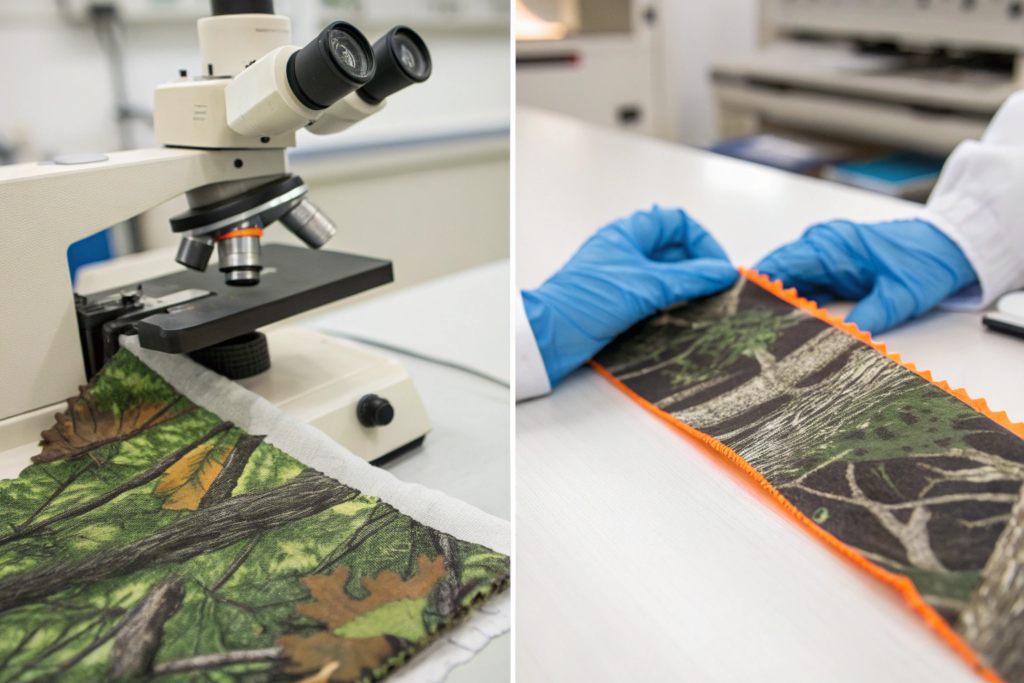
Do not accept "we tested it and it feels strong." You need data. For accessories exposed to friction, like backpack straps or holsters, require ASTM D3886 for abrasion resistance. For items exposed to rain or sweat, require AATCC 193 for water repellency. For items that flex repeatedly, like ammo pouch flaps, require a flex test at -10°C if your customer hunts in the Dakotas. We require our accessory partners to submit third-party lab reports from SGS or BV before bulk production. If they hesitate, they are hiding something.
How does yarn dyeing versus piece dyeing affect Mossy Oak?
Most Mossy Oak apparel is "piece dyed" or "printed." You weave white fabric, then print the camo on top. This is cost-effective. However, for high-end accessories like performance fishing shirts or technical packs, "yarn dye jacquard" is superior. The camo pattern is woven into the fabric using different colored yarns. It never washes off. It never fades unevenly. It is expensive and rare. Only specialized mills in Japan and a few in China do this well. If your brand positions at the absolute premium tier, ask your manufacturer if they have jacquard capability. If they look confused, they are not your partner for this project.
What is the acceptable defect rate for complex accessory patterns?
Every factory has a defect rate. Zero defects is not realistic. It is a myth salespeople tell you to win the order. The question is not whether defects occur. The question is what rate you accept and how the factory sorts them out.
For Mossy Oak accessories, the acceptable AQL (Acceptable Quality Limit) should be stricter than for basic apparel. For a solid black t-shirt, a General II, AQL 2.5 is common. For licensed camouflage accessories, you should demand General I, AQL 1.0 or 1.5. This means fewer than 1.0 defects per hundred units. The difference is the "print registration" defect category. Misalignment of the pattern by more than 3mm is a major defect. It destroys the camouflage effect.
A client from Missouri sourced Mossy Oak trail camera bags in Vietnam in 2021. The factory used an AQL 2.5 standard. They accepted bags where the camo print was visibly skewed on the front panel. The bags arrived at the retailer. The retailer rejected the entire pallet at the receiving dock. The client paid return freight and liquidation costs. They lost $47,000. We now build AQL 1.0 into our contracts. We inspect at the factory. We send video. You see the defects before the container seals.
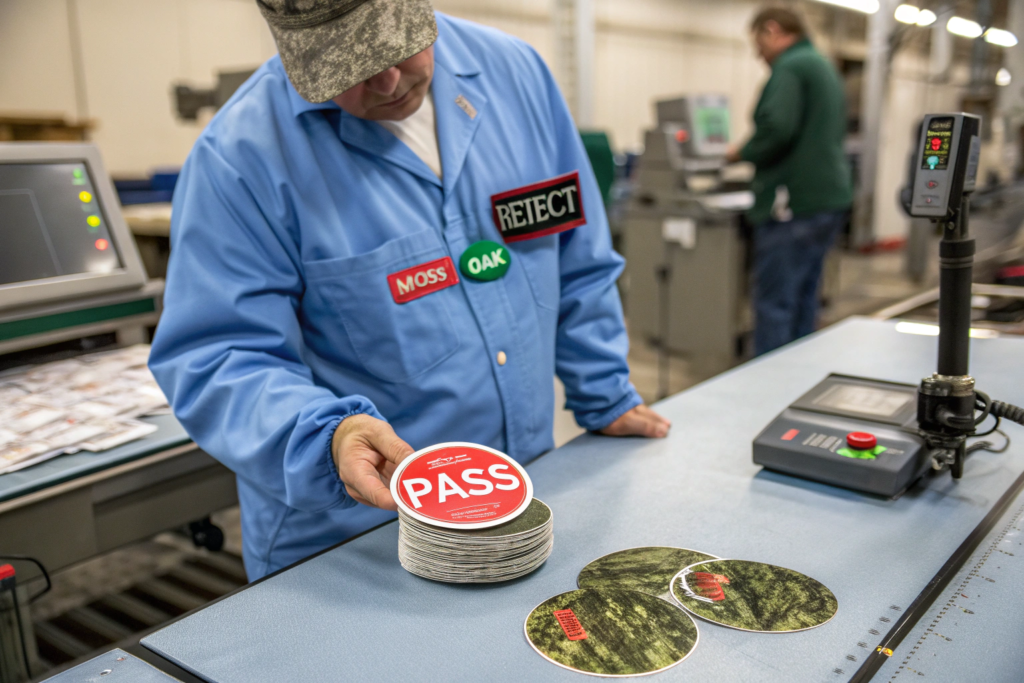
How do you define a "critical" defect in camo registration?
You must define this in your technical specification. Do not say "pattern should look correct." This is subjective. Say: "The primary Mossy Oak leaf element must be fully visible and not truncated at any seam. Pattern shift from the approved strike-off must not exceed 2mm in the horizontal or vertical axis. Any color variation beyond Delta E 1.0 under D65 light is rejectable." We provide our clients with a sealed Production Limit Sample. This is the physical standard. The factory cannot guess. They match the sample. We also cross-reference color standards using Pantone Capsure readings to eliminate visual bias between my eyes and yours.
What is the financial impact of a 1% defect rate increase?
I want you to think about this mathematically. You order 50,000 Mossy Oak caps at $8.00 FOB. Your total investment is $400,000. If your defect rate is 2% instead of 1%, you have 1,000 defective caps. You cannot sell these at full price. You sell them to an off-price channel at $3.00. You lose $5.00 per cap. You lose $5,000. That is painful. But the real loss is your retail partner's trust. They ordered 50,000 sellable units. They received 49,000 sellable units and 1,000 units they cannot put on the floor. Their inventory system is off. Their planogram has gaps. Next season, they order 40,000 units from a more reliable vendor. The $5,000 defect cost becomes a $400,000 lifetime value loss. Reliability is an investment in your future revenue.
How should logistics and DDP terms be adjusted for accessory orders?
Accessories are not apparel. This sounds obvious, but buyers treat them the same in logistics. A hoodie is soft. It compresses. You can pack 500 hoodies in a carton and squeeze the air out. A Mossy Oak backpack has a rigid frame. A gun case is long and inflexible. A molded holster has shape. If you ship these on a mixed pallet with heavy cut-parts, the accessories crush.
You must segment your DDP freight strategy. Apparel ships in 40HQ containers by cubic meter. Rigid accessories ship by pallet position. Do not let a generalist freight forwarder mix them. We learned this in 2020 when a client's Mossy Oak folding stools arrived with bent legs because 500 pounds of denim jackets were stacked on top of them. We now ship accessory orders on dedicated pallets with corner boards and edge protectors. We pay slightly more for freight. We save the client 100% of the damage claims.
We also adjust the Incoterm based on the accessory value. For high-value, low-volume accessories like optics covers or GPS pouches, we sometimes shift to CIP (Carriage and Insurance Paid to) instead of DDP. This gives the buyer control over the last-mile courier. We learned this from a client in Wyoming. His remote location added $400 in trucking fees that generic DDP rates did not cover. We flex the terms. We do not force a square peg in a round hole.
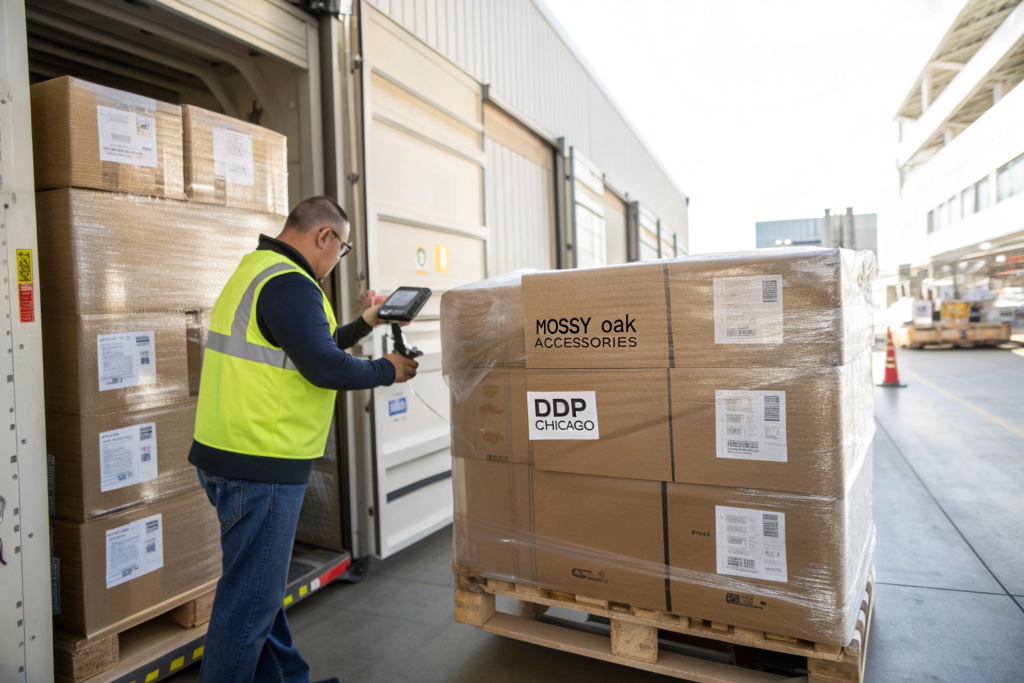
What is the optimal cartonization for non-apparel SKUs?
Do not assume your factory knows how to pack Mossy Oak accessories for US retail. Many accessory factories in Asia primarily serve local markets or European distributors who use different shelf standards. You must specify: maximum carton weight (usually 22kg for OSHA compliance), carton dimensions (must fit standard 48x40 pallets), and inner packing (poly bags must be printed with "Mossy Oak" or left clear?). We provide a detailed Packing Specification Sheet to every accessory vendor. We require photos of the packed carton before sealing. We check for sharp staples that scratch painted surfaces. We verify the desiccant packs are food-grade if the accessory touches skin. These details differentiate a professional vendor from a casual one.
How do you protect against "country of origin" marking violations?
Accessories are heavily scrutinized by US Customs for marking compliance. Each individual unit must be marked "Made in China" in a conspicuous, permanent location. For a t-shirt, this is easy. You sew a label. For a Mossy Oak branded decal or a small zipper pull, it is difficult. I have seen shipments detained because the factory stamped the marking on the poly bag, not the product. The poly bag is packaging. It is discarded. The product enters the US stream unmarked. This is a Section 304 violation. You can be fined. The goods can be exported. We audit every accessory SKU specifically for this. We stamp, deboss, or sew the marking. We photograph it. We keep the photo in the shipment file for five years. I recommend you verify this requirement with your customs broker using the CBP Marking Rulings before you place the order.
How can you stress-test a new vendor before committing to bulk?
You would not marry someone after one coffee. Yet buyers often commit to a $200,000 production order based on one 30-minute Zoom call and a price list. This is high-risk behavior. You must stress-test the vendor.
A reliable manufacturer for Mossy Oak accessories will pass the "Three Sample" test. First, the Development Sample. This proves they can interpret your tech pack. Second, the Photo Sample. This proves they can execute the print registration to Mossy Oak standards. Third, the Test Run. This is a mini-bulk order of 50 to 100 units that goes through your full supply chain, including your 3PL and your returns department. Only then do you release the full quantity.
We did this with a client from Pennsylvania who was launching a Mossy Oak game cleaning kit. Gloves, aprons, cutting boards. The development sample was excellent. The photo sample was excellent. The test run of 50 units revealed that the waterproof coating on the apron delaminated at 40°C, which is normal warehouse temperature in Arizona in July. We caught it. We changed the adhesive. We saved the full order of 8,000 aprons. If we had gone straight to bulk, the failure rate would have been 80%.
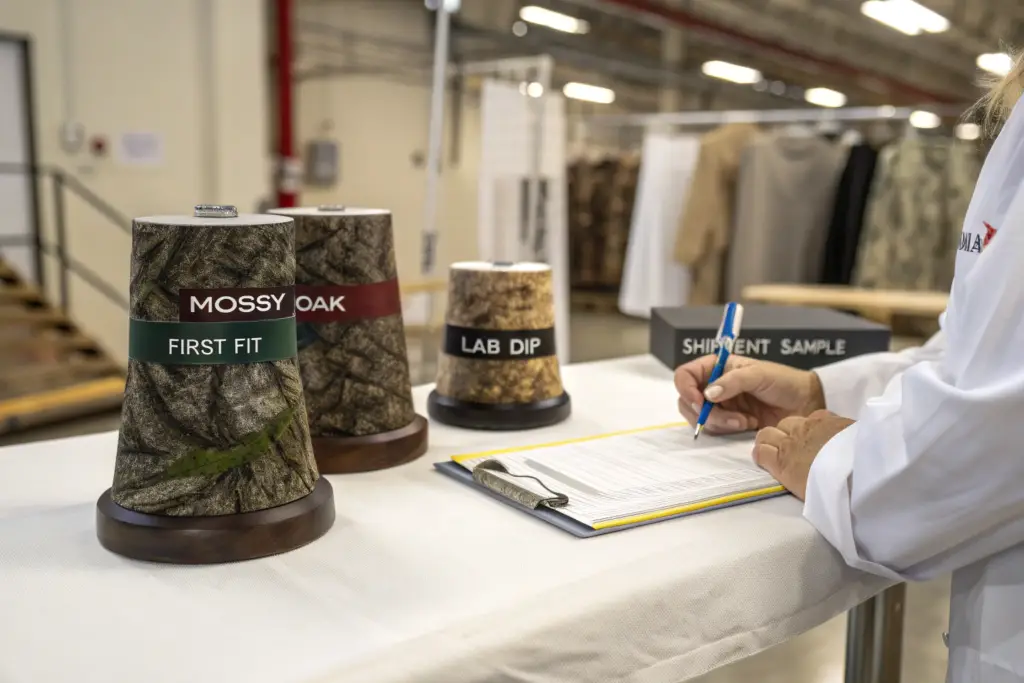
What is the "Capacity Buffer" test?
Ask your vendor: "If I double my order next week, what happens?" The reliable vendor says: "I can shift resources, but I need 45 days and I may need to air freight some components. The cost will increase by X%." The unreliable vendor says: "No problem! Same price! Same lead time!" This is a lie. They will still take your order. They will then subcontract it to an unqualified workshop at 2 AM. You will discover this when the pattern registration fails. We are honest about our capacity. We currently run at 85% utilization. We keep 15% buffer for client emergencies and reorders. If you need more, we schedule it. We do not hide the math.
How do you validate their understanding of Mossy Oak's "Break-Up" science?
Ask them to explain, in their own words, why the pattern works. If they say, "It looks like trees," they fail. If they say, "The pattern uses macro-patterns for large shapes and micro-patterns to mimic bark texture at distance," they understand. Mossy Oak is not just a print. It is a scientifically developed optical illusion. A vendor who understands this will respect the registration tolerances. A vendor who sees it as "just brown and green spots" will treat your quality requirements as annoying nitpicking. Choose the former.
Conclusion
Assessing a manufacturer for Mossy Oak accessory production is a forensic exercise. You are not just checking if they have sewing machines. You are checking if they have the specific color management software for shadow grass tones. You are checking if their logistics team knows how to brace a long gun case against shifting in a 40HC container. You are checking if their compliance officer renewed the license on January 1st, not January 31st.
I built Shanghai Fumao to serve as a bridge between ambitious American brands and this complex reality. We do not claim to make every accessory in-house. We do claim to vet every partner we recommend with the same rigor I apply to our own cut-and-sew lines. If you need Mossy Oak backpacks, we will find you the factory that has passed the Mossy Oak annual audit for five consecutive years. If you need caps, we will introduce you to the facility that owns its own laser-guided panel cutting machines. We do not take commissions. We do not mark up their prices. We do this because a client who trusts us for their core apparel program should trust us for their peripheral accessory expansion.
If you are currently struggling to find a reliable vendor for your Mossy Oak accessories, or if you are worried your current vendor is cutting corners on the license validation, let us help you.
Please contact our Business Director, Elaine. She manages our strategic vendor partnerships and accessory sourcing programs. She will discuss your specific product category, recommend pre-qualified manufacturers, and facilitate the initial sample development. You do not need to fly to China to find the right partner. You just need the right introduction. Her email is: elaine@fumaoclothing.com. You can review our primary apparel manufacturing capabilities at our website: https://shanghaigarment.com/. We look forward to earning your trust, one accessory at a time.