As a garment importer, you negotiate fiercely on price and payment terms. You secure a great FOB price and 30% deposit terms. But when the shipment arrives, you get a shock: a $4,000 bill from your freight forwarder for local port fees, customs clearance, and trucking—costs you didn’t budget for. The factory says, “That’s your responsibility under FOB.” Your profit margin just vanished. This painful scenario happens daily because importers prioritize payment terms but treat Incoterms as fine print.
Understanding Incoterms is as critical as payment terms because they legally and financially define where your risk and costs transfer from supplier to buyer in the shipment journey. While payment terms dictate when you pay, Incoterms define what you are paying for and who is responsible for logistics, insurance, and risk at every stage. Misunderstanding them leads to unexpected costs, shipment delays, and legal liability for lost or damaged goods.
Think of it this way: Payment terms are the “when” of your money; Incoterms are the “where” and “who” of your goods. Both are non-negotiable pillars of a secure transaction. Let’s dissect why mastering these three-letter codes is non-negotiable for your bottom line.
How Do Incoterms Directly Impact Your Landed Cost?
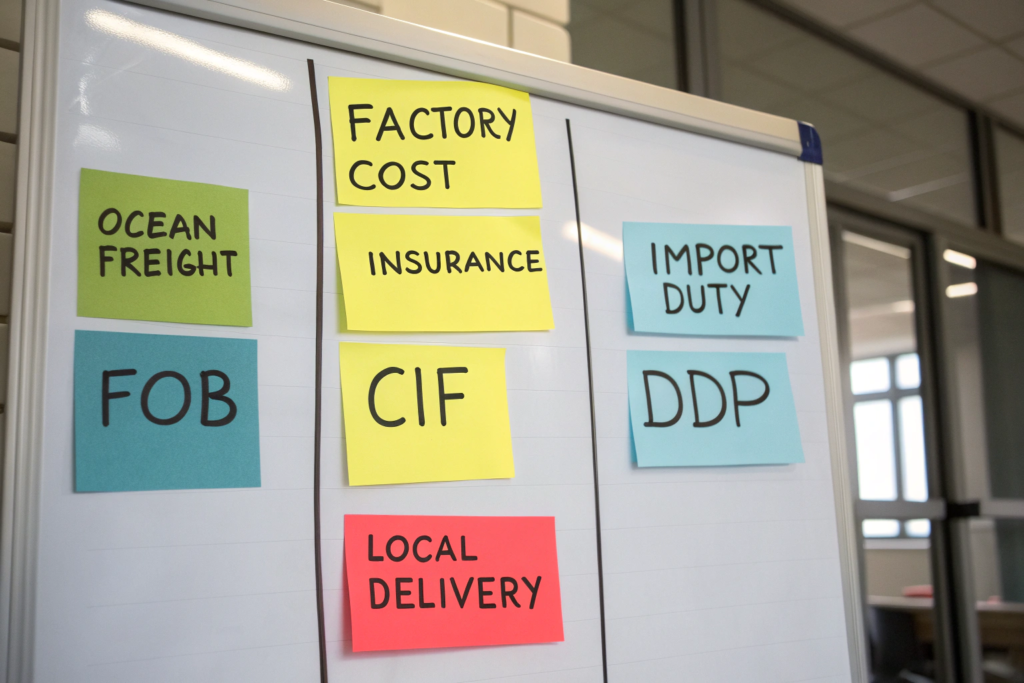
Your negotiated FOB (Free On Board) price is not the final cost of your goods. It’s merely the starting point. The chosen Incoterm dictates which additional logistics costs—often amounting to 20-40% of the FOB value—you, the buyer, must pay separately.
Incoterms directly determine your landed cost by allocating responsibility for major expense categories: international freight, marine insurance, import duties, and local delivery. Choosing FOB over CIF or DDP can mean the difference between a predictable all-in cost and a cascade of hidden, variable fees that destroy your margin.
What Costs Are You Responsible for Under Common Incoterms?
- EXW (Ex Works): You pay for and manage everything from the moment goods leave the factory gate. This includes local trucking in China, export customs, ocean freight, insurance, import customs, and final delivery. It offers the lowest factory price but the highest risk and management burden for you.
- FOB (Free On Board): The factory’s responsibility ends once goods are loaded on the ship at the origin port. You pay for the main carriage (ocean freight), insurance, and all destination costs. This is common but leaves you vulnerable to freight rate spikes.
- CIF (Cost, Insurance & Freight): Factory pays for ocean freight and basic insurance to your destination port. You pay for all costs after the ship arrives: port fees, customs clearance, duties, and final delivery. Risk transfers to you at the origin port.
- DDP (Delivered Duty Paid): Factory is responsible for delivering the goods to your designated warehouse, with all costs and risks covered, including import duties. You get one all-in price. This is the simplest but usually comes at a premium.
Last year, a client insisted on EXW to get the “lowest price” from a factory, not understanding the term. They failed to arrange export customs in China, causing the goods to be stuck for three weeks and incurring over $2,500 in demurrage fees. Their “low price” became their most expensive lesson.
How Can Misaligned Incoterms Lead to Costly Disputes?
If your contract says “FOB Shanghai” but you assumed the factory would handle export customs clearance (which is their responsibility under FOB), you’ll face delays and extra charges. The contract rules. At Shanghai Fumao, we explicitly confirm Incoterms and provide a cost checklist to clients. For example, under FOB, we remind them: “You must book freight, pay for it, and handle import customs. We will handle export clearance and deliver to the port.”
Who Bears the Risk When Goods Are Lost or Damaged?
Payment terms protect your money, but Incoterms protect your cargo. The moment risk transfers from seller to buyer is defined by the Incoterm, not by when you pay or when the ship sails. If goods are lost or damaged before that point, it’s the supplier’s problem. After that point, it’s yours—and your insurance company’s.
The risk of loss or damage transfers at a specific geographic point defined by the Incoterm. Under FOB, risk transfers when goods pass the ship’s rail at the origin port. Under DDP, risk stays with the supplier until delivery to your door. Not having insurance coverage for your period of risk is a catastrophic financial vulnerability.
What Happens in a “No Insurance” Scenario?
Assume you use CIF. The factory provides basic marine insurance (typically covering 110% of the good's value). But if the ship is delayed, causing you to miss your selling season, basic insurance does not cover this economic loss. If you use FOB and forget to buy insurance, and the container falls overboard, you lose the entire cargo and still owe the factory the balance payment. A sportswear brand learned this the hard way when a container fire damaged their goods mid-ocean under an FOB shipment. They had no insurance and absorbed a $75,000 loss.
How Do Incoterms Interact with Your Insurance Policy?
You must ensure your marine insurance coverage is active from the exact point risk transfers to you. For FOB, your policy should start “from the ship’s rail at the port of loading.” For EXW, it should start “from the factory gate.” Always confirm coverage with your insurer based on your chosen Incoterm. This is a non-delegable task.
How Do Incoterms Affect Your Control Over Logistics?
Your choice of Incoterms determines how much control you have over the shipping process—which directly impacts cost, speed, and reliability. Ceding too much control to save time can cost you money and flexibility.
Incoterms dictate your control over carrier selection, freight negotiation, routing, and scheduling. Terms like EXW and FOB give you maximum control (and burden). Terms like CIF and DDP give control to the supplier, which can be efficient but may result in slower or more expensive shipping options that prioritize their convenience, not your deadline.
Why Might FOB Give You Better Leverage?
With FOB, you choose and contract with your own freight forwarder. You can negotiate rates, select a faster vessel, or use a forwarder you trust for smooth customs clearance. This is crucial during peak seasons when space is tight. A client of ours switched from CIF to FOB and used their forwarder’s relationship to secure container space two weeks faster than the factory’s agent could, hitting a critical Black Friday deadline.
When Does DDP Make Sense Despite Less Control?
For new importers or for smaller shipments, DDP simplifies everything. The factory (or their agent) handles the complex chain. At Shanghai Fumao, we offer DDP for clients who want predictability. We quote an all-in landed cost, and we manage the logistics. The trade-off is that you pay for our management and assume we will choose a cost-effective, not necessarily the fastest, route. It’s a balance of control versus convenience.
What Is the Strategic Link Between Incoterms and Payment Terms?
These two concepts are deeply intertwined. Your cash flow needs and risk tolerance should influence your choice of both. They form the financial and operational backbone of your purchase order.
The strategic link is that Incoterms determine when you incur major costs, which must be aligned with your payment schedule. For example, under DDP, your largest cost is bundled and may be due before shipment. Under FOB, a large freight payment is due to your forwarder separately, after you’ve paid the factory. Your cash flow plan must account for both.
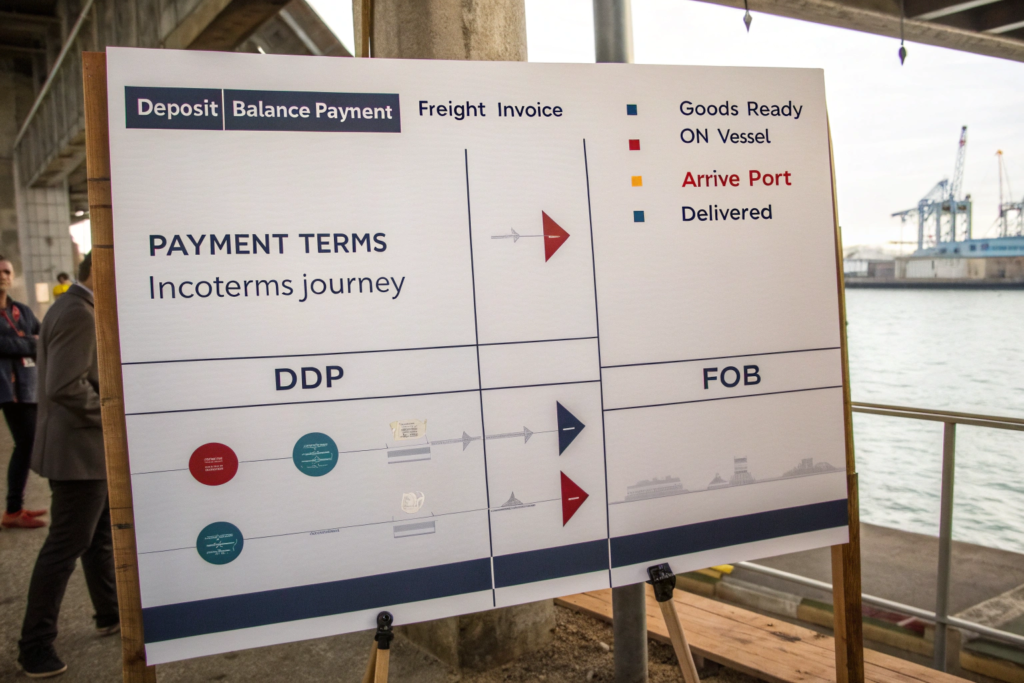
How to Structure Payments with Different Incoterms?
- For DDP Orders: Since the factory bears all costs upfront, they may require a higher deposit (e.g., 50%) and the balance before shipment to cover their outlay for freight and duties.
- For FOB Orders: A standard 30/70 payment split is common. But remember, the 70% balance due before shipment does not cover the freight you must pay your forwarder separately. You need cash reserved for that.
A common cash flow mistake is to spend all reserved funds on the factory balance payment, leaving nothing to pay the forwarder, who then won’t release the goods.
Can Incoterms Affect Your Negotiating Power?
Absolutely. Offering to use DDP can be a strong negotiating point for a factory. It gives them control and potentially extra margin on logistics. In return, you might negotiate better payment terms, like a lower deposit. Conversely, insisting on EXW might get you a lower unit price, but you’ll need to demonstrate you have a competent freight forwarder to handle the complex logistics, or the factory may see you as a high-risk client.
Conclusion
Treating Incoterms as secondary to payment terms is one of the costliest errors an apparel importer can make. They are two sides of the same coin: one governs the flow of money, the other governs the flow of goods and risk. Mastery of both is what separates profitable, smooth operations from those plagued by budget overruns and logistical nightmares.
Before your next order, clarify the Incoterms in your contract as vigorously as you debate the price. Understand exactly which costs and risks are yours, ensure you have the insurance and cash flow to cover them, and choose terms that align with your operational capacity. At Shanghai Fumao, we believe an educated partner is a successful partner, and we are committed to providing this clarity in every transaction.
If you want to eliminate financial surprises and build a sourcing strategy where every cost and risk is transparent and managed, let’s talk. We can help you select the right Incoterms and payment structure for your business. Contact our Business Director, Elaine, at elaine@fumaoclothing.com.