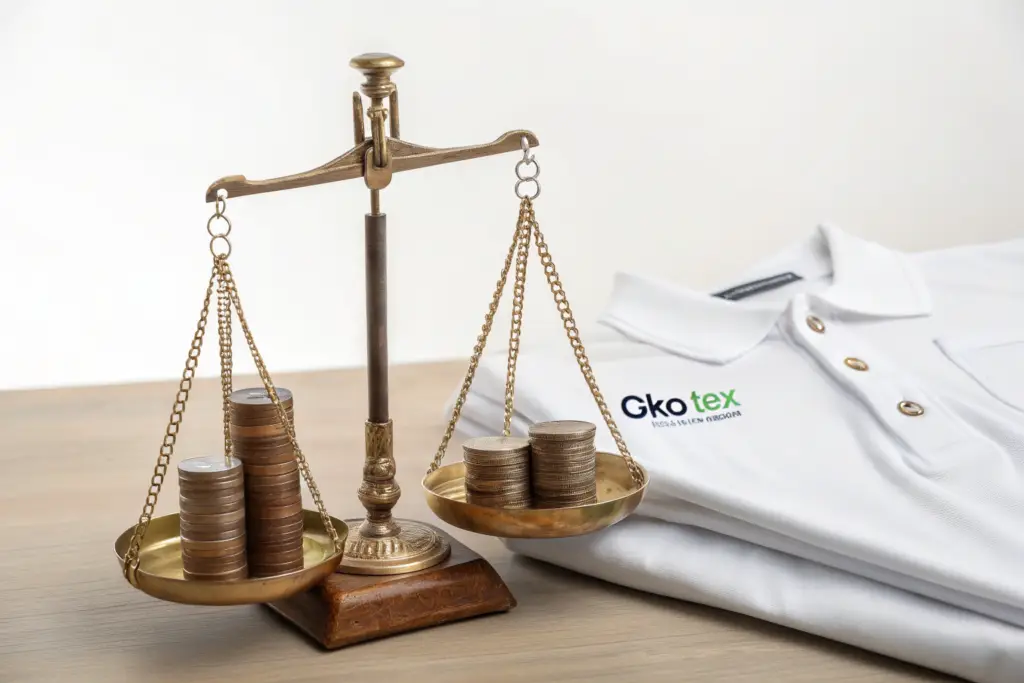
For any apparel brand, the equation of cost versus quality is a daily calculation. When you add OEKO-TEX certification into the mix, many fear the balance tips irreversibly toward higher cost. As a factory owner who has guided dozens of brands through this, I can tell you that balance is not only possible—it’s where the smartest brands build their long-term advantage. The secret isn't about cutting corners; it's about making strategic choices that maximize value at every stage of production.
You balance cost and quality in OEKO-TEX certified production by viewing certification not as an added expense, but as a framework for smarter sourcing and more efficient manufacturing. The key strategies include consolidating material orders, designing for certification from the start, selecting the right factory partner, and leveraging the certification as a premium branding tool that justifies value. Last year, we helped a mid-sized golf brand optimize their line. By rationalizing their fabric palette to three OEKO-TEX certified bases used across multiple styles, they reduced per-meter costs by 18% through volume discounts while maintaining top-tier quality, and their marketing conversion rate on those items rose by 30%.
Achieving this balance requires moving beyond a checklist mentality to a strategic partnership with your manufacturer. Let’s explore the practical steps.
Can Smart Fabric Sourcing Reduce Certified Material Costs?
Yes, absolutely. Fabric is typically the largest cost component, and sourcing for certification is where the most significant savings can be found—without compromising quality.
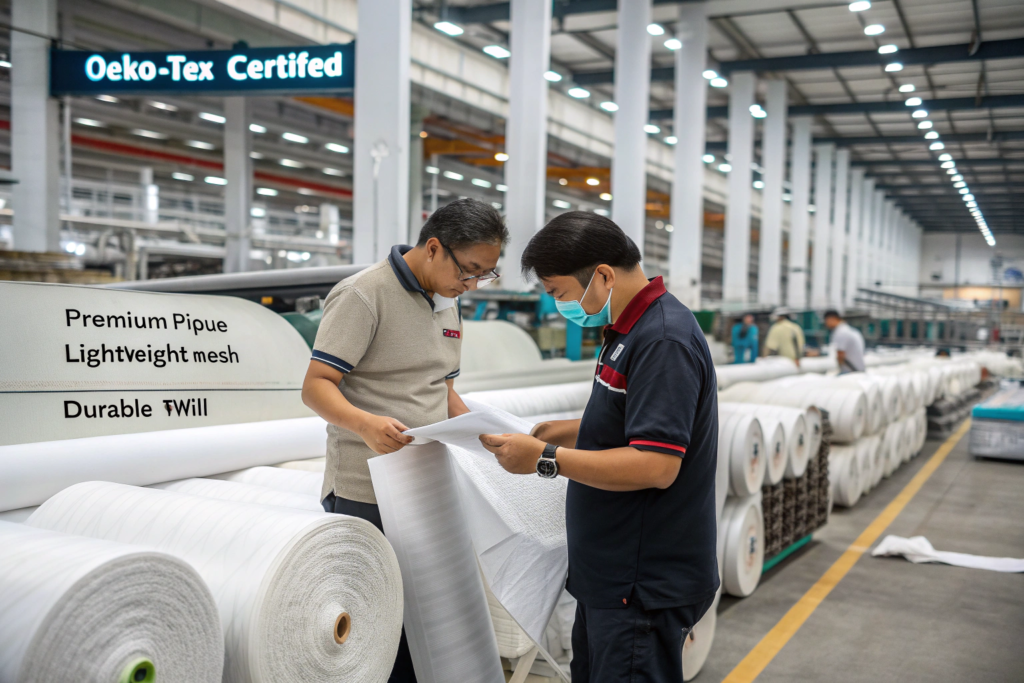
Smart fabric sourcing for certified production reduces costs by leveraging economies of scale, building long-term relationships with specialized mills, and prioritizing versatile, pre-certified fabric bases over custom, one-off developments. The most common mistake is developing a unique fabric for every single style. Instead, work with your manufacturer to identify 2-3 high-performance, OEKO-TEX certified fabrics (e.g., a premium pique, a lightweight mesh, a durable twill) that can serve as the foundation for 80% of your collection. This volume commitment gives you negotiating power.
How does fabric consolidation create savings?
Consolidating your fabric portfolio has multiple cost benefits:
- Lower Unit Price: Mills offer substantial discounts for larger, repeat orders.
- Reduced MOQs: Instead of meeting a high minimum order quantity (MOQ) for five different fabrics, you can place one larger order for two, making production planning more efficient.
- Less Waste: Larger fabric rolls mean less end-of-roll waste in the cutting room.
- Simplified Certification: Fewer fabric types mean fewer individual items to submit for testing, lowering testing fees. A factory like Shanghai Fumao maintains an inventory of popular certified fabrics, allowing brands with smaller orders to access bulk pricing without holding stock themselves.
Should you choose pre-certified or custom-certified fabrics?
This is a critical decision point:
- Pre-Certified Fabrics: These are a mill's standard fabrics that already hold an OEKO-TEX certificate. They are almost always more cost-effective and have faster lead times. The quality is proven and consistent.
- Custom-Certified Fabrics: You develop a unique fabric (color, weight, composition) and then pay for it to be certified. This is significantly more expensive due to development and testing costs, and should be reserved for true signature pieces.
For most brands, building a core collection on pre-certified bases and perhaps introducing one custom-certified "hero" fabric per season is the optimal balance. It ensures competitive pricing while allowing for unique design expression.
How Does Design-for-Certification Optimize Manufacturing?
Design decisions made on a computer screen have a massive downstream impact on both certification feasibility and production cost. Designing with certification in mind from the outset is a powerful cost-control tool.
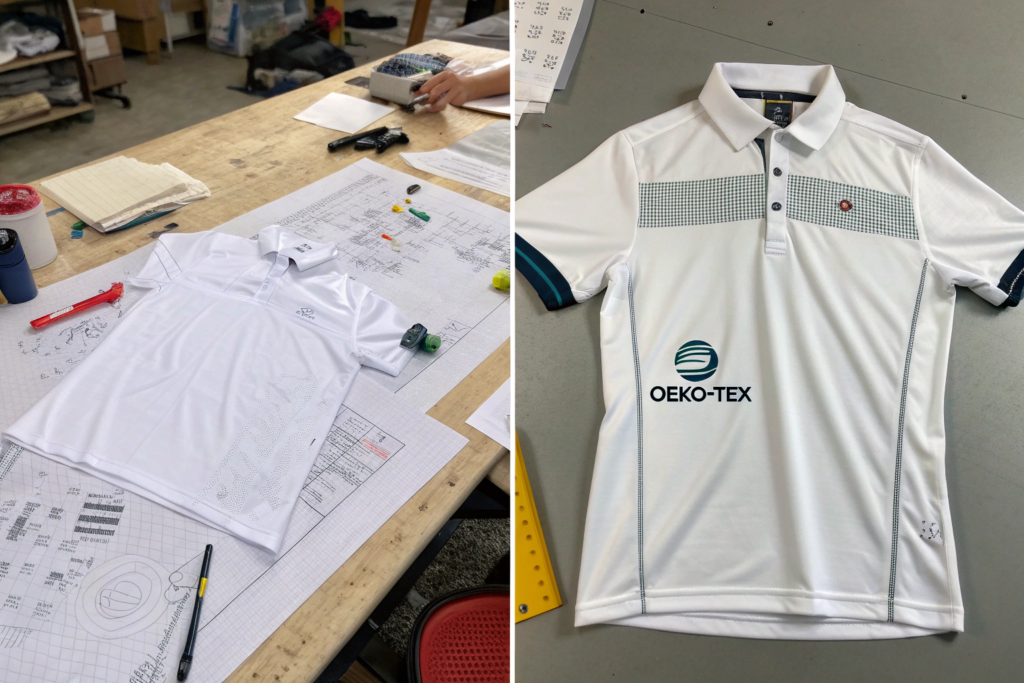
Designing for certification optimizes manufacturing by simplifying the Bill of Materials (BOM), standardizing components, and minimizing the number of unique items that require separate testing. A simpler product is faster and cheaper to produce and certify, without sacrificing aesthetic quality. We implemented a "Design for Compliance" workshop with a client. By reducing the number of unique button types across their line from eight to two (both pre-certified), they saved over $5,000 in testing fees and simplified their supply chain.
What are the key design principles for cost-effective certification?
Follow these guidelines during the product development phase:
- Minimize Material Types: Use the same thread, binding, and interlining across multiple styles.
- Standardize Trims: Select zippers, buttons, and buckles from suppliers who can provide OEKO-TEX compliance certificates for their standard products.
- Simplify Prints & Embroideries: Complex, multi-color graphics require more inks/threads, each needing compliance verification. A simplified, bold design can be just as impactful.
- Consider Fabric Properties First: Choose a fabric whose natural hand and drape are close to your desired outcome, minimizing the need for additional chemical softeners or finishes.
How does this impact the sampling process?
An optimized design drastically reduces sampling iterations. If you specify pre-certified components from the start, the first sample is much closer to the final compliant product. This avoids the costly cycle of: sample -> fail compliance check -> re-source component -> resample. For our clients, we provide a "Preferred Compliant Components" list at the start of a project, which cuts the average sampling time for certified styles by 40%. This efficiency is a core part of our full-package manufacturing service, ensuring brands hit their market windows without expensive delays.
Why is Factory Choice the Most Critical Cost Factor?
The factory you choose is not just a production venue; it's your operational partner. Its expertise, systems, and sourcing networks will determine whether certification becomes a cost burden or a value-adding process.
The factory choice is the most critical cost factor because an experienced certified manufacturer has optimized its entire workflow for compliance. It has established relationships with certified mills and trim suppliers, has in-house expertise to navigate testing, and runs efficient production lines that minimize errors and rework—the true hidden costs. A brand once came to us after a failed partnership with a low-cost factory that promised certification. The factory lacked experience, used non-compliant substitutes during bulk production, and the entire shipment was rejected, resulting in a total loss. The initial "low cost" became catastrophic.

What questions identify a cost-efficient certified factory?
Beyond asking "Can you do it?", ask these operational questions:
- "Do you have in-house compliance staff?" This shows dedicated expertise, preventing costly mistakes.
- "Can you share examples of certified fabrics and trims you regularly use?" This indicates an established supply chain and potential for material consolidation.
- "What is your process for managing the certification sample submission?" A clear process prevents lab rejections that delay timelines.
- "How do you segregate certified and non-certified production?" This ensures no cross-contamination that could invalidate certification.
A factory like ours at Shanghai Fumao has systematized this. Our quality assurance team manages the certification pipeline, and our sourcing team leverages group purchasing power, passing economies of scale directly to our clients.
How does production efficiency translate to cost savings?
An experienced factory achieves savings through:
- Higher First-Pass Yield: More garments pass quality control the first time, reducing waste.
- Accurate Consumption: Precise fabric cutting and material handling reduce waste.
- On-Time Delivery: Avoids air freight charges caused by delays. Our DDP mode logistics are optimized for reliable, cost-effective delivery.
These operational efficiencies often offset the premium paid for working with a specialist factory, resulting in a better total cost and a guaranteed, certified product. The cheapest price per piece can be the most expensive total cost.
How to Justify the Premium to Your Customers?
The final step in the balance equation is value communication. If you’ve invested in certified production, you must capture that value in the marketplace. Customers will pay a premium if they understand what it delivers.
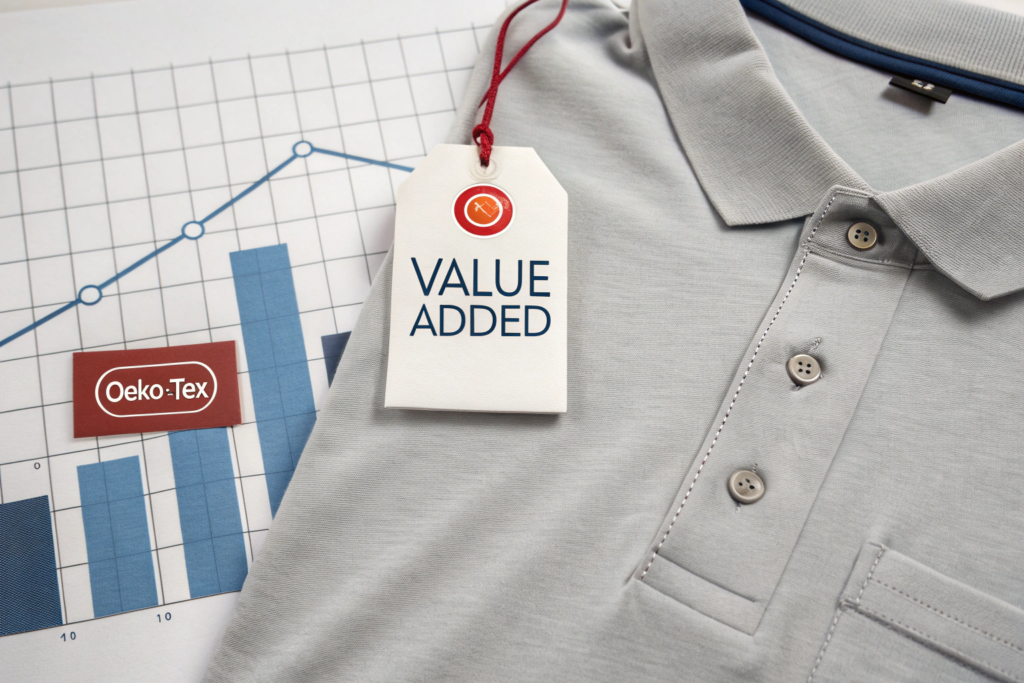
Justify the premium to customers by clearly communicating the tangible benefits of OEKO-TEX certification: verified skin safety, higher product durability, and support for ethical manufacturing. Frame the price not as an extra cost, but as an investment in health, performance, and peace of mind. A client of ours included a hangtag with their certified polo that said, "Why does this shirt cost $10 more? Because your skin isn't a lab, but our fabric has been tested in one." This direct, confident messaging resonated and supported a 15% price increase with no loss in sales volume.
How should you position certified versus non-certified lines?
Be strategic in your assortment planning. Not every item needs to be certified, but your certified items should be your heroes.
- Tier Your Collection: Offer a "Core" line (great quality, basic styles) and a "Performance+" or "Eco-Advanced" line (OEKO-TEX certified, with premium features). This gives customers a choice and clearly segments the value.
- Bundle Benefits: Don't isolate the certification. Pair it with other desirable features: "OEKO-TEX Certified + UPF 50 + 4-Way Stretch." This creates a powerful, multi-attribute value proposition.
- Tell the Story: Use your digital marketing channels to explain the "why." A short video about what certification means builds emotional connection and rational justification.
Can certification reduce other business costs?
Interestingly, yes. Investing in certification can lead to savings that offset its direct cost:
- Reduced Return Rates: Higher, verifiable quality leads to fewer returns due to skin irritation or color bleed.
- Stronger Retailer Relationships: As discussed in a previous article, distributors and retailers prefer certified goods, reducing your cost of sales and opening doors to premium accounts.
- Brand Equity: Long-term, being known as a trustworthy brand reduces marketing costs to acquire new customers and increases loyalty.
This holistic view turns certification from a cost center into a strategic asset that improves the entire business model. For brands working with us on apparel export, this strategic positioning is part of our collaborative planning.
Conclusion
Balancing cost and quality in OEKO-TEX certified production is a strategic exercise, not a financial compromise. The balance is achieved through intelligent fabric consolidation, design simplification, partnership with an expert factory, and effective value communication to the end customer. When executed well, certification becomes a catalyst for a more efficient, higher-quality, and more profitable supply chain. It forces discipline that eliminates hidden costs and builds a brand reputation that commands a justified premium.
The goal is not to produce the cheapest certified garment, but the one with the highest perceived value and the most reliable quality. This is where long-term brand loyalty is built. At Shanghai Fumao, we are partners in this balancing act, providing the expertise, systems, and transparent costing to help you make informed decisions. If you are ready to build a certified collection that wins on both quality and smart economics, let's start the conversation. Contact our Business Director Elaine to develop a cost-effective, high-value production strategy: elaine@fumaoclothing.com.