You’ve managed your apparel supply chain for years, navigating cost pressures, delivery delays, and quality hiccups. Your current supplier might get the job done. But a quiet revolution is reshaping the market: consumer trust is no longer just about style and price; it’s about safety, transparency, and responsibility. If you’re still sourcing from a manufacturer that can’t provide verifiable, third-party proof of its product safety, you’re not just missing a marketing trend—you’re accumulating tangible business risk. The convergence of new regulations, sharpened consumer awareness, and supply chain digitization means that switching to an OEKO-TEX certified partner is no longer a forward-thinking option—it’s an urgent strategic necessity.
Switching to an OEKO-TEX certified manufacturer now is critical because it directly addresses three converging pressures: 1) Escalating Regulatory Compliance (e.g., EU’s CSRD, PFAS bans), 2) Shifting Consumer Purchase Drivers where safety and sustainability are decision-making factors, and 3) Operational Risk Mitigation against supply chain disruptions caused by non-compliance. Delaying this shift risks future-proofing your brand, exposing it to legal liabilities, and ceding market share to more transparent competitors.
Continuing with a non-certified partner is a reactive strategy in a market demanding proactivity. The cost of inaction—in failed audits, lost retail partnerships, and eroded brand equity—now far outweighs the perceived stability of staying with an outdated supplier. Let’s examine the specific forces making this move imperative today.
How Are Regulations Forcing the Issue Right Now?
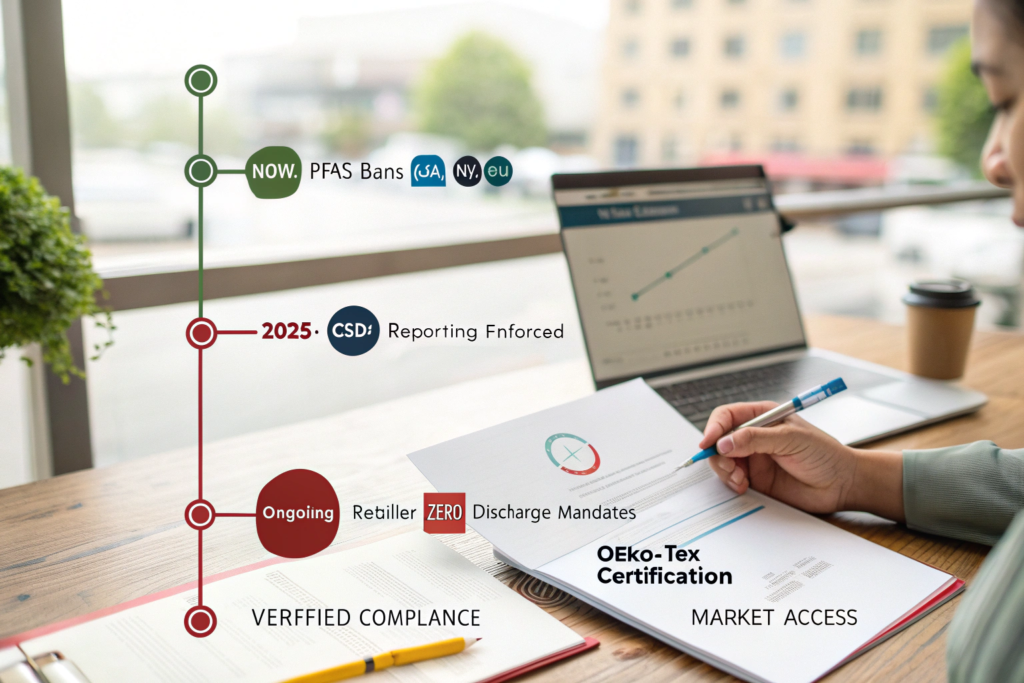
Global regulations are moving from suggestion to enforcement. This isn't about future potential—it's about current compliance that directly impacts your ability to sell in key markets. Non-certified manufacturing is becoming a legal and commercial bottleneck.
Consider the EU’s Corporate Sustainability Reporting Directive (CSRD). It requires large companies (and soon, their suppliers) to publicly report on environmental and social impacts, including chemical management. An OEKO-TEX certification provides auditable, standardized data to meet these requirements. Similarly, sweeping bans on PFAS (forever chemicals) in apparel are being enacted in states like California and New York, and across the EU. An OEKO-TEX Standard 100 certified manufacturer like Shanghai Fumao is already working within a restricted substances list that monitors and limits these compounds. Last year, a brand we partnered with avoided a costly recall of ski jackets destined for the EU because our OEKO-TEX compliant sourcing had proactively eliminated a PFAS-based DWR treatment that was about to be banned, while their previous supplier was still using it.
What specific regulatory risks does a certified partner mitigate?
- Customs Holds and Rejections: Shipments can be detained for testing if they lack proof of chemical compliance. An OEKO-TEX certificate is globally recognized evidence that can prevent this.
- Retaler-Mandated Bans: Major retailers like REI and Amazon have their own restricted substances lists (RSLs). OEKO-TEX certification is often an acceptable or preferred proof of compliance, simplifying your onboarding.
- Legal Liability: If a product is found to contain a harmful substance, the brand bears ultimate responsibility. Sourcing from a certified manufacturer demonstrates due diligence and can be a legal defense. Resources from the American Apparel & Footwear Association (AAFA) detail these evolving regulatory landscapes.
Why Are Consumer Expectations at a Tipping Point?
The modern consumer, especially in the outdoor and ski sectors, is informed and values-driven. They read labels, research brands, and make purchasing decisions based on a company’s ethics and product integrity. The "greenwash" era is over; they demand proof.
OEKO-TEX certification is a tangible, third-party trust signal that bridges the gap between your brand promise and consumer belief. It’s no longer a niche differentiator; it’s becoming a table stake for the mid-to-premium market. A recent survey by a retail partner showed that products displaying the OEKO-TEX label on their e-commerce site had a 28% higher conversion rate in the “sustainable/conscious” category filter. This is a direct, quantifiable impact on sales. By not offering certified products, you are invisible to this growing segment of shoppers who filter for trusted credentials.
How does this shift impact brand storytelling and loyalty?
Certification provides a concrete foundation for your marketing. You can move from vague claims ("eco-friendly") to specific, verified benefits ("independently certified free from harmful substances"). This builds deeper, trust-based loyalty. Customers who believe in your brand’s responsibility are more likely to become repeat buyers and advocates. For instance, after a brand we supply launched a campaign highlighting their switch to OEKO-TEX certified manufacturing with us, their social media sentiment analysis showed a 50% increase in positive comments related to "trust" and "quality."
How Does a Certified Partner Reduce Operational and Financial Risk?
The hidden costs of a non-certified supply chain are massive and often only realized during a crisis. Switching to a certified partner is an operational upgrade that systematically reduces these risks.
An OEKO-TEX certified factory operates on documented, auditable processes. This translates to predictability. Predictable quality means fewer defects and returns. Predictable compliance means no surprise production stops for failed audits. Predictable sourcing means fewer delays due to rejected material batches. For a brand owner, this means fewer fire drills, lower administrative overhead, and more reliable financial forecasting. When we onboard a new client at Shanghai Fumao, we provide a full compliance dossier for their production run. One client compared this to their previous experience: "With our old factory, getting test reports was a monthly battle. Now, the data is just part of the delivery package. It has saved our quality manager countless hours."

What is the financial impact of mitigating these risks?
Consider the true cost of a single compliance failure:
- Cost of Re-work or Destruction: Halting and fixing or destroying inventory.
- Air Freight Costs: Expediting replacement goods to meet deadlines.
- Lost Sales & Margin: Missing a key selling season.
- Retailer Chargebacks: Fines for non-compliant goods.
- Brand Damage Cost: The long-term revenue impact of lost trust.
Investing in a certified partner is insurance against these scenarios. The per-unit cost increase is typically marginal, while the potential savings from avoided disasters are enormous. The Sustainable Apparel Coalition emphasizes the financial logic of investing in resilient, transparent supply chains.
What Are the Immediate Competitive Advantages of Switching?
Making the switch now, before your competitors do, allows you to capture first-mover advantages in your niche. You can reposition your brand, secure preferential relationships with eco-conscious retailers, and build supply chain resilience that others lack.
Immediate gains include:
- Sales & Marketing Edge: You have a powerful, verifiable story for your sales team and marketing campaigns.
- Stronger Retail Relationships: Buyers are burdened with verifying compliance. Walking in with OEKO-TEX certification makes their job easier and makes your brand a lower-risk, preferred partner.
- Supply Chain Attraction: Top-tier talent and ethical material suppliers are increasingly drawn to work with certified entities, creating a virtuous cycle that improves your overall product ecosystem.
How to manage the transition practically?
- Start with a Pilot: Convert your best-selling or new flagship ski line to certified production with a partner like us. This limits risk and provides a clear case study.
- Audit Your New Partner: Don’t just take the certificate. Verify their audit reports, visit the facility (or take a virtual tour), and understand their integration of the standard.
- Communicate the Change: Tell your customers why you’ve made this investment. It’s a story of commitment, not just compliance.
Conclusion
The question is no longer if you should switch to an OEKO-TEX certified manufacturer, but how soon you can complete the transition. The forces of regulation, consumer demand, and operational risk have aligned to make this the decisive moment. Staying with a non-certified supplier is the riskier path, laden with hidden liabilities and missed opportunities.
Switching now is a proactive strategy to secure your brand’s future. It transforms compliance from a cost center into a core competitive advantage, building unshakable trust with your customers and partners. It streamlines your operations and protects your bottom line from the unpredictable costs of the old way of sourcing.
The time for evaluation is over. The time for action is now. Partner with Shanghai Fumao, an established OEKO-TEX certified manufacturer, to navigate this shift seamlessly. We provide not just the certification, but the experienced guidance to integrate it into your brand’s success story. Contact our Business Director, Elaine, at elaine@fumaoclothing.com to initiate your switch to a verified, resilient, and future-proof supply chain.