
You've invested in OEKO-TEX certified production. Your golf polos and pants have passed every lab test. Now, the final hurdle looms: getting them from your factory floor to the warehouse or store shelf without compromising that hard-won certification. From our experience managing thousands of certified shipments, we can tell you logistics is not an afterthought—it's the final, critical phase of certification integrity.
Managing logistics for OEKO-TEX certified shipments requires a proactive, document-driven strategy that protects the goods from cross-contamination, ensures all paperwork travels seamlessly with the cargo, and chooses Incoterms that align certification liability with operational control. The goal is to deliver not just a product, but an unbroken chain of custody from certified production to certified receipt. A single oversight can invalidate all prior efforts.
We learned this lesson years ago. A shipment of certified golf shirts was delayed in a transshipment port. To save space, the freight forwarder stacked our cartons next to industrial chemical drums in a temporary warehouse. While the goods were physically untouched, the risk of fume contamination was high. We had to recall the entire shipment for retesting. Since then, we've built a logistics protocol that treats certified goods as sensitive cargo.
Why Is Documentation the Most Critical Link in Certified Logistics?
For certified goods, the paperwork isn't just administrative—it's the legal and commercial proof of compliance. It must be perfect, travel with the goods, and be readily available at every checkpoint. Any discrepancy can trigger customs holds, rejections at the buyer's warehouse, or worse, a breach of certification terms.
Documentation is critical because it provides the verifiable audit trail that links the physical product to its certification. Customs authorities and savvy buyers will demand to see this trail. Incomplete or incorrect paperwork is the single fastest way to turn a smooth shipment into a costly, delayed nightmare. Your documents are your cargo's passport.
For every OEKO-TEX shipment, we create a "Master Compliance File." This isn't just an invoice and packing list. It includes:
- The original OEKO-TEX certificate (with the unique license number).
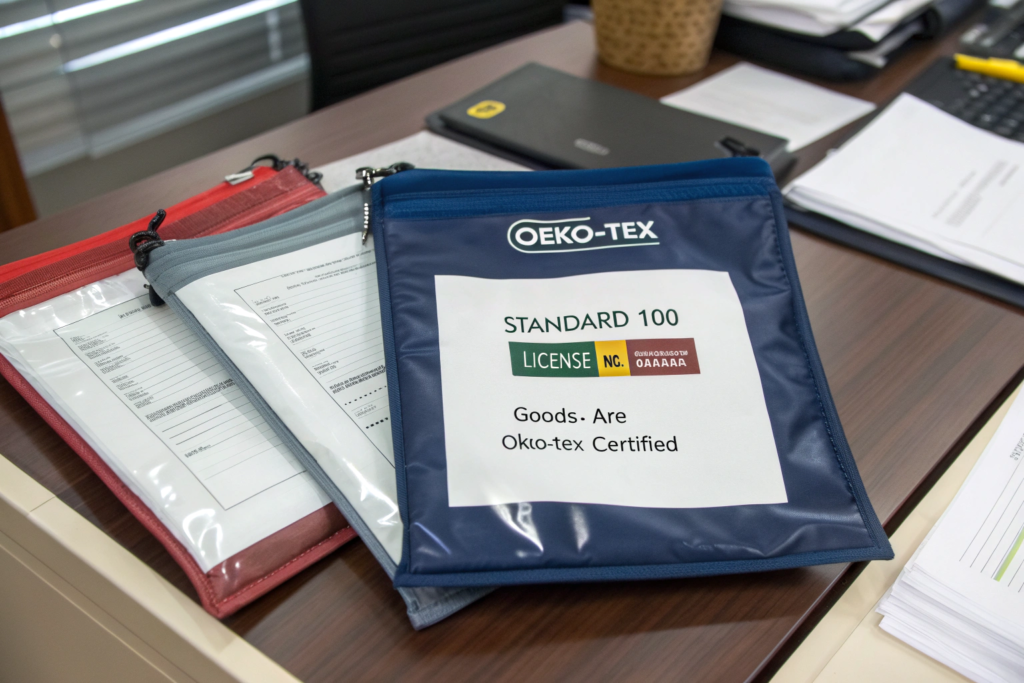
- A commercial invoice that explicitly states: "Goods are OEKO-TEX STANDARD 100 certified, License No. XXXXXX."
- A packing list that matches carton numbers to certified product SKUs.
- A supplier's declaration of conformity.
We provide this digitally to the client and freight forwarder before shipment and place three physical copies in waterproof pouches: one inside the container, one with the ship's manifest, and one sent separately via courier. This redundancy has saved multiple shipments from being held for "lack of proof."
What specific details must be on the commercial invoice?
Beyond the standard information, you must include the OEKO-TEX license number and a clear statement of certification. This allows customs to verify the claim instantly. Using vague terms like "eco-friendly" or "non-toxic" without the cert number is useless and can be flagged as misleading. Precise language is a cornerstone of international trade compliance.
How do you handle HS Code classification for certified apparel?
Harmonized System (HS) codes classify products for tariffs. While OEKO-TEX doesn't change the base HS code for a golf shirt, you must ensure the classification is accurate. An incorrect code can lead to inspections, delays, and questions about your declared value and certification. Work with a seasoned freight forwarder who understands apparel classification. This precision is part of the professional service a partner like Shanghai Fumao provides.
How to Prevent Cross-Contamination During Storage and Transit?
The certification applies to the product you shipped, not the product that arrives. Cross-contamination during logistics is a silent, often invisible threat that can nullify your certification and pose serious safety risks.
Preventing cross-contamination requires controlling the environment from the factory loading dock to the final destination. This means using clean, dedicated shipping materials, selecting reputable logistics partners with proper warehousing, and explicitly instructing handlers on the sensitive nature of the cargo. Certified goods cannot be treated as general commodity freight.
Our protocol includes several non-negotiable steps:
- Dedicated Packing Area: Certified goods are packed in a clean area of our warehouse, away from non-certified production or any volatile substances.
- Virgin Packaging Materials: We use new, uncontaminated cartons and polybags. We avoid recycled cartons that may have held unknown prior contents.
- Container Inspection: We request a "clean inspection report" or "trip report" for the shipping container to ensure it hasn't previously carried chemicals, fertilizers, or strong-smelling goods.
- Clear Labeling: Cartons are marked with "OEKO-TEX Certified Textiles - Keep Away from Chemicals" in English and the local language.

What questions should you ask your freight forwarder or shipping line?
Don't assume they understand. Ask directly:
- "Can you guarantee our container will not be co-loaded with hazardous materials or strong-smelling commodities?"
- "What are your procedures for cleaning and inspecting containers before loading sensitive goods?"
- "If transshipment is required, do your partner warehouses have separate areas for sensitive textiles?"
Their answers will reveal their competence. A good forwarder will have a dangerous goods segregation mindset for your safe goods.
Why is DDP (Delivered Duty Paid) often the safest Incoterm for certified goods?
Under DDP terms, the seller (exporter) bears all risks and costs until the goods are delivered to the buyer's named place. This is crucial for certification because:
- Control: You, the seller/factory, control the choice of forwarder, shipping lines, and transit routes, minimizing contamination risk.
- Liability Alignment: If customs delays or questions the certification, it is your responsibility and cost to resolve it, incentivizing you to get the documentation perfect.
- Buyer Confidence: It provides a hassle-free experience for the buyer, as you handle all complexities, reinforcing your role as a full-service, reliable partner. Understanding Incoterms 2020 is essential for this decision.
What Are the Best Practices for Customs Clearance of Certified Goods?
Clearing customs is the moment of truth. Authorities have the power to inspect, test, and detain your shipment. Proactive communication and flawless documentation are your best tools for a green-light passage.
Best practices include pre-filing accurate documentation, using a customs broker experienced with textile imports and eco-labels, and potentially pre-registering your OEKO-TEX certificates with the relevant authorities. The strategy is to make the customs officer's job as easy as possible by providing transparent, verifiable information. Surprises are your enemy.
We work with a network of trusted customs brokers in key markets. For a new client shipping to the EU, we provided our broker with the OEKO-TEX certificate weeks in advance. The broker was able to pre-advise customs that the shipment was arriving with verifiable compliance to REACH (Registration, Evaluation, Authorisation and Restriction of Chemicals) standards via its OEKO-TEX certification. The shipment cleared within hours of arrival, while a competitor's non-certified shipment was held for secondary inspection.

Should you consider a Customs-Trade Partnership Against Terrorism (C-TPAT) certified partner?
If shipping to the USA, absolutely. While C-TPAT focuses on security, using C-TPAT certified manufacturers, carriers, and brokers streamlines the entire process. It signals to U.S. Customs and Border Protection (CBP) that your supply chain is secure, transparent, and low-risk, which often results in fewer physical inspections and faster clearance. This reduces the chance of your sealed, certified cartons being opened and potentially contaminated in a general inspection bay. Explore the benefits of C-TPAT certification.
How to prepare for a potential customs inspection?
Hope for the best, plan for the worst. Ensure:
- Accessible Samples: Have a spare set of product samples and copies of all certificates ready to be couriered to the inspection site if needed.
- Contact Readiness: Your broker and a technical representative from your company (who can speak to the certification) must be on standby.
- Clean Inspection Kits: If cartons are opened, provide inspectors with fresh gloves to prevent contamination from their hands or tools.
This level of preparedness demonstrates professionalism and can influence how carefully your goods are treated.
How to Handle Returns or Rejects of Certified Shipments?
Even with perfect planning, returns happen. A buyer may reject a shipment due to quality issues unrelated to certification, or an order may be cancelled. The logistics of bringing certified goods back into your custody or redirecting them is a complex scenario that most factories fail to plan for.
Handling returns requires a pre-defined protocol to maintain the chain of custody and certification integrity. You must decide if returned goods can be re-sold as certified, if they require re-testing, or if they must be destroyed to protect the certification's credibility. There are no shortcuts here.
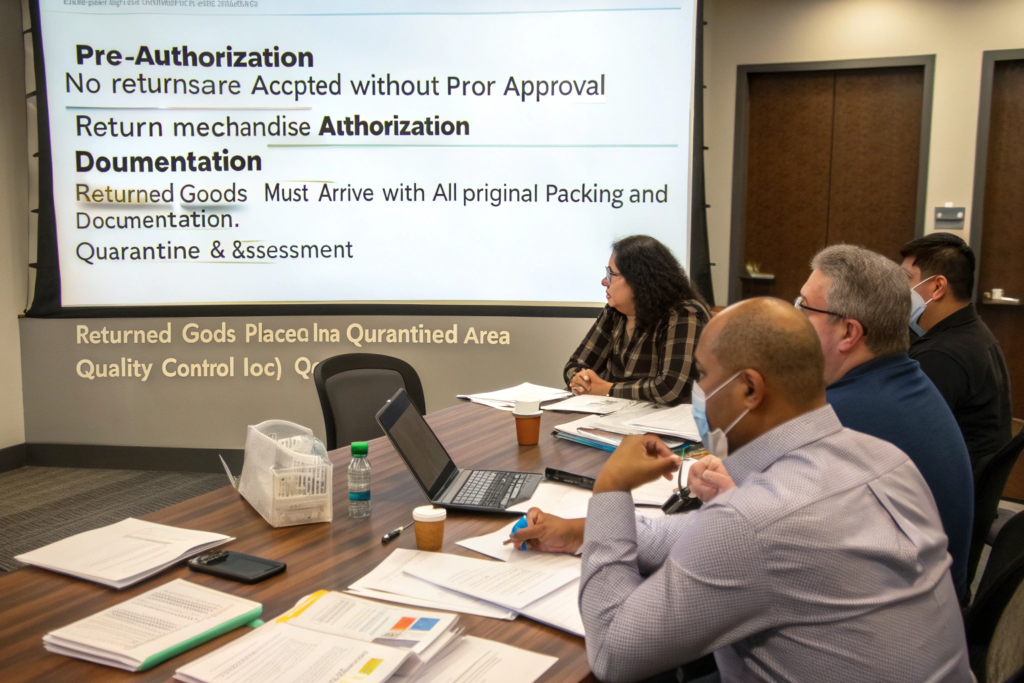
We have a strict "Returned Goods Policy" shared with all clients. Key points include:
- Pre-Authorization: No returns are accepted without prior approval and a Return Merchandise Authorization (RMA) number.
- Documentation: The returned goods must arrive with all original packing and documentation.
- Quarantine & Assessment: Returned goods are placed in a quarantined area. Our QC team assesses if the packaging is intact and if there's any risk of contamination during return shipping.
- Re-certification Decision: If the packaging is sealed and pristine, the goods may be re-sold. If opened or potentially compromised, they must be sent for re-testing at an approved lab—a costly but necessary step—or de-labeled and sold as non-certified seconds.
What insurance considerations are unique to certified shipments?
Standard marine cargo insurance covers physical loss or damage. You should discuss with your insurer whether it covers "loss of value due to loss of certification status." If a container is contaminated and the goods lose their OEKO-TEX status, their commercial value plummets. Specific contingent coverage for this may be necessary. This is part of comprehensive supply chain risk management.
How does this affect your relationship with the buyer?
Transparency is key. If a shipment is rejected and you plan to re-sell the goods as certified, you must be 100% confident in their integrity. Any doubt must lead to re-testing or de-certification. Selling potentially compromised goods as certified is fraudulent and will destroy your reputation. A reliable partner like Shanghai Fumao prioritizes long-term trust over short-term gain in these situations.
Conclusion
Managing logistics for OEKO-TEX certified golf apparel is a discipline that extends far beyond booking a container. It is an integrated process of documentary precision, environmental control, customs strategy, and contingency planning. The certification is a promise that remains fragile until the goods are safely in the buyer's hands. Every touchpoint in the logistics chain is an opportunity to uphold or break that promise.
For brand owners, choosing a manufacturing partner who masters this end-to-end process is as important as choosing one who masters sewing. It ensures your investment in certified product integrity is protected all the way to your customer.
If you seek a partner who views logistics as the final, critical phase of certified manufacturing—a partner with documented procedures, trusted freight alliances, and a proactive mindset—let's connect. At Shanghai Fumao, we manage the complete journey, ensuring your OEKO-TEX certified golf apparel arrives not just on time, but with its value and verification perfectly intact. Contact our Business Director Elaine to plan your next seamless shipment: elaine@fumaoclothing.com.